Au Gold Lines Up 5,000m Maiden Drill Programme to Test Victorian Gold-Antimony Thesis


Au Gold Corp (TSXV:AUGC) plans 5,000m of maiden drilling below 1880s high-grade mines at its Havelock gold-antimony project in Victoria, Australia.
- Au Gold Corp plans maiden diamond drilling at its Havelock Gold-Antimony Project in Victoria around the end of October 2026, testing beneath 1880s mines never drill tested.
- Four priority targets on the 9 km Shaw-McFarlane Trend were built from reconstructed historic mine records, with the anticipated programme expanded from 2,000 to 5,000 metres.
- A grab sample from the Shaw's Main waste dump returned 54.20 g/t gold, and Rob Roy historically reported 293 ounces at an average of 52 g/t.
- CEO Marc Blythe argues that narrow veins can be economic if grades are high, citing Costerfield's output of around 40,000 ounces of gold a year and 5% of global antimony.
- A placement announced at $2 million has been increased to $3.5 million, subject to TSXV approval, with first results expected early 2027.
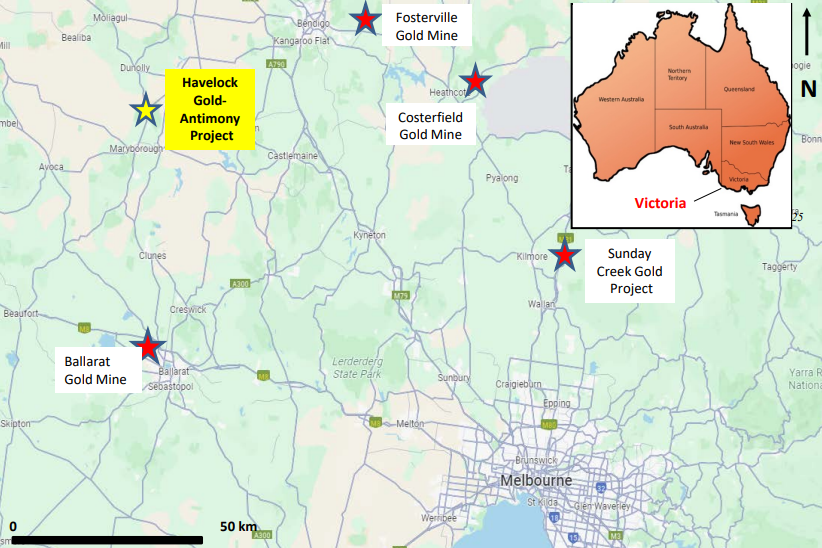
Victoria has produced more than 80 million ounces of gold, and its most valuable recent discoveries have come from a specific style of deposit. Epizonal gold-antimony systems such as Agnico Eagle's Fosterville, Alkane Resources' Costerfield and Southern Cross Gold's Sunday Creek combine very high grades with mineralisation that extends more than a kilometre below surface. Au Gold Corp (TSXV:AUGC), a junior explorer with a market capitalisation of around C$16 million, is betting that a string of shallow mines abandoned in the 1880s and 1890s sits on the same kind of system.
Founder and CEO Marc Blythe explained how the company plans to begin its maiden diamond drilling programme at the Havelock Gold-Antimony Project near Maryborough around the end of October 2026. The programme will test beneath historic workings that have never been drill tested.
Reconstructing 1880s Mine Records Into Drill Targets
The mines along the Shaw-McFarlane Trend (SMT) were run by individual public companies, which left a paper trail of quarterly disclosures and newspaper reports. Au Gold engaged a research geologist to collate these records and reconstruct long sections of each mine, showing where the widest veins and the most visible gold were recorded.
There are no historical assays. Blythe was candid that the records are subjective. Vein widths are recorded, and he believes those measurements remain valid today. Grade, however, is unknown. His working assumption is that miners of that era needed roughly half an ounce per ton, or around 15 g/t gold, for a vein to be payable. Visible gold in a vein that miners chose to follow is therefore treated as a positive signal, not as proof of grade.
The workings are shallow because pumping technology was in its infancy. Operators used stamp batteries and gravity recovery, and cyanide was not used in the district until some 20 years later. Mines have closed when groundwater inflow became unmanageable rather than because mineralisation ran out. Parts of the trend have since been levelled for farmland, leaving waste dumps as some of the few visible clues.
The company has stated that no mineral resources exist on the project and that the historical information predates NI 43-101 (Canada's National Instrument 43-101 disclosure standard).
From Due Diligence Consultant to Founder
Blythe is a mining engineer by training. He began his career in Australia before moving to Canada in the early 2000s with Placer Dome, and stayed in Vancouver after Barrick acquired the company in 2006. He now runs an independent consultancy that carries out due diligence on mining projects for companies and financiers.
That work led him to Costerfield and Sunday Creek in 2024, where he saw narrow, very high-grade gold-antimony veins being mined and explored successfully. He then began searching digitised historical records for Victorian prospects that had been overlooked. The search turned up an old mine where 19th-century operators had found so much antimony mixed with high-grade gold that they could not separate the two. According to Blythe, nobody had returned to explore it since.
Blythe framed his edge as perspective rather than local incumbency. He argued that newcomers to an established district can see opportunities that long-standing operators miss, and that Havelock is being explored for a deposit type in an area where others have not looked for it.
Four Targets on the Shaw-McFarlane Trend
The SMT runs for about 9 km within the 11,663-hectare Havelock land package. Blythe said more than 15 old shafts sit in the central section alone. The original plan was a single target with a drill programme of around 2,000 metres. Further research produced three more targets, and management now anticipates a 5,000-metre programme across four priority areas covering 2.34 km of the trend:
- McFarlane's - the original gold-antimony target, where historic records describe abundant stibnite (antimony sulphide) mixed with gold at the lowest levels. Drilling will target the down-plunge extension beneath the 350-foot (107-metre) level.
- Shaw's No. 1 - a single-level mine with a 140-metre drive at 55 metres depth. Drilling will test continuity below that level and a parallel reef roughly 10 metres to the east.
- Shaw's Main - the deepest workings on the trend at about 152 metres, where the mine manager recorded continuous visible gold along an 80-metre section of the lowest level. Grab samples taken by Au Gold from the waste dump returned 54.20 g/t, 25.10 g/t and 16.70 g/t gold.
- Rob Roy - a small but very high-grade mine that reported 293 ounces at an average of 52 g/t gold. Historic notes describe quartz so rich that it was effectively held together by gold.
Blythe described the trend as a planar, linear system with mineralised zones occurring at regular intervals. He believes cover has hidden further mineralisation that the old miners never found.
Interview with Marc Blythe, President & CEO of Au Gold Corp.
The Economics of Narrow, High-Grade Veins
Blythe expects the target veins to be a metre wide or less. He addressed the economic question directly by comparing them to Australian underground vein mines, which he said typically operate at average grades of 2-3 g/t gold.
His illustration was a one-metre vein grading 15 g/t gold, which he stressed was hypothetical. Mined mined across three-metre widths, that vein would still deliver around 5 g/t after dilution, above the industry average. The underlying concept is grade-thickness, measured in gram-metres. High enough grades allow narrow veins to absorb the dilution that comes with mining them.
Costerfield illustrates the point. Blythe said the mine produces around 40,000 ounces of gold a year and about 5% of global antimony supply from veins often narrower than a metre.
Funding, Timeline & Social Licence
Au Gold announced a $2 million non-brokered private placement on 29 September 2026, priced at $0.23 per unit with a half warrant exercisable at $0.40. Blythe said strong demand led the company to increase the raise to $3.5 million, which he described as a compromise between runway and dilution. The financing remains subject to TSX Venture Exchange approval.
Drilling will run on day shift only. Several targets sit among hobby farms, and the company wants to limit disturbance to neighbours. Blythe therefore expects slow progress, with first results possibly early in 2027. The Shaw's Main and Rob Roy sites are on Crown land near Four Mile Creek and require preparatory work, while McFarlane's and Shaw's No. 1 require access agreements with private landowners that were still under discussion in September.
Exploration Manager Bill Wengzynowski brings more than 40 years of experience, mostly in the Yukon, and the company has added a Victorian geologist with epizonal experience. Au Gold also holds the Ponderosa gold-silver project in British Columbia, which Blythe said remains of interest but is secondary to Havelock. Blythe is the largest shareholder with over 7 million shares.
What the First Holes Must Prove
Blythe set out a two-stage test for success:
"First base for us is really just demonstrating that what's described in the old literature is valid. If we can generate thicknesses and grades that confirm what's described in the old literature I think that's first base for us. And then beyond that I think it's really a question of us demonstrating scale."
This is pure exploration with no resource and no historical assays. The targets are interpreted from public company reports and newspaper records dating from the 1880s and 1890s. The dump samples are selective grab samples from material believed to come from the lowest levels, and Au Gold did not insert its own QA/QC samples. Groundwater, which contributed to the closure of several historic mines, is a potential operational challenge. Narrow-vein economics are also highly sensitive to gold and antimony prices.
Investment Thesis for Au Gold
- Au Gold offers early exposure to Victoria's epizonal gold-antimony model at a market capitalisation of around C$16 million, well below established peers in the same belt.
- None of the four priority targets has been drill tested, so the maiden programme represents a genuine first test of whether high-grade mineralisation continues below the historic workings.
- The 54.20 g/t dump sample supports the historical records at Shaw's Main, although grab samples are selective and not representative of grade.
- The expansion from 2,000 to 5,000 metres gives the company several independent chances of success rather than a single binary hole.
- Insider ownership of around 18%, including the CEO's stake of more than 7 million shares, aligns management with shareholders.
- Investors should monitor the start of drilling around late October 2026, final approval of the upsized placement, and first assay results, which management expects early in 2027.
Macro Thematic Analysis
Victoria's gold history is one of the world's richest, but the state's modern revival rests on a narrower geological idea. Blythe explained that most Victorian epizonal gold-antimony systems formed around 370-380 million years ago, distinct from the roughly 440-million-year event linked to the classic goldfields such as Bendigo and Ballarat.
Fosterville changed how the market views these systems. It was a modest mine until deeper drilling hit the bonanza-grade Swan Zone, which turned it into one of the highest-grade gold mines in the world. Sunday Creek has since become one of the most closely followed exploration stories in the sector, and Costerfield shows that veins under a metre wide can sustain production when grades are high enough.
Antimony adds a second layer. It has become a strategic metal, used in flame retardants, batteries and defence applications, and supply is concentrated in a small number of countries. A Victorian deposit carrying both gold and antimony would offer exposure to both themes, although Havelock's antimony potential is currently based on historic descriptions alone.
The wider lesson for investors is that historic production in Victoria was limited by technology, especially pumping. Many shallow fields were abandoned for engineering reasons rather than geological ones. That creates a pipeline of under-explored targets that modern diamond drilling can test cheaply, with the caveat that most such tests will not lead to a discovery.
TL;DR
Au Gold Corp is preparing to drill beneath a line of shallow 1880s gold mines on the 9 km Shaw-McFarlane Trend at its Havelock Gold-Antimony Project in Victoria, Australia. CEO Marc Blythe believes the trend may host an epizonal gold-antimony system like Fosterville, Costerfield and Sunday Creek, which extend over a kilometre deep. Four targets, never drill tested, were built from reconstructed historic records, and a dump grab sample returned 54.20 g/t gold. Management now anticipates a 5,000-metre programme starting around late October 2026, funded by a placement upsized to $3.5 million. Grade, continuity and groundwater remain key risks, with first results expected early 2027.
FAQs (AI Generated)
Analyst's Notes





Subscribe to Our Channel





Stay Informed