




$50M cash, 70,000m Drilling Planned, Own 6 Rigs All in the Most Prospective Terrain for Orogenic Gold Deposits in the West


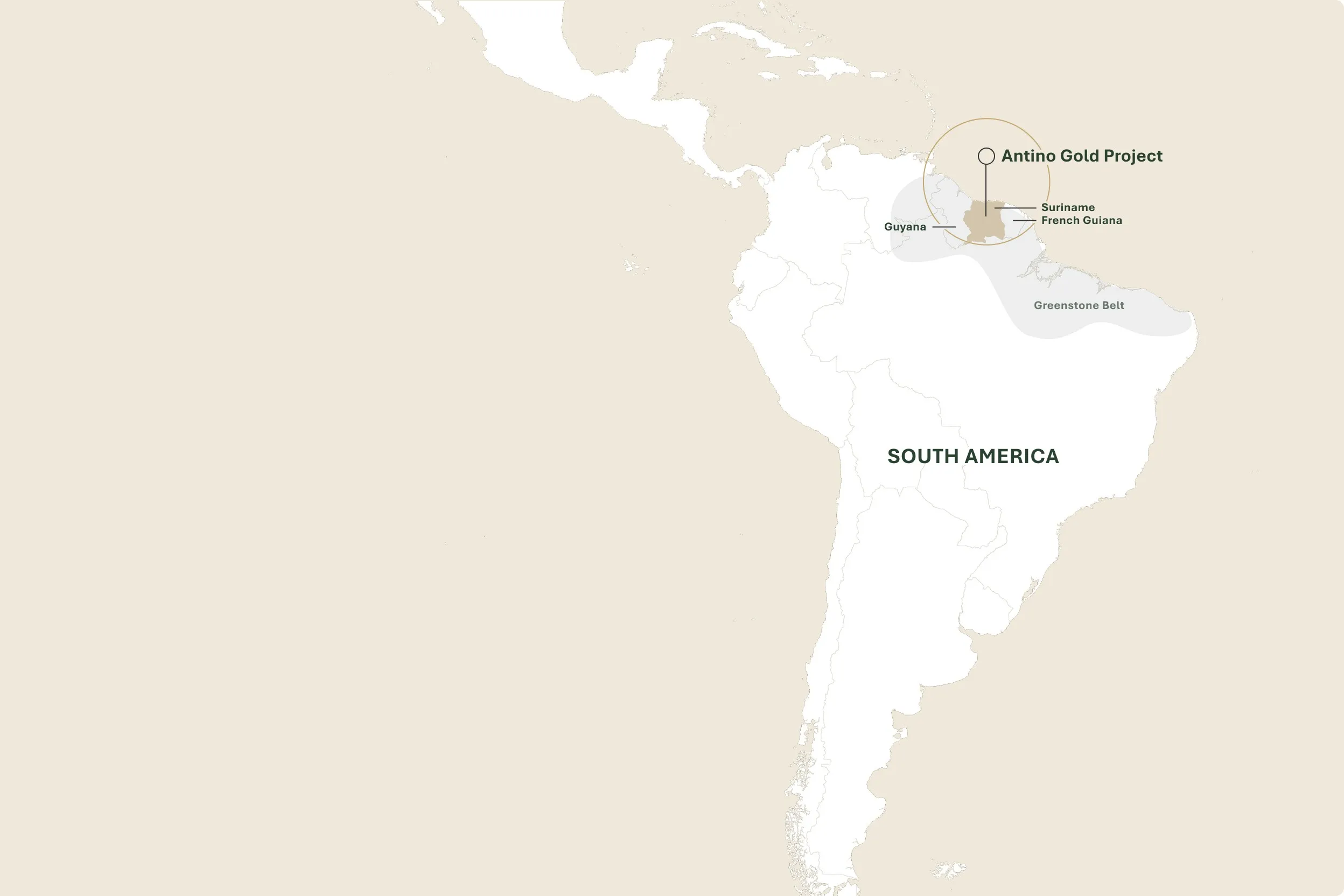
- Founders Metals is advancing its Antino gold project in Suriname across a 100,000-hectare land package in the Guyana Shield, a geological setting widely regarded as one of the most prospective orogenic gold terrains in the western hemisphere.
- The project hosts two distinct styles of gold mineralisation: the high-grade shear-hosted veins at Upper Antino, and lower-grade bulk tonnage material at Lower Antino offering substantial flexibility for future mine planning and economic studies.
- Five new discoveries have been made outside Upper Antino in the past 18 months, and the company has launched its first-ever drilling at Antino North, a target covering approximately 100 square kilometres that management considers one of its highest-priority grassroots opportunities.
- Founders Metals holds approximately $50 million in cash, owns six drill rigs outright, and has attracted institutional investorswith management retaining ~7.5% ownership which reflects strong alignment between the company and its shareholders.
- Management is deliberately deferring a formal resource estimate in favour of continued discovery-driven value creation allocating half of its planned 70,000-metre 2026 drill programme to grassroots targets.
Founders Metals is a gold exploration company operating in Suriname, in the northeast corner of South America. Its flagship Antino project now spans over 100,000 hectares of Guyana Shield greenstone belt, a geological setting widely regarded as one of the most prospective terrains for orogenic gold deposits in the western hemisphere. CEO, Colin Padget outlines the company's current operational status, exploration philosophy, and strategic positioning as it enters its third consecutive year of large-scale drilling.
The Antino Project: A Camp-Scale Opportunity
The Antino project's growth over the past 12 months has been substantial. As recently as 6 months ago, the project covered was just at 20,000 hectares while now stands at over 100,000 hectares, a fivefold expansion achieved through new concession additions, reflecting both the company's on-the-ground relationships in Suriname and the geological rationale for holding a large land package.
The geological thesis underpinning the Antino Gold Project's district-scale narrative draws directly on work conducted by the company's chief geoscientist, Vincent Combes who completed his PhD on the Yaou gold deposit in French Guiana, located approximately 10 kilometres from Antino across the border. That structural geology work, combined with the company's own exploration results and the historical mining record at nearby Benzdorp, forms the basis for characterising the broader area as a legitimate gold camp and not merely a collection of isolated occurrences.
Two Types of Mineralisation, One Flexible System
A key feature of the Antino project is the presence of two distinct styles of gold mineralisation, each with different economic implications and development pathways. Upper Antino hosts high-grade shear-hosted mineralisation, a gold and quartz-carbonate vein system that has returned some exceptional drill intercepts, including 50.5 metres at 31 g/t gold and 45 metres at grades in a similar range. Lower Antino, by contrast, offers broader, lower-grade bulk tonnage mineralisation, with intercepts of 80-90 metres averaging around 1 g/t from surface, a profile more consistent with open-pit development.
The two zones sit approximately 3.5 kilometres apart, and Padget emphasised that this combination of styles is not a complication but a strategic advantage:
"The flexibility of having the different types or styles of mineralisation when we look at Upper and Lower. One is from surface, broad, bulk tonnage, but relatively low strip, and then you've got Upper Antino, which has been very high-grade, shear-hosted. You tie all of those things together, it means you have a lot of flexibility in a future potential milling scenario."
The metallurgy at Upper Antino is described as straightforward, a gold-only system hosted in quartz-carbonate veins with no significant penalty elements reported to date, which is a meaningful consideration for future economic studies.
Interview with Colin Padget, President & CEO of Founders Metals
2026 Drill Program: Discovery First
Founders Metals has planned up to 70,000 metres of drilling in 2026, with four of its six company-owned drill rigs currently turning. The company owns its rigs outright, giving it operational control over pacing and target prioritisation without the logistical constraints or cost variability associated with contract drilling. Padget indicated that both technical and financial capacity exist to drill substantially beyond the planned 70,000-metre figure if warranted.
The programme is being allocated on a roughly 50/50 basis between advancing known targets including infill drilling at Upper Antino oriented toward an eventual resource, and grassroots exploration at newer, earlier-stage targets. Five new discoveries have been made outside Upper Antino in the past 18 months, the result of systematic geological work including large-scale geophysical surveys, soil sampling, and auger sampling programmes. The company is running these exploration activities in parallel with more advanced work at Upper and Lower Antino, including a second year of environmental baseline studies and the commencement of more detailed metallurgical test work.
Resource Strategy: Disciplined, Not Absent
One of the more nuanced aspects of Founders Metals' current positioning is its approach to resource definition. The company has been deliberate about not rushing a maiden resource estimate at Upper Antino, even as infill drilling progressively demonstrates mineralisation continuity across sub-parallel shear structures and down-plunge gold shoots. Padget acknowledged the tension between investor expectations for a formal resource and the company's view that near-term value creation remains more closely tied to new discoveries.
"When we stop seeing the sort of reactions that we have seen to date for new discoveries, if we're not getting value from that new discovery piece, then that's when we maybe push more firmly on getting that maiden resource out," Padget explained.
For now, the market's continued response to exploration results is being interpreted as validation of the current strategy. The board brings meaningful precedent to this question. The presence of that perspective at the governance level reinforces the company's confidence in its current approach.
Capital Position and Institutional Support
Founders Metals holds approximately $50 million in cash, providing a well-funded runway for the 2026 programme and beyond. The institutional shareholder register includes BlackRock, Inc. and Franklin Templeton, both of which came in at relatively early stages based on the project's scale potential and the technical competency of the team. Management retains a meaningful ownership position of approximately 7.5%, maintaining strong alignment with shareholders.
A recent addition to the board, Vijay Kirpalani is a well-connected figure within Suriname and is expected to further strengthen the company's in-country relationships and land access capabilities, both of which have already proven critical in expanding the Antino concession package.
Suriname is a jurisdiction that has attracted increasing attention from the mining industry in recent years, with companies such as Newmont via Merian and Surgold (a joint venture with the Surinamese government) maintaining producing operations in the country. Founders Metals has been operating in Suriname since early 2023, with drilling commencing mid-year. Padget described the operating environment as supportive, noting continued backing from the government under the country's new president. He acknowledged learning curves associated with managing the company's own drilling operation but characterised the overall experience as rewarding and the jurisdiction as conducive to long-term exploration.
The Investment Thesis for Founders Metals
- District-scale land position in a proven gold belt: The Antino project covers over 100,000 hectares of Guyana Shield greenstone belt, one of the world's most historically underexplored yet geologically prospective orogenic gold terrains. The land package has grown fivefold in under a year.
- Multiple discoveries already in hand: Five new discoveries outside Upper Antino have been made in the past 18 months. The company is not a single-asset story; it is building a portfolio of targets across a contiguous land package with demonstrated geological prospectivity.
- High-grade results with continuity: Upper Antino has returned intercepts including 50.5 metres at 31 g/t Au. Subsequent infill drilling has demonstrated mineralisation continuity, addressing the key risk associated with high-grade, shear-hosted systems.
- Two mineralisation styles provide development flexibility: The combination of high-grade underground potential at Upper Antino and bulk tonnage open-pittable material at Lower Antino provides optionality for mine design and future economic studies that many single-style projects lack.
- Fully funded with operational control: With $50 million in cash, six company-owned drill rigs, and a 70,000-metre programme planned for 2026, the company is not dependent on equity markets to execute its current work plan.
- Institutional-grade shareholder register: BlackRock, Franklin Templeton, and other institutional investors are on the register is a signal of credibility and due diligence that provides a meaningful reference point for prospective investors.
- Exploration upside remains the primary value driver: Management is allocating 50% of drill metres to grassroots targets, including the previously undrilled Antino North. For investors seeking leverage to new discovery, that allocation is a direct expression of where management believes the next significant re-rating could come from.
- Board with relevant precedent: Chris Taylor's presence on the board, an architect of the Great Bear Resources exit which is one of the most celebrated resource-free acquisitions in recent Canadian mining history, provides both strategic credibility and a validated playbook for maximising shareholder value at the exploration stage.
The Guyana Shield's Moment
The Guyana Shield, a Precambrian craton spanning Suriname, Guyana, French Guiana, and parts of Brazil and Venezuela, has long been considered a geological analogue to West Africa's Birimian gold belt. Both terrains share structural and geochemical characteristics associated with world-class orogenic gold systems, yet the Guyana Shield has historically received a fraction of the exploration investment directed at its African counterpart.
As Padget summarised the regional opportunity:
"You look at the Guyana Shield and because it shares that geology across to the Birimian and the West African piece, it means that you have a lot of investors that come into it that are familiar with West African analogues and it also brings interest from the corporate side of things as well."
A combination of factors is driving renewed corporate and institutional attention to the region. Gold prices sustained above $4,000 per ounce have materially improved the economics of exploration in jurisdictions that were previously considered marginal on cost grounds. At the same time, a global shortage of large, high-grade gold discoveries has prompted major mining companies to broaden their geographic aperture, with the Guyana Shield emerging as one of the few remaining underexplored terrains capable of hosting deposits of genuine scale.
The structural geological work underpinning projects like Antino is increasingly being validated by drill results that match the quality and scale of the West African comparisons. As that validation accumulates, the discount that has historically been applied to Guyana Shield projects on jurisdictional or unfamiliarity grounds appears likely to narrow further.
TL;DR
Founders Metals is a well-funded junior gold explorer building a district-scale gold camp in Suriname on a 100,000-hectare Guyana Shield land package. The Antino project hosts two styles of mineralisation, high-grade shear-hosted veins and lower-grade bulk tonnage material, and has already produced five discoveries beyond its flagship Upper Antino zone. With $50 million in cash, six company-owned drill rigs, 70,000 metres of drilling planned for 2026, and a shareholder register that includes BlackRock and Franklin Templeton, the company is executing an aggressive discovery-first strategy backed by institutional capital and a board with proven precedent for resource-free value creation.
Frequently Asked Questions (FAQs) AI-Generated
Management has made a deliberate decision to prioritise new discovery over near-term resource definition. CEO Colin Padget has indicated that so long as the market continues to reward exploration results with meaningful share price reactions, the greater value for shareholders lies in expanding the discovery pipeline rather than formalising what is already known. Infill drilling at Upper Antino is ongoing and oriented toward an eventual resource, but no specific timeline has been set. Chris Taylor, whose Great Bear Resources was acquired without a formal resource estimate for a significant premium, sits on the board and brings direct precedent for this approach.
The Guyana Shield is a Precambrian craton that shares geological characteristics — including structural controls, rock types, and mineralisation styles — with West Africa's Birimian gold belt, which has produced numerous world-class orogenic gold deposits. This analogy is not merely promotional; it is grounded in peer-reviewed structural geology work conducted by Founders Metals' own chief geoscientist, who completed his PhD on the Yaou gold deposit in neighbouring French Guiana. The presence of major producers such as Newmont in Suriname further validates the jurisdiction as a credible long-term mining address.
Founders Metals applies a structured prioritisation framework, allocating drill metres on a roughly 50/50 basis between advancing known targets and testing grassroots opportunities. Systematic geological work — including large-scale geophysical surveys, soil sampling, and auger sampling — precedes drilling on new targets to reduce the likelihood of unproductive holes. The company also owns its drill rigs outright, giving it operational flexibility to redirect resources quickly as results come in, without the cost and scheduling constraints associated with contract drilling.
The coexistence of high-grade shear-hosted mineralisation at Upper Antino and lower-grade bulk tonnage material at Lower Antino — located just 3.5 kilometres apart — provides a level of development flexibility that many single-style projects lack. A future mining scenario could involve blending high-grade underground ore with open-pit bulk tonnage material through a shared processing facility, potentially optimising overall mill feed grade and improving project economics. This optionality is considered a meaningful differentiator at the exploration stage.
The company has been operating in Suriname since early 2023 and has navigated a change of government without disruption to its work programme. The new president has been publicly supportive of exploration activity, and the company has developed strong in-country relationships over three years of continuous operations. The recent addition to the board of Vijay Kirpalani, a well-connected figure within Suriname, is expected to further strengthen those relationships. Operationally, the company manages its own drilling fleet, which reduces reliance on external contractors and provides greater day-to-day control over programme execution.
Analyst's Notes





Subscribe to Our Channel




Stay Informed






















