7 Points Behind P2 Gold's One-Raise Plan for the Gabbs Heap Leach


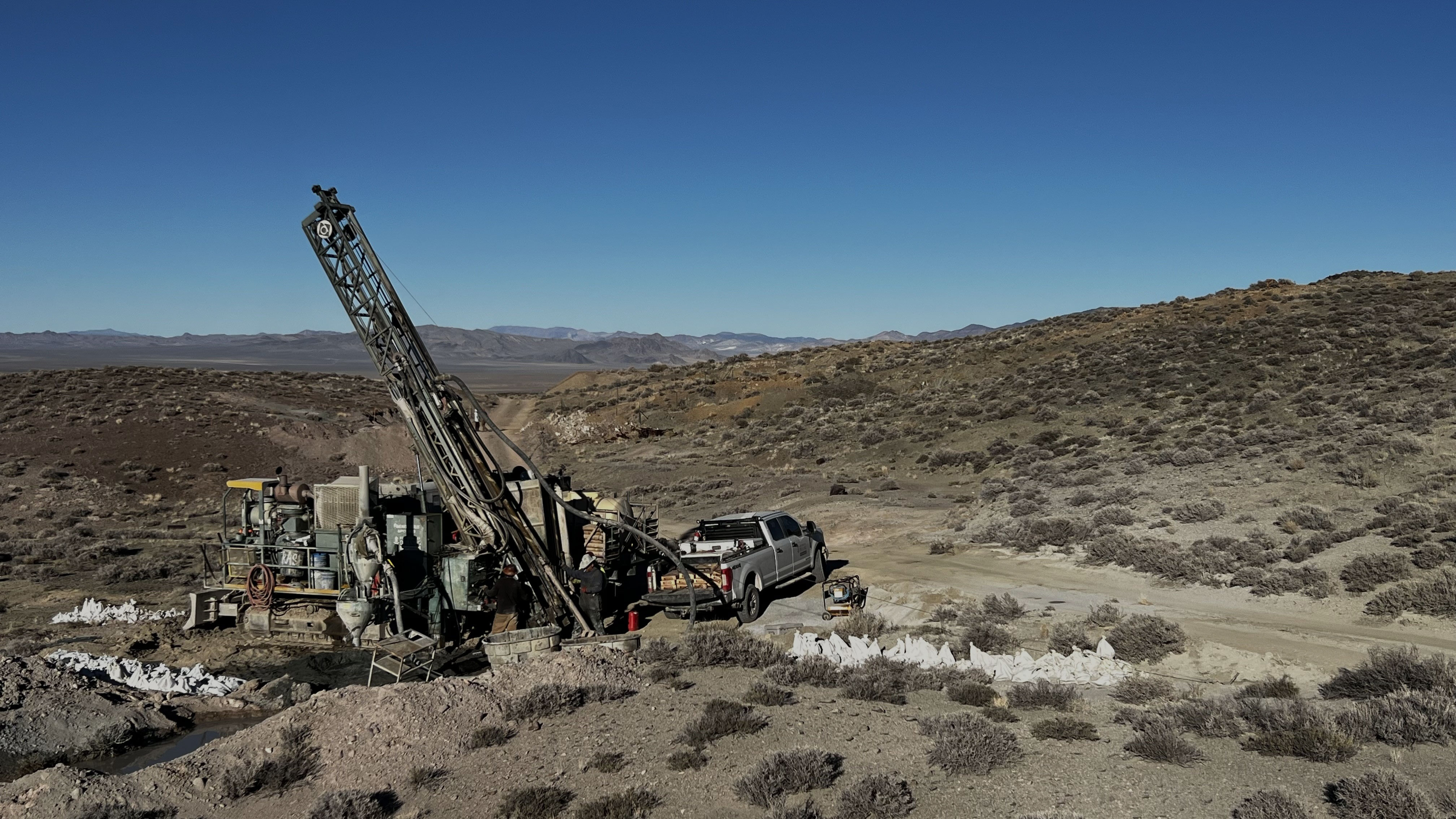
P2 Gold plans a single up-front raise to start the Gabbs heap leach, with heap leach cash flow in years 1 and 2 intended to fund a mill starting in year 3.
Project Overview
P2 Gold (TSXV: PGLD | OTCQB: PGLDF) is advancing its 100%-owned Gabbs gold-copper project on the Walker Lane Trend in Nevada toward a feasibility study (FS) targeted for completion in the first quarter of 2027. The 2025 preliminary economic assessment (PEA) outlined average annual production of 109,000 ounces (oz) of gold and 33 million pounds (lb) of copper, processing 9 million tonnes (t) per year over a 14.2-year mine life.
The FS is advancing at a production rate of a minimum of 12 million t per year, targeting average annual production of 150,000 oz of gold and 45 to 50 million lb of copper. P2 Gold has now laid out how it intends to pay for construction. The project has access via paved Highway 361, with power and water on site.
1. One Raise Is Planned for the Build
A single up-front construction capital raise is all P2 Gold expects to need to get the heap leach going.
President and Chief Executive Officer of P2 Gold, Joe Ovsenek, ties the mill to what the heap leach earns in its first 2 years:
"And so, we feel that in the first 2 years we'll have enough cash flow to pay off funds for the initial CapEx and fund construction of the mill. There's just one CapEx raise up front."
For shareholders, the plan means a single construction financing to price, sized to start the heap leach. A second raise for the mill is not included.
2. Heap Leach First, Mill From Year 3
A single raise depends on the order in which Gabbs is built.
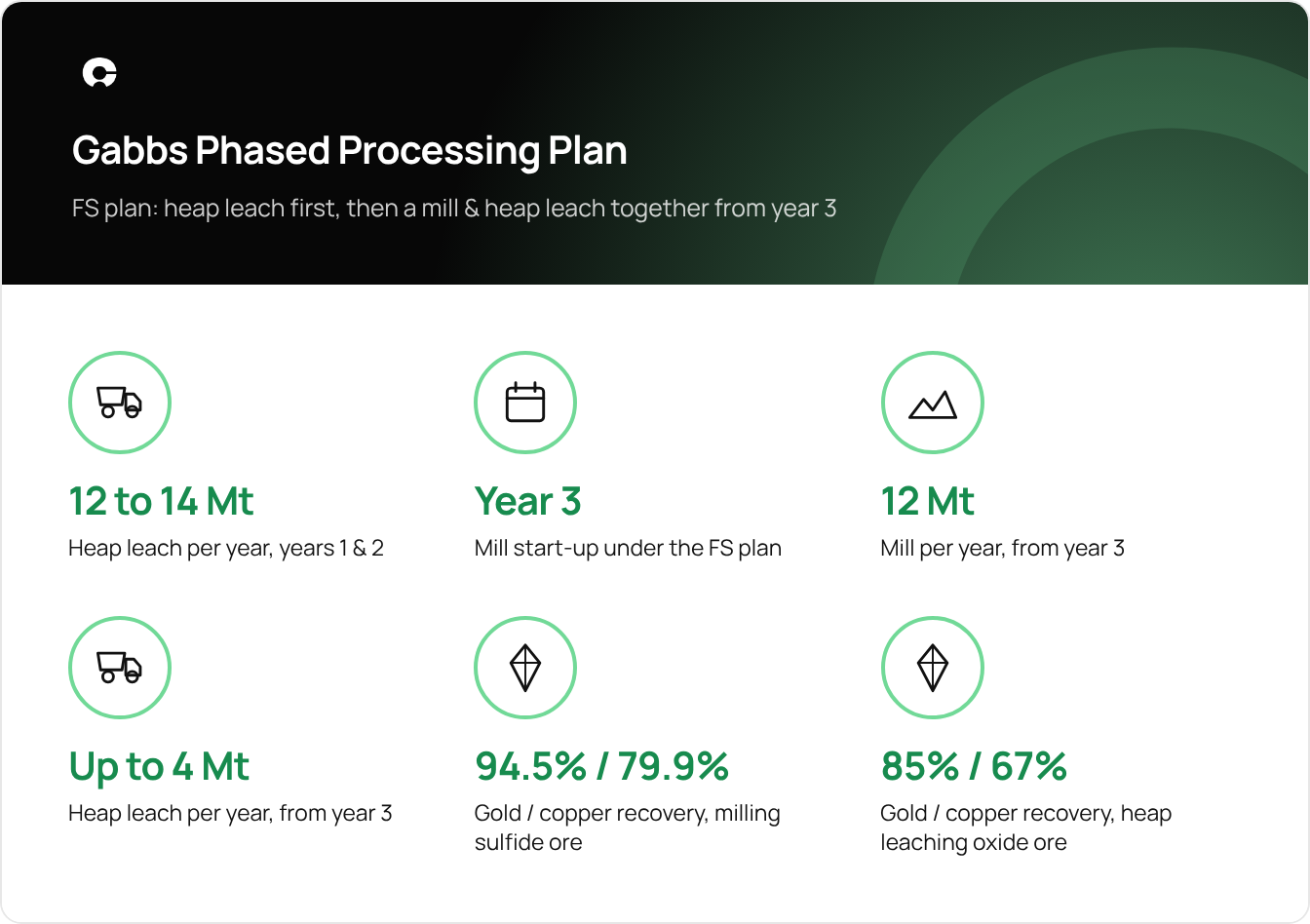
Under the phased plan now contemplated, the heap leach facility operates at 12 to 14 million t per year in years 1 and 2 of operations. The FS then plans a mill that starts up in year 3 and runs at 12 million t per year for the remainder of the mine life. Alongside it, the heap leach operates at a variable rate of up to 4 million t per year. From year 3, mining prioritizes 12 million t per year of sulfide for the mill. The heap leach takes the oxide mined to reach it, expected to vary from 2 to 4 million t per year.
Milling sulfide ore is estimated to recover 94.5% of the gold and 79.9% of the copper, compared with 85% and 67% for heap leaching oxide ore.
3. The PEA Sets the Capital Benchmark
The 2025 PEA, effective October 7, 2025, is the printed reference for the cost to build Gabbs.
It puts total preproduction capital at US$382.7 million: US$73.6 million for mining, US$213.1 million for process and heap leach, and US$96.0 million for other items. Total production capital, including the mill, is US$571.8 million, of which US$350.9 million is the mill. At base case prices of US$2,350 per ounce for gold, US$29.00 per ounce for silver, and US$4.50 per pound for copper, the PEA gives a payback of 2.4 years on preproduction capital.
The FS is built on a different plan, at 12 million t per year or more, compared with the PEA's 9 million t per year. Its mill starts in year 3, whereas the PEA started it in year 6.
4. Car Body as an Early Cash Source
Car Body gives P2 Gold a potential source of gold during construction, before commercial production from the main zones. Car Body is a low-sulfidation epithermal gold deposit with minimal copper, so its solution can bypass the SART plant, a circuit that recovers copper from the leach solution. Using contract mining, crushing, and stacking, with offsite gold recovery, Car Body may deliver cash flow roughly 6 months into construction. Preproduction feed from Car Body is planned at up to 10,000 tonnes per day, starting as soon as reasonably possible after construction begins.
Car Body has potential for 50,000 oz of gold within the first year of construction, on a management estimate it describes as looking some way ahead. Car Body is small, at about 100,000 oz, and requires additional drilling to move material from the inferred to the measured and indicated categories.
For Ovsenek, the early Car Body gold could change how the build is financed:
"That's our focus, and it's a nice way to really augment the cash, really help us with our financing; we could then structure financing a little differently for the project."
P2 Gold plans to examine the Car Body sequence within the FS, and in more detail during detailed engineering.
5. Royalty Buyback Before Cash Flow
P2 Gold plans to clear the 2% royalty on Gabbs before the project produces cash. A 2% net smelter return royalty sits on the property, and P2 Gold has the right to acquire it at any time for US$6.5 million. The plan is to buy back the full 2% before cash flow, so the company views Gabbs as royalty-free.
Ovsenek keeps a royalty in play only where it pays for shareholders:
"If a royalty is what makes sense at the time for the shareholders financially, well, we would look hard at it as part of a construction financing package. But having no royalty on the project really gives you a lot of flexibility on the financing side."
With the buyback planned before cash flow, a royalty is among the terms P2 Gold can offer, or withhold, when the construction package is assembled.
6. Water Payment Sets Up the Next Raise
Before the construction raise, P2 Gold has a nearer payment to make.
In April 2026, P2 Gold signed a definitive agreement to acquire 2,500 acre-feet of water rights per year. Closing is subject to the Nevada Division of Water Rights approving a change of use from irrigation to mining, milling, and dewatering. Once that change is approved, P2 Gold has a period to pay the US$10.5 million purchase price. As of September 21, 2026, approval was anticipated in 3 to 6 months, coinciding with the projected completion of the FS.
P2 Gold had about C$9 million in cash in late October 2026, which management considers enough to get through the FS. It expects to raise funds, probably into the new year, to pay for the water rights and for long-lead items.
7. Resource, Study & Permits Test the Plan
Three dated events will put numbers on the funding plan.
The updated mineral resource estimate will include drill holes completed by the end of October 2026. It is targeted for the fourth quarter of 2026 and, on management's timing, due before Christmas 2026 and will form the basis of the FS. The FS is expected to follow in the first quarter of 2027, and P2 Gold plans to disclose production year by year when it is released.
Filing of the mining plan of operations with the Bureau of Land Management is expected in the first quarter of 2027. Construction start is contingent on permitting, which management expects between the end of 2027 and mid-2028. Within that range, construction would start in early 2028 or the third quarter of 2028, allowing production from the Lucky Strike and Sullivan zones in 2029. The FS capital figure will show how large the single raise needs to be, and its year-by-year production will show what the heap leach is planned to produce in years 1 and 2.
Key Takeaways for Investors
- P2 Gold plans a single up-front capital raise to start the Gabbs heap leach, with no separate raise planned for the mill.
- The heap leach is planned to run at 12 to 14 million tonnes per year in years 1 and 2, before a 12-million-tonne-per-year mill starts in year 3.
- Car Body may deliver cash flow roughly 6 months into construction, which management sees as a way to structure financing a little differently.
- P2 Gold plans to buy back the 2% net smelter return royalty for US$6.5 million before the project produces cash flow.
- A near-term raise, likely in the new year, is planned to pay the US$10.5 million water rights price and fund long-lead items.
Bottom Line
P2 Gold's funding plan for Gabbs depends on the construction order. A single capital raise is meant to start the heap leach. Two years of heap leaching at 12 to 14 million t per year are expected to generate the cash for a mill running at 12 million t per year from year 3. Car Body's early gold and the planned US$6.5 million royalty buyback accompany that plan, with a near-term raise expected for the US$10.5 million water payment. The FS, targeted for the first quarter of 2027, will set the capital figure that the single raise must cover and the year-by-year production that the heap leach must deliver to fund the mill. Until then, the 2025 PEA's US$382.7 million in preproduction capital and US$571.8 million in total production capital are the printed reference points.
Analyst's Notes





Subscribe to Our Channel






Stay Informed