GoldInxs Launches First Modern Drill Test at Fishpot, 2000 Meters to Probe Gold-Silver & Copper-Gold Targets


GoldInxs has started a 2,000 m maiden drill program at Fishpot in BC, testing a Blackwater-style gold thesis, with first assays targeted in the new year.
- GoldInxs Mining has started the first modern and systematic drill test at Fishpot, a 5,509-hectare property with only 378 m of historic drilling.
- The program of approximately 2,000 m over 8-10 holes opens at the Lightening Zone, and will tests both epithermal gold-silver and porphyry copper-gold targets, giving GoldInxs more than one route to a discovery.
- Fishpot has year-round road access and sits 20 km from powerlines and a paved road, which supports low-friction exploration.
- First assay results are targeted early in the new year, and wide altered zones could support further vectoring even at low gold grades.
- The C$1.25 million raised covers this program and its assays, while follow-up work will require another financing.
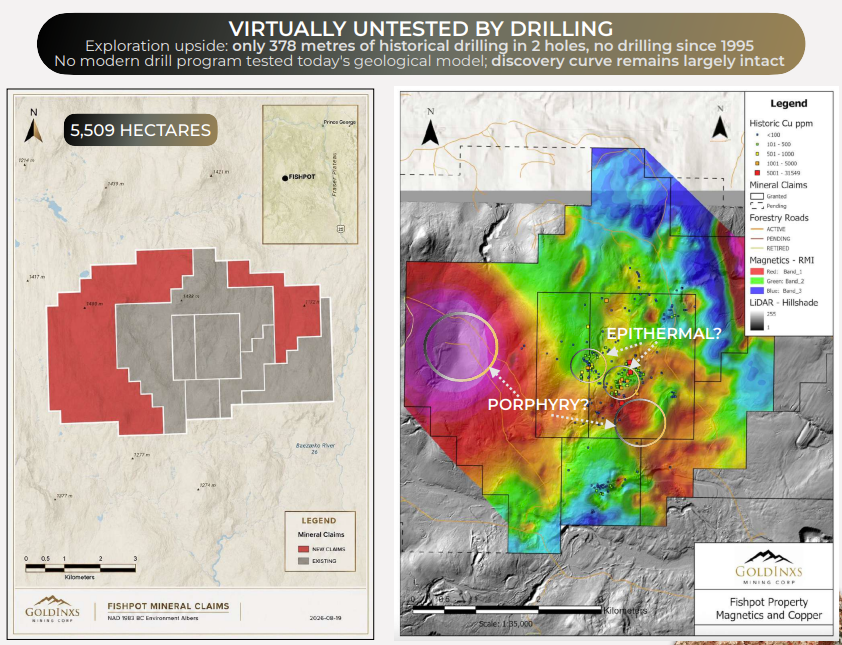
Central British Columbia hosts one of Canada’s largest gold operations at Artemis Gold’s Blackwater Mine. Fishpot, approximately 65 kilometers (km) away, has seen only 378 meters (m) of drilling across 2 holes, and none since 1995. GoldInxs Mining Corp. (TSXV:INXS | OTCQB:INXGF) started to close that gap in October 2026 with a maiden drill program of approximately 2,000 m over 8 to 10 holes at the 5,509-hectare project.
The program is the first modern, systematic drill test of a property where surface work has mapped widespread hydrothermal alteration and gold, silver and copper anomalies. Funding for the drilling and assays is in place, drill permits are issued, and GoldInxs is targeting first results early in the new year. Those results bear on one question: whether Fishpot’s large alteration footprint holds a valuable mineralized system.
A Large System With Little Drilling
Fishpot’s drill history accounts for much of the opportunity. Phelps Dodge drilled the 2 historic holes in 1995, and those short holes stayed within sediments without testing deeper. Later owners confined their work to surface soil sampling, rock sampling and preliminary mapping.
GoldInxs rebuilt the dataset before committing to a drill. The company collected more soil samples, completed a magnetic survey and inverted it into 3D, ran a 53.4-line-kilometer 3D induced polarization (IP) survey, and reviewed trace geochemistry and pathfinder elements. Surface rock samples returned up to 5.65 grams per tonne (g/t) gold, 11.35 g/t silver and 0.42% copper, and GoldInxs states those results are not indicative of expected drill grades.
Newly approved claims took the land package from 2,472 to 5,509 hectares. The property has year-round road access and is 20 km from powerlines and a paved road.
Source: GoldInxs Corporate Presentation
Drill Targeting: Layered Data Over Blind Geophysics
GoldInxs built its targets from geochemistry and geology outward. Trace geochemistry supplies vectors across multiple elements and ratios, and geophysics adds depth. The magnetic survey showed where high-priority features lay but not how deep they were, so the company used the 3D IP survey to set drill azimuths and dips. A satellite-based system called Virtual DRILL provided further depth estimates, though the team does not rely on it alone.
The working theory borrows from Blackwater, where targeting resistivity anomalies pointed to silica alteration at depth. Epithermal targets pair resistivity highs with structural zones and overlapping surface geochemistry, and magnetic highs guide the porphyry targets.
Vice President Exploration of GoldInxs, Darcy Vis, said a chargeability anomaly could reflect pyrite, which can host gold in its rims, or graphitic sediments, and that ambiguity sets his rule for choosing holes:
“We’re not just drilling geophysical targets. It has to be connected something else to really increase your confidence.”
Drilling opened at the Lightening Zone, where resistivity above 800 ohm-meters and chargeability above 20 millivolts lie beneath a 2 km by 500 m surface zone of intense silica alteration. Gold, silver, copper, bismuth, antimony and zinc anomalies overlap at surface, and Vis pointed to a linear resistivity high under the zone and fairly good gold in surface grab samples. Thriller, Believin’, Luftballon, Southside and BullsEye complete the priority list.
Interview with Darcy Vis, VP Exploration of GoldInxs Mining Corp.
The Blackwater Comparison: What Is Established & What Is Not
GoldInxs uses Blackwater as its exploration model because Vis regards it as the region’s best deposit and the surface evidence fits. Vis cited sericite and kaolinite alteration, fine-grained disseminated sulfides, volcanic rocks of a similar type and age, and a location 65 km from the mine.
Blackwater holds proven and probable reserves of 334.3 million tonnes at 0.78 g/t gold equivalent, containing approximately 8.0 million ounces (Moz) of gold and 62.2 Moz of silver. GoldInxs is targeting the same broad style of lower-grade, bulk-tonnage mineralization, and Vis said anything above 0.5 g/t gold in surface grab samples pleases the team. He added that silver does not always track gold at Fishpot, and that the search is for big zones at the highest grade available, not narrow veins.
No drilling has yet confirmed mineralization, grade, tonnage or continuity at depth. The company’s own presentation states that no mineral deposit has been identified at Fishpot and that the similarities do not imply mineralization comparable to Blackwater. Vis said the team remains open to other interpretations, though he described the evidence as looking more similar every day.
Catalysts: Reading the First Assays
The team is balancing ambition against a limited budget. Mineralization keeps the drill on a target for multiple holes so the company can start to define a volume, interesting alteration may also hold it there, and a poor result sends it to the next zone.
Labs across Canada are quoting approximately 7 to 8 weeks, according to Vis, so GoldInxs is staggering its holes and targeting first results early in the new year.
Vis also set out how early results can be read. Wide zones of silica, veining or breccia bodies, even with gold around 0.1 g/t or below 0.5 g/t, would indicate the drill is in the right area of a 2 km target, given how small a sample one drill core takes. On the porphyry side, propylitic alteration (chlorite and epidote) or phyllic alteration (pyrite and sericite) would suggest proximity to a halo around a potassic source. He said the team is very optimistic about making a discovery but does not assume a hit from the first holes, and a wide altered zone with low gold would give the company a vector, not a headline grade.
Permits, Community & Board
GoldInxs holds a 5-year, multi-year area-based permit that took approximately 9 months to secure. The permit covers 12 holes, and the company plans to file an amendment to add more for future drilling.
Vis has met with First Nations several times, and a First Nations site visit took place shortly before the interview. The company’s presentation cites positive engagement with the Nazko First Nation, and Vis said a discovery would require neighbors on side, so the team is building social license now.
The October 16, 2026 annual meeting added Deepak Malhotra, with over 50 years in the mining sector, and Zoran Pudar, with 40 years in the industry including over 5 years as Exploration Manager of Mako Mining. The board then appointed mining engineer Gordana Slepcev. Vis with over 17 years in the junior sector, and geologists from Tripoint Geological Services, which he has run for 9 years, are processing the core.
The Investment Thesis for GoldInxs Mining
- GoldInxs is testing a 5,509-hectare property in central British Columbia that has only 378 meters of historic drilling in 2 holes.
- The Lightening Zone provides the first test, with overlapping induced polarization resistivity and chargeability anomalies beneath a 2 kilometer by 500 meter surface zone of intense silica alteration. Results are targeted early in the new year, with labs quoting approximately 7 to 8 weeks.
- Thriller, Believin’, Luftballon, Southside and BullsEye target zones give the 8 to 10 hole programme further targets, so the first results do not rest on the Lightening Zone alone.
- Monitor first assay results early in the new year, when wide zones of silica, veining or breccia with gold near 0.1 grams per tonne would support further vectoring even without discovery grades.
- The C$1.25 million raised covers this program and its assays, and follow-up drilling on any result requires a further financing.
Macro Thematic Analysis
Epithermal gold systems in central British Columbia attract capital because bulk-tonnage deposits can be profitable at moderate grades when tonnage and continuity are present. Blackwater is the reference point, and Artemis Gold intends towards triple production. Evolution Mining has optioned the nearby Clisbako property, and the Newton Project holds an inferred resource of approximately 1.6 Moz of gold and 7.7 Moz of silver.
These systems commonly occur in clusters, which gives under-drilled ground near an established deposit its exploration appeal. Vis tied Fishpot’s opportunity to how hard this deposit style is to detect:
“We were really hunting in that region for Blackwater-style mineralization that may have been overlooked. It’s not an easy thing to search for or find, which is why we believe that people haven’t had a significant amount of success in that area.”
He cited glacial overburden and limited outcrop as the physical barriers, and 3D geophysics is the company’s response. Vis said labs have become busier in the past month as drill programs wrap up, which he called a good sign for the wider industry. GoldInxs also sold flow-through units at C$0.13 against C$0.11 for ordinary units, and intends to renounce qualifying exploration expenses to subscribers with an effective date no later than December 31, 2026.
TL;DR
GoldInxs Mining has started the first modern, systematic drill test at Fishpot, a 5,509-hectare property in central British Columbia with only 378 m of historic drilling. The program of approximately 2,000 m over 8 to 10 holes opens at the Lightening Zone, where IP anomalies lie beneath a 2 km by 500 m surface silica zone. Surface evidence resembles Artemis Gold’s Blackwater Mine, but the company states that no deposit has been identified. C$1.25 million covers this program and its assays, and first results are targeted early in the new year.
FAQs (AI-Generated)
Analyst's Notes





Subscribe to Our Channel





Stay Informed