




7 Signals Atomic Eagle's Muntanga Can Outgrow Its 25.3 Million-Pound Mine Plan


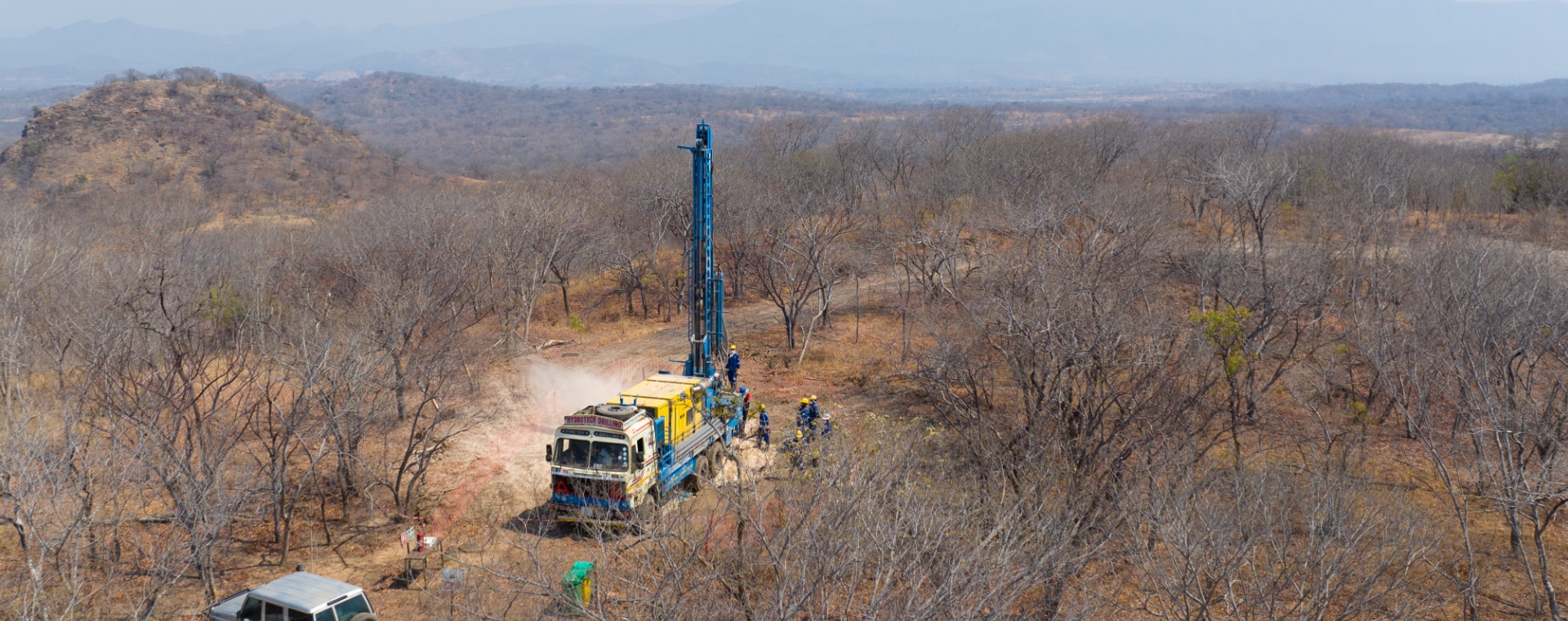
Atomic Eagle plans a larger Muntanga uranium mine on low-capital heap leach growth and the 44% of its JORC resource that the 2025 study left out.
Project Overview
Atomic Eagle (ASX: AEU | OTCQX: AEUXF) owns 100% of the Muntanga Uranium Project in Zambia, with a JORC resource of 58.8 million pounds (lb) of uranium oxide at 309 parts per million. The company also owns 60% of the Madaouela Uranium Project in Niger. Muntanga is fully permitted.
The company's plan for Muntanga is a larger operation than the one described in the 2025 study, fed by resources the study excluded and by resource growth from drilling. The economics of that plan depend on how heap leach costs change as an operation grows, how much resource lies outside the old mine plan, and whether the metallurgy performs on new deposits.
1. Heap Leach Scale at Low Capital Intensity
Atomic Eagle's case for a larger Muntanga starts from the position that increasing the scale of a heap leach project is low-capital-intensity. Heap leaching dissolves uranium by trickling acid through piles of crushed ore, then recovers the metal from the collected solution. The 2025 plan paired that process with low-strip open-pit mining, sealed road access, nearby power and water within the mining license, and export via a known uranium port.
Chief Executive Officer of Atomic Eagle, Phil Hoskins, explains why a bigger heap leach operation needs little extra capital:
"The important thing here to make the economics look better is that heap leach operations don't require a lot of capital cost to make them much bigger. The back end of the processing plant is just a modest part of the overall processing."
Atomic Eagle's stated aim is to improve project economics through increased scale.
2. Higher Throughput Than 3.5 Million Tonnes a Year
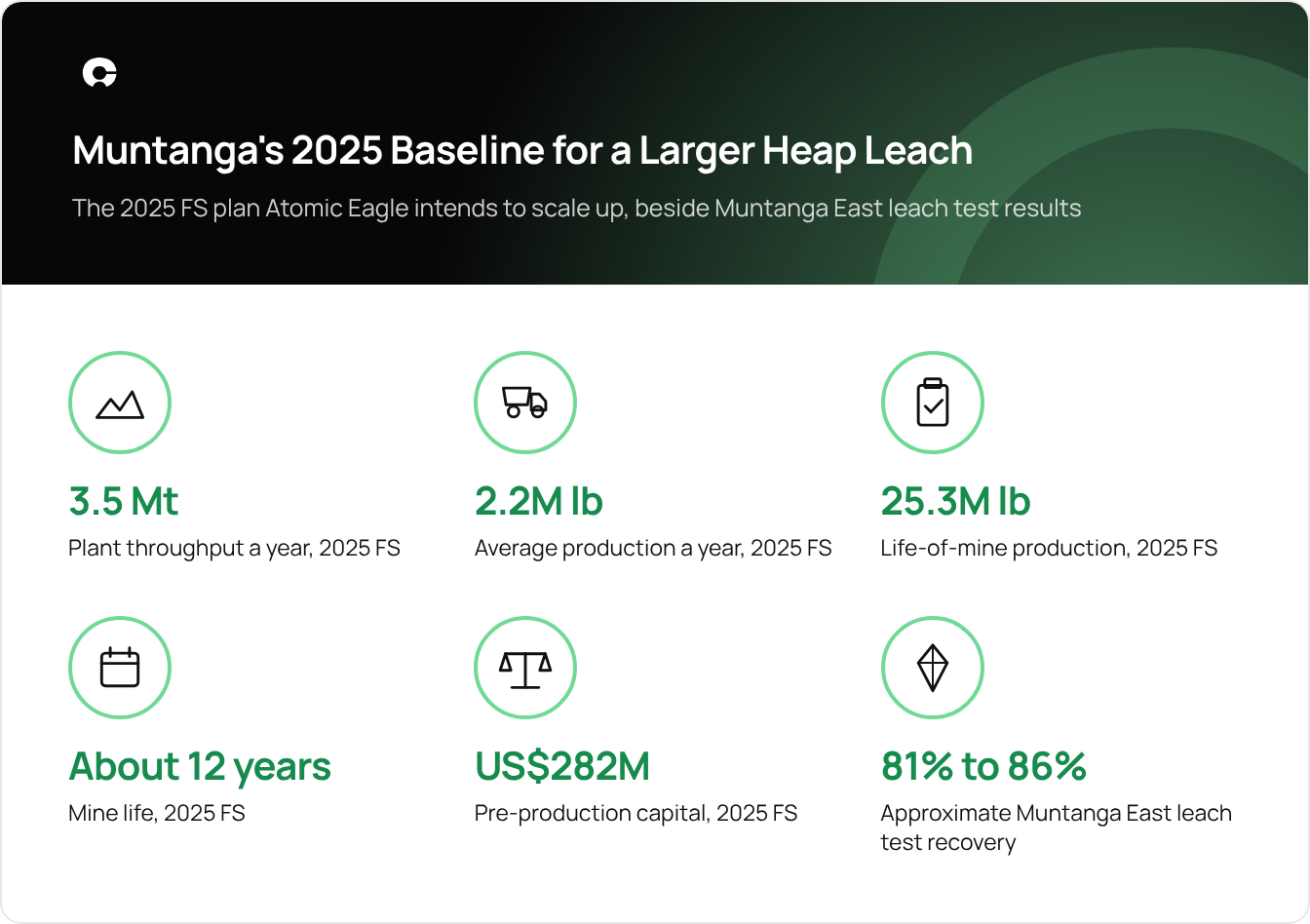
Atomic Eagle intends to raise Muntanga's plant throughput above the 3.5 million tonnes a year set in the 2025 study. That plan set average production at 2.2 million lb a year, from ore grading 320 parts per million.
Hoskins ties higher throughput to better economics, conditional on recoveries from the heap:
"If you can get the uranium recoveries from simply loading the material onto a heap, and so our intention is to significantly increase the throughput, and that will have a disproportionately large impact on the economics as a result."
That condition links the throughput plan to the metallurgy of every deposit that would feed a larger heap.
3. The 2025 Feasibility Study Baseline
The 2025 feasibility study (FS), completed under previous owner GoviEx Uranium Inc., set Muntanga's baseline at 25.3 million lb of uranium oxide over a mine life of about 12 years. Recoveries topped 90% over the life of mine, and acid consumption averaged 20 kilograms per tonne treated. The plan called for mining 39.6 million tonnes of ore, at a strip ratio of 1.2 to 1 at Muntanga and just over 3 to 1 at Dibbwi East.
Pre-production capital came to US$282 million, with operating costs of US$32.20 per lb.
The mine plan drew only on measured and indicated resources, 25.7 million lb at Dibbwi East and 7 million lb at Muntanga, so every figure above reflects that smaller inventory.
4. Resources Left Outside the 2025 Plan
Atomic Eagle counts 44% of Muntanga's JORC resource as not considered in the FS, split across 3 blocks it targets for future studies. Satellite deposits hold 8.7 million lb, excluded despite showing positive cash flow: 7.3 million lb measured and indicated and 1.4 million lb inferred. Another 6.0 million lb of inferred resources lies at the existing Muntanga and Dibbwi East deposits. That block was excluded from the FS under NI 43-101 regulations: 2.1 million lb at Muntanga and 3.9 million lb at Dibbwi East. The 2026 resource upgrade added the last 11.4 million lb, all inferred.
Infill drilling and technical studies will seek to convert all 3 excluded blocks into ore feed. For the satellite deposits’ inferred resources, Hoskins expects a place in future mine planning:
"The grades are fine. They'll absolutely be part of the mine plan moving forward."
Inferred resources carry the lowest geological confidence among the resource categories, so their conversion depends on infill drilling that raises that confidence.
5. Muntanga East Metallurgy on Lower-Grade Material
Leach tests on Muntanga East core recovered between about 81% and 86% of the uranium, using about 3 kilograms of acid per tonne during the extraction period, below the broader project’s average. Mintek in South Africa tested 2 composites, blended samples of diamond core, from the recently discovered Muntanga East uranium deposit, crushed to a nominal top size of 25 millimeters. Extraction was mostly complete after about 20 days. Bottle roll tests, which leach a sample in a rotating bottle of acid solution, returned 85.9% and 81.9% after 25 days. The results indicate that about 80% of the uranium occurs in minerals that dissolve readily under heap leach conditions.
Column tests, which trickle acid through a tall column of crushed ore to mimic a heap, continued for 62 days in total, with only modest extra recovery while acid use rose to between 7.0 and 7.6 kilograms per tonne. The material was of lower grade than samples historically tested from several other Muntanga deposits, yet recoveries matched those of earlier programs. Stacking tests simulating a heap 6 meters (m) high showed hydraulic conductivity greater than 4 times the design threshold typically required for heap leaching, a measure of how freely solution drains through the pile.
The results will be incorporated into ongoing technical studies and add confidence in the potential integration of Muntanga East into future mine planning.
6. Permits in Place for a Larger Build
Muntanga's resources are on granted mining licenses, with approvals in place for environmental and social impact assessments and a Resettlement Action Plan. Atomic Eagle received the environmental and resettlement approvals in June. The license package covers 1,126 square kilometers, and the 2026 program has drilled across it at Chisebuka, Muntanga North, and Namakande.
Being fully permitted is, by management’s account, a premium in the uranium sector and an advantage for Atomic Eagle, because projects take a long time to move through the permitting process.
7. Drilling Ahead of the Scale Decision
Muntanga's operating scale depends on drilling that runs through the end of 2026, since management will not select a scale until more of the exploration potential has been tested. Drilling at the current Muntanga North targets is expected to finish in the fourth quarter of 2026. At Muntanga North Target 5, wide-spaced holes outlined a zone of about 600 m by 200 m that stays open along-strike and down-dip to the east. Across Targets 1 to 5, Atomic Eagle drilled 64 holes for 5,995 m, and Targets 1 to 3 returned no anomalous uranium.
Atomic Eagle will also continue first-pass drilling at Targets 6, 7, and 8, which are large, early-stage targets. At Namakande, 60 holes for 6,832 m outlined a zone of about 1,000 m by 400 m at Target 2, where intercepts have generally been less than 2 m thick. The schedule then runs to an updated resource in the first quarter of 2027, updated studies through 2027, financing in 2028, and production by 2031, by management's estimate.
The updated studies through 2027 will draw on that first-quarter resource.
Key Takeaways for Investors
- Atomic Eagle presents a larger heap leach operation at Muntanga as low-capital-intensity because the back end of the plant is a modest part of the processing.
- Management intends to raise throughput above the 3.5 million tonnes per year set in the 2025 feasibility study, provided heap leach recoveries are achieved.
- Resources making up 44% of the JORC resource were not considered in the 2025 feasibility study.
- Leach tests on Muntanga East core recovered between about 81% and 86% of the uranium, using about 3 kilograms of acid per tonne during the extraction period.
- Drilling runs through the end of 2026 ahead of an updated Muntanga resource in the first quarter of 2027.
Bottom Line
Atomic Eagle's plan for Muntanga depends on heap leach capital rising more slowly than throughput, as the company presents its scale case. The FS outlined a mine of about 12 years at 2.2 million lb a year, with US$282 million in pre-production capital, using only the measured and indicated resources at Muntanga and Dibbwi East. The company now counts 44% of the 58.8 million lb JORC resource as outside that plan. Leach tests on Muntanga East core have recovered between about 81% and 86% of the uranium, using about 3 kilograms of acid per tonne during the extraction period. Management intends to raise throughput above 3.5 million tonnes a year and will not settle the scale until drilling, which runs through the end of 2026, has tested more of the exploration ground. The resource update in the first quarter of 2027 is the dated point at which that larger inventory feeds the updated studies, which are planned through 2027.
Analyst's Notes





Subscribe to Our Channel
Stay Informed


