Abitibi Metals' Expanding B26 Footprint & Why Camp-Scale Growth Could Reshape Its Strategic Value


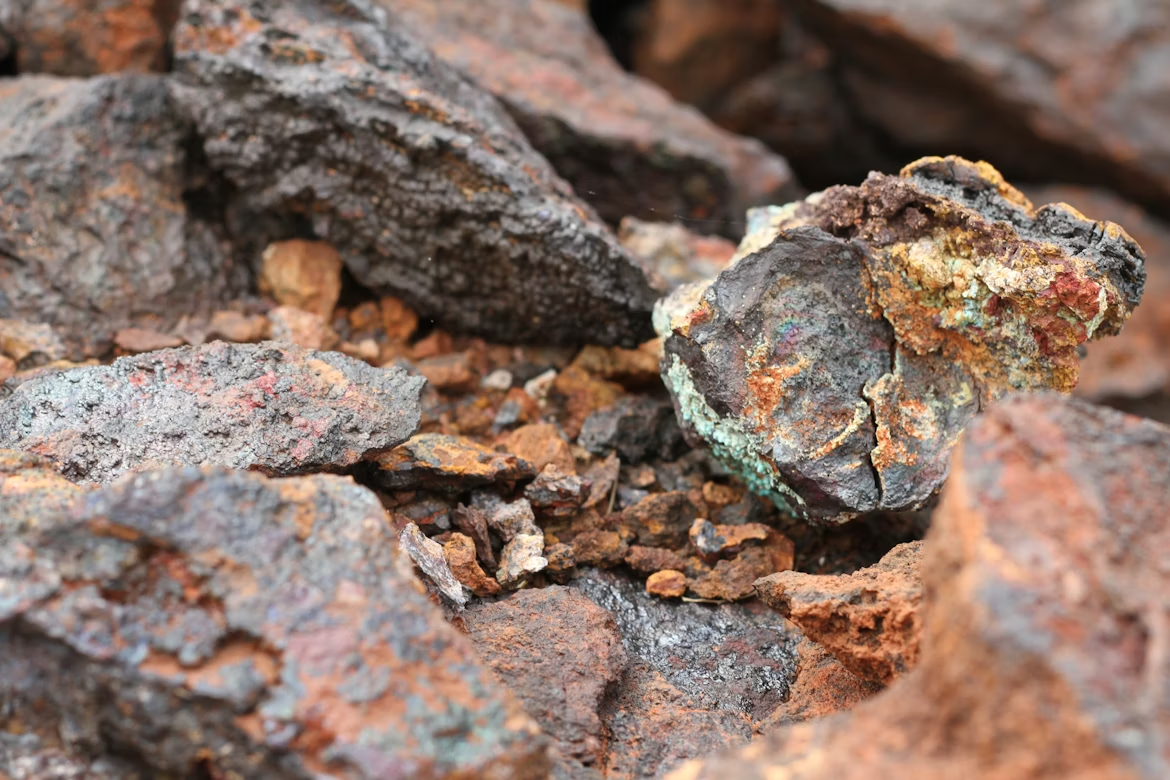
Abitibi Metals expands B26 beyond its resource boundary as strategic funding and step-out drilling support camp-scale copper-gold growth.
- Abitibi Metals' Phase 4 drilling extended mineralisation 300 metres beyond the 2024 resource boundary, with broad chlorite alteration halos suggesting a larger hydrothermal system than currently modelled.
- Discovery Silver invested C$30.7 million for a 9.9% stake, providing funding through the first quarter of 2027 for a 40,000 metre drill program targeting both resource expansion and infill conversion.
- The company is simultaneously advancing resource growth, infill drilling to convert inferred resources to indicated category, and technical studies, including a preliminary economic assessment (PEA).
- B26's 25.3 million tonne (Mt) resource contains 775 million pounds (Mlbs) of copper, 471 thousand ounces (Koz) of gold, 376 Mlbs of zinc, and 16 million ounces (Moz) of silver at 2.1% copper equivalent.
- Canadian mining M&A surged 220% in 2025 to C$62.1 billion, with the Foran Mining acquisition by Eldorado Gold for approximately C$4 billion demonstrating valuation premiums for scalable VMS projects in stable jurisdictions.
Why Mining Camp Potential Matters More Than Single-Deposit Growth
Mining markets assign valuation premiums to district-scale systems over isolated deposits because they reduce discovery risk, extend mine lives, and create infrastructure leverage that single deposits cannot replicate. A camp-scale system allows companies to centralise processing facilities and share infrastructure across multiple production centres, reducing per-tonne capital intensity as additional resources are defined. When mineralisation extends across a larger footprint with demonstrated geological continuity, future exploration drilling carries lower binary risk than greenfield programs, which improves long-term net present value (NPV) calculations and makes assets more attractive in merger and acquisition (M&A) processes.
Canadian mining M&A activity surged 220% in 2025 to C$62.1 billion. Copper exposure in jurisdictional environments with year-round access and established permitting frameworks commands higher multiples during consolidation cycles, which positions district-scale copper systems in stable jurisdictions as strategic acquisition targets.
B26 Is Expanding Beyond Its Original Resource Boundary
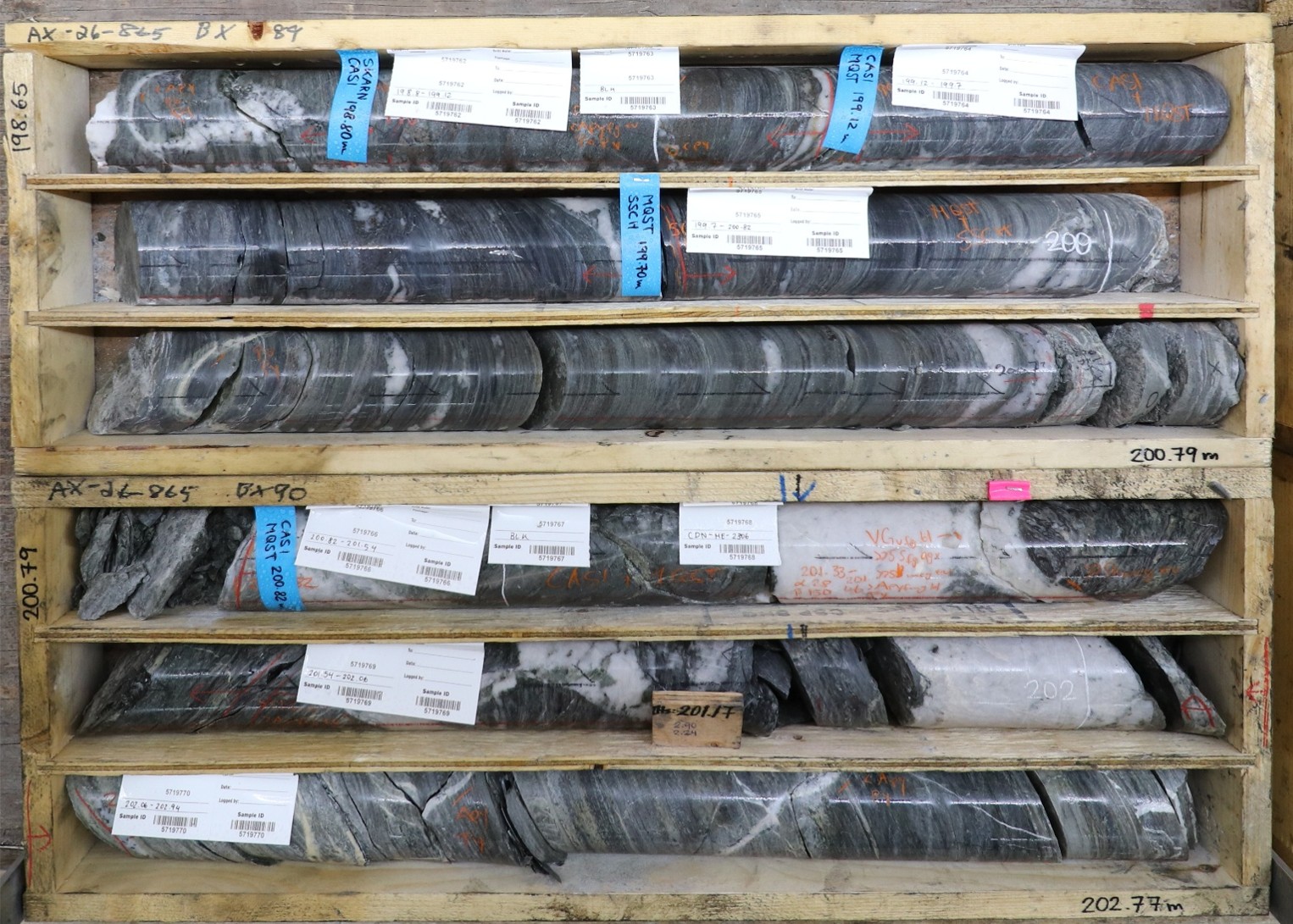
Abitibi Metals' (CSE: AMQ | OTCQB: AMQFF | FSE: FW0) Phase 4 drilling program targeted the High-Grade Copper Stringer zone with a 150 metres step-out west of previous intercepts, extending mineralisation by a cumulative 300 metres beyond the 2024 block model boundary. The previous intercept already sat 150 metres west of the resource boundary, meaning the latest results push the western edge of the system into an area not accounted for in the current 25.3 million tonnes (Mt) resource. Mineralisation remains open to the west, and the company has not yet defined the lateral extent of the copper-rich stringer zone.
President and Chief Executive Officer of Abitibi Metals, Jon Deluce, described the implications:
"We delivered our first results from Phase 4, which included once again a 150-metre step out at strong grades, expanding this at depth, and that continues to support our goal and thesis that this is a much larger deposit and is a long-life potential asset."
Down-plunge continuity in volcanogenic massive sulfide (VMS) systems matters for resource expansion because continuous mineralisation suggests the hydrothermal system operated across a larger area than the current resource boundary.
Recent 200 metres and 350 metres step-outs from known mineralisation intersected broad chlorite alteration halos of 22 metres and 13 metres, respectively, despite returning lower-grade intercepts. These alteration halos are significant because chlorite-dominant assemblages in VMS systems indicate proximity to a hydrothermal feeder structure, even when economic grades have not yet been intersected. Alteration footprints can extend hundreds of metres beyond high-grade sulfide lenses, meaning the presence of broad chlorite zones across large step-out distances suggests a hydrothermal system larger than the current resource footprint.
Resource Growth Is Being Matched by Aggressive Capital Deployment
The company added a third drill rig to its B26 program, increasing simultaneous drilling capacity and allowing the exploration team to test multiple targets concurrently. This expansion accelerates resource conversion by allowing infill drilling and step-out drilling to proceed in parallel rather than sequentially. The current Phase 4 program totals 40,000 metres, with an 8,232 metres campaign already underway targeting both the western down-plunge extension and infill zones within the existing resource boundary.
The Phase 4 program includes infill drilling at 70 metres spacing, a density required to convert inferred resources to the indicated category under Canadian NI 43-101 standards. By advancing infill drilling concurrently with step-out exploration, Abitibi Metals is positioning B26 for near-term engineering work while simultaneously testing for resource expansion.
B26's Strategic Value Extends Beyond Resource Size
B26 is located approximately 7 kilometres from the past-producing Selbaie Mine, which produced 56.9 Mt of ore grading 0.87% copper, 1.85% zinc, and 39 grams per tonne (g/t) silver. Proximity to historical mining infrastructure reduces certain categories of development risk because the region's geological characteristics, environmental baseline conditions, and workforce availability have already been established through prior operations.
Hub-and-spoke mining models centralise ore processing at a single mill while extracting material from multiple satellite deposits, reducing per-tonne capital costs by amortising infrastructure investment across a larger production base. B26's location within the Abitibi Belt positions it as a potential regional processing hub if additional deposits are discovered or acquired within trucking distance.
Strategic Capital Is Reinforcing the Growth Narrative
Abitibi Metals closed a non-brokered financing of up to C$30.7 million led by Discovery Silver, which acquired a 9.9% strategic stake and secured participation rights in future financings. Strategic investments from operating mining companies carry a different signalling value than traditional brokered financings because they indicate that a third-party operator with mine-building expertise has conducted due diligence and concluded that the project justifies capital allocation.
Jon Deluce contextualised the financing:
"We've been able to really well capitalise the company, build a world-class team, and now attract, upon closing, a world-class producing partner that will have a 9.9% stake in the company."
Deluce also outlined the capital deployment strategy:
"This injects $31 million into a market that is still volatile. We now have a war chest to deliver what, 80,000 metres plus of drilling to deliver the PEA, to put a huge dent into our feasibility study."
The financing leaves Abitibi Metals with approximately C$19 million in cash and funding visibility through the first quarter of 2027, according to company disclosures. The company has around 187 million shares outstanding with minimal warrant overhang, which limits near-term dilution risk and allows management to execute the Phase 4 program without requiring additional capital raises during a potentially volatile equity market environment.
Why B26's Geological Profile May Matter in a Consolidating Market
B26's resource profile contains approximately 775 million pounds (Mlbs) of copper, 471 thousand ounces (Koz) of gold, 376 Mlbs of zinc, and 16 million ounces (Moz) of silver across 25.3 Mt at just over 2.1% copper equivalent. This polymetallic composition provides diversified commodity exposure that reduces revenue volatility relative to single-metal projects, which matters in long-term mine planning because it allows operators to maintain positive cash flow across a broader range of metal price scenarios.
VMS systems with high copper grades in stable jurisdictions are strategically scarce, and most new copper supply is expected to come from expansion of existing operations or redevelopment of past-producing mines rather than greenfield discoveries. The Foran Mining acquisition by Eldorado Gold for approximately C$4 billion in 2025 demonstrated the valuation premiums that scalable VMS projects in stable jurisdictions can command in M&A processes.
Jon Deluce referenced this transaction:
“How rare these deposits are in the marketplace, and we look at the recent closing of the Foran takeover by Eldorado for almost $4 billion. It showcases the demand for these in the market, but also how rare they are. There are very few of these available across Canada that have the size and scale of B26.”
The Investment Thesis for Abitibi Metals
- B26 continues to expand beyond its original resource footprint, with recent drilling extending the western down-plunge zone by 300 metres and mineralisation remaining open, suggesting the potential for a much larger deposit than currently modelled.
- Large alteration halos identified across major step-outs indicate geological continuity consistent with a broader camp-scale mineralised system, which reduces future discovery risk and creates infrastructure leverage opportunities.
- The company is simultaneously advancing resource expansion, infill conversion to indicated category, and technical studies, including a preliminary economic assessment, potentially accelerating future development timelines and reducing time to production.
- Strategic financing led by Discovery Silver, including a 9.9% stake and participation rights, strengthens funding visibility through the first quarter of 2027 and validates the project's long-term potential through external due diligence by an operating mining company.
- B26 combines copper-gold polymetallic leverage, infrastructure access through proximity to past-producing operations, scalable exploration upside across a growing land position, and Québec jurisdictional strength at a time when Canadian mining merger and acquisition activity remains elevated and copper-focused assets in Tier-1 jurisdictions remain strategically scarce.
The combination of scale, geological continuity demonstrated through large step-out drilling, regional consolidation strategy, and strategic backing from Discovery Silver positions Abitibi Metals as more than a single-asset exploration story. If continued drilling confirms camp-scale mineralisation beyond the current block model, the company may increasingly attract attention as a scalable future development platform within one of North America's most established mining districts.
TL;DR
Abitibi Metals is advancing B26 from a single-deposit exploration story to a potential district-scale copper-gold system. Recent step-out drilling extended mineralisation 300 metres beyond the resource boundary, with broad alteration halos suggesting a larger hydrothermal system. Strategic investment from Discovery Silver (9.9% stake, C$30.7 million) and a 40,000 metres Phase 4 program will fund systematic exploration through the first quarter of 2027. B26's 25.3 million tonnes resource (775 Mlbs of copper, 471 Koz of gold, 376 Mlbs of zinc, 16 Moz of silver at 2.1% copper equivalent) sits 7 kilometres from the past-producing Selbaie Mine in Québec's Abitibi Belt. With Canadian mining M&A surging 220% in 2025 to C$62.1 billion, continued drilling confirming district-scale continuity could position Abitibi Metals as a scalable production platform in a consolidating market.
FAQs (AI-Generated)
Analyst's Notes





Subscribe to Our Channel


Stay Informed