




Abitibi Metals: From Drill Results to Development Costs at B26


Step-out drilling extends B26 by 150m down-plunge within a 2,400m strike and 1,450m depth system, highlighting geometry-driven complexity and development costs.
- Step-out drilling extends the western down-plunge zone by 150 metres, adding to previously defined mineralisation within a broader B26 system that spans up to approximately 2,400 metres in strike and 1,450 metres in depth, supporting potential resource growth.
- Geometry drives complexity as variable widths from 3.0 to 89.5 metres, and multiple mineralised lenses point to selective underground mining and higher design and cost requirements
- Depth versus value trade-off emerges with wider, lower-cost shallow zones contrasted against narrower but higher-grade deeper zones, influencing both cost efficiency and revenue per tonne
- Infrastructure offsets capital through existing power, road access, and location in the Abitibi Greenstone Belt, while a potential hub-and-spoke model could reduce upfront costs but introduce third-party dependency
- Key catalysts ahead include metallurgical testing, the Preliminary Economic Assessment (PEA), and ongoing drilling, which will define capital expenditure (capex), operating costs, and overall economic viability
What Has Happened
Abitibi Metals (CSE: AMQ | OTCQB: AMQFF | FSE: FW0) has reported further step-out drilling at its B26 polymetallic project, extending the western down-plunge zone by 150 metres and returning intervals such as 2.71% Copper equivalent over 7 metres within a broader 1.81% Copper equivalent over 15 metres. The update builds on an expanding mineralised footprint that now stretches over a strike length of up to 2,400 metres and extends to depths of approximately 1,450 metres.
The company states that mineralisation remains open laterally and at depth, indicating potential for further expansion. The recent updates also provide early signals on a more consequential question for investors: what it may cost to develop B26. Geometry, depth, metallurgy, and infrastructure all point toward a project that could benefit from existing advantages, while still carrying complexity that will shape its eventual capital intensity.
Drill Expansion & the Shift Toward Development Questions
The 150-metre expansion adds additional drill information for future resource modelling, but it also shifts the investor focus from discovery success to development feasibility.
The reported intercept of 2.71% copper equivalent over 7 metres within a broader 15-metre envelope reflects previously reported mineralisation characteristics. The narrower high-grade interval within a wider zone also signals variability that will directly affect mine design.
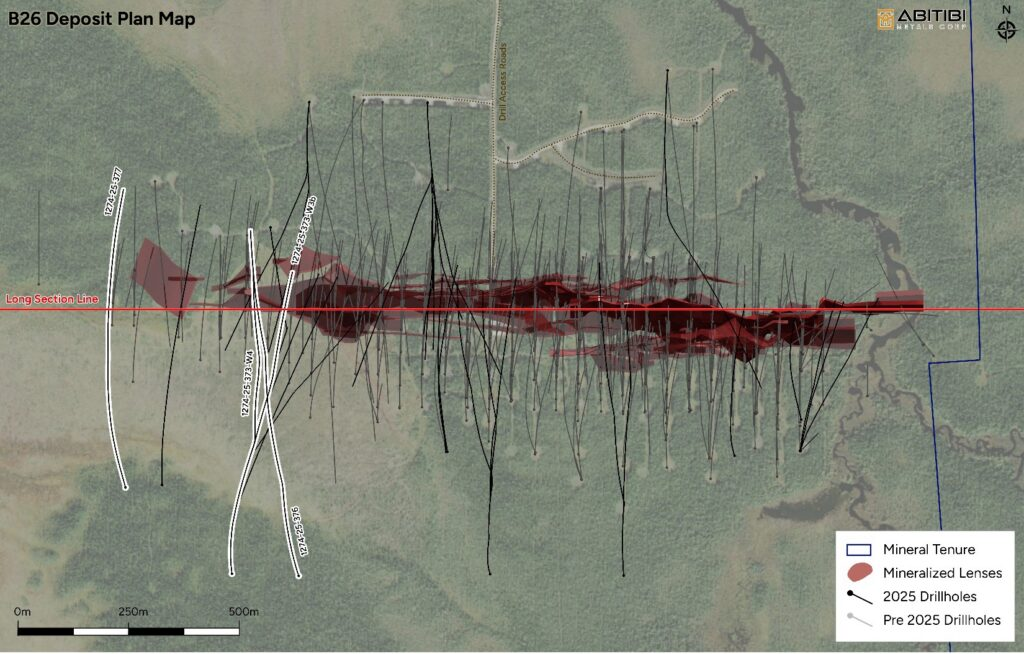
Geometry & Variability: Implications for Mining Complexity
This geometry reflects a laterally extensive mineral system with strike continuity of approximately 1,655 to 2,400 metres, supported by stacked polymetallic lenses and open mineralisation along strike. The scale and variability in widths from 3.0 to 89.5 metres indicate that future underground development will need to account for changes in geometry across the system.
The deposit also includes feeder copper, horizon zinc, and remobilised silver-zinc zones, which introduce distinct metallurgical and sequencing domains within the same system. Vertical variability further influences future development considerations. Shallow zones between 0 and 400 metres include wider intercepts such as 89.5 metres at 2.26% copper equivalent, while deeper intercepts beyond 800 metres include narrower but higher-grade intervals such as 6.3 metres at 17.91% copper equivalent and 21.1 metres at 4.46% copper equivalent. This distribution will inform sequencing and mine design assumptions.
Mining Method & Design Constraints
The current mineral resource estimate applies a cut-off grade based on an in-situ value of US$100 per tonne, specifically designed for underground mining. This indicates that the resource has been evaluated within an underground mining context, consistent with the depth and geometry of mineralisation observed at B26. Future technical studies will further refine underground development assumptions as additional geological and engineering data becomes available.
The variability in grade and width across B26 suggests that a combination of mining methods may be required within an underground framework. Selective stoping techniques may be evaluated in narrower high-grade zones, while wider zones may allow for more efficient bulk mining approaches. This indicates that variability in geometry and grade may require evaluation of different underground mining approaches in future evaluation work. Each additional mining method introduces design requirements that can increase upfront capital and extend development timelines.
Infrastructure & the Potential to Lower Capital Intensity
B26 benefits from established infrastructure, including a 120-kilovolt power line, substation, communication tower, and year-round road access. This reduces the need for major upfront investment, particularly in power generation and site access, which are often significant cost drivers in remote projects.
Its location within the Abitibi Greenstone Belt adds further advantage, providing access to a skilled workforce and nearby processing facilities in a well-established mining region. These factors reduce the need for new infrastructure by leveraging existing grid power and regional mining infrastructure
The company is also considering a hub-and-spoke model, where ore is transported to regional mills rather than processed on-site, potentially eliminating the need for a standalone plant. However, this approach introduces dependencies on third-party facilities and shifts some costs from upfront capital to ongoing transport and processing expenses, while also creating potential capacity constraints.
Metallurgy & Processing Considerations
B26 is a polymetallic Volcanogenic Massive Sulfide (VMS) deposit, and the in-situ value assumptions incorporate processing recoveries of 98.3% for copper, 96.1% for zinc, 90% for gold, 72.1% for silver, and 44% for lead.
These recovery rates suggest that the deposit has the potential to produce multiple payable metals, which reflects the polymetallic nature of the deposit. However, polymetallic deposits also introduce processing complexity. Lower recovery rates for certain metals, such as silver and lead, indicate that not all contained value will be realised. This reduces effective revenue per tonne and may require more complex processing circuits to optimise recovery.
The company has scheduled dedicated metallurgical testing as part of its 2026 technical program. These results will be critical in determining whether the assumed recoveries can be achieved in practice and whether additional processing steps are required. Metallurgical performance will determine the extent to which assumed recoveries can be achieved.
Development Pathway & Capital Timing
Abitibi Metals is fully funded through the first quarter of 2027 and is currently executing a 40,000 metre drill program targeting resource expansion. The development timeline includes an internal scoping study and a Preliminary Economic Assessment (PEA), followed by progression toward a feasibility study.
The PEA will provide the first formal estimate of capital expenditure (capex) and operating costs. Until that stage, visibility on project economics is based on indirect indicators derived from exploration results and broader deposit characteristics. Additional technical work, including environmental baseline studies, hydrogeological assessments, and mine optimisation studies, will feed into the PEA. Each of these components introduces potential cost variables that will refine the capital intensity profile.
The sequencing of these studies indicates that the project is transitioning from exploration to early-stage development planning. This transition typically marks a shift in investor focus from resource growth to economic viability.
Cost Signals from Drilling & Efficiency Metrics
The company reports drilling costs of C$250 to C$300 per metre and a discovery cost of C$0.025 per pound of copper equivalent since 2023. These figures indicate efficient exploration at the project level. Exploration efficiency reduces the cost of defining the resource, but development capital is driven by factors such as depth, geometry, and infrastructure.
The variability observed in drilling results introduces uncertainty in mine design. Consistent, wide zones can support simpler and lower-cost mining through simpler extraction methods, while variable zones require more selective approaches that increase cost. The current dataset suggests that B26 contains both types of mineralisation. The proportion of each will determine the degree of selectivity and development requirements in future underground mine design.
What to Watch Next
The next phase of development at B26 will provide more definitive data on capital intensity and economic viability. Key attention points include results from the ongoing 40,000 metre drill program, particularly any changes in width and grade consistency that could influence mine design, as well as upcoming metallurgical test work in 2026, which will validate or challenge current recovery assumptions. Progress toward the Preliminary Economic Assessment (PEA) will be especially important, as it will deliver the first formal estimate of capital and operating costs.
At the same time, developments related to infrastructure and potential mill agreements under a hub-and-spoke model will shape the project’s capital requirements and operating strategy, while environmental and hydrogeological studies will play a key role in determining permitting timelines and associated costs. Together, these milestones will clarify whether B26 can convert its expanding resource base into a financially viable mining operation.
FAQs (AI-generated)
The step-out drilling extends the western down-plunge zone by 150 metres, reinforcing continuity of mineralisation and expanding the potential resource footprint. It also shifts focus toward how the deposit may be developed rather than only how it grows.
B26 shows variable widths from 3.0 to 89.5 metres and multiple stacked lenses. This variability implies that selective underground mining will likely be required, increasing design complexity and influencing both capital and operating cost structure.
Deeper mineralisation, extending to approximately 1,450 metres, typically requires more complex underground access and sequencing. This influences mine design choices and can affect overall cost efficiency compared to shallower zones.
Existing infrastructure, including a 120 kilovolt power line, road access, and proximity to regional mills in the Abitibi Greenstone Belt, reduces the need for standalone site development and may lower upfront capital intensity.
Key catalysts include ongoing drilling, metallurgical testing in 2026, and the Preliminary Economic Assessment (PEA). These will define key inputs for capital expenditure, operating costs, and project viability.
Analyst's Notes





Subscribe to Our Channel




Stay Informed






















