




Why Mineral Point Is Where i-80 Gold's Mid-Tier Ambition Is Really Being Built


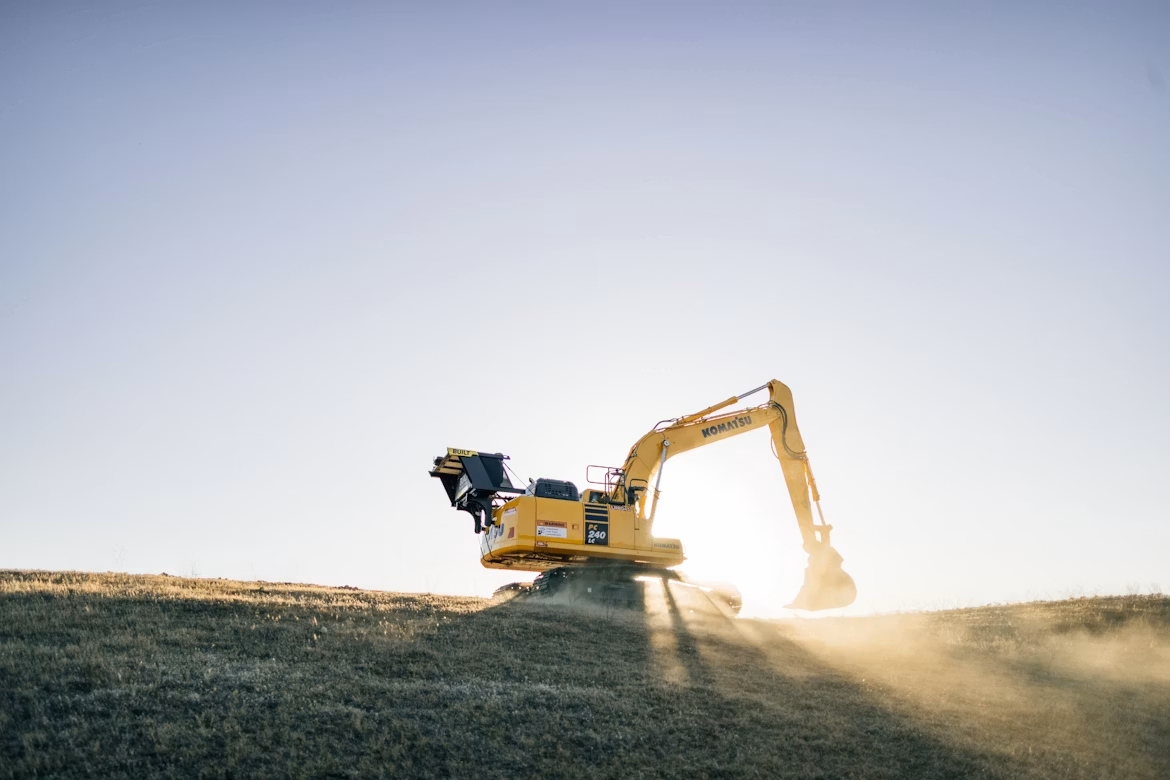
i-80 Gold’s Mineral Point could deliver 282k GEOs annually, with spot-price NPV reaching $2.3B as Franco-Nevada funding accelerates development.
- i-80 Gold's Mineral Point Open Pit holds an indicated resource of 3.4 million ounces of gold and 104.3 million ounces of silver, making it the company's largest oxide asset.
- A $250 million net smelter return royalty with Franco-Nevada US Corporation allocates $50 million in two tranches to Mineral Point Open Pit in 2026, funding resource expansion drilling and early-stage permitting work.
- A 131,000-metre drilling programme is underway in 2026 to convert inferred resources to indicated status ahead of a Pre-Feasibility Study (PFS) targeted for 2027.
- Current estimates place construction initiation at 2029 and first gold production at 2031, with earlier commencement of the Environmental Impact Statement (EIS) process potentially compressing that schedule by one to two years.
- At spot prices of $3,000 per ounce gold and $35.00 per ounce silver, Mineral Point Open Pit's after-tax net present value (NPV) reaches $2.3 billion, compared to a base-case figure of $614 million.
For years, Mineral Point Open Pit sat at the far end of i-80 Gold's (NYSE American: IAUX | TSX: IAU) three-phase development sequence, a project of acknowledged scale that the company's funding model was not designed to address until earlier phases generated sufficient cash flow. The closing of a $250 million royalty agreement with Franco-Nevada US Corporation has changed the sequencing terms. With $50 million now specifically allocated to Mineral Point Open Pit in 2026, the project has moved from a long-dated commitment to an asset with a funded technical programme and a defined milestone path.
Mineral Point's Resource Position
Mineral Point Open Pit is i-80 Gold's largest oxide project and holds the company's largest gold and silver mineral resources. The indicated resource stands at 216,982 thousand tonnes containing 3.4 million ounces of gold at 0.48 grams per tonne and 104.3 million ounces of silver at 15.0 grams per tonne. The inferred resource adds 194,442 thousand tonnes containing 2.1 million ounces of gold at 0.34 grams per tonne and 91.5 million ounces of silver at 14.6 grams per tonne. Both sit within a dominant land position in the Eureka Mining District.
Chief Operating Officer of i-80 Gold, Paul Chawrun, puts the resource scale into plain terms:
"Mineral Point is 3 million ounces measured and indicated already, and about 2 million ounces inferred."
Phase 3 Sequencing & Funding Logic
Mineral Point Open Pit is the third phase of i-80 Gold's development plan, which progresses through Granite Creek, Archimedes, and Cove underground operations, the Granite Creek Open P{it, and the refurbishment and commissioning of the Lone Tree Plant before reaching the construction stage of Mineral Point Open Pit. The company's funding structure is built around the expectation that Mineral Point's Open Pit capital requirements will be met by operating cash flows generated during Phase 1 and Phase 2, meaning earlier operations must reach production before Mineral Point's Open Pit build programme can be internally funded.
Both Mineral Point and Granite Creek open-pits require full Environmental Impact Statement (EIS) permitting and completed feasibility work before construction can begin, placing both assets several years from production.
Chawrun is precise on where the Mineral Point Open Pit sits in that timeline:
"Both of those need a full EIS permitting process and, as well, feasibility. So they're 3 to 4 years out and the numbers for that, which we released in the PEA about a year ago, are in the range of about 250,000 to 300,000 ounces per year out of Mineral Point."
The Franco-Nevada $50M Allocation
The $250 million net smelter return royalty with Franco-Nevada US Corporation carries a 1.5% rate for the life of the mine, stepping up to 3.0% in January 2031, with $225 million received at closing. The royalty structure allocates $50 million to the Mineral Point pen pPt in 2026, structured in two tranches: an initial $25 million disbursed at closing to advance the Pre-Feasibility Study (PFS) and permitting work, with a further $25 million available upon expenditure of the initial disbursement and satisfaction of specified project conditions.
The combined $50 million funds resource expansion and infill drilling, engineering, and early-stage pre-permitting activities at the project. Management noted that Franco-Nevada was eager to participate specifically because the capital enables significant drilling at Mineral Point Open Pit, an activity that had been constrained prior to the royalty financing.
The 131,000-Metre Campaign & PFS Pathway
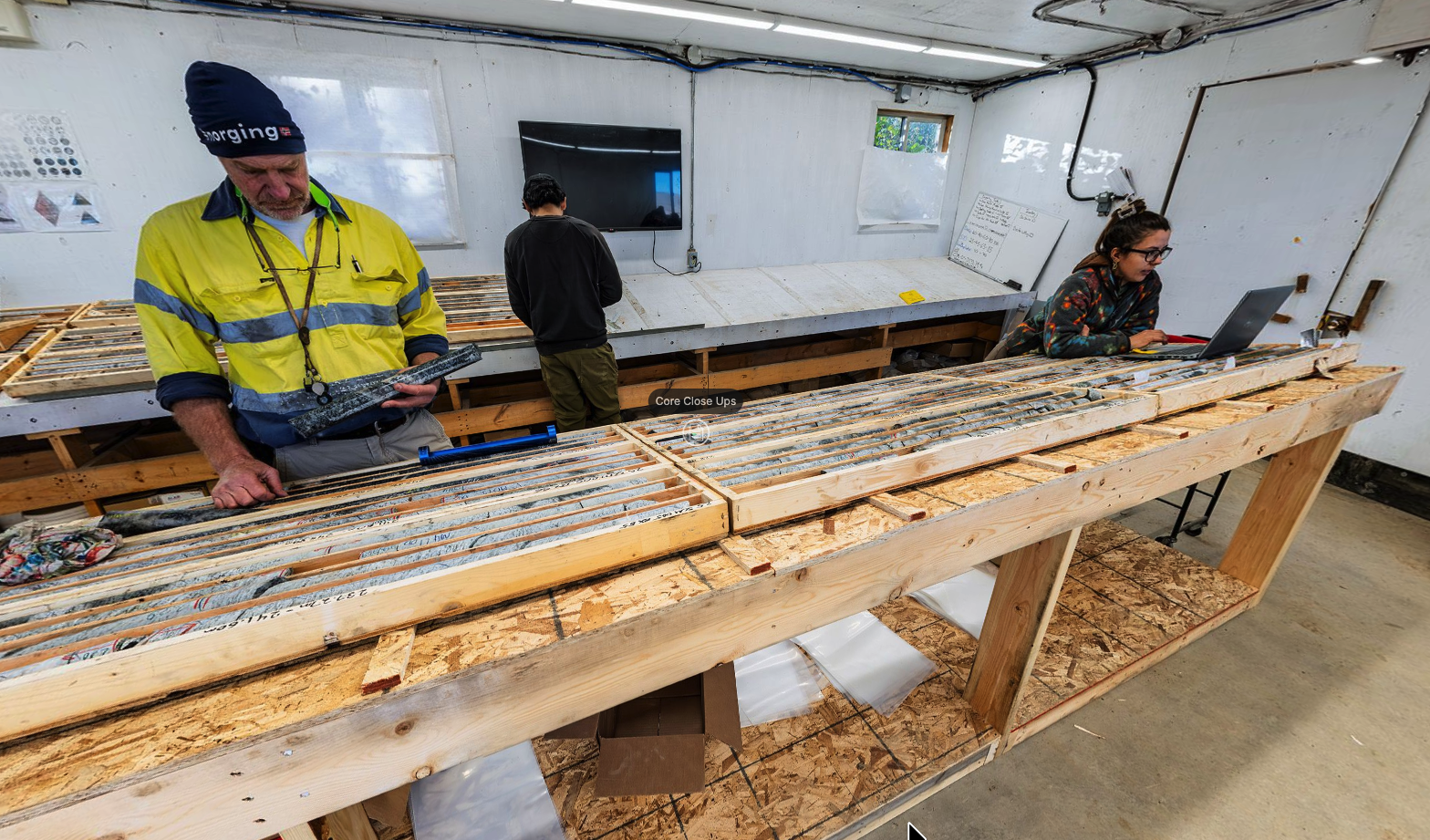
The 2026 technical programme at Mineral Point Open Pit centres on approximately 131,000 metres of drilling aimed at converting inferred resources to indicated status, which is the prerequisite for a PFS trade-off process covering hydrogeology, metallurgy, and an optimised mine plan. Two surface core drill rigs had completed 750 metres of surface core drilling by the end of the first quarter of 2026. Ongoing engineering work addresses large-scale open-pit mine design, dewatering requirements, and an on-site heap leach configuration.
A PFS is anticipated in 2027, though the timing is currently under review, with management targeting the early part of that year for delivery of the converted resource base. Current estimates place construction initiation at 2029 and first gold production at 2031.
Chawrun describes the effect of the capital raise on Mineral Point's Open Pit development path:
"This is part of what this capital raise provides for us, to do the drilling, get that done sooner, but to start the EIS process sooner, and that would allow us to accelerate the timeline for Mineral Point by anywhere from one to two years."
Economics at Spot Prices & the Mid-Tier Production Range
The preliminary economic assessment (PEA) for the Mineral Point Open P{it outlines a mine life of approximately 17 years and a construction capital cost of $708 million. Following ramp-up, average annual gold-equivalent production is projected at approximately 282,000 gold-equivalent ounces at an All-in Sustaining Cost of $1,400 per ounce. At a base case of $2,175 per ounce for gold and $27.25 per ounce for silver, the after-tax net present value at a 5% discount rate (NPV5%) is $614 million, with an internal rate of return (IRR) of 12%. At $2,900 per ounce gold and $32.75 per ounce silver, the after-tax NPV rises to $2,092 million with a 27% IRR. At spot prices of $3,000 per ounce of gold and $35.00 per ounce of silver, the figure reaches $2.3 billion with a 29% IRR.
Management states that adding Mineral Point Open Pit's projected output to the portfolio would bring annual production to a range of 400,000 to 600,000 ounces, consistent with the company's target of approximately 600,000 ounces of average annual gold output in the early 2030s. The project has the potential to become one of Nevada's largest open-pit truck-and-shovel mining operations and i-80 Gold's largest gold-producing asset.
Chawrun frames the significance of the capital raise directly, describing what it positions the company to achieve:
"Very much a mid-tier producer. The largest hurdle was for us to raise this capital."
FAQs (AI-Generated)
Analyst's Notes





Subscribe to Our Channel


Stay Informed






















