Abitibi VMS Clusters Point Copper-Gold Explorers Back to Under-Drilled Ground Near Past Mines


Abitibi VMS camps formed in clusters. Deeper drilling at B26 near Selbaie tests under-drilled ground as Canadian copper-gold deal activity picks up.
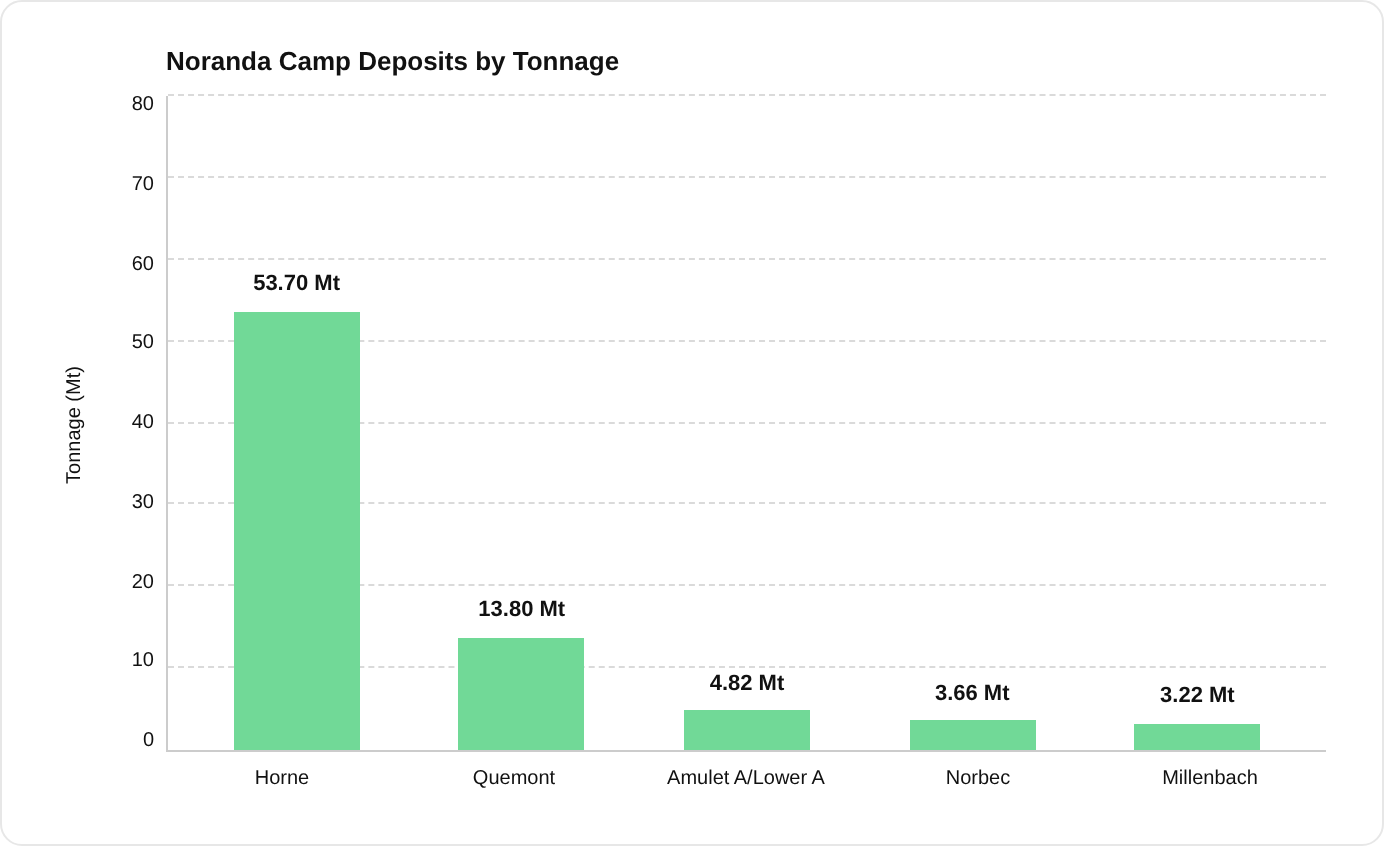
- Historical Abitibi volcanogenic massive sulfide (VMS) camps formed as clusters: 11 of the 14 Noranda deposits with published data were under 5 million tonnes, grouped around the roughly 54 million tonne Horne deposit.
- The Matagami camp repeats the pattern with a zinc-rich metal mix, hosting about 19 deposits and prospects and more than 60 million tonnes of historical VMS ore.
- Deeper drilling and earlier technical work are being applied at the B26 deposit near the former Selbaie mine, where mineralization is confirmed at about 1,417 meters.
- Canadian mining mergers and acquisitions rose 220% to C$62.1 billion in 2025, according to figures compiled by Abitibi Metals, including Eldorado Gold's C$3.8 billion merger with Foran Mining.
- Historical camp figures are not NI 43-101 compliant, and geological scale alone does not establish that a new deposit can support a profitable mine.
The volcanogenic massive sulfide (VMS) camps of Québec's Abitibi region were not built on single orebodies. In the Rouyn-Noranda camp, about 20 deposits and prospects formed around the Horne deposit, and 11 of the 14 with published tonnage and grade were under 5 million tonnes. If that clustering repeats across VMS districts, ground near past producers that was never fully drilled holds discovery potential that earlier programs left untested.
The question has a commercial side. Canadian mining mergers and acquisitions rose 220% year-over-year to C$62.1 billion in 2025, led by large-scale copper, gold and critical metals transactions, according to figures compiled by Abitibi Metals (CSE: AMQ | OTCQB: AMQFF | FSE: FW0). The copper-gold VMS transaction on that list is Eldorado Gold's C$3.8 billion merger with Foran Mining.
The company offers a current test case at B26, about 7 kilometers southeast of the former Selbaie mine, in a district where the company reports no significant exploration since 1997. B26 is one example of the pattern under test, not proof of it.
Industry Context
The Rouyn-Noranda camp is the reference case for Abitibi VMS geology. Over roughly 100 years of exploration and mining, it produced about 130 million tonnes of historical VMS ore, with Horne the largest deposit at about 54 million tonnes. Abitibi Metals has converted the published Noranda figures to copper equivalent using the same metal prices and recoveries as its B26 resource, including US$4.50 per pound copper, US$2,500 per ounce gold and 98.3% copper recovery. On that basis, Horne holds 3,656 kilotonnes of contained copper equivalent at 6.81% copper equivalent, followed by Quemont at 13.80 million tonnes and 873 kilotonnes.
The Matagami camp follows the same pattern with a different metal mix. Across more than 65 years of activity, it hosted about 19 deposits and prospects, 12 to 13 past-producing mines and more than 60 million tonnes of historical VMS ore, with the zinc-rich Matagami Lake deposit the largest at 25.6 million tonnes.
In both camps, the largest deposit was accompanied by many smaller ones, and President and Chief Executive Officer of Abitibi Metals, Jonathon Deluce, said the Québec government's interest in the district rested on VMS camps always occurring in clusters. At global scale, Kidd Creek falls in the giant class above 100 million tonnes on the company's VMS compilation, which draws on Galley et al. (2007). All historical figures come from published sources of varying vintage, are not NI 43-101 compliant and are not directly comparable to current mineral resources.
Emerging Practices & Industry Progress
Wedge drilling, which branches several holes off a single parent hole, is one way explorers in mature camps are testing VMS systems at depth. At B26, the 2026 program covers near-surface (0 to 400 meters), mid-level (400 to 800 meters) and deep step-out (below 800 meters) zones, with several holes drilled as wedges off parent holes. Drilling confirmed down-dip continuity at about 1,417 meters. Downhole magnetotelluric surveys are under way to test for a higher-grade source of the copper stringer mineralization, and the company plans a pilot hole testing a deep extension at potentially 1.5 kilometers vertical depth.
Deluce linked the deep program to the scale of Abitibi systems:
"In Abitibi, these are very deep-seated systems, and we think our ability to target this in a deeper hole will provide a look at the potential upside of this being a much larger system."
Technical de-risking can also start before an economic study. Metallurgical testwork, environmental baseline studies and hydrogeology take time to complete, and Deluce said partners such as Discovery Silver and other producers value that work when they assess where a deposit is in its life cycle and its pathway to production. Abitibi Metals runs these as parallel workstreams, with an internal scoping study initiated in the first quarter of 2026, environmental baseline and hydrogeology work started and the formal environmental baseline program scheduled to commence in 2027. On cost, the company reports a discovery cost of C$0.037 per pound of contained copper equivalent, defined as blended exploration spend since its 2023 option divided by contained copper equivalent added, and all-in drilling costs of C$250 to C$400 per meter. These are company-reported figures, not industry benchmarks.
Remaining Challenges
Historical camp data sets the geological case, but it cannot be used as a valuation input. Regional drill intercepts outside known deposits are exploration information and do not form part of any mineral resource.
Tonnage establishes scale, not mine economics. A 25.3 million tonne resource says nothing on its own about capital requirements, operating costs or margins, which only an economic study can test. At B26, 12.96 million tonnes are Indicated at 2.08% copper equivalent and 12.34 million tonnes are Inferred at 2.20% copper equivalent, mineral resources are not mineral reserves, and the preliminary economic assessment (PEA) is targeted for 2027. Inferred tonnage may not be upgraded.
Depth brings a capital trade-off. Deluce described the deep step-out at B26 as a hole to demonstrate longer mine-life potential, with drilling then returning to mid-level and shallower targets that offer a better return on capital. Field programs in the region are also exposed to seasonal interruption: drilling at B26 was suspended during the 2026 wildfire season before resuming with up to 3 rigs.
Company & Project Examples
Foran Mining shows the path from VMS developer to acquisition. Dave Bernier, now Chief Operating Officer at Abitibi Metals, led the team that permitted Foran's McIlvenna Bay in 18 months from scratch, and Deluce described Foran's sale as a liquidity event that came with the project close to production. McIlvenna Bay holds 38.6 million tonnes Measured and Indicated at 2.04% copper equivalent and 4.5 million tonnes Inferred at 1.73% copper equivalent, according to Abitibi Metals' peer table. The company says B26 shares the high-grade, copper-dominant VMS profile that made McIlvenna Bay a C$3.8 billion acquisition target.
FireFly Metals and Abitibi Metals are at different stages of the same path. FireFly's Green Bay Copper Gold project, classed as a development project, holds 60.2 million tonnes Measured and Indicated at 2.41% copper equivalent, while B26 is at the exploration stage. On spot-price copper equivalent calculated before recoveries, the market valued Foran at C$1.64 per pound of contained copper equivalent at its last full trading session on April 15, 2026, against C$0.32 for FireFly and C$0.13 for Abitibi Metals on October 6, 2026. Those figures compare companies at different stages of permitting, study work and resource confidence.
Discovery Silver is the producer example. It acquired the Kidd Creek complex, which Deluce described as potential smelting capacity, and holds a 9.9% strategic stake in Abitibi Metals. The stake is an equity position, and B26 has no completed study defining a processing route. Initial B26 testwork returned 98.2% copper recovery from what the company describes as clean, simple mineralogy.
Deluce tied that testwork to concentrate quality:
"We just delivered preliminary metallurgica results: it had 98% recovery on copper, because of it being basically purely chalcopyrite, with the ability to produce a concentrate between 22 to 30% copper, which is very premium and will be very sought-after in this market."
Regional & Jurisdictional Perspective
The B26-Selbaie corridor in James Bay, Québec, is earlier in its cycle than Noranda or Matagami. The former Selbaie mine produced 56.9 million tonnes, according to Abitibi Metals' camp comparison, before operations were suspended in 2004. SOQUEM, a Québec government subsidiary, explored B26 for 25 years before optioning it to Abitibi Metals in November 2023. Abitibi Metals reports a combined corridor endowment of about 82 million tonnes, which adds Selbaie's historical production to B26's current resource and is not a single mineral resource.
The evidence for further discoveries is early-stage. SOQUEM has redirected its budget to adjacent ground, reporting 263.2 meters at 1.3% copper equivalent, including 39.7 meters at 4.0% copper equivalent, on Wagosic, in results dated September 15, 2026 and compiled by Abitibi Metals on a spot-price copper equivalent basis. Abitibi Metals holds a 10-year right of first refusal over Wagosic and Carheil, and a regional hole it drilled about 1.5 kilometers west of B26 returned 14.25 meters of 1.13% zinc and 52 grams per tonne silver.
Deluce pointed to the proximity of these targets:
"This isn't upside 100 kilometers away; this is within a 12 kilometer circumference, which shows us potentially the ability to build really a district."
Infrastructure is the jurisdictional argument. The B26 site has existing mill, road and 120 kV power infrastructure, and Abitibi Metals describes the Abitibi greenstone belt as suited to a hub-and-spoke model feeding existing and planned mills. The company cites Québec transactions, including Agnico Eagle's acquisition of O3 Mining for about C$200 million, as evidence that buyers prioritize high-grade deposits, existing infrastructure and a stable jurisdiction.
Industry Outlook
Copper prices change how much tonnage a deposit can report. Copper rose from about US$3.74 per pound on November 20, 2023 to about US$6.55 per pound at the October 5, 2026 close, against the US$4.50 used in the B26 resource. Abitibi Metals presents cut-off sensitivity as its measure of price leverage: at a 20% lower cut-off, B26's Indicated tonnage rises to 15.73 million tonnes at 1.88% copper equivalent and Inferred to 14.50 million tonnes at 2.01% copper equivalent. Deluce views projections of US$10 copper as realistic, which is his own outlook and not a consensus forecast.
The clustering argument will be tested through new systems found near known deposits, mineralization confirmed at depth and economic studies showing that the new tonnage can be mined profitably. In the B26-Selbaie corridor, Abitibi Metals is targeting 30 to 35 million tonnes in its next resource update, funded drilling of 40,000 meters in 2027, regional follow-up drilling west of B26 and a Selbaie extension target in the first quarter of 2027, and a PEA in 2027.
Results across more than one camp would show whether historical VMS districts can supply acquisition-scale copper-gold tonnage close to existing infrastructure. The clustering pattern tells explorers where to look; economic studies will decide what any new deposit is worth.
FAQs (AI-Generated)
Analyst's Notes





Subscribe to Our Channel




Stay Informed