




Abitibi's B26 Drilling Now Runs on 2 Tracks: Resource Conversion & Down-Plunge Growth


Abitibi Metals drills B26 on 2 tracks: copper-gold resource conversion and Western Down-Plunge expansion ahead of a resource update and PEA.
- Abitibi Metals is drilling its B26 copper-gold deposit in Québec on 2 parallel tracks, with up to 3 rigs split between definition drilling inside the resource and expansion drilling at its margins.
- The 2026 resource totals 12.96 million tonnes Indicated at 2.08% copper equivalent and 12.34 million tonnes Inferred at 2.20% copper equivalent, after Inferred tonnage rose from 7.2 million tonnes in the 2024 estimate.
- Definition holes in the Western Down-Plunge (WDP) corridor linked higher-grade areas and added continuity, including 1.45% copper equivalent over 14.1 meters from 985.3 meters.
- Expansion holes extended the WDP footprint by 0.66% copper equivalent over 40 meters, traced the system eastward, and confirmed down-dip continuity at a depth of approximately 1,417 meters.
- About C$44 million in cash funds up to 80,000 meters of drilling across 2026 and 2027, with the company's 2026 plan pairing a resource update with the start of a preliminary economic assessment (PEA).
B26 Drilling Has Split Into Conversion & Expansion Programs
Abitibi Metals (CSE: AMQ | OTCQB: AMQFF | FSE: FW0) holds 100% of the B26 polymetallic deposit, 7 kilometers southeast of the former Selbaie Mine in Québec's Abitibi Greenstone Belt. The 2026 mineral resource estimate (MRE), effective January 1, 2026, totals 12.96 million tonnes Indicated at 2.08% copper equivalent and 12.34 million tonnes Inferred at 2.20% copper equivalent. Drilling on the deposit now has 2 distinct objectives against that base: raising confidence in the tonnage already within the resource, and testing whether mineralization continues beyond its current limits.
The September 2026 assay batch contains holes from both programs. Holes the company describes in terms of definition and continuity were tested in target areas within the Western Down-Plunge (WDP) corridor, including under-drilled ground at its upper limit. A second set of holes was drilled to the western, eastern, and down-dip margins of the system, and the company describes them as extending the footprint. Sorting the results by program gives a clearer read on what the next resource update will have to work with than sorting them by grade.
Chief Executive Officer of Abitibi Metals, Jonathon Deluce, described how the rigs are being allocated for the balance of the year:
"With up to three drill rigs on site for the remainder of 2026, we are simultaneously advancing on definition and resource conversion drilling as well as further expanding the limits of the B26 system, that remain open."
Why the Conversion Pool Has Grown With the Resource
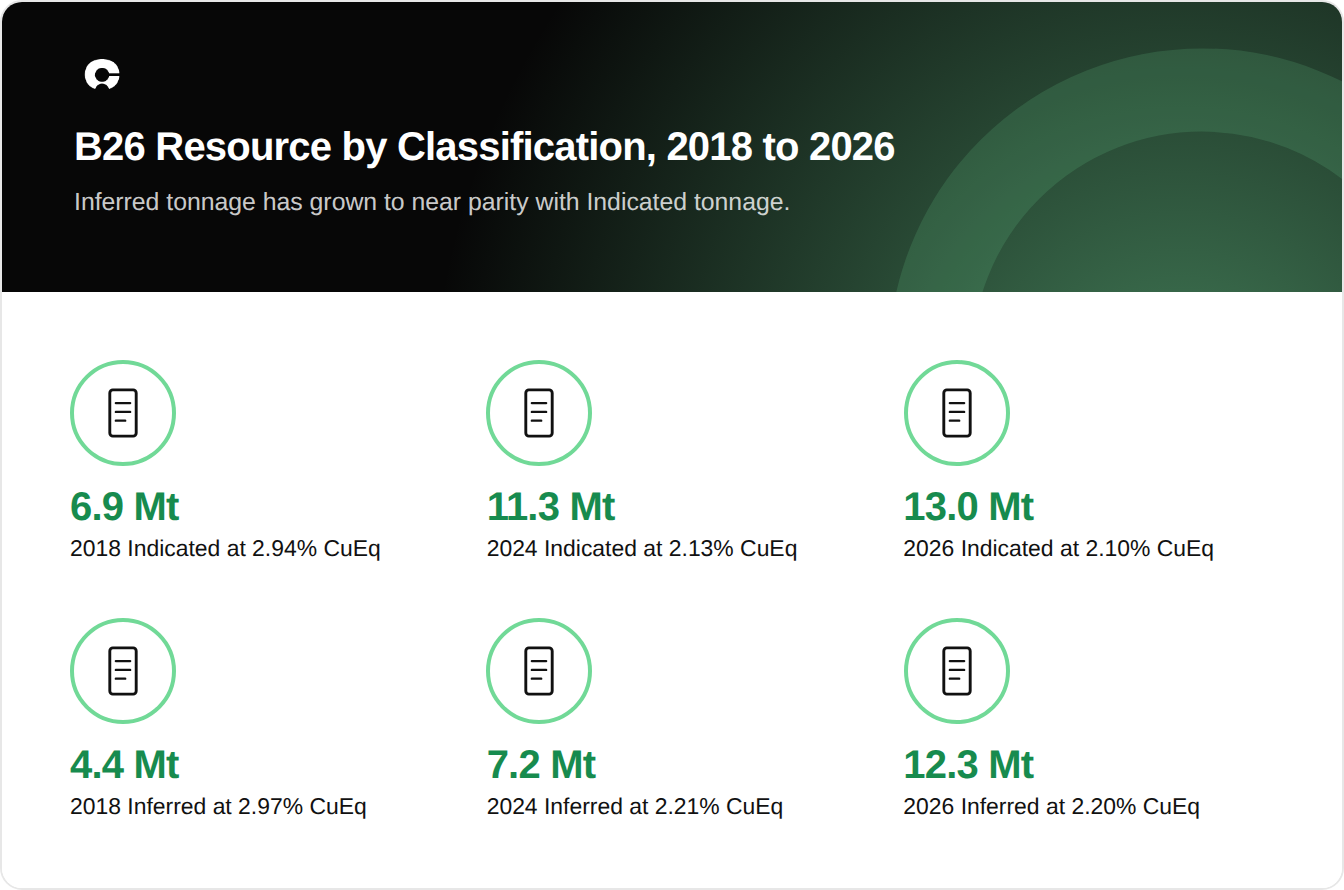
B26's resource growth can be tracked across 3 estimates. The 2018 estimate, completed before Abitibi's involvement, reported 6.9 million tonnes Indicated at 2.94% copper equivalent and 4.4 million tonnes Inferred at 2.97% copper equivalent. The 2024 estimate reported 11.3 million tonnes Indicated at 2.13% copper equivalent and 7.2 million tonnes Inferred at 2.21% copper equivalent. The 2026 estimate added 6.7 million tonnes, bringing the total to 13.0 million tonnes Indicated and 12.3 million tonnes Inferred. Between the last 2 estimates, Inferred tonnage increased from 7.2 million tonnes to 12.3 million tonnes, while Indicated tonnage increased from 11.3 million tonnes to 13.0 million tonnes. The 2 categories are now close to parity.
The Inferred tonnage is concentrated in a single zone. Of the 12.34 million tonnes Inferred, 11.82 million tonnes sit in the Feeder Cu zone at 1.67% copper, 0.70 grams per tonne gold, and 2.23% copper equivalent. The same zone holds 9.29 million tonnes of Indicated material at 2.10% copper equivalent. The zinc- and silver-rich Horizon Zn and Remob Ag-Zn zones are mostly Indicated, at 3.27 million tonnes and 0.40 million tonnes, respectively, against 0.34 million tonnes and 0.18 million tonnes Inferred. Conversion work at B26 is therefore mainly a copper-gold exercise.
The company's development timeline schedules resource conversion drilling through the end of 2026, with a preliminary economic assessment (PEA) starting in the fourth quarter of 2026. The share of Feeder Cu tonnage that moves from Inferred to Indicated at the next update will determine the confidence profile of the resource base on which the PEA is built.
Definition Drilling Links Grade Inside the WDP Corridor
Intercept grades in this batch use 2026 copper-equivalent assumptions of US$4.50 per pound of copper, US$1.50 per pound of zinc, US$28.00 per ounce of silver, and US$3,000 per ounce of gold. The resource uses US$1.35 per pound of zinc, US$30 per ounce of silver, and US$2,500 per ounce of gold, so the 2 sets of grades are not directly comparable. The first definition hole targeted an under-drilled area of about 210 meters by 215 meters at the upper limit of the WDP. It returned 0.9% copper equivalent over 7.2 meters from 921.2 meters, plus 1.1% copper equivalent over 2.5 meters. The company reports that the hole intersected economically significant mineralization that helps link higher-grade areas in the resource, and follow-up holes are being planned.
A second hole targeted an area of approximately 130 meters by 320 meters. It returned 1.45% copper equivalent over 14.1 meters from 985.3 meters, including 2.21% copper equivalent over 5.9 meters. The hole adds continuity to the mineralized footprint. It also groups this hole with the footprint-extending hole described in the next section as holes that intersected and expanded the WDP, so this hole contributes to both programs.
Outside the WDP, a hole on the eastern side of the deposit was drilled as part of what the company groups as its mid-level expansion drilling. The hole plots inside the 2026 resource boundary on the company's long section. It returned 1.25% copper equivalent over 60.2 meters from 548.8 meters downhole, including 3.72% copper equivalent over 9.2 meters. Its estimated true width of 52.1 meters is the widest true-width figure in the batch. The company reports the grades came in materially higher than anticipated.
Expansion Drilling Tests the Western, Eastern & Down-Dip Margins
The down-plunge holes provide the clearest evidence of expansion. A hole drilled as a continuation of a parent hole, terminated for technical reasons, extended the mineralized footprint of the WDP as planned. It returned 0.66% copper equivalent over 40 meters from 966 meters, including 1.65% copper equivalent over 7.6 meters. The company drilled 2 wedge holes from the first definition hole to explore the down-plunge extension. The first wedge cut 41.1 grams per tonne silver and 1.0% zinc over 20.6 meters, including 69.9 grams per tonne silver and 1.7% zinc over 11.1 meters, plus a separate gold-copper interval of 0.68% copper equivalent over 5.5 meters. The second wedge returned narrow veins of 9.54% copper equivalent over 0.5 meters and 4.32% copper equivalent over 1.8 meters.
To the west, a hole testing the upper western extension of the WDP intersected 7.0 meters of 0.32% copper equivalent together with the characteristic B26-style alteration. The company interprets the higher-grade portion of the corridor as lying further west or at greater depth and treats it as a defined target for future drilling. A further 2 holes tested a lower-grade, under-drilled target west of the deposit, returning 0.50% copper equivalent over 3.3 meters and 1.05% copper equivalent over 2.0 meters in a zinc-rich zone.
The remaining step-outs tested the eastern and deep margins. An eastern step-out returned 1.1% copper equivalent over 3.5 meters and extends the known system eastward. A deep step-out returned 2.5% copper equivalent over 2.0 meters and confirmed down-dip continuity at approximately 1,417 meters. The company's long section shows a deposit roughly 1,850 meters long and 1,450 meters deep, and its 2026 drilling strategy marks the system as open to the west, east, and at depth. The company states that these results increase resource confidence within the WDP while supporting additional resource growth potential along this priority expansion corridor.
Funding & Sequencing Ahead of the PEA
Abitibi reported a cash balance of about C$44 million as of July 27, 2026 following a C$31 million private placement in which Discovery Silver acquired a 9.9% interest. The company describes itself as fully funded for up to 80,000 meters of drilling across 2026 and 2027, at a drilling cost of C$250 to C$300 per meter. It reports a discovery cost of C$0.025 per pound of copper equivalent since 2023. Around 240 million shares are outstanding, with a warrant overhang of 0.6 million.
The development timeline sequences the 2 drilling programs into study work. Resource conversion is scheduled to finish by the end of 2026, while resource expansion continues into the first quarter of 2027. Additional metallurgical testing is scheduled for the second and third quarters of 2026, and technical studies extend through the first quarter of 2027. The PEA spans the fourth quarter of 2026 and the first quarter of 2027; an environmental baseline program begins in the first quarter of 2027, and a feasibility study (FS) is scheduled to start in the third quarter of 2027. Ownership was consolidated to 100% through an agreement with SOQUEM announced June 11, 2026, and SOQUEM retains a 1% net smelter return royalty.
The management team includes Chief Operating Officer Dave Bernier and Vice President of Exploration Louis Gariépy. Bernier was formerly Chief Operating Officer of Foran Mining, where he brought the McIlvenna Bay project to construction. Deluce linked the current drilling directly to the next estimate:
"These results as well as results from our ongoing program will be incorporated into a future resource update for the B26 Deposit, improving and derisking it as a foundation for long-term value creation."
How the Company Prices the Current Base Against Peers
Abitibi's own peer comparison uses spot metal prices as of July 27, 2026. It places Abitibi's in-situ value at C$11.5 billion and its enterprise value at C$136 million, equal to 1.2% of in-situ value, or C$0.10 per pound of copper equivalent. Foran Mining's McIlvenna Bay is shown at an enterprise value of C$2,944 million, 17% of in-situ value, and C$1.46 per pound, with Foran's figures taken as of April 15, 2026, its last full trading session before delisting. Green Bay is shown at an enterprise value of C$1,110 million, equal to 3.1% of in-situ value. B26's 25.3 million tonnes grade 2.3% copper equivalent at spot, against 2.0% at McIlvenna Bay's 43.1 million tonnes and 2.2% at Green Bay's 79.7 million tonnes.
Both peers are classified as development-stage projects, while B26 is classified as an exploration-stage project. Expansion drilling addresses the tonnage gap to larger peers, while conversion drilling and the PEA address the stage gap.
The Investment Thesis for Abitibi Metals
- Abitibi Metals is conducting definition and expansion drilling at B26 simultaneously, with up to 3 rigs on site for the remainder of 2026.
- The 2026 mineral resource estimate contains 12.96 million tonnes Indicated at 2.08% copper equivalent and 12.34 million tonnes Inferred at 2.20% copper equivalent, and most of the Inferred tonnage is in the copper-gold Feeder Cu zone.
- Definition holes in the Western Down-Plunge corridor linked higher-grade areas and added continuity, including 1.45% copper equivalent over 14.1 meters from 985.3 meters.
- Expansion holes extended the Western Down-Plunge footprint, traced the system eastward, and confirmed down-dip continuity at approximately 1,417 meters depth, and the company describes the system as open to the west, east, and at depth.
- The company holds about C$44 million in cash and is fully funded for up to 80,000 meters of drilling across 2026 and 2027, with a resource update and a preliminary economic assessment on its timeline.
- In the company's own comparison, its enterprise value equals 1.2% of in-situ resource value, compared with 3.1% and 17% for 2 development-stage North American peers.
The September drilling results show the B26 program working on resource confidence and resource size in parallel. How much Feeder Cu tonnage converts to Indicated, and how much new tonnage the margin holes add, will define the resource base on which the preliminary economic assessment is built.
TL;DR
Abitibi Metals is drilling B26 on 2 tracks. Definition holes in the WDP corridor linked higher-grade areas and added continuity inside a resource of 12.96 million tonnes Indicated and 12.34 million tonnes Inferred. Expansion holes extended the WDP footprint and confirmed continuity to the east and down-dip at approximately 1,417 meters. With about C$44 million in cash and up to 80,000 meters funded, the results feed a resource update that the company pairs with the start of a PEA.
FAQs (AI-Generated)
Analyst's Notes





Subscribe to Our Channel

Stay Informed


