




TRX Gold's Expansion Targets Lower Processing Costs From US$25.66 Per Ton


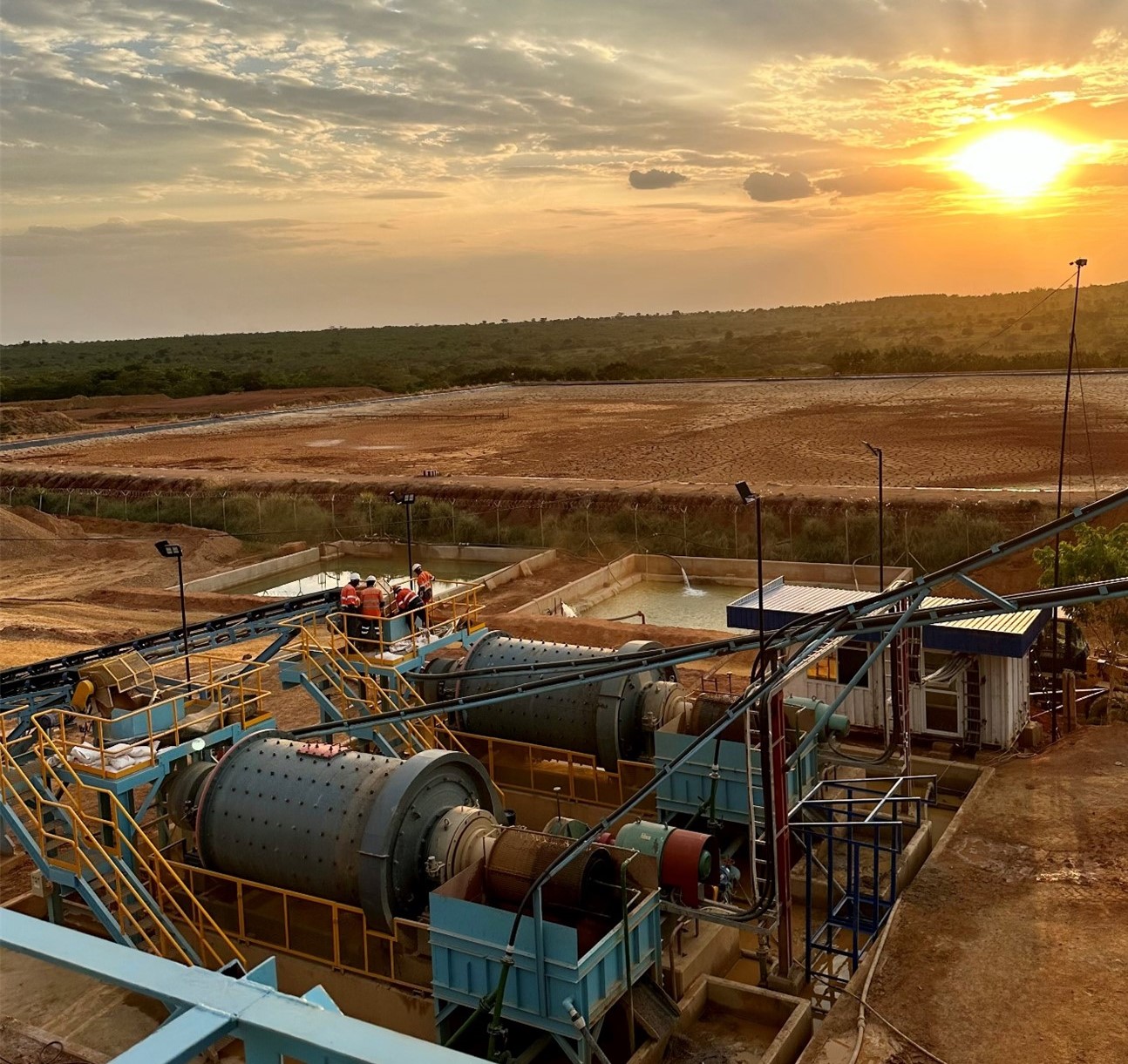
TRX Gold targets lower processing costs at its Buckreef gold mine from US$25.66 per ton as a 5,500 tons per day expansion advances toward an updated study.
- TRX Gold's processing cost reached US$25.66 per ton of ore in the three months ended May 31, 2026, up from US$14.60 a year earlier, while mining cost fell to US$3.02 per ton of rock from US$3.63.
- Cash cost per ounce fell to US$1,648 from US$1,819, against full-year guidance of US$1,400 to US$1,600 per ounce.
- A realized gold price of US$4,703 per ounce, up 51%, and production of 7,426 ounces, up 58%, lifted revenue to US$32.8 million from US$12.5 million.
- Management is targeting lower per-ton costs from an upgraded crushing circuit and from scale, with a new 3,500 tons per day (tpd) mill circuit to run alongside the upgraded 2,000 tpd plant.
- The updated preliminary economic assessment, targeted for the fourth quarter of 2026 with a possible move into early 2027, will test that cost target against the 2025 study's US$1,017 life-of-mine cash cost per ounce.
TRX Gold Corporation (TSX: TRX | NYSE American: TRX) reported record adjusted earnings before interest, taxes, depreciation, and amortization of US$20.7 million and record net income of US$8.4 million for the three months ended May 31, 2026. Processing cost over the same period was US$25.66 per ton of ore, against US$14.60 a year earlier. The Buckreef Gold Project in Tanzania is adding a new 3,500 tons per day (tpd) mill circuit next to its upgraded 2,000 tpd plant, and the per-ton economics of that expansion depend on how far scale lowers the processing figure.
A Record Quarter Built on Volume & Price
The quarter produced 7,426 ounces of gold, up 58% from 4,687 ounces, at an average realized price of US$4,703 per ounce, up 51% from US$3,114. Revenue reached US$32.8 million against US$12.5 million, and gross profit was US$19.5 million at a 59% margin. Plant throughput hit a record 1,690 tpd, up 16% from 1,461 tpd a year earlier, and gold recovery improved to 84.9% from 67%.
Unit costs moved unevenly. Mining cost fell to US$3.02 per ton of rock from US$3.63, and cash cost per ounce fell to US$1,648 from US$1,819. The quarterly cash cost compares with full-year guidance of US$1,400 to US$1,600 per ounce, which management reaffirmed. Processing cost rose to US$25.66 per ton of ore from US$14.60. Management is targeting a lower processing cost per ton over time and cites heavy reagent use in the existing plant, which is being upgraded.
Processing Cost Has Ranged From US$11.22 to US$23.86 Per Ton
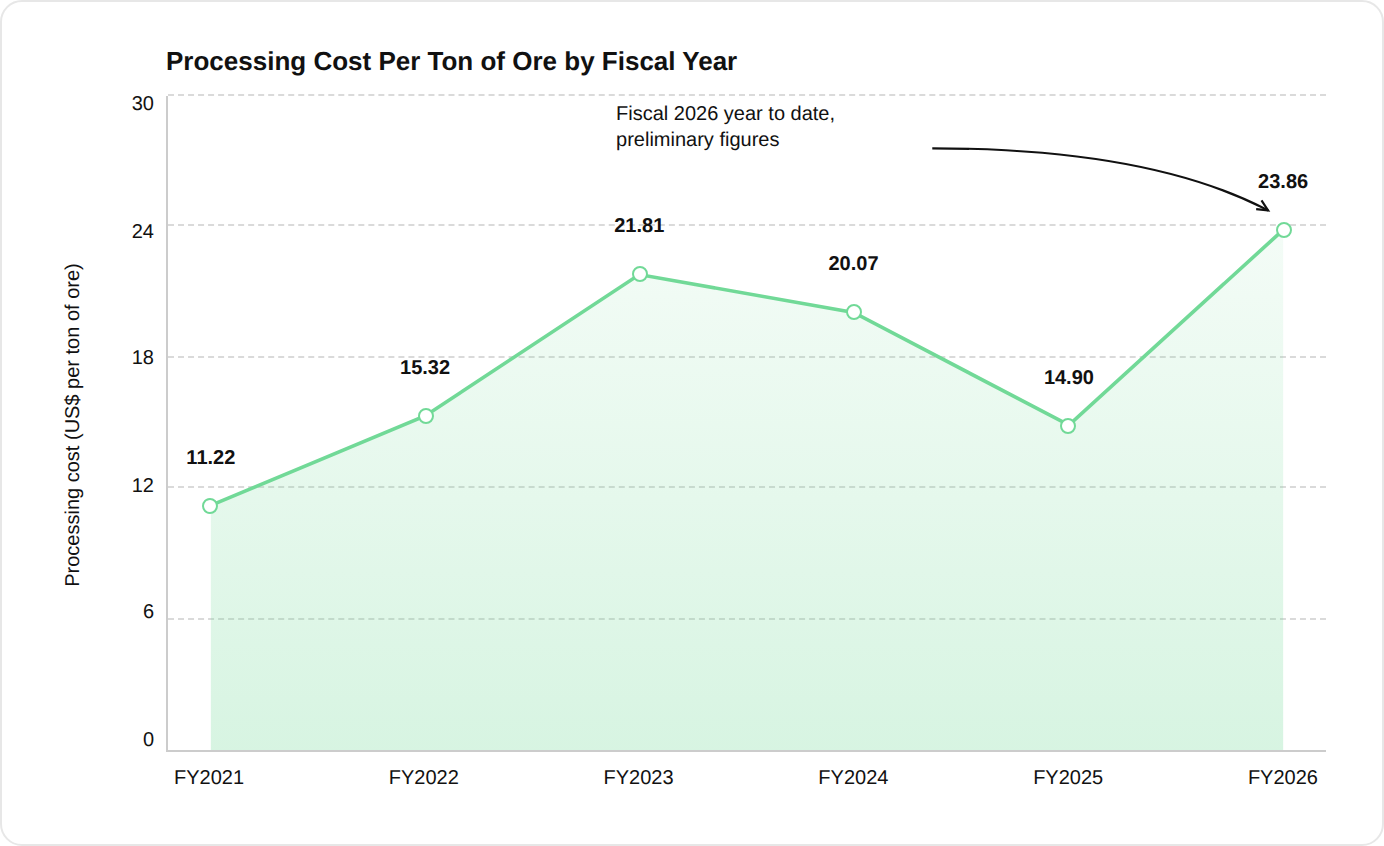
Fiscal year ends August 31. Processing cost per ton of ore was US$11.22 in fiscal 2021, US$15.32 in fiscal 2022, US$21.81 in fiscal 2023, US$20.07 in fiscal 2024, and US$14.90 in fiscal 2025. Fiscal 2026 year-to-date shows US$23.86 on preliminary figures. Mining cost per ton of rock rose from US$2.22 to US$3.94 over the same span, and average head grade moved from 2.22 grams per tonne (g/t) of gold to 1.93 g/t, with a low of 1.53 g/t in fiscal 2025.
The plant grew from a 120 tpd test plant in the first half of 2021 to 2,000 tpd in the second half of 2024. The last expansion took it from 1,000 tpd to 2,000 tpd, and the fourth adds a new 3,500 tpd circuit alongside the existing plant.
Where Management Is Targeting Lower Costs
Chief Executive Officer of TRX Gold, Stephen Mullowney, described how grade changes the cost of an ounce and which measure he tracks:
"What I try to do is maintain the cost profile per ounce. The grade profile will fluctuate over time, so you'll get more expensive ounces at lower grade profile and cheaper ounces at the higher grade profile. So you have to look at your per-ton metrics on cost."
Upgrades under way at the existing plant include a pre-leach thickener, upgraded agitators and a new tertiary crusher, in various stages of completion. Mullowney named the upgraded crushing circuit and scale as sources of lower cost per ton:
"We just upgraded the crushing circuit again. That will have an impact on processing costs per ton. Our mining costs will come down with scale as well, per ton."
Mullowney targets cash costs on the larger plant similar to the 2025 preliminary economic assessment (PEA). In the 2025 PEA, life-of-mine average cash cost is US$1,017 per ounce and all-in sustaining cost is US$1,199 per ounce at 3,000 tpd. The latest quarter's cash cost was US$1,648 per ounce, and the two figures cover different periods and plant sizes.
The 2025 Study Puts a Price on Cost Changes
The PEA tests operating cost changes of 10% and 25% in both directions. At its consensus base case, where gold prices average US$2,296 per ounce, pre-tax net present value at a 5% discount rate (NPV5%) is US$701.0 million. A 25% cut in operating costs lifts that to US$858.9 million, and a 25% increase lowers it to US$543.2 million.
At US$3,000 gold, the same 25% swings put NPV5% between US$1,022.6 million and US$1,338.3 million, against US$1,180.5 million at unchanged costs. The headline NPV5% of US$1,878.5 million uses US$4,000 gold. The updated study, now in progress, is targeting 5,500 tpd nameplate capacity and a longer open pit phase.
What the Updated Study & November Results Will Show
The updated PEA is targeted for the fourth quarter of 2026, with a possible move into early 2027 while new drill results are incorporated. Mullowney has said mining rates will set the initial processing rate, and that, as currently configured, the operation will not reach 5,500 tpd. Other deposits on the property would supplement mine feed. The scale benefit management cites therefore applies to a plant that initially runs at the rate the mine can supply.
TRX Gold is scheduled to report fourth-quarter and full-year results, along with its financial statements and management's discussion and analysis, in November 2026. The cost target can be checked against processing cost per ton, cash cost per ounce, and the updated PEA's cash cost figure.
FAQs (AI-Generated)
Analyst's Notes





Subscribe to Our Channel


%20(1)%20(1).jpg)
.jpg)
Stay Informed






















