




Atlas Salt Lines Up C$300M+ Lender Interest as Road Salt Tenders Nearly Double


Atlas Salt's CEO on road salt tenders nearing double last year's price, its Meridian model and C$300M+ in lender interest for the Great Atlantic Salt Project.
- Recent US road salt tenders have drawn bids of US$155 to US$160 per ton, and West Virginia has authorised purchases of up to US$175, against roughly US$88 per ton a year earlier. CEO Nolan Peterson attributes the jump to depleted inventories, capacity-constrained mines and rising import costs.
- Atlas Salt holds non-binding financing letters of interest (LOIs) exceeding C$300 million, including up to C$150 million from Export Development Canada (EDC). Peterson says these represent more than half of the C$589 million initial capital expenditure (capex) for the Great Atlantic Salt Project.
- The company's in-house Meridian model maps North American salt demand and the least-cost supply route for each buyer. Peterson said an unconstrained run shows profitable demand for up to 6.5 million tonnes, although this has not been studied at feasibility level.
- Early construction is under way, and Peterson identified drift development as the main risk. He estimated a 10% slower advance rate could add $10 million to $20 million in cost.
- The 2025 Updated Feasibility Study (UFS) outlines a C$920 million after-tax NPV8 and 21.3% after-tax IRR, compared with an enterprise value of C$174.7 million as of 14 September 2026.
North America's road salt market has long been one of the quietest corners of the resource sector. Prices have typically climbed around 2-4% a year through annual municipal tenders with few surprises, but the pattern is now breaking down. In parts of the US, including Ohio and West Virginia, recent tenders have drawn no bids at all. Those that cleared did so at close to double the previous year's price.
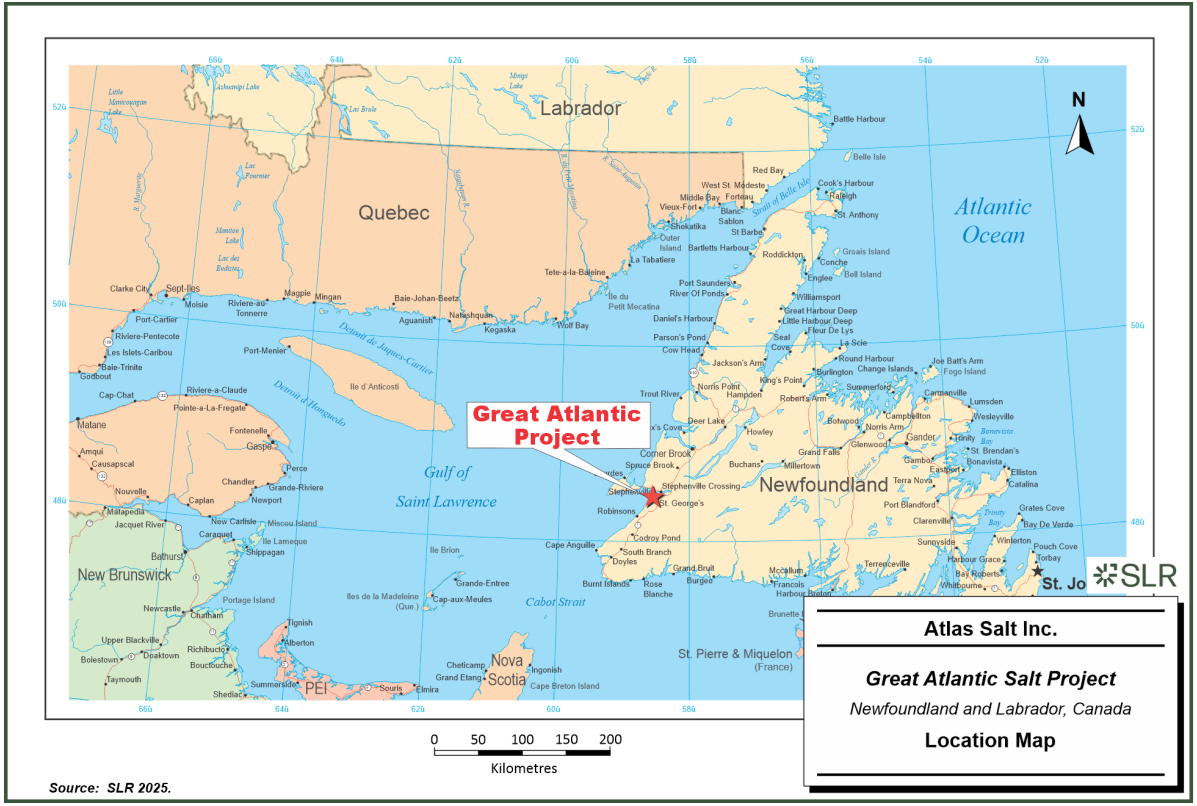
Atlas Salt Inc. (TSXV:SALT) is developing the Great Atlantic Salt Project on the west coast of Newfoundland, which the company describes as North America's first new salt mine in nearly three decades. Chief Executive Officer Nolan Peterson explained how three factors are shaping the project's path to construction finance: the shift in pricing power, a proprietary distribution model, and more than C$300 million in non-binding financing letters of interest (LOIs).
From a Buyers' to a Sellers' Market
Peterson describes the de-icing salt market as an aggregation of thousands of separate contracts rather than a single quoted price. Cities, counties, states and provinces across the US Northeast, the Midwest, Ontario, Quebec and Atlantic Canada typically issue tenders in spring and summer. Suppliers then bid on one-year terms, and the winning price holds for the season.
Peterson described jurisdictions that paid US$83-88 per ton in recent years. This time they received no bids, and after relaxing their criteria they accepted a single bid of around US$165 per ton. In Pennsylvania, a low bid through the South Hills Area Council of Governments came in at US$160 per ton against US$88 per ton a year earlier. West Virginia resolutions now authorise purchases of up to US$175 per ton, compared with US$88.38 per ton paid in 2025. In Ohio, 18 counties received no offers in a first round of bidding before a US$155 per ton bid arrived in the second.
Peterson attributes the change to a lack of supply. The last two winters have drained inventories. Existing North American mines are running at full capacity and have limited room to expand because of cost and environmental constraints. Peterson said no competing new-mine projects are being advanced. Higher diesel costs at conventional mines, rising ocean freight from Chile and Egypt, and Panama Canal transit restrictions add further pressure.
A Least-Cost Distribution Model
Atlas Salt has built an in-house distribution model called Meridian, which Peterson said the company has not yet formally debuted. Rather than forecasting sales mine by mine, the model maps demand and every realistic route to meet it.
"We have modelled the entire North American market, every selling jurisdiction, every county, every city and municipality, how much salt they buy [and] how that salt can get from every mine and supplier in the world that could realistically supply them," Peterson said.
The model layers estimated production costs for North American mines and importers onto rail, barge, road and ocean networks to find the lowest-cost suppliers for each buyer. Peterson said back-testing produced a price within about a dollar of what New York State paid in one prior year. Where a competitor's delivered break-even sits well above Atlas Salt's, the company can price just below it and still earn a wide margin. The model also flags markets to avoid. Peterson added that an unconstrained run shows profitable demand for up to 6.5 million tonnes. That is well above the planned 4 million tonnes per annum (Mtpa), although this has not been studied at feasibility level.
Financing to Cover More Than Half the Capex
The 2025 Updated Feasibility Study puts initial capital expenditure at C$589 million. Atlas Salt is targeting approximately C$350 million to C$400 million of senior secured debt, advised by Endeavour Financial. Non-binding LOIs now include up to C$150 million from Export Development Canada (EDC), up to C$75 million from a second export credit agency, and up to approximately C$79 million of equipment financing from Sandvik, of which about C$45 million relates to capital equipment and the balance is available for equipment leasing in the early years of operations
Peterson acknowledged these remain LOIs rather than binding agreements, but argued their value lies in signalling. An anchor lender such as EDC lets other banks consider a C$50 million to C$100 million ticket rather than the full package. He also sees Canadian banks, traditionally reluctant project financiers, warming to the sector following federal tax changes. Binding debt terms would in turn set the stage for the equity component.
Interview with Nolan Peterson, CEO of Atlas Salt
Construction Progress and the Drift Risk
Atlas Salt has started early construction. The work so far focuses on site preparation, which is time-consuming but relatively low-cost and best completed in summer. The company has added a site operations manager and is bringing a permitting, community and environment lead in-house. It is also hiring safety representatives and construction managers. Former Vice President of Projects Robert Booth has been promoted to Chief Operating Officer (COO).
Peterson identified the mining drift as both the largest cost driver and the largest risk. Ground competency and fault structures will determine advance rates, and the design encases the entire drift access in 30 cm to 60 cm of concrete. He estimated a 10% slowdown in advance rate could add $10 million to $20 million in cost, with the bigger impact falling on the schedule. Drier or more competent ground than the conservative base case could shorten the timeline instead. The company's presentation estimates production by 2030.
Project Economics and Valuation
The feasibility study outlines an after-tax net present value at an 8% discount rate (NPV8) of C$920 million, an after-tax internal rate of return (IRR) of 21.3% and a 4.2-year payback. Output of 4 Mtpa over a 24.3-year reserve life generates average annual after-tax free cash flow of approximately C$188 million, using a base salt price of C$81.67 per tonne. Corporate presentation cites a Q3 2026 de-icing price of approximately $92 per tonne, up 8% year on year, and an enterprise value of C$174.7 million
The Investment Thesis for Atlas Salt
- Recent US road salt bids of US$155-160 per ton, and authorised ceilings of up to US$175, sit well above prior-year prices. This suggests the UFS base price of C$81.67 per tonne may prove conservative if conditions persist, although delivered tender prices and the UFS base price are not directly comparable.
- Investors should monitor the conversion of more than C$300 million in non-binding LOIs into binding terms as the key near-term catalyst.
- The Meridian model offers a potential commercial edge in selecting higher-margin markets.
- Drift advance rates are the main construction risk, and the size of the equity raise remains an open variable for dilution.
- An enterprise value of C$174.7 million against a C$920 million NPV8 reflects the discount typically applied before financing is secured.
Macro Thematic Analysis
The road salt story shows what happens when a mature, low-growth commodity market loses its buffer. De-icing salt has long behaved more like a utility than a commodity, with public-sector buyers and annual contracts. That stability depended on spare inventory. Once consecutive heavy winters drained stockpiles and existing mines reached capacity, negotiating power moved from buyers to sellers almost overnight.
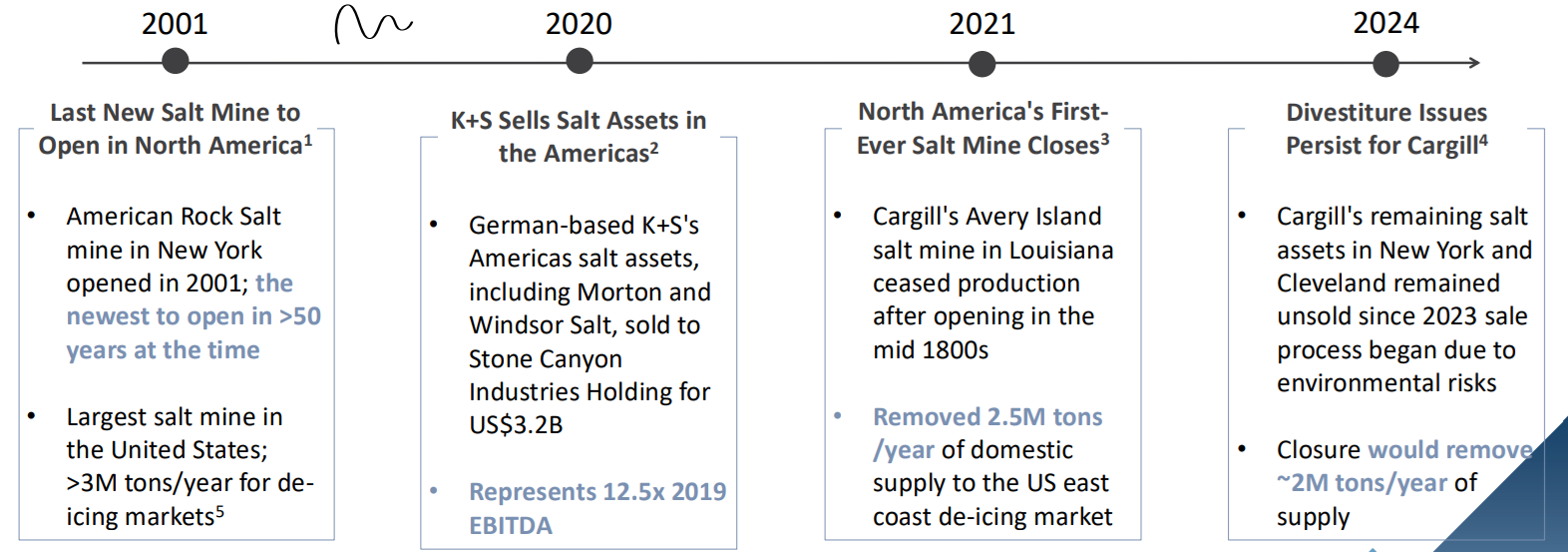
The structural drivers behind the shift extend beyond the weather. North America's legacy salt mines are old and deep, and several operate beneath the Great Lakes, which makes expansion expensive and environmentally complex. The presentation notes that Cargill's Avery Island mine in Louisiana closed in 2021, removing 2.5 million tons per year of supply to the US east coast. Imports from Chile, Egypt and Morocco have traditionally filled shortfalls. They depend on long-haul shipping, which Peterson argues is no longer a reliable backstop:
"The big thing that people will say [is], we'll just get more salt from overseas. Well, what has happened to shipping costs from Chile and Egypt? ... And then there's slowdowns in transits through the Panama Canal because their water levels are low. It's just a confluence of events that's making a very good time to be marketing a salt company," Peterson explained.
Energy costs, freight rates and trade policy all feed into the delivered cost of salt, and each has recently moved against distant suppliers. The brief attempt to tariff Canadian salt, followed by its quick reversal, showed how little room buyers have to substitute supply. Atlas Salt's project sits three days' sailing from Boston, compared with more than 14 days from Egypt or Chile, so proximity is a direct cost advantage in every tender. The shift also aligns with a wider policy push in Canada to support domestic resource development. Export credit agencies and federal tax measures are lending support to projects that serve North American supply chains.
TL;DR
Atlas Salt (TSXV:SALT) is advancing the Great Atlantic Salt Project in Newfoundland as North American road salt shifts to a sellers' market. Recent US tenders have drawn bids of US$155 to US$160 per ton, with authorised ceilings of up to US$175, against roughly US$88 a year earlier. CEO Nolan Peterson attributes the change to depleted inventories, maxed-out mines and costlier imports. The company holds non-binding financing LOIs above C$300 million against C$589 million capex, including up to C$150 million from EDC. Its in-house Meridian model targets higher-margin markets. The 2025 feasibility study shows a C$920 million NPV8 and 21.3% IRR. Key watch-items are binding debt terms, equity dilution and drift advance rates.
FAQs (AI Generated)
Analyst's Notes





Subscribe to Our Channel

.jpg)

Stay Informed


