




North American Salt Assets Price at 7.9x-16.5x EBITDA as Lender Support Builds



Salt assets price at 7.9x to 16.5x EBITDA. Atlas Salt has C$300M+ in lender interest, and binding debt is the next step toward those multiples.
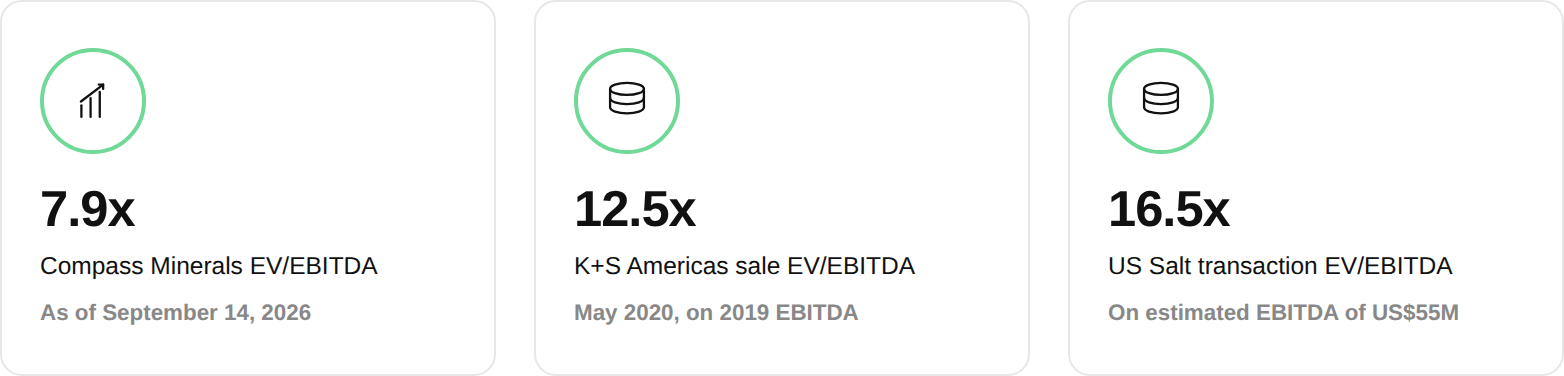
- Compass Minerals trades at 7.9x, the 2020 K+S Americas sale priced at 12.5x, and the US Salt transaction at 16.5x enterprise value (EV) to earnings before interest, taxes, depreciation & amortization (EBITDA).
- A developer without financed construction is valued on price-to-net-asset value, and Atlas Salt's own illustrative range puts developers at 0.2x to 0.4x before project finance and about 1.0x once production begins.
- Export credit agencies and an equipment vendor have issued letters of interest for the only comparable new salt mine under development in North America, and management says the letters exceed half of the C$589 million capital cost and more than 75% of the senior secured debt target.
- Atlas Salt projects average annual EBITDA of C$325 million over a mine life of more than 24 years in its feasibility study, against a current EV of C$174.7 million.
- Atlas Salt also projects an after-tax net present value at an 8% discount rate of C$920 million and a 4.2-year payback on C$589 million of pre-production capital.
North America has not added a new salt mine since American Rock Salt opened in 2001, and the shortage is now visible in municipal tenders. In Ohio, 18 counties received no offers in a first round of road salt bidding before a US$155 per ton bid arrived in the second round. West Virginia has authorized purchases of up to US$175 per ton, against US$88.38 per ton paid in 2025. Existing mines are producing at full capacity with no inventory, and no comparable new mine or expansion project is planned.
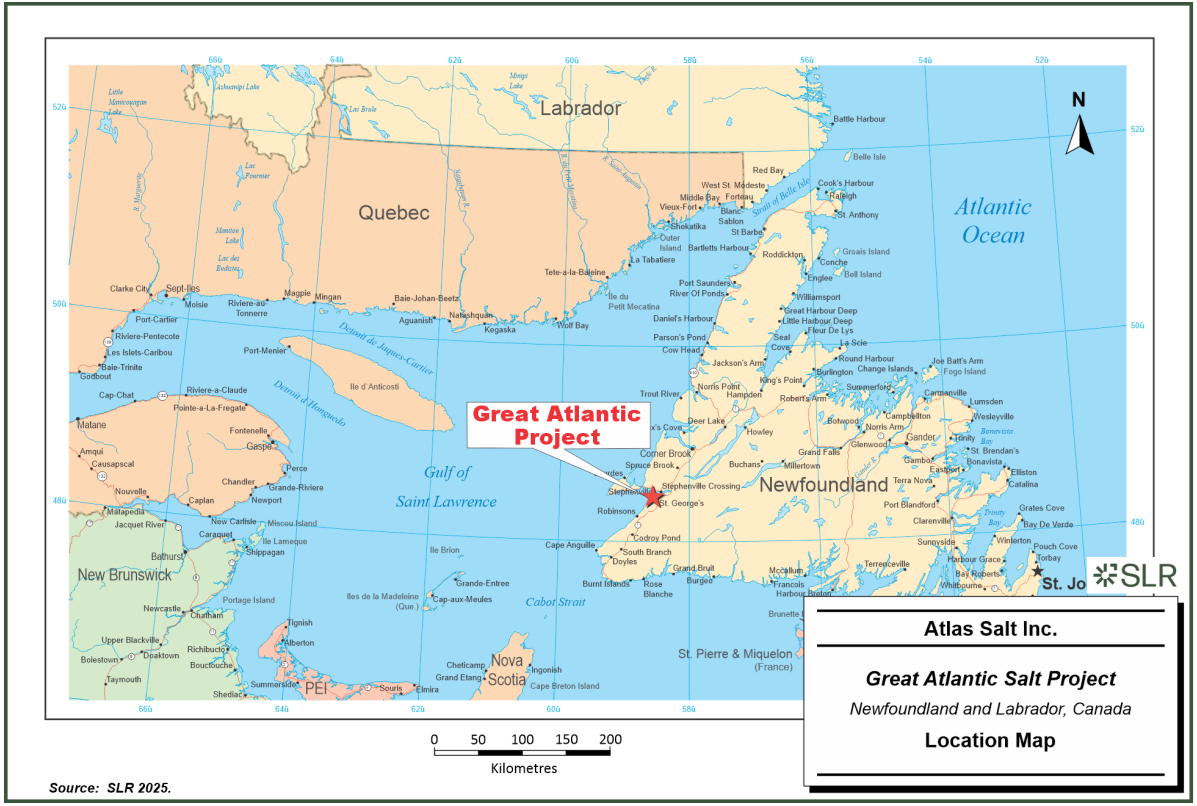
Higher salt prices raise a valuation question for developers. Operating and transacted salt assets price on earnings: 7.9x enterprise value (EV) to earnings before interest, taxes, depreciation & amortization (EBITDA) for Compass Minerals, 12.5x for the K+S Americas sale and 16.5x for US Salt. A developer without financed construction is valued like mining developers, on price-to-net-asset value (P/NAV), and Atlas Salt Inc. (TSXV: SALT | OTCQX: SALQF | FSE: 9D00) is developing the Great Atlantic Salt Project in Newfoundland at that stage.
The gap between the two yardsticks closes in stages, and financing is the first. Atlas Salt holds more than C$300 million of letters of interest (LOIs), which management says exceed half of the C$589 million capital cost and more than 75% of the senior secured debt target. About C$50 million to C$100 million of senior secured debt remains to place. Whether the LOIs convert into binding debt sets the framework that lenders and equity investors apply to the company.
Industry Context
Salt valuations come from operating earnings, and the 3 reference points differ in ownership & margin. Compass Minerals, the public operator of the Goderich mine in Ontario and the Cote Blanche mine in Louisiana, has an EV of US$1,710 million on last-twelve-month (LTM) EBITDA of US$216 million, a 16.7% margin, as of September 14, 2026. K+S sold its Americas salt business, including the Morton & Windsor brands, to Stone Canyon Industries Holding for US$3.2 billion in May 2020, on US$257 million of EBITDA. US Salt has a transaction value of US$907.5 million, and Atlas Salt estimates US Salt's EBITDA at US$55 million on US$131 million of sales at a 42% margin.
The legacy asset base is old and deep. Goderich operates about 600 meters below Lake Huron, and Nutrien's Picadilly mine reaches about 1,000 meters. Cargill ended production at its Avery Island mine in Louisiana in January 2021, removing 2.5 million tons per year of supply from the US East Coast de-icing market. Cargill's remaining New York & Cleveland assets have been unsold since its 2023 sale process began, and a closure would remove about 2 million tons per year.
Emerging Practices & Industry Progress
Export Development Canada (EDC), a second export credit agency (ECA) wholly owned by its national government, and equipment vendor Sandvik have each issued LOIs for the Great Atlantic Salt Project. The company announced them to show the market that lender interest exists and acknowledges that they are not yet binding agreements.
Canadian banks have traditionally not project-financed mining. Management points to federal tax code changes, including accelerated depreciation, as a reason they may become more receptive, and it cites Canadian and North American preference for local supply as a further tailwind for domestic salt.
Remaining Challenges
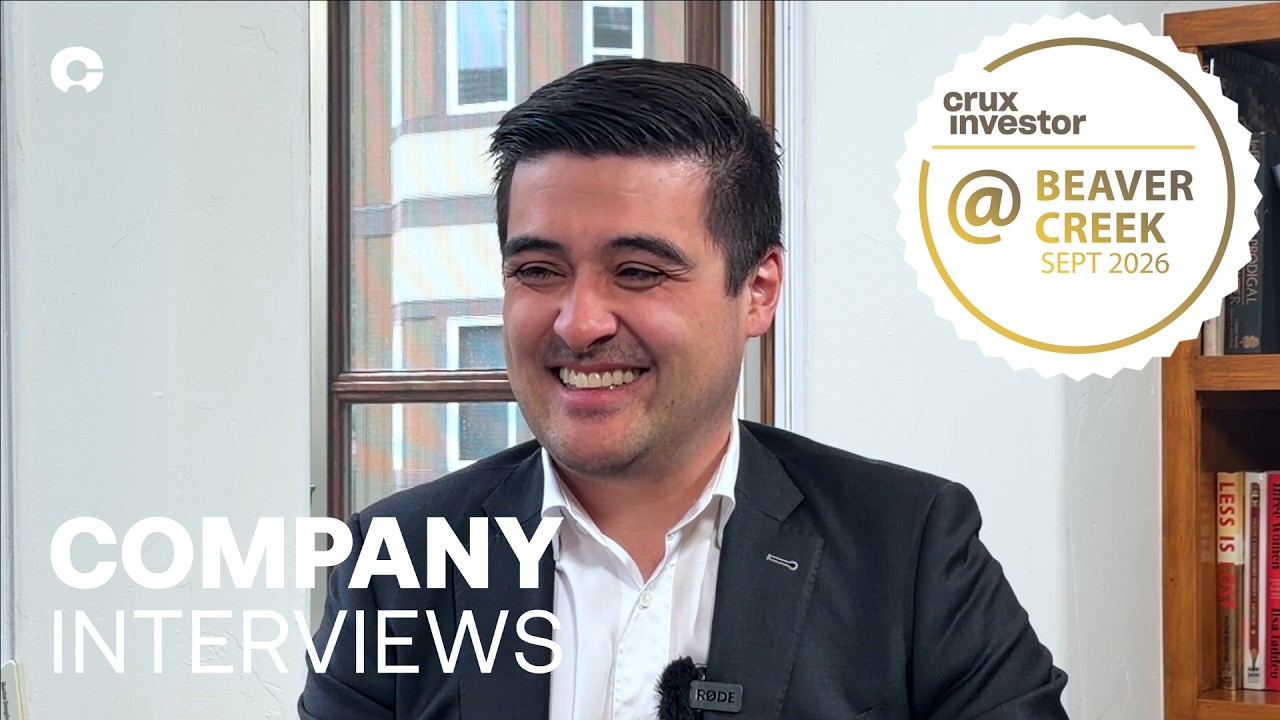
Lender classification is 1 item still to resolve. Management says lenders describe salt as falling outside their mining sector, closer to industrial minerals or a diversified category. Chief Executive Officer of Atlas Salt, Nolan Peterson, sees the obstacle as familiarity rather than economics:
"It makes all the sense in the world on a financial basis. So, it's just getting them comfortable with salt."
A financing package, remaining permits, and mine construction all remain ahead of the project, with production estimated by 2030. The multiples themselves use different bases: Compass Minerals' 7.9x uses LTM EBITDA, the K+S Americas 12.5x uses 2019 EBITDA, the US Salt 16.5x uses an estimated EBITDA, and Atlas Salt's C$325 million is a life-of-mine feasibility average.
Company or Project Examples
Atlas Salt projects an after-tax net present value at an 8% discount rate (NPV8%) of C$920 million, an after-tax internal rate of return of 21.3%, and a 4.2-year payback on C$589 million of pre-production capital in its feasibility study (FS). Average annual EBITDA over a mine life of more than 24 years is C$325 million on C$407 million of net revenue, an 80.0% margin, and average annual free cash flow (FCF) is C$188 million. Probable reserves are 95.0 million tons at 95.9% sodium chloride, and the deposit lies about 180 meters below the surface.
The LOIs include up to C$225 million for senior debt: up to C$150 million from EDC and up to C$75 million from the second ECA. Sandvik's LOI covers mining equipment valued at C$79 million, including C$45 million for capital equipment. The company is targeting equity raises in addition to debt at various points, and a debt-weighted package to limit dilution, following C$8.7 million raised at C$0.80 per share in October 2025 and C$15.2 million at C$1.20 per share in June 2026.
The market values the company at an EV of C$174.7 million: a fully diluted market capitalization of C$198.6 million at C$1.49 per share, less C$23.9 million of net cash, as of September 14, 2026. Atlas Salt's own illustrative ranges, drawn from mining companies on a similar path, place developers at 0.2x to 0.4x P/NAV before project finance, 0.4x to 0.6x at about 50% construction, and about 1.0x when production begins. Management targets 50% of average annual unlevered FCF of about C$161 million in years 1 to 8 for debt repayment, and more than 90% of about C$200 million a year in years 9 to 24 for shareholder returns once all debt obligations are satisfied.
Peterson wants mining, industrial minerals & dividend investors all to own Atlas Salt:
"I want mining investors to think we're a mining project. I want industrial minerals investors to think we're industrial minerals. I want long-term value dividend chasing investors to chase the dividend on this project."
Regional or Jurisdictional Perspective
Newfoundland & Labrador ranked 9th globally in the Fraser Institute's 2025 mining investment attractiveness ranking. The province released the Great Atlantic Salt Project from environmental assessment in April 2024 after about 2 months of review.
The site is about 2 kilometers from the Turf Point deep-water port and 1.4 kilometers from the St. George's substation, and salt ships to Boston in under 3 days, compared with more than 14 days from Egypt or Chile. Management describes government support for such developments in Canada as strong.
Industry Outlook
Binding debt terms are the next milestone on Atlas Salt's list, ahead of remaining permits, mine construction and production targeting 2030. Atlas Salt projects a 4.2-year payback and a C$920 million NPV8% in its FS, and the company's EV of C$174.7 million is below the C$325 million of average annual EBITDA it projects.
With more than C$300 million of LOIs already in hand, binding terms would be the first evidence lenders and equity investors can use to test that feasibility case against the salt sector's 7.9x to 16.5x multiples. The checkpoints ahead include converting the LOIs, the size of the remaining C$50 million to C$100 million of senior secured debt, the follow-on equity raise, and the next municipal tender round after this season's US$155 per ton Ohio bid.
FAQs (AI-Generated)
Analyst's Notes





Subscribe to Our Channel

.jpg)
.jpg)
Stay Informed


