Brimstone Silver Reaches Surface While Hycroft's Costed Plan Stays an Open Pit


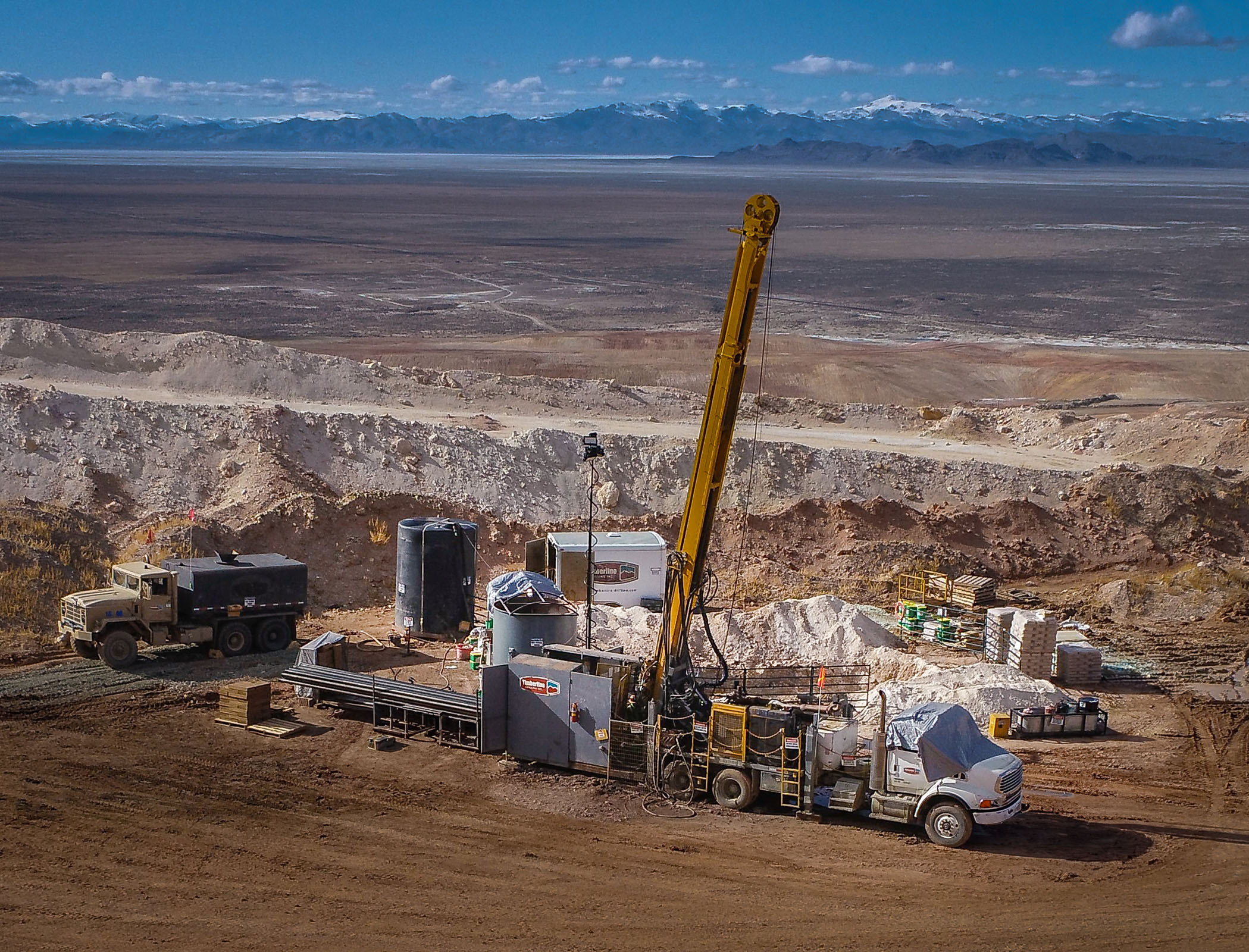
Brimstone drilling moved the high-grade system closer to the surface. Hycroft points to a pit or an underground mine, but only one is costed.
- Up-dip drilling at Brimstone confirmed high-grade silver continuity and moved the system closer to surface, with 2 holes mineralized from zero metres (m), and the widest section of the system confirmed at 82.7 m of 87.52 grams per tonne (g/t) silver and 0.77 g/t gold from 122.2 m depth.
- Hycroft states that grades of this nature can potentially be supportive of both open-pit and underground contexts, while Diane Garrett, Executive Chairman and Chief Executive Officer of Hycroft Mining Holding Corporation, states that the results reinforce the case for a high-grade underground mine.
- Every published economic figure is for a conventional open-pit mine, with an after-tax net present value at a 5% discount rate (NPV5%) of $4.3 billion and a 16.9% internal rate of return, based on a base case of $3,600 per ounce for gold and $48.00 per ounce for silver.
- The resource itself is reported within a computer-generated, optimized pit that holds 4.92 billion tonnes of material, so any shallower high-grade material falls within the existing framework.
- No underground economics have been published, and no open-pit economics specific to the high-grade domains. The mining method is unpriced either way.
High-Grade Silver Traced Up-Dip Toward Surface
The August 18, 2026, drilling at Brimstone worked upward through the system, not downward, and it confirmed high-grade silver continuity up-dip while moving the system closer to the surface. Five holes expanded the up-dip portion of the Hycroft Mine in northern Nevada's Brimstone high-grade system, and one of them confirmed continuity through the widest section.
That hole returned 82.7 metres (m) at 87.52 grams per tonne (g/t) silver and 0.77 g/t gold from 122.2 m depth, including 19.4 m at 108.19 g/t silver and 2.10 g/t gold from 181.7 m depth, plus a 0.7 m interval grading 14.35 g/t gold. Shallower in the same hole, 4.9 m ran 92.81 g/t silver from 71.2 m depth, and 15.0 m ran 41.96 g/t silver and 0.70 g/t gold from 91.0 m depth. Two further holes were mineralized from zero metres, returning 153.0 m at 9.87 g/t silver and 0.44 g/t gold, and 142.2 m at 17.66 g/t silver and 0.37 g/t gold. A fourth returned 147.8 m at 32.34 g/t silver and 0.44 g/t gold from 29.3 m depth, including 4.4 m at 546.83 g/t silver from 50.6 m depth, and a fifth 149.4 m at 33.32 g/t silver and 0.42 g/t gold from 85.6 m depth, including 8.5 m at 148.12 g/t silver and 1.37 g/t gold from 100.2 m depth.
Exploration Manager of Hycroft Mining Holding Corporation (Nasdaq: HYMC), Justin Davenport, describes what the team found when it read the data on site:
"You get out here, you start looking at the data. There are interesting things that say there's more to it than just one broad low-grade system."
Brimstone's current dimensions are approximately 300 m wide north to south and approximately 500 m long east to west down-dip, against approximately 250 m north to south and approximately 380 m down-dip. The system remains open in all directions and at depth.
Two Readings of the Same Result
Hycroft published 2 readings of the August 18, 2026, results, and they point to different mines. For the widest-section hole, the company states that grades of this nature could support both open-pit and underground operations and provide attractive optionality for mining. Executive Chairman and Chief Executive Officer (CEO) of Hycroft Mining Holding Corporation, Diane Garrett, states that the results, taken together, reinforce the case for a high-grade underground mine. The company separately states that the results support a strategy to expand both systems to define the best path forward for development, including the potential for a high-grade underground silver mine.
Both statements stand, and neither displaces the other. The published option set is unchanged: a large open pit, a high-grade underground operation, or a hybrid in which high-grade underground material complements the pit, with the new underground opportunity on the 2 high-grade silver systems under evaluation.
For an investor, the practical effect is that the latest results have added a method to the live set rather than removing one. Grade at the surface is usable by a pit. Grade in a continuous high-grade domain at depth is usable by a decline. The same drilling has strengthened both readings. The method question is wider than it was before.
What the Published Economics Describe
Every cost figure Hycroft has published reflects a conventional open-pit operation, so the economics and the underground argument do not currently refer to the same mine. The production plan is a conventional open-pit operation with a throughput of 57,100 tons per day and a low strip ratio of 1.55 waste to ore, over a 51-year mine life, averaging 295,000 ounces of gold equivalent a year, on an equivalence basis of $48.00 per ounce for silver to $3,600 per ounce for gold.
Based on a base case of $3,600 per ounce for gold and $48.00 per ounce for silver, the plan yields an after-tax net present value at a 5% discount rate (NPV5%) of $4.3 billion and a 16.9% internal rate of return. At spot prices of $4,569 per ounce for gold and $77.98 per ounce for silver, the same plan returns an NPV5% of $10.0 billion and a 30.1% internal rate of return. Initial capital is $2.4 billion with life-of-mine sustaining capital of $3.1 billion, and payback is 4.7 years post-tax on the base case and 2.9 years post-tax at spot prices. Life-of-mine production is 10.4 million ounces of gold and 347 million ounces of silver, averaging 204,000 ounces of gold and 6.8 million ounces of silver a year.
The price leverage in that plan is steep in both metals. Each $100 increase in the gold price per ounce raises the NPV5% by approximately $300 million, and each $5 increase in the silver price per ounce raises it by approximately $460 million, which takes the NPV5% from $4.3 billion at $3,600 per ounce for gold and $48.00 per ounce for silver to $9.1 billion at $4,500 per ounce for gold and $70 per ounce for silver, and $15.8 billion at $6,000 per ounce for gold and $100 per ounce for silver. A further 6.8 million ounces of gold equivalent, drawn from the inferred resource, is not in the mine plan at all.
Three Cutoffs & Three Sets of Grades
A Hycroft grade figure carries no meaning without the cutoff it was reported against, because the deposit is reported against 3 different economic tests. The heap leach resource holds 184,495 thousand tonnes at 0.155 g/t gold and 3.34 g/t silver in the measured and indicated categories, at a cutoff of $2.07 to $4.00 net of refining per tonne. The flotation mill and concentrate treatment resource holds 1,345,783 thousand tonnes at 0.358 g/t gold and 12.53 g/t silver, at a cutoff of $18.44 net of refining per tonne. Combined, the measured and indicated resource is 1,530,279 thousand tonnes at 0.333 g/t gold and 11.42 g/t silver, containing 16,414 thousand ounces of gold and 562,575 thousand ounces of silver, with a further 516,799 thousand tonnes at 0.303 g/t gold and 7.99 g/t silver in the inferred category. That estimate is effective January 21, 2026, at $3,100 per ounce for gold and $36 per ounce for silver.
The high-grade domains are reported on a third test entirely, at a cutoff of 68.57 g/t silver, also expressed as 2 ounces per ton. On that basis, Brimstone holds 3,198 thousand tonnes at 0.368 g/t gold and 269.54 g/t silver in the measured and indicated categories, Vortex holds 14,940 thousand tonnes at 0.543 g/t gold and 130.14 g/t silver, and the 2 together hold 18,137 thousand tonnes at 0.512 g/t gold and 154.71 g/t silver. Sulfide sulfur is 1.38% across both domains, against 1.90% for the combined measured and indicated resource.
None of these resources are reserves, and detailed economic considerations have not been applied to them. The practical consequence for reading the August 18, 2026, intercepts is that an 87.52 g/t silver interval and a 269.54 g/t silver domain average are measured against different thresholds, and a surface intercept of 9.87 g/t silver over 153.0 m belongs to the low-grade envelope, not to either high-grade domain.
A Resource Built Inside an Optimized Pit
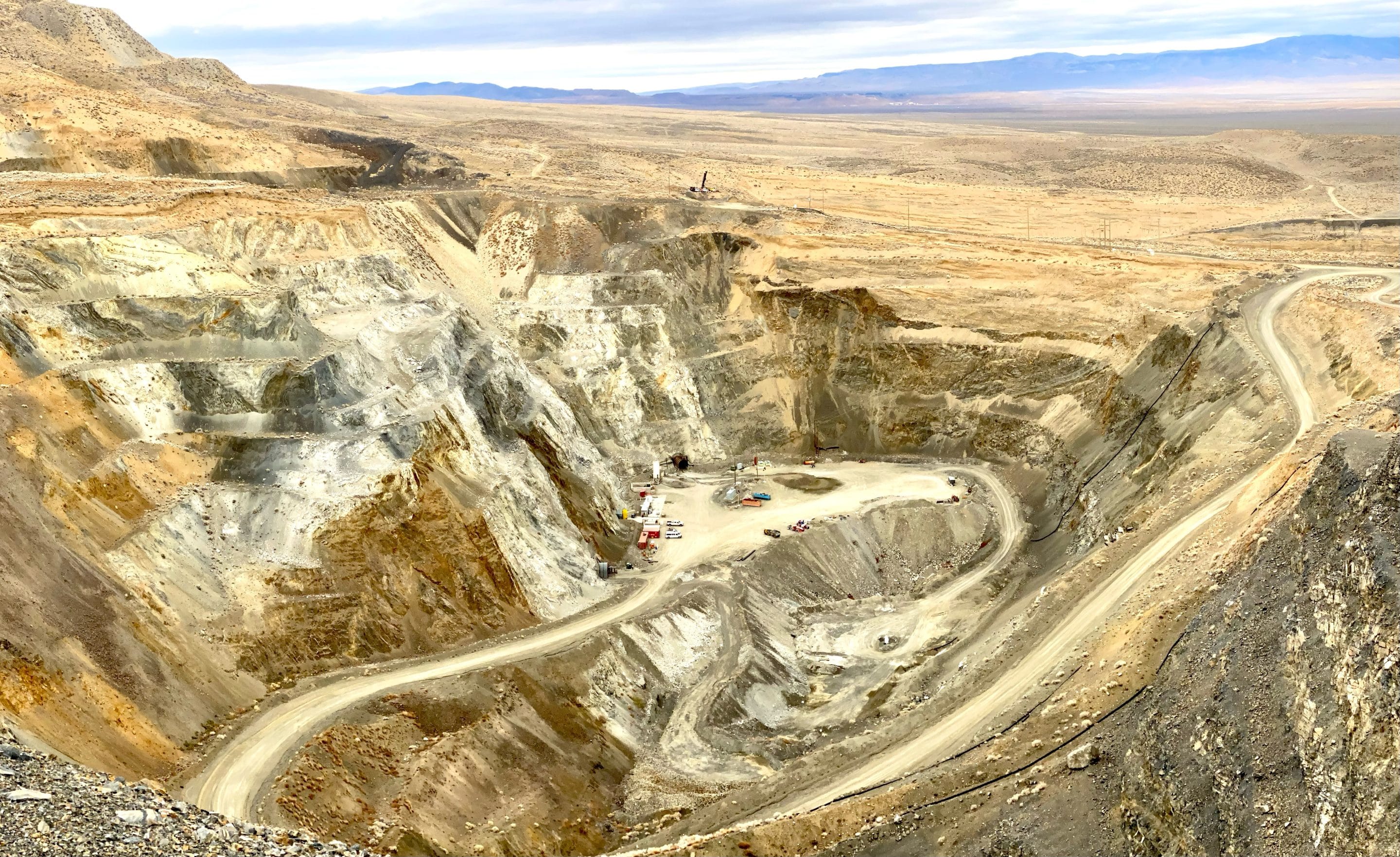
The resource framework already presumes open-pit extraction, so shallower high-grade material lands within it rather than beside it. The mineral resources are contained within a computer-generated optimized pit, and the total material in that pit is 4.92 billion tonnes. Modifying factors for mine and process design have not been applied, so the pit that bounds the resource is a reporting construct and not a mine design.
That boundary is also narrow relative to the ground Hycroft holds. The current resource comprises less than 15% of a land position of more than 64,000 acres; the system remains open, and new targets have been identified within the plan of operations. Surface mapping, soil geochemistry, induced-polarity geophysics, which measures how rock responds to an electrical current, and high-resolution drone imaging of the high walls all indicate additional strong mineralization trends to the east and northeast along newly identified structural trends, and the company annotates mineralization outside the current resource.
Vice President, Exploration of Hycroft Mining Holding Corporation, Alex Davidson, points at the ground where the pit design had been written off:
"This wall would have come down in the pit, but it's always been considered waste."
Material reclassified from waste to feed affects a pit's economics, so the reporting boundary is worth monitoring alongside drilling.
The Feeder Target & the Underground Case
The evidence that would most strengthen an underground case is the program's least advanced part. Alongside the up-dip work, the drilling is testing a geophysical anomaly identified in 2025, which indicated a potential feeder system below the known mineralization. Two holes stepped out approximately 90 m down-dip from the initial holes tested in late 2025 and returned alteration and geochemical results consistent with the Brimstone fluid pathway. One intersected an 18-metre zone of stockwork veining, a dense network of small crosscutting veins, including 1.5 m at 120.00 g/t silver at a depth of 645.9 m. The same hole also returned 2.7 m at 44.63 g/t silver and 0.10 g/t gold at 664.8 m depth.
The company qualifies the signatures as consistent with the feeder interpretation, noting that drilling remains high in the system and will continue to advance toward the target. The stockwork vein zone is annotated as open at depth on both the March 16, 2026, and August 18, 2026 sections. Engineering analysis for a decline is well underway, and engineering on a decline for the high-grade is targeted for the second half of 2026. Approximately 7,200 m of core remain to be drilled at Brimstone out of an approximately 26,000-metre program, of which approximately 15,585 m had been completed since August 2025.
Davenport separates the part of the rock column that the drill penetrates from the part that hosts the ore:
"The alteration at Hycroft is an epithermal system, so the top part of it has a lot of clay alteration in it. And the top part of the holes can be a bit of a struggle, but most of our ore is hosted in a more silicified hard rock."
An epithermal system forms where hot fluids rise through fractures near the surface, and rock competence improves below roughly 200 to 300 m. Deep holes are therefore slower to start and steadier to finish, which bears on how quickly the feeder question can be closed.
Unpriced Options & the Next Decision Points
Nothing published prices an underground operation, or a pit confined to the high-grade domains, so the method question is not answerable from what Hycroft has released. Among the company's own disclosed risks are the lack of a completed feasibility study, uncertainties regarding mineral resource estimates, risks related to metallurgical test work and process development, and risks related to its ability to re-establish commercially feasible mining and processing operations.
Investors are cautioned not to assume that all or any part of measured or indicated mineral resources will ever be converted to mineral reserves, and inferred resources have a high degree of uncertainty as to their existence. Any exploration target described in the results does not represent, and should not be construed to be, an estimate of a mineral resource or mineral reserve. Some permit modifications may be required based on final operating plans.
The scheduled work ahead is narrow. Assessing a restart of the heap leach operation and the decline engineering both fall in the second half of 2026, while the resource update with final metallurgical recoveries on pressure oxidation, a process that uses heat and oxygen under pressure to break down sulfide minerals, and the study with economics and an updated resource were both completed earlier in 2026. A roasting study is nearing completion and could add a third revenue stream from the sale of sulfuric acid. The program began with 2 core rigs and 1 reverse-circulation rig, and 2 more core rigs are targeted for the second half of 2026, for a total of 5 rigs. Approximately 3,000 m of core is targeted at Vortex across the northern, southern, and eastern extensions, as well as the western zone.
The Investment Thesis for Hycroft Mining Holding Corporation
- Grade at surface widens the method set because the same up-dip drilling that confirmed continuity through Brimstone's widest section also put mineralization in 2 holes from zero metres, which a pit can reach.
- The company holds both readings at once, stating that the grades could support both an open-pit and an underground context, while its Executive Chairman and Chief Executive Officer states that the results reinforce the case for a high-grade underground mine.
- Only the pit is priced, with an after-tax net present value at a 5% discount rate of $4.3 billion and a 16.9% internal rate of return on a base case of $3,600 per ounce for gold and $48.00 per ounce for silver.
- The resource framework presumes a pit, reported within a computer-generated, optimized pit holding 4.92 billion tonnes of total material, with no mine and process design factors applied.
- Price leverage is the dominant variable in the published case, with each $100 increase in the gold price per ounce adding approximately $300 million and each $5 increase in the silver price per ounce adding approximately $460 million.
- The underground evidence is the least advanced, with the deep holes returning alteration and chemistry consistent with a feeder, while the drilling remains high in the system.
Hycroft is a large, low-grade, open-pit-costed deposit with 2 high-grade silver domains inside it that are unpriced. The August 18, 2026, drilling brought those domains closer to the surface, even as the company argued for reaching them from underground. An investor is underwriting an unresolved method question on a project whose presented economics assume the answer is a pit.
TL;DR
Hycroft is an open-pit-costed Nevada gold and silver project with 2 high-grade silver domains that are unpriced. The August 18, 2026, Brimstone drilling confirmed high-grade continuity up-dip and put mineralization in 2 holes from surface, and the company reads those grades as potentially supportive of a pit or an underground mine, while its Executive Chairman and CEO argues the case for a high-grade underground operation. The published economics describe a conventional open-pit mine, with an NPV5% of $4.3 billion on a base case of $3,600 per ounce for gold and $48.00 per ounce for silver, and the resource is reported within an optimized pit shell. Neither an underground case nor a high-grade pit case has been published. The mining method is therefore the open variable, and the decline engineering in the second half of 2026 is the next step to address it.
FAQs (AI-Generated)
Analyst's Notes





Subscribe to Our Channel



Stay Informed