




China Pays Record Copper Premium Despite Surplus, Favoring Metal Outside the US


With copper piling up in US warehouses ahead of a tariff decision, China is running short and sellers elsewhere hold the upper hand until Washington rules.
- Chinese buyers paid an average $205 per tonne over the LME price for imported copper on 28 October.
- The International Copper Study Group forecasts a global refined copper surplus of 104,000 tonnes in 2026, widening to 368,000 tonnes in 2027.
- The surplus has gathered in US warehouses on uncertainty over import tariffs, leaving China short of refined copper even with prices near records.
- Producers selling refined copper into Asia on spot terms collect the premium while Chinese fabricators pay it. Nobody outside the White House knows when the tariff decision lands.
- A US ruling excluding refined copper from import tariffs would free stranded US stocks for export, and is the event most likely to collapse the premium.
US Tariff Stockpiling Pushes China's Copper Import Premium to a Record
Chinese importers paid a record $205 a tonne above the LME price for copper on 28 October, up $17 from the previous day, according to Shanghai Metals Market (SMM). North China spot copper premiums jumped 160 yuan in a day to 690 yuan per tonne as suppliers held back cargo.
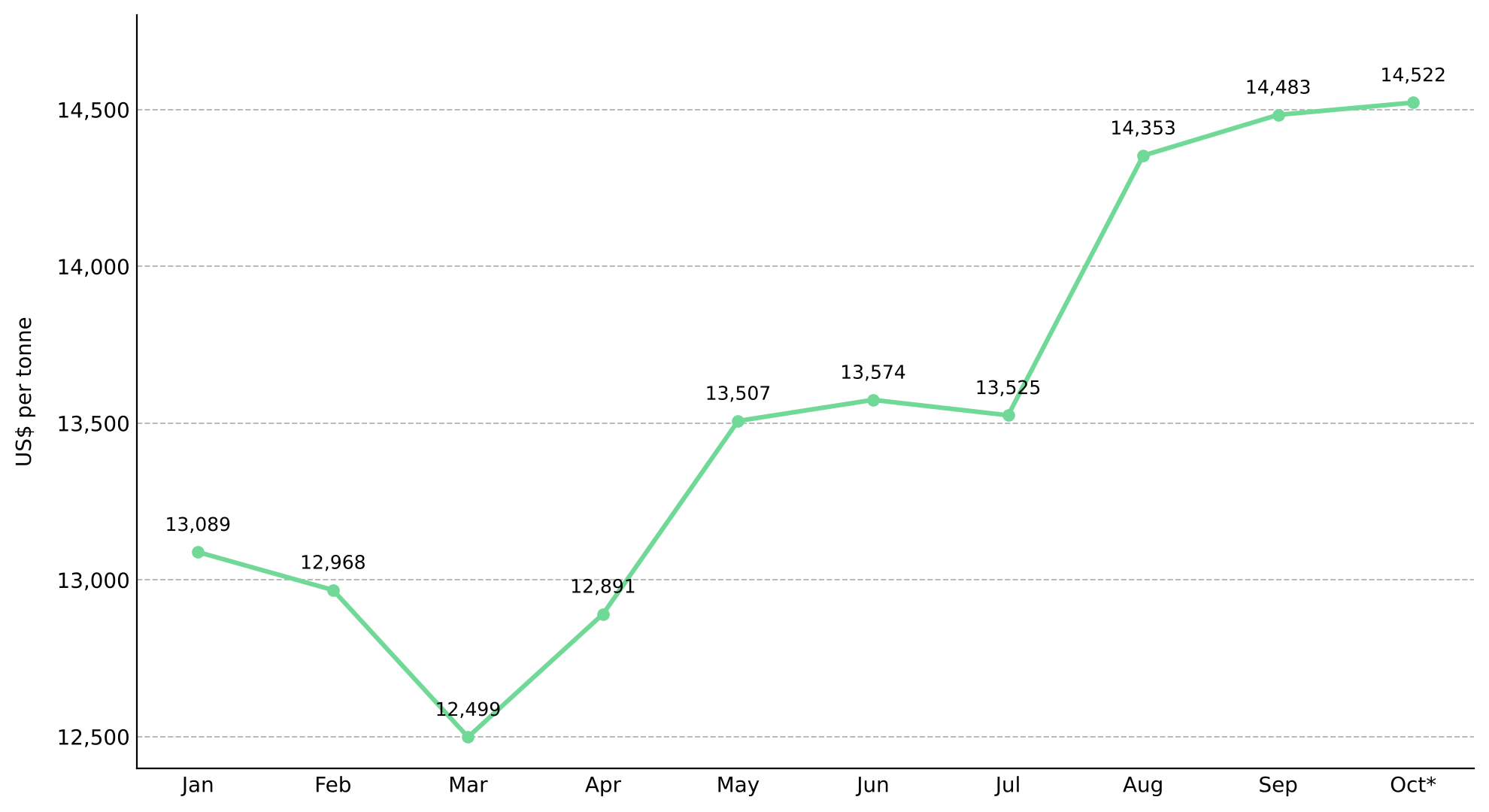
The Yangshan premium is the extra cost a Chinese buyer pays to secure imported copper near bonded storage. A record reading therefore signals physical shortage rather than speculation. The premium comes with LME cash copper averaging $14,522.50 per tonne in October through the 26th, up from $12,498.98 in March. Shanghai Futures Exchange stocks fell more than 25% last week while LME stocks rose, mostly in the US.
Tariff Uncertainty Strands Surplus in the US While China Runs Short
The International Copper Study Group (ICSG) forecast puts 2026 world refined output at 28.69 million tonnes against usage of 28.59 million tonnes, a 104,000-tonne surplus. Supply at the mine is thin. CSG cut its 2026 mine growth forecast to 1.3% from 1.6% in April, citing continued disruption at Grasberg in Indonesia and Kamoa-Kakula in the Democratic Republic of Congo and lower output in Chile. Scarce concentrate (the mined ore smelters process) is also limiting smelter output.
The surplus exists on paper but not where buyers sit. Global exchange inventory exceeds 1.2 million tonnes, double year-ago levels. Nearly all of it is in the US as traders wait on whether President Donald Trump imposes copper import tariffs, Reuters columnist Andy Home reported on 26 October. Shanghai Futures Exchange stocks stood at just 54,400 tonnes. On Crux Investor analysis, metal shipped to the US on a tariff bet stays there while the decision is open, since re-exporting means paying freight twice.
A US Tariff Ruling Decides When China's Premium Breaks
US storage is being built to absorb arrivals, not release them. CME Group is rapidly listing new warehouse capacity.
Two outcomes hang on the tariff decision. If the US excludes refined copper, US stocks become exportable, the Yangshan premium compresses, and the ICSG surplus reaches prices outside the US. Sucden Financial noted the US stock build already caps the LME price, per Reuters. If tariffs are confirmed or the decision drags, China's shortage carries into 2027 even as the ICSG surplus widens to 368,000 tonnes.
The exposed cohort is copper producers selling refined metal into Asia on spot terms, against Chinese fabricators paying the premium. The horizon runs to ICSG's next forecast round, with SMM's daily Yangshan assessment showing which outcome is playing out. The reversal trigger is a White House decision excluding refined copper from tariffs. The first price exposed to that decision is the LME cash premium over three-month copper, $199.50 per tonne on 27 October.
Split Copper Pricing Rewards Sellers Into Asia and Squeezes Chinese Fabricators
Margin pressure lands first on Chinese cable fabricators. They buy copper at exchange prices plus the premium and sell into contracts priced earlier, and SMM reported North China purchasing sentiment fell on 28 October. Producers with uncommitted metal able to ship into China capture the premium on top of the price.
The test separating winners from bystanders is whether a producer's tonnes can reach Asian buyers. Output at Grasberg and Kamoa-Kakula remains constrained by 2025 incidents, ICSG reported. Their owners keep leverage to the price but have fewer tonnes to sell into the premium. Constrained concentrate, which Sucden Financial credited for supporting prices, favors producers with running mines over restart stories.
Nobody outside the White House knows when or how the tariff decision breaks, so a retail holder cannot trade the premium. Position size is the variable under control. Copper equities priced off $14,000-plus copper carry downside risk, since a release of US stocks could pull premiums and the LME price lower. Leveraged junior developers would fall harder than producers. ING commodities strategist Ewa Manthey warned price-sensitive demand could resist further gains, Reuters reported.
Where the Advantage Sits
Copper is not short worldwide. It is short in China and plentiful in US warehouses, and US tariff policy, not mine output, decides where the metal sits. Chinese buyers now pay a price set by location, not by the global balance.
Sellers holding refined copper outside the US get the gains, while Chinese fabricators carry the cost. Where a producer sells, and on what contract terms, now shapes its earnings almost as much as the copper price itself.
Over the longer run, the surplus offers less cushion than it appears. Mine growth is weak, concentrate is scarce, and copper parked in US warehouses has moved, not multiplied. Sellers with copper outside the US, and producers able to reach Asian buyers, hold the advantage.
Analyst's Notes





Subscribe to Our Channel







Stay Informed


