How to Spot Junior Projects Major Miners Will Pay to Own



Michael Gentile values junior gold ounces at zero or a lot, backing deposits with grade, scale, nearby mills and fast permits that major miners pay to own.
- Junior gold ounces carry two values in practice: nothing if they never reach a mill, and far more than market prices if they can.
- Producer margins have widened far faster than junior valuations, and recent takeovers at about US$500 - US$600 per ounce show what buyers will pay for ounces that fit their operations.
- A defined resource shifts the risk from whether a deposit exists to whether it can be mined at a profit, and bear market prices resource-stage companies like explorers.
- Grade, scale and nearby infrastructure set capital costs, and an existing mill can remove the highest single cost of building a mine.
- Stable, fast-permitting Canadian provinces shorten the road from resource to production and carry a growing premium with acquirers.
Asset selection decides which companies receive the first cheque. Michael Gentile, founding partner and senior portfolio manager at Bastion Asset Management and a shareholder in more than 30 junior mining companies, applies a short checklist before investing: a discovery already made, enough grade and scale to pay for a mine, infrastructure close enough to cut the build cost, and a jurisdiction where the rules hold. Each test answers a single question: whether the ounces in the ground will ever be mined.
Junior Ounces Are Worth Zero or A LOT
For Gentile, ounces with no realistic path to production are worth nothing. For the rest, the question is what a builder could pay and still earn a good internal rate of return, and a major cannot discover a five-million-ounce deposit for $30 to $50 per ounce. Gentile applies the test on the first day he looks at a company, before any per-ounce comparison, and explains why only cash-flowing ounces carry real value:
"In my mind, there are two values for ounces. Zero and a lot... On day one, my assumption is either your ounces are worth nothing, or they're worth a heck of a lot. And how they're worth a heck of a lot is if they're cash-flowing ounces."
Producers Can Pay Far More Than the Market for Minable Ounces
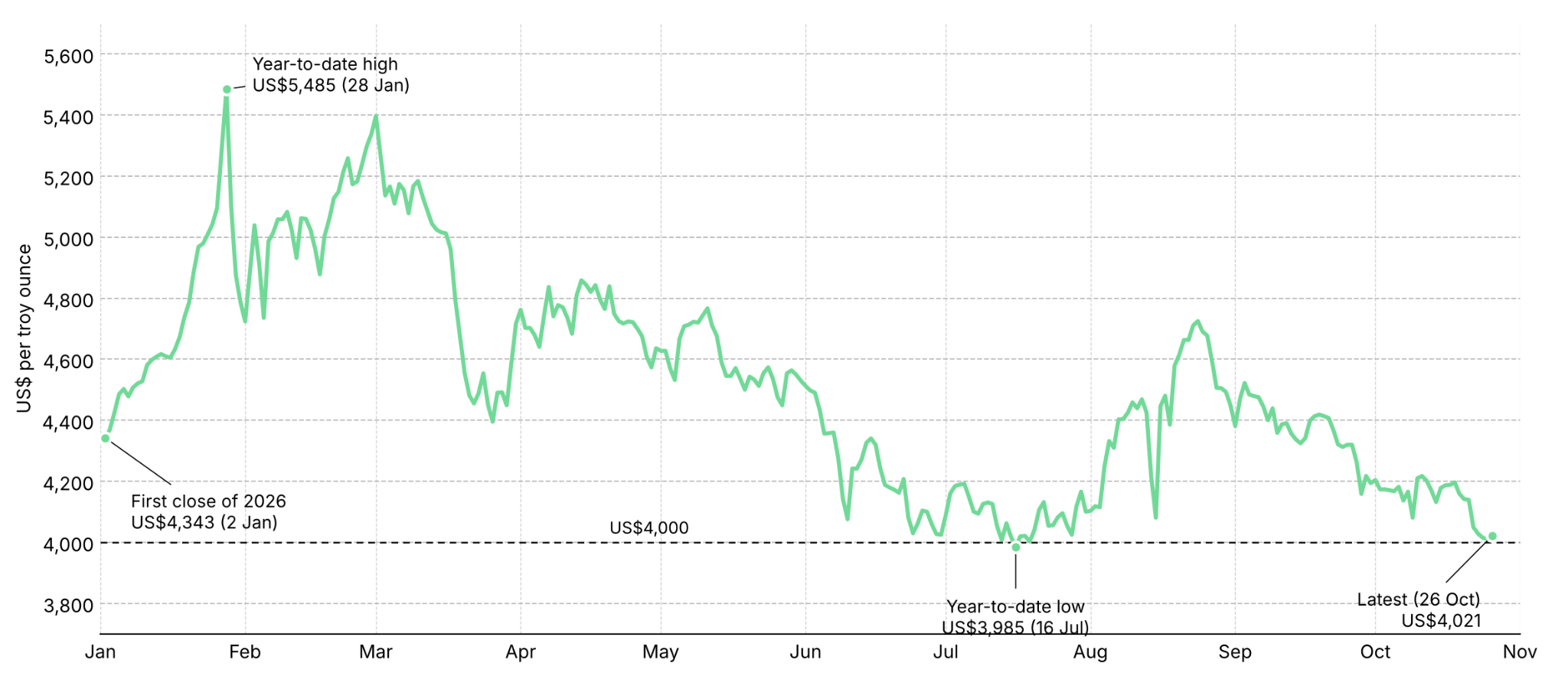
At July 2026 prices, gold at $4,000 per ounce and all-in costs of $2,000 per ounce left a $2,000 margin, or about $1,800 after allowing $200 per ounce of build capital. Juniors Gentile believes can become mines traded at $50 to $100 per ounce in the ground. In 2010, majors paid about $100 per ounce, with margins of $400 to $500. Comparing the two cycles, he argues the price paid for junior ounces has to catch up unless gold falls back:
"They were buying things for $100 an ounce back in 2010, because there was still an IRR in that math, but it was $500 a margin, and you're paying $100. Now you have $1,700 a margin, and you're still paying $100? That doesn't make sense. That arbitrage has to close over time, or the gold price has to go back to $2,000."
Recent deals set new benchmarks. G Mining Ventures paid about US$600 per ounce for G2 Goldfields, and Agnico Eagle paid about US$500 per ounce for Rupert Resources, both at premiums of roughly 70%.
Roxmore Resources, a Nevada developer, agreed on 13 October 2026 to sell to SSR Mining for about US$464 million in cash, a 58% premium including shares in an exploration spin-out. The company’s Converse Gold Project holds 2.2 million Indicated and 3 million inferred ounces at about 0.5 grams per tonne, 6 kilometers from SSR’s Marigold mine. The price of roughly US$95 per ounce shows how low-grade and a large inferred share limit what an acquirer will pay.
Producers are also taking stakes before any sale. Agnico Eagle holds 13.9% of Cascadia Minerals, an advanced copper-gold explorer in the Yukon, in which Gentile holds 7.6%, while Glencore and Vale sit on the register of Errington Metals, an explorer in Ontario's Sudbury Basin.
A Defined Resource Removes the Discovery Gamble
Gentile rarely pays for discovery risk. He makes exceptions only when the price is right and he knows the people. He explains the entry point is set by where failure rates run highest:
"I typically only invest post-discovery. It can be a discovery hole or two. I'm not asking for fully fleshed out... I don't like taking on too much discovery risk because that's really where your failure rate is extremely high."
Bear Markets Price Resource-Stage Companies Like Explorers
Over eight years of full-time junior investing, Gentile has mostly bought companies with market values of $20 million to $30 million and an existing resource. Weak markets allow it, because resource-stage companies trade at exploration-stage prices. Once a deposit is defined, the question shifts from whether it exists to whether it can be mined profitably.
OnGold Resources holds 2 million Measured and Indicated ounces at 0.84 g/t plus 0.49 million Inferred ounces at Monument Bay in Manitoba, and Agnico Eagle owns 12%. The next work is economic: metallurgy and engineering are planned for late 2026 and 2027, ahead of a first study on a site with air and winter-road access only and grid power 55 kilometers away.
Grade & Scale Decide Whether a Deposit Pays Back
Gentile's first screen asks whether the ore body can pay for its own mine. To attract a major, a deposit needs enough ounces to support 300,000 to 500,000 ounces a year for 20 years. He sets out where his analysis starts:
"You need to have enough margin and enough volume of rock to move to generate enough cash flow to pay for the capital required to build the mines. That's your first place where you start. So grade is king and scale is king."
High-Grade Starter Pits Fund the Larger Deposit
McFarlane Lake Mining’s Juby resource grew from about four million to about six million ounces during 2026 and now stands at 1.07 million Indicated and 5.09 million Inferred ounces at below 1 g/t. At a 2.0 g/t cut-off, 254,000 indicated ounces grade 2.94 g/t near surface, which Gentile sees supporting a starter pit producing 50,000 to 70,000 ounces a year. Most of the resource remains inferred. Mark Trevisiol, Chief Executive Officer, explains how the starter pit could generate cash before a mill is built:
"On the cash generation side, that's going to come as we de-risk the project. There are 11 mills within an hour and a half's drive. We've been talking to a couple of them... So that's the wild card in production... is getting milling capacity."
NorthIsle Copper and Gold, a British Columbia developer targeting a prefeasibility study in the first quarter of 2027, holds 8.7 million ounces of gold and 3.8 billion pounds of copper in the Indicated category. Renatus Resources, a British Columbia developer due to list in early 2027, brings a historical resource of about three million gold-equivalent ounces at Revel Ridge, with Measured and Indicated ounces grading 6 g/t gold-equivalent.
Nearby Mills Cut the Cost of Building a Mine
Ounces next to infrastructure can be lower-grade and still worth more, while remote projects can face $4 billion bills for roads, ports, airports, and power, and still stay stranded for 20 to 30 years. Gentile explains how infrastructure changes payback:
"If we have a billion dollars of capital and we produce $200 million a year of cash flow, it's going to take five years to pay back that infrastructure. If you can reduce that capital from a billion to a hundred million, you could pay it back in six months."
Existing Plants Turn Ounces Into Earlier Cash Flow
G Mining's purchase of G2 Goldfields replaced two side-by-side mills with one, generating more than $1 billion of synergies and lifting output from 300,000 to about 500,000 ounces a year. Radisson Mining Resources, a Quebec developer with 2.3 million ounces at O'Brien, bases its 2025 preliminary economic assessment on milling ore at IAMGOLD's Doyon plant 21 kilometers away, giving initial capital of C$175 million and a 48% after-tax internal rate of return.
Cambria Gold Mines, a British Columbia developer, already owns a newly commissioned 2,500-tonne-per-day mill, tailings facility and water treatment plant at Premier, where C$538 million has been spent since 2021. Premier holds 1.07 million indicated ounces at 8.01 g/t, with a restart targeted for 2027 and an updated feasibility study due in the first quarter of 2027. In Timmins, Galleon Gold, a developer surrounded by what Gentile calls "hungry mills," is taking an 86,500-tonne bulk sample, and Pan American Silver has agreed to buy up to 6.25 million shares at C$1.12.
Fast Permits Shorten the Road to Production
Jurisdiction is among the few risks a company cannot fix later. A sudden tax change or a local campaign against mining can rule out an otherwise good asset. Gentile explains why stable jurisdiction matters as much as the deposit itself:
"If you find a mine, but the rules change overnight, where it's a 10% tax rate becomes 70% tax rate, or the government's changing the rules on you... The stability of jurisdiction is extremely important."
Atlantic Canada Moves Fastest From Permit to Drill Rig
Galway Metals holds 1.42 million indicated ounces at 1.62 g/t and 1.29 million inferred ounces at Clarence Stream in New Brunswick, plus antimony, which Gentile excluded from his valuation. Paved roads, a tidal deep-water port and grid power serve the project, and drilling costs about C$120 per meter. Robert Hinchcliffe, Chief Executive Officer, gives an example of New Brunswick's permitting speed:
"The turnaround for drill permitting approval is less than three weeks, which is the quickest in Canada."
Gentile rates Newfoundland among the fastest permitting routes in North America, with consultation mainly at the provincial level for projects under 5,000 tonnes per day. Big Ridge Gold holds about one million indicated ounces at 2.14 g/t in the Hope Brook pit shell, sits on tidewater for possible toll milling and has hired the specialist who permitted the province's last gold mine.
Canterra Minerals, a Newfoundland explorer in which Gentile holds 5.8%, controls a 36.5 million-tonne resource bordering Equinox Gold's Valentine mine. Acquirers are paying for Canadian addresses: Fresnillo agreed to pay about C$780 million (US$560 million) to enter Canada through Probe Gold.
A Checklist Narrows a Crowded Field to a Few Minable Deposits
Producer margins of about $1,700 per ounce after capital, against junior valuations of $50 to $100 per ounce, leave a wide gap between what ounces earn in a mine and what they fetch in the ground. Takeovers at about US$500 to US$600 per ounce show the gap closing only for ounces with a credible path to production.
Gentile's checklist separates the two values. A defined resource removes discovery risk; grade and scale decide whether the deposit can pay for a mine; nearby mills can cut build capital toward zero, and stable, fast-permitting jurisdictions shorten the timeline. Ounces failing any test are worth close to nothing, whatever the price.
The Investment Thesis for Junior Ounces
- The gap between producer margins and in-ground valuations is wider than in the last cycle, and takeover pricing has started to move toward producer economics.
- Grade and resource confidence decide how much of the gap a sale captures, as low-grade, mostly Inferred ounces still sell far below high-grade benchmarks.
- Bear markets price resource-stage companies like explorers, removing the need to pay for discovery risk.
- Mill proximity changes capital needs more than any other single factor, and toll milling can bring cash flow earlier than a company building its own plant.
- Permitting speed and jurisdictional stability are important in valuation, as acquirers pay premiums for Canadian assets.
Junior gold equities have not followed the gold price or producer margins higher, leaving most in-ground ounces priced near levels from the last cycle. Takeovers at premiums of about 70% suggest acquirers recognize the mismatch, but they pay most for ounces near existing mills, at grades and scale able to support long-life production, in jurisdictions where permits arrive on schedule.
Ounces that fail the tests will remain worth close to zero. The rest form a narrowing pool of deposits producers can buy more cheaply than they can discover, and the pricing of the next wave of takeovers will show how much of the margin gap moves into the ground.
TL;DR
Michael Gentile treats junior gold ounces as worth nothing unless they can become cash-flowing mines. Producer margins of about $1,700 per ounce after capital costs far exceed junior valuations of $50 to $100 per ounce, and takeovers such as G Mining’s purchase of G2 Goldfields at about US$600 per ounce show buyers will pay up for ounces that fit their operations. Gentile avoids discovery risk by buying companies with defined resources at market prices, like explorers. He then screens for grade and scale able to repay a mine, nearby mills able to cut build capital toward zero, and stable, fast-permitting jurisdictions such as New Brunswick and Newfoundland.
FAQs (AI-Generated)
Analyst's Notes





Subscribe to Our Channel





Stay Informed