Cobra's 150 Million Tonne Rare Earth Resource Sets Up 2027 ISR Demonstration


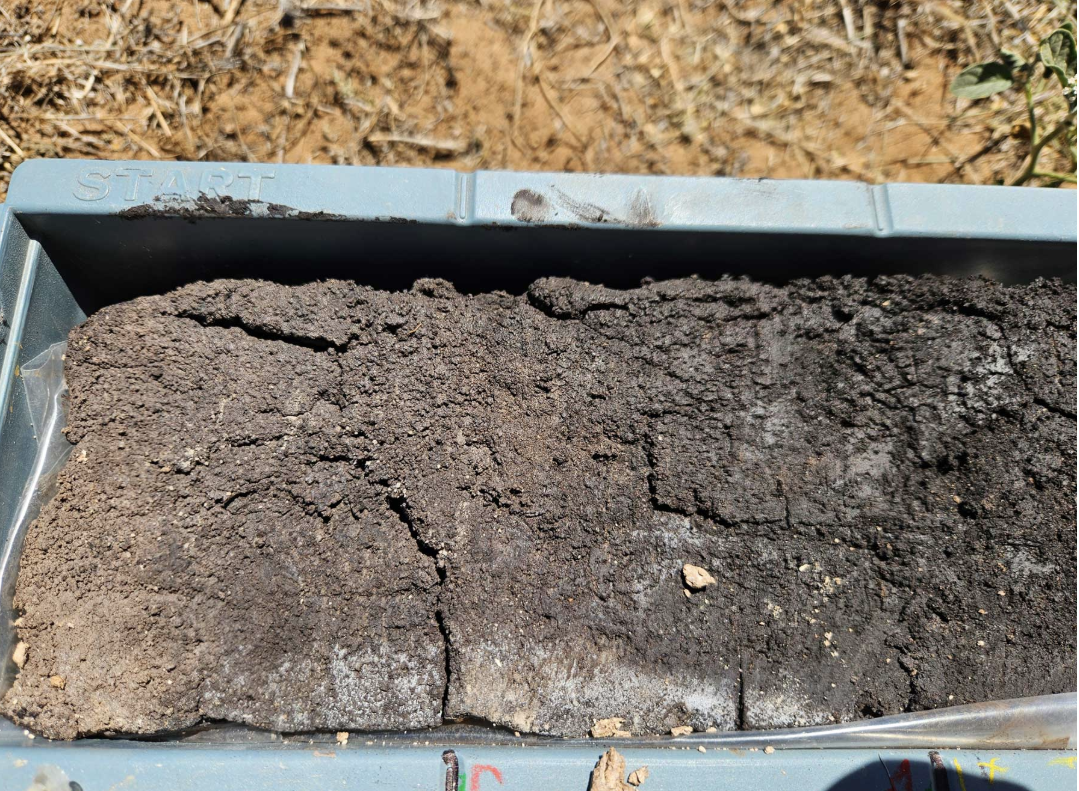
Cobra defines a 150 million tonne Wudinna rare earth resource at 470 parts per million TREO ahead of 2027 small-scale ISR production work.
- Cobra Resources has reported a maiden JORC Mineral Resource Estimate (MRE) of 150 million tonnes at 470 parts per million total rare earth oxide (TREO) for its Wudinna Rare Earth Project in South Australia, containing 70,400 tonnes of TREO.
- Indicated material totals 60 million tonnes at 572 parts per million TREO across the Garford and Pidinga formations. The estimate is based on 91 sonic core holes drilled between 2024 and 2026.
- The estimate was assessed for both in situ recovery (ISR) and open pit mining. 61% of Pidinga ore tonnes and 57% of Pidinga TREO metal tonnes are evaluated as ISR-recoverable, and further work is required to demonstrate permeability and recovery.
- A conceptual Exploration Target of 665 to 1,447 million tonnes at 376 to 478 parts per million TREO covers the Boland and Head areas and is not part of the resource.
- Cobra's indicative schedule includes small-scale ISR production in 2027 and progress toward an investment decision in 2029, subject to feasibility, commercial arrangements, approvals and funding.
Cobra Resources PLC (LSE: COBR) reported a maiden JORC Mineral Resource Estimate (MRE) for the Wudinna Rare Earth Project on October 26, 2026. The MRE outlines 150 million tonnes grading 470 parts per million total rare earth oxide (TREO), containing 70,400 tonnes of TREO. The company assessed the deposit for in situ recovery (ISR) and open pit mining, and the estimate follows 2 years of testwork on the paleochannel sediments. The resource establishes Wudinna's scale. The company's next step is to determine whether ISR recovery, product quality, and operating costs can support a development case.
Resource Defined Across 2 Formations
The MRE is reported at a cut-off of 200 parts per million TREO excluding cerium. Indicated material totals 60 million tonnes at 572 parts per million TREO, with 42 million tonnes at 575 parts per million in the Garford formation and 18 million tonnes at 564 parts per million in the Pidinga formation. The Inferred portion comprises 37 million tonnes at 472 parts per million in Garford and 54 million tonnes at 354 parts per million in Pidinga. Across the full inventory, neodymium-praseodymium averages 101 parts per million, and dysprosium-terbium averages 10 parts per million.
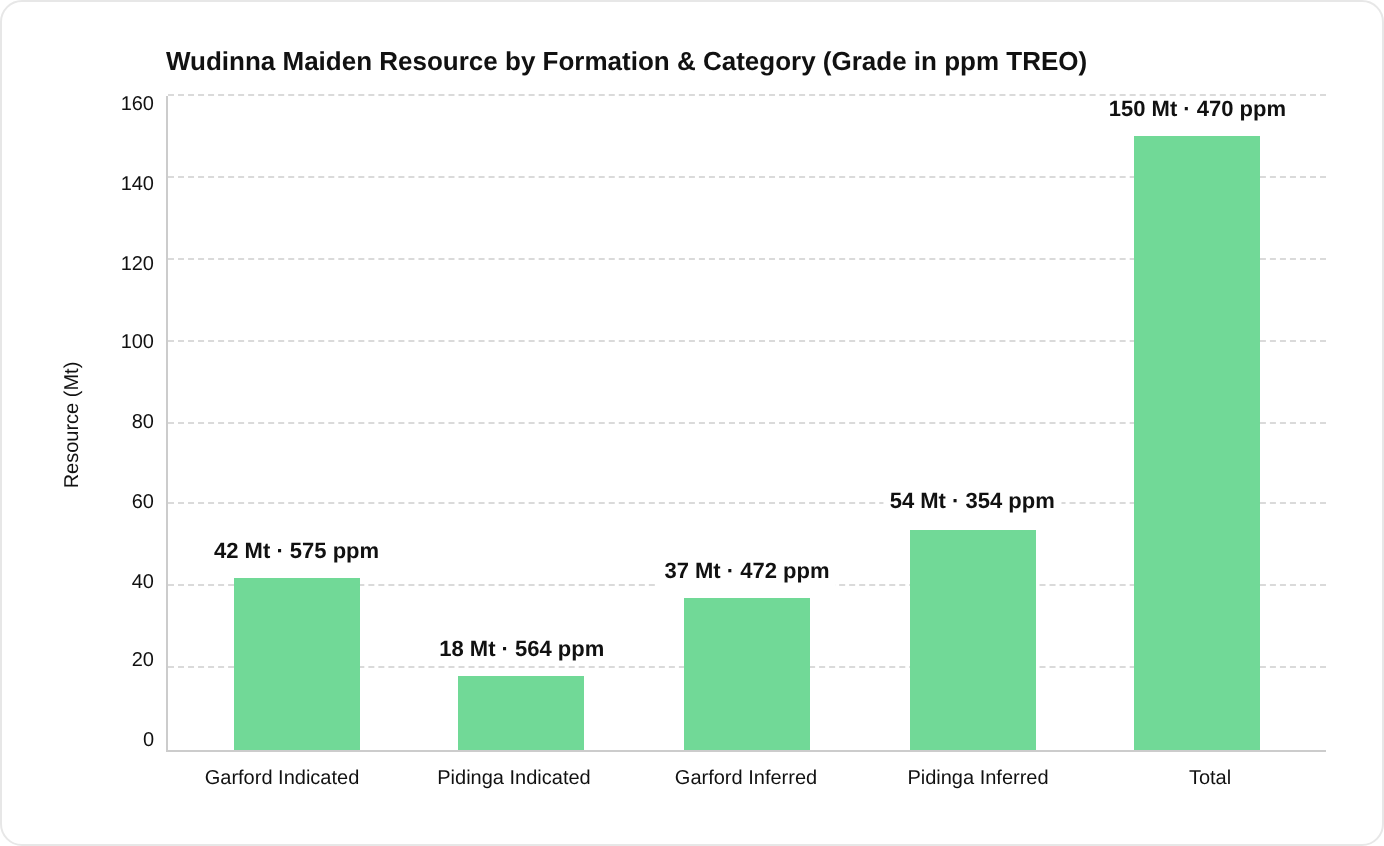
Independent Competent Person Dr Maxim Seredkin of ERM Australia Consultants prepared the estimate from 91 sonic core holes drilled from 2024 to 2026. The estimate uses an average bulk density of 1.6 tonnes per cubic meter, and Cobra has said additional density testing is required. No Ore Reserve has been estimated.
ISR Case Defined, Recovery Still to Be Demonstrated
The estimate applies 2 cut-off cases. The ISR case uses a processing cost of US5.27pertonne,equaltoabout180partspermillionTREOexcludingcerium.Theopenpitcaseuses200partspermillionandaminingcostofUS2.3 per tonne. The ISR case covers permeable paleochannel sediments of the Pidinga formation, contained within laterally continuous confining units in a confined aquifer. On that basis, 61% of Pidinga ore tonnes and 57% of Pidinga TREO metal tonnes are evaluated as ISR-recoverable.
Those percentages are the share of Pidinga material the estimate classes as amenable to ISR. They are not metallurgical recovery rates. Cobra states that further work is required to demonstrate permeability and recovery via ISR methods before more Pidinga material can be classed as ISR-recoverable.
Earlier metallurgical testing recovered more than 80% from selected lower-grade zones with very low sulfuric acid additions, while higher-grade zones returned lower recoveries. Cobra notes that higher-grade material with unfavorable hydrological or metallurgical characteristics may be less suited to ISR. The more-than-80% result therefore applies to the zones tested and is not a project-wide recovery figure.
Funding Priorities
Managing Director and Chief Executive Officer Rupert Verco linked the resource to the next study stage:
"This MRE will underpin the Scoping Study and provides the foundation for our five-pillar development strategy."
The strategy has 5 parts. It targets bottom-quartile production costs through ISR recovery and wellfield productivity. It aims for a higher-value product by maximizing recovery of valuable rare earths and optimizing product specifications to reduce downstream processing requirements. It seeks strategic partners and offtake, and advances feasibility, environmental baseline studies and approvals alongside funding. It also stages capital, with modular ISR cell designs validated through field trials before any final investment decision. Cobra describes bottom-quartile cost as a strategic objective, not a demonstrated position.
Verco said spending over the next 12 months will favor the rare earth project.
"Between the rare earth project and the copper, we expect the spend to actually be 60/40, rare earth to copper, with a pilot study or small-scale production study on the rare earth for in situ recovery coming up."
Verco said the board will assess the financing strategy for the rare earth project, and outlined the route the company anticipates.
"What we anticipate is we will work through a process that will be around strategic offtake partnerships to support the funding of that project."
Cobra has said its Manna Hill copper drilling program is funded, and a number of warrants have been exercised recently. Separately, at final settlement of the sale of its gold assets, Cobra will own 6.45 million Barton Gold shares and is due A$9.5 million in further future payments. These are a shareholding and deferred payments, not current cash.
2027 Work Tests Recovery & Costs
In 2027, Cobra plans to build the cost model, optimize ISR chemistry and product recovery, and demonstrate results through small-scale production, while engaging partners and customers, defining the approvals pathway and baseline studies, and developing the modular wellfield design.
Over 2027 and 2028, the company plans to model wellfield output, demonstrate field performance, validate product quality, negotiate commercial terms, and advance approvals and funding. Progress toward an investment decision follows in 2029, subject to feasibility, bankable commercial arrangements, approvals and funding. Cobra states these windows are indicative and are not a committed timetable. The MRE gives Cobra a defined starting point. ISR recovery across the resource, operating costs and product quality have yet to be established, and the Scoping Study cost model and the 2027 small-scale production work are the next steps toward establishing them.
Beyond the MRE, Cobra holds a prospective paleochannel landholding of about 3,200 square kilometers. Its Exploration Target of 665 to 1,447 million tonnes at 376 to 478 parts per million TREO across Boland and Head is conceptual. Cobra states that there has been insufficient exploration to estimate a Mineral Resource there and that conversion is uncertain, and the target is not part of the 150 million tonne MRE. The company has defined a permeable, high-grade channel at Head as the target for extension and infill drilling.
FAQs (AI-Generated)
Analyst's Notes





Subscribe to Our Channel











Stay Informed