




Diesel’s 16.3-Point Gap Over Crude Exposes Mining Cost Risk


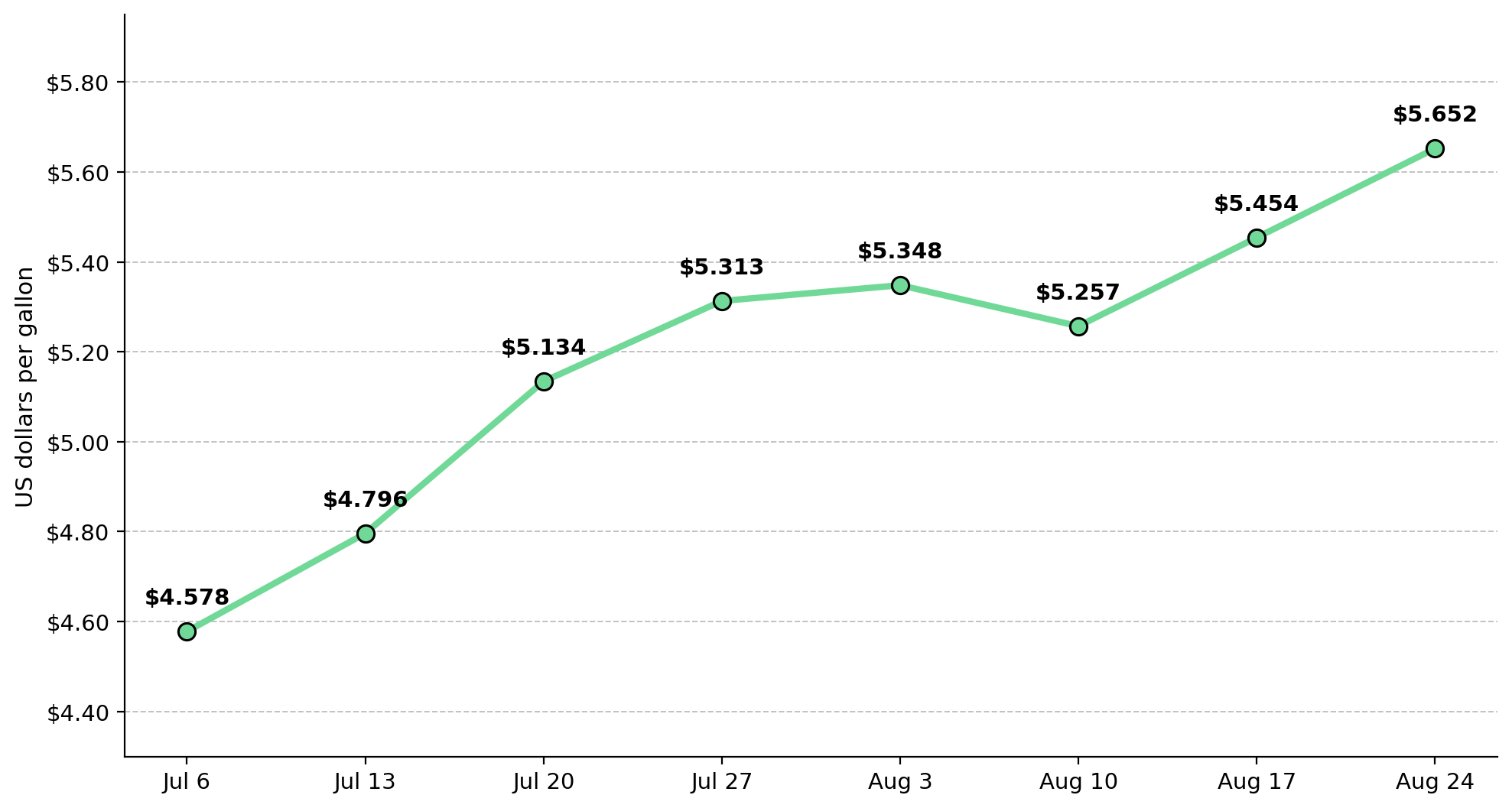
- Brent crude fell roughly 9% from August 20 to August 27, 2026 as Iran and Oman proposed a temporary shipping route through the Strait of Hormuz, while the US national average retail diesel price rose $0.198 to $5.652 per gallon during the week ending August 24.
- US refineries operated at 97.4% of capacity in the week ending August 21, 2026, but distillate production fell to 5.1 million barrels per day, showing near-full utilization was insufficient to rebuild depleted inventories.
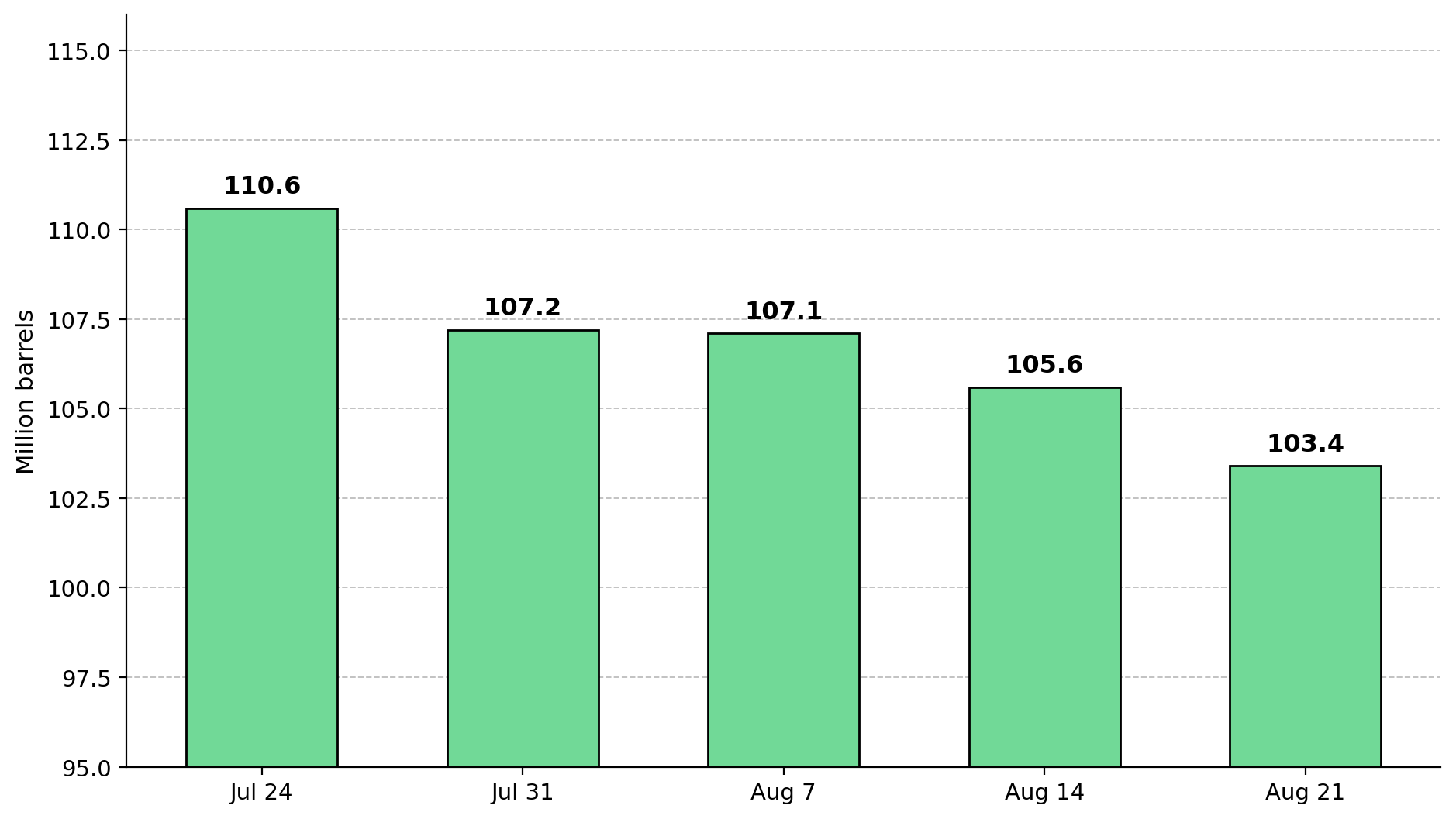
- US distillate inventories fell to 103.4 million barrels in the week ending August 21, 2026, about 14% below the five-year average, reducing the supply buffer before Northern Hemisphere heating demand rises.
- Producer fuel sensitivity tables indexed to crude can understate delivered fuel costs, with a gold producer disclosure showing that a 6% diesel price increase added approximately $3.00 per ounce to all-in sustaining costs (AISC), above the $2.50 per ounce impact from a $10 per barrel oil increase.
- The International Energy Agency (IEA) forecasts global refinery throughput to rebound 3.5 million barrels per day in 2027, indicating that diesel-intensive operations may not receive refinery-driven cost relief until then.
Hormuz Diplomacy Cut Crude 9%, but Refinery Constraints Raised Retail Diesel Prices
On August 24, US Treasury Secretary Scott Bessent announced sanctions against 60 Iran-linked entities and individuals but omitted secondary penalties on Iran’s trading partners, limiting the immediate threat to oil purchases. On August 25 and 26, Iran and Oman proposed a temporary shipping route through the Strait of Hormuz and attempted to clear mines from parts of the waterway, raising the prospect of higher tanker traffic. Brent fell 8.9% from $95.40 per barrel on August 20 to $86.93 on August 27, while West Texas Intermediate (WTI) ended the period at $81.36.
Diesel prices moved against crude over the same period, preventing industrial operators from receiving immediate fuel-cost relief. According to the US Energy Information Administration (EIA), the US national average retail diesel price rose $0.198 during the week to $5.652 per gallon on August 24, or $1.944 above the year-earlier level. The New York Harbor ultra-low sulfur diesel spot price rose to $4.473 per gallon from $4.332 during the same week, compared with $2.361 one year earlier. The simultaneous decline in crude and increase in diesel indicates that refined-product supply constraints, rather than crude prices, were setting near-term fuel costs.
The crude sell-off followed diplomatic claims of improving Strait of Hormuz flows, but independent tracking data had not confirmed a corresponding increase. President Trump said roughly 10 million barrels passed through Hormuz on August 25, while Kpler recorded two commodity vessel transits on August 24 and Vortexa estimated seven-day average oil flows at 6 million to 7 million barrels per day. EIA estimates crude oil and petroleum liquids through the strait averaged 4.9 million barrels per day in the second quarter of 2026, 77% below the 21.6 million barrels per day recorded in the fourth quarter of 2025 before the conflict began. Crude therefore fell on expectations of improving shipping flows, while diesel remained tied to measured refinery output and inventory constraints.
Refinery Throughput Falls 5 Million Barrels Per Day, Holding Diesel Cracks Above $90
IEA records global refinery throughput at 80.9 million barrels per day in July 2026, nearly 5 million barrels per day below the year-earlier level. Middle East product export disruptions and attacks on Russian refineries led IEA to lower its third-quarter refinery throughput estimate by a further 370,000 barrels per day. IEA forecasts global refinery throughput to decline by an average of 2.5 million barrels per day across 2026, keeping processing volumes below 2025 levels. Seaborne product trade fell 3.8 million barrels per day year over year, while diesel exports from Russia, Middle East, and Asia were 1.3 million barrels per day lower, equivalent to about 20% of global seaborne diesel trade and reducing supply available to importing markets.
EIA reported that US refineries operated at 97.4% of operable capacity in the week ending August 21, 2026, up from 97.2% the prior week, while processing 17.4 million barrels of crude per day. Despite the higher utilization rate, distillate production fell to 5.1 million barrels per day. This opposite movement indicates that refinery design and available crude quality, rather than additional crude processing, were limiting further diesel output.
The US diesel crack spread, which measures the difference between diesel and crude prices, reached a record $102.20 per barrel on August 17, 2026, and closed above $100 the following session for the first time. Late-August spreads held near $93 to $94 per barrel on the US Gulf Coast, more than double the $40 upper end of the typical $20 to $40 range, while Northwest Europe gasoil traded around $78 and Singapore around $72 per barrel. Russia supplied about 10% of global diesel before Ukrainian strikes reduced its refining capacity. After 18 refinery attacks in August matched the record set in July, Russia was considering extending its diesel export ban to October 1, which would continue restricting seaborne supply. Elevated crack spreads increase refiners’ gross margins while raising fuel costs for diesel-dependent industrial operations.
Distillate Inventories 14% Below Average Reduce Winter Buffer & Raise Fourth-Quarter Fuel-Cost Risk
EIA reported that US distillate inventories fell 2.2 million barrels to 103.4 million in the week ending August 21, 2026, leaving stocks about 14% below the five-year average and 10.8 million barrels below the year-earlier level. The shortfall widened from 13% the prior week as inventories declined from 105.6 million barrels, reducing the available buffer against further supply disruptions.
Diesel and heating oil draw from the same distillate production stream, so winter heating demand competes with industrial diesel consumption while inventories are already depleted. Scheduled refinery maintenance reduces processing capacity before heating demand peaks, tightening distillate supply while US refinery utilization already exceeds 97%. Fuel budgets based only on fourth-quarter crude prices can therefore understate operating costs because delivered diesel prices also reflect refinery capacity and product inventories.
Diesel Outpaces Crude Benchmarks, Understating Mining Costs While Import Demand Supports Oil Margins
Many mining fuel sensitivity tables index costs to crude, which can miss diesel increases caused by refinery constraints. Barrick Mining’s Second Quarter 2026 Results uses base assumptions of $70 per barrel for WTI and $75 for Brent and estimates that each $10 per barrel change affects gold all-in sustaining cost (AISC) by $12 per ounce. However, EIA data show retail diesel rose 52.4% year over year compared with 36.1% for WTI. Orla Mining’s First Quarter 2026 Financial Results provides a direct comparison, as a 6% diesel-price increase added approximately $3.00 per ounce to AISC, above the $2.50 impact from a $10 per barrel oil-price change. These disclosures show that crude-only sensitivity tables can understate delivered fuel costs when diesel prices rise faster than the benchmark.
Integra Resources reported second-quarter mine-site AISC of $3,371 per ounce and revised full-year guidance of $3,300 to $3,500, citing higher diesel and explosives costs among the contributing factors. Cost sensitivity varies by mine design and hedging, with SSR Mining reporting that fuel represents 10% to 15% of its cost base and that a $10 per barrel oil-price change affects consolidated AISC by approximately $10 per ounce when hedged and $20 to $30 per ounce for unhedged US operations. Agnico Eagle reports that a 10% diesel-price change affects costs by approximately $4 per ounce directly and $2 per ounce indirectly. These differences make haul distance, strip ratio, grid power access, fuel hedge coverage, and underground versus open-pit configuration important variables when comparing operating-cost sensitivity. The same crude-diesel gap also affects oil developers that rely on diesel-powered trucking to reach refineries.
Dune Oil reports a 29% interest in the Block M47 conventional light oil discovery in southeast Turkey, with an established trucking route to the Tupras Batman refinery. At US$72 oil, the company estimates a US$50 per barrel netback after a US$9 royalty, US$8 operating cost, and US$5 trucking cost. The separate trucking line identifies where higher diesel prices could narrow early margins, while pipeline capacity completed in 2026 offers a longer-term transport option as production grows. Scott Lower, President of Dune Oil, connects conservative Brent pricing with strong local demand:
“We’re benchmarking in the $70 to $72 range because that is a conservative pre-war number. Everything is bought and sold at that level because Turkey is a massive oil importer. It’s the biggest importer in the region, fifth biggest importer in the world. We’re selling at top dollar, and you’re selling to the refinery that’s just up the road. They’ll buy every bit of it because they’re displacing Russian, Iranian, and Iraqi oil.”
Refinery Throughput Rebounds in 2027, Delaying Diesel Cost Relief as Key Market Tests Approach
IEA forecasts global refinery throughput to decline by an average of 2.5 million barrels per day in 2026 before increasing by 3.5 million barrels per day in 2027. EIA’s August 2026 Short-Term Energy Outlook (STEO) forecasts Brent to average approximately $85 per barrel in the third quarter of 2026 before declining in 2027. These official forecasts place potential refinery-driven cost relief for diesel-intensive operations in 2027 rather than 2026.
Russia was considering extending its diesel export ban beyond September 1 to October 1 or year-end, which would continue restricting seaborne diesel supply. Seven core members of the Organization of the Petroleum Exporting Countries and allied producers (OPEC+) will meet on September 6 after the group completed the rollback of its 1.65 million barrel per day voluntary cut through a 188,000 barrel per day September increase, making the meeting the next test of crude-supply growth. EIA releases its next STEO on September 9, providing updated crude-price and refinery-throughput forecasts. The Federal Open Market Committee (FOMC) sets interest-rate policy on September 16 after the July Personal Consumption Expenditures price index recorded 3.7% headline inflation and 3.3% core inflation, with the decision affecting the US dollar and oil prices through rate expectations.
Distillate inventories rising above 106 million barrels while refinery utilization remains above 97% would show that US refineries can rebuild stocks near current utilization rates. The ultra-low sulfur diesel crack spread remaining below $80 per barrel for three consecutive sessions would indicate that refinery-driven diesel price pressure is weakening. Vortexa’s seven-day average oil flows through Hormuz rising above 10 million barrels per day would confirm a sustained recovery in shipping and reduce crude-supply risk, although lower diesel prices would still require improved refinery output and inventory data. EIA’s September 2, 2026 Weekly Petroleum Status Report will provide the first update on whether distillate inventories rise from the 103.4 million barrel baseline.
The Investment Thesis for Oil & Gas
- Refinery constraints have widened diesel crack spreads despite falling crude prices, making refined-product supply a more direct driver of delivered fuel costs for diesel-intensive operations.
- Crude-indexed sensitivity tables can understate mining fuel costs when diesel prices rise faster than oil benchmarks, increasing AISC and contributing to higher cost guidance.
- Haul distance, strip ratio, grid power access, fuel hedge coverage, and underground versus open-pit mine design influence how strongly diesel prices affect operating costs.
- Independent project valuations based on pre-conflict assumptions may understate potential revenue at current crude prices and operating costs at current diesel prices, requiring both sides of project economics to be reassessed.
- Replacing trucked oil transport with pipeline access can reduce diesel-linked hauling costs and improve margin predictability, making transport infrastructure relevant to project value.
- IEA forecasts global refinery throughput to rebound in 2027 rather than 2026, making elevated diesel costs a more prudent planning assumption through year-end.
Brent fell 9% between August 20 and August 27, 2026, while US retail diesel rose $0.198 during the week ending August 24, showing that lower crude benchmarks did not provide immediate fuel-cost relief to mining operations. With US refineries operating at 97.4% of capacity and distillate inventories 14% below the five-year average, delivered diesel costs depend more on refinery throughput and product inventories than crude supply. Mining cost guidance should therefore be tested against delivered diesel prices because crude-only sensitivities can understate cost pressure when refining margins widen. Operations and development plans that shorten haul distances, use grid power, hedge fuel, or replace truck transport with pipeline access can retain more margin when diesel prices rise faster than crude.
TL;DR
US refineries operated at 97.4% of capacity, but distillate output fell and inventories remained 14% below the five-year average, keeping diesel prices elevated even as Brent declined. Global refinery throughput was nearly 5 mb/d below the prior-year level, while disruptions to Russian and Middle Eastern product exports lifted diesel crack spreads above $90 per barrel. This disconnect means crude-indexed fuel models can understate delivered costs for mining and oil operations, particularly those reliant on trucking. IEA forecasts refinery throughput to rebound in 2027, so diesel-intensive businesses may receive limited cost relief through year-end. Key signals are rising distillate stocks, lower crack spreads, and sustained recovery in Hormuz flows.
FAQs (AI-Generated)
Analyst's Notes





Subscribe to Our Channel








Stay Informed


