




Dryden Gold Bets on Scale Over Speed as Northwestern Ontario Footprint Expands


Dryden Gold delays resource estimate to pursue district-scale discovery in Ontario, banking on geological continuity and a funded 32,000m 2026 program.
When most junior exploration companies hit visible gold and consistent drill intercepts, the instinct is to rush toward a maiden resource estimate. Dryden Gold Corp. (TSXV:DRY, OTCQX:DRYGF) is doing the opposite - and President Maura Kolb is unapologetic about it.
"One of the reasons I'm hesitant to do a resource too early is [because] you cap the potential. In this market, even though gold's crazy high, you don't really care until you're at a bigger [multi] million-ounce resource."
That restraint reflects conviction, not caution. Over two years of drilling at the company's Gold Rock target in northwestern Ontario, the number of identified parallel mineralised structures has grown from three to fifteen. The most recent hole extended the Big Master system - a secondary gold zone within Gold Rock - to a true depth of 460 metres, more than quadrupling its previously drilled extent. Across 500 metres of strike, the structural continuity is holding.
For a geologist who spent eight years at the Red Lake mine, this is the kind of pattern worth waiting for.
Building the Model
The Gold Rock target sits within an 80,000-hectare land package that Dryden Gold controls entirely. Historic drilling across the broader district totals only about 30,000 metres - shallow, sporadic, and largely focused on near-surface showings. Where previous operators saw scattered occurrences, Kolb's team is constructing long sections for each of the fifteen structures, revealing something more systematic: high-grade mineralisation appearing as vertical continuity within each zone, forming what she calls "towers" of grade that repeat across multiple structures.
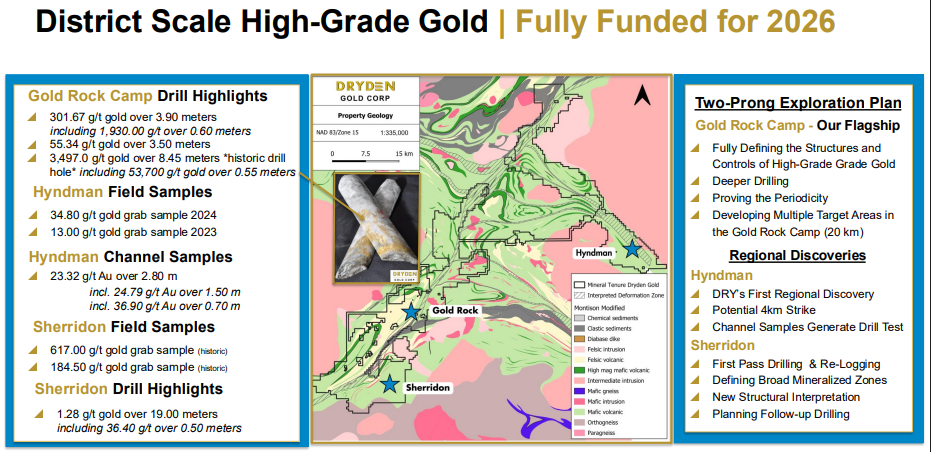
The grades themselves are striking - including historical intersections of 53,700 g/t gold over 0.55 metres - but Kolb is clear that spectacular assays don't define success in high-grade systems without understanding the underlying controls. "In high-grade gold, you can drill a whole lot, and if you don't understand the pattern early, you will waste a lot of money," she said. "You have to be very systematic."
That discipline extends beyond the drill program. Approximately 80% of capital raised has been directed into the ground rather than corporate overhead. The technical team is based in Dryden alongside the project; there is no dedicated corporate office. It's a lean operating model enabled by strong technical depth and strategic backing from Centerra Gold, which holds a 9.9% stake and remains focused on discovery rather than near-term milestones.
Interview with Maura Kolb, President of Dryden Gold Corp
Testing the Thesis
Dryden Gold's broader bet rests on what Kolb calls a "string of pearls" model: the hypothesis that the 20-kilometre Gold Rock corridor will ultimately host multiple discrete deposits along the same geological trend, much like the Red Lake camp's three historically productive mines. Last summer, the company discovered the Mud Lake target, which displays a geological footprint similar to Gold Rock. In 2026, two additional untested anomalies along strike will be drilled.
But the most significant development may be happening on the eastern side of the property. A property-wide soil geochemistry program - completed to validate the company's structural targeting model - delivered more than confirmation. The Hyndman target lit up with multiple high-grade soil anomalies extending over 4 kilometres. The company responded by staking an additional 10,000 hectares and initiating Hyndman's first-ever drill program. Channel samples returned 23.32 g/t gold over 2.80 metres, including 36.90 g/t over 0.70 metres. The initial drilling tested only a portion of the anomalous footprint.
If Gold Rock represents the flagship, Hyndman could be the proof of concept for district-scale potential.
A Funded Field Season
Dryden Gold enters 2026 with a fully funded 32,000-metre drill program and $9 million in cash. The bulk of that capital - roughly three-quarters - will go into drill-ready targets at Gold Rock, Hyndman, and Sherridon, with the balance split between priority regional targets and follow-up work on the soil-till program. Year-round drilling is possible thanks to grid power, highway access, and proximity to skilled labour, with all-in drilling costs running approximately $250 per metre.
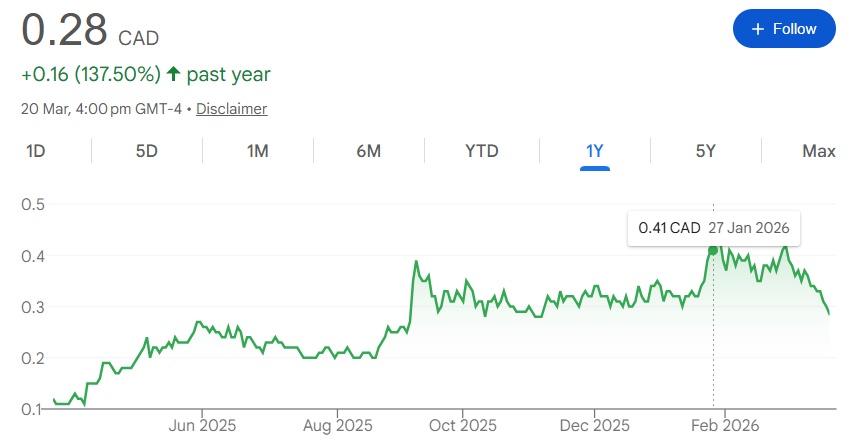
The market backdrop has shifted in the company's favour. Gold prices remain elevated, and interest in high-grade exploration stories has returned. At PDAC 2026, Kolb noted the change in energy: "Everyone is asking about gold, and if they aren't a shareholder, they're looking at you." The company's share price has gained 137.5% over the past year, though it has pulled back from a January peak, trading at $0.28 CAD as of late March. Management's public comments suggest a preference for valuation to strengthen further before pursuing additional capital - a signal that the near-term focus remains squarely on the drill bit.
What 2026 Will Answer
The upcoming field season will test the core elements of Dryden Gold's thesis. At Gold Rock, drilling will continue to define the footprint and test for depth extensions. At Mud Lake and two additional anomalies along the 20-kilometre trend, the company will drill-test the periodicity concept - looking for evidence that high-grade zones repeat at predictable intervals, as they do in Red Lake. At Hyndman, the goal is to understand the scale and geometry of what appears to be a different mineralisation style.
For investors, the newsflow will serve as a referendum on the "string of pearls" model and the decision to defer a resource estimate. If the company demonstrates meaningful continuity at Mud Lake and defines a second district-scale target at Hyndman, the rationale for waiting becomes compelling. If results are scattered, the patience may look premature.
But Kolb's confidence is rooted in geology, not optimism. The structural continuity at Gold Rock is real, the depth potential is confirmed, and the targeting tools are working. The question now is not whether Dryden Gold will eventually publish a resource - it's whether that resource will be large enough to command institutional attention in a sector where multi-million-ounce deposits set the threshold.
In a market hungry for high-grade gold in safe jurisdictions, drilling first and counting later may prove to be exactly the right call. The company has the cash, the ground, and the geological confidence. What it needs now are the results to prove the system is as big as the model suggests.
Analyst's Notes





Subscribe to Our Channel



.png)



Stay Informed






















