



Dune Oil Ranks a Lateral First to Fix C-1 After 3 Failed Cement Jobs


Dune Oil traces C-1's stalled test to 3 failed cement jobs and ranks a lateral first among sidetrack options for M47's fractured carbonate reservoirs.
- The C-1 well on Block M47 logged 38 meters (m) of net oil pay but has never had a sustained production test.
- Three failed cement jobs made it impossible to isolate and produce the C-1 oil zone.
- Management ranks a lateral of 200 or 300 m above a 45-degree deviated well and a vertical well.
- The C-1 sidetrack is first in Dune Oil's work order, with step-out wells to follow.
- Further drilling to confirm deliverability, including the planned C-1 sidetrack, is a listed contingency on the North Field resource.
Why C-1 Has Not Flowed
Dune Oil (CSE: DUNE | OTCQB: DUNXF) has the right to earn a 29% working interest in Block M47 in southeastern Türkiye, where exploration drilling in 2025 found oil at the C-1 and C-2 wells. C-1 logged more than 70 meters (m) of gross oil pay and 38 m of net pay in light oil of 32.4° API gravity, held in the fractured carbonates of the Mardin and Beloka Groups. No sustained production test has been run on the North Field. C-1 was drilled on the structural flank and encountered only part of the interpreted oil column.
More than 150 m of Mardin reservoir remains undrilled in the well. The plan is to reach it via a sidetrack, a new wellbore drilled from the existing hole, for a production well. Management describes the logs as strong and reports agreement among its geophysicists and engineers that C-1 is an oil well.
The well has not produced because 3 failed cement jobs made it impossible to isolate the oil zone and produce it. Cement seals the space between a well's steel casing and the surrounding rock. President and Chief Executive Officer of Dune Oil, Scott Lower, traces the failure to the cementing rather than the rock:
"It's a technical issue, not a reservoir issue. And that's the key because the technical issue was they had 3 failed cement jobs."
A technical failure of this kind can be fixed where a reservoir failure cannot, by management’s account.
How Fractured Carbonates Deliver Oil
Oil in M47's North Field comes from fractured carbonate. According to management, the Mardin and Beloka carbonates are relatively tight and produce through their natural fractures. Producing fields near the block draw on the same Beloka and Mardin Group reservoirs.
The North Field structure is an anticline, a rock layer folded upward into a dome, with a crest, a forelimb, and a backlimb. Fracturing is densest on the crest, where the brittle rock snapped as it was uplifted, and the forelimb is the next-best zone, by management's description. Lower links well length to the fracture networks:
"The longer you can go, the more probabilities you hit all the fracture networks."
The drilling instruction that follows is to cross the crest and continue as far as possible into the forelimb. Management lists Oman, Saudi Arabia, Iran, Iraq, the Kurdish area of northern Syria, and Canada among the places where this reservoir type produces, and puts Türkiye at about 4 years in these carbonates, compared with about 30 years for other operators.
Completion Options for the C-1 Sidetrack
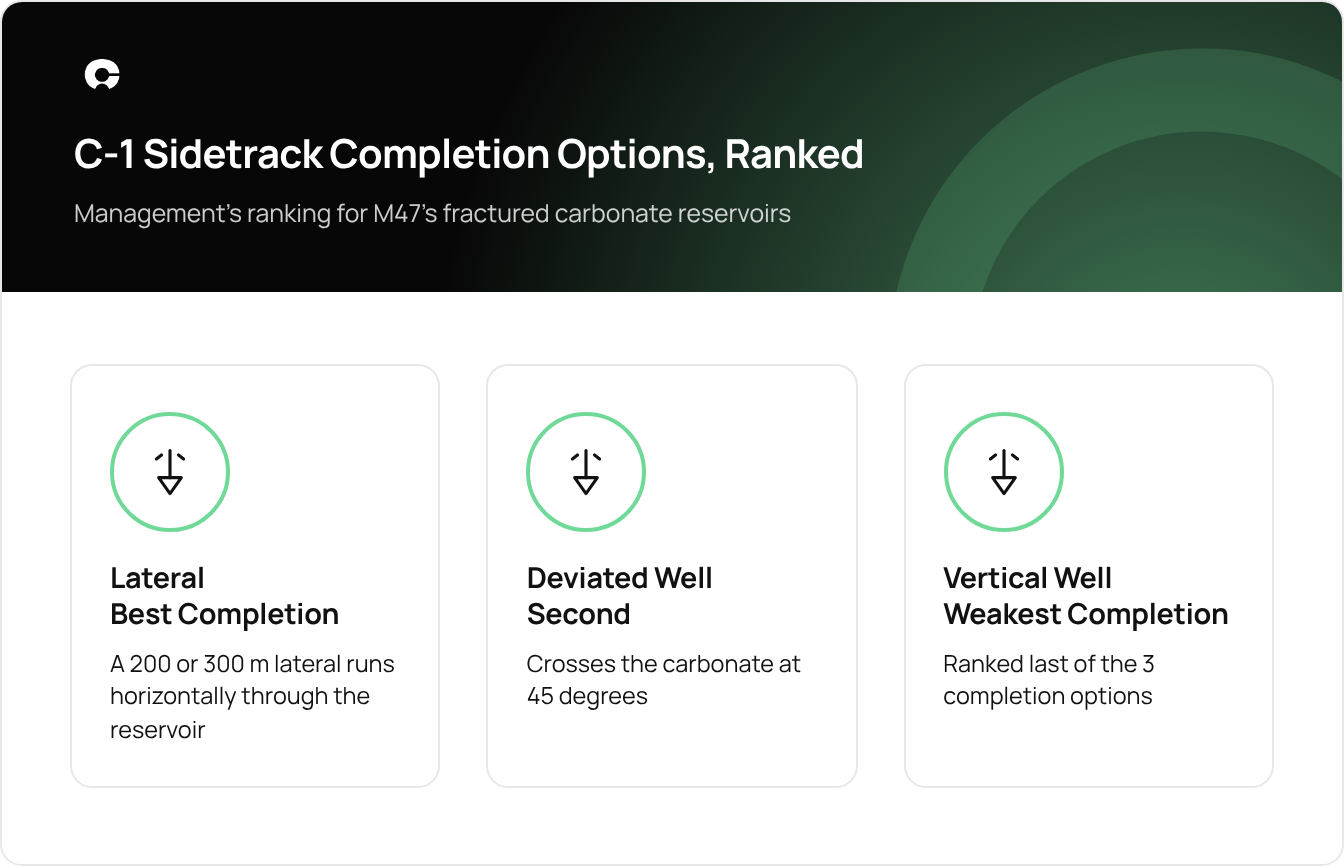
Dune Oil's released plan calls for the C-1 sidetrack to be either deviated or lateral, alongside a re-entry of the C-2 well. Management ranks a vertical well as the weakest completion, a well that crosses the carbonate at 45 degrees as second, and a lateral of 200 or 300 m as the best. A lateral is a well turned to run horizontally through the reservoir, which lengthens the section open to the rock.
Chief Operating Officer of Dune Oil, Jordan Coleman, ties the directional option to initial production (IP) and keeps it conditional:
"So we're looking at and planning to possibly do some directional work through these naturally fractured carbonates to increase our contact area, and that's what's going to help us maximize the initial production and the IP from these wells."
The stabilized rate and the test result depend on that completion choice, by management’s account, and management expects the new seismic to give a little guidance on how the wells are completed. The recompletion work includes running electric submersible pumps, downhole pumps that lift oil to the surface, into the wells to bring them to flow and clean them up.
Four consulting engineers who have worked in 30 countries have peer-reviewed the plan. Dune Oil's 4 technical advisors bring experience matched to fractured carbonate reservoirs, including horizontal completions and work in the Zagros basin. Their experience also covers managed-pressure and underbalanced drilling, techniques that control wellbore pressure during drilling, with projects in Iraq, Saudi Arabia, Oman, and other countries.
Sequencing Around the Sidetrack
The C-1 sidetrack is first in Dune Oil's order of work. Management considers the next-least-risky well to be a step-out 200 m east or west of C-1, using the same design. A further well beside it would let a small well battery share a single set of tanks and a single truck route. The early production facility would be rented and built around tanks. The planned C-2 re-entry would deepen that well into the Mardin Group for testing.
The C-1 re-entry would cost roughly US$1.5 million, or about US$1.3 million net to Dune Oil, by management’s estimate. Dune Oil’s share of the next 2 wells is up to 80%, the upper threshold, while contributions from other parties are discussed.
Seismic acquisition covers approximately 45 kilometers of 6 two-dimensional lines across the C3 and C4 licenses, designed to define fault-controlled structural traps better. The program is budgeted at approximately US$600,000 net to Dune Oil, with US$200,000 advanced. Mobilization is planned for November 2026, with completion expected in February 2027. After interpretation, Dune Oil expects to finalize and announce new drilling locations in the South Lead and North Lead areas, as well as the C-2 re-entry and the C-1 sidetrack. The schedule places C-1 and C-2 production and testing in early 2027. If everything goes according to plan, management hopes to have the wells running by the end of the first quarter or the start of the second quarter of 2027.
What the Flow Test Must Establish
The independent evaluation of the North Field is effective December 31, 2025, before any sidetrack. It classifies the oil as economic contingent resources in the development-unclarified sub-class, a category for discoveries whose development still requires further appraisal or evaluation, with an 81% chance of development. Its best estimate is 27.6 million barrels, company gross to Dune Oil's 29% working interest before royalty, against an unrisked low case of 8,148 thousand stock-tank barrels and a high case of 44,930 thousand stock-tank barrels.
The evaluation lists the contingencies that stand between that estimate and development. They include further appraisal or development drilling, the planned C-1 sidetrack among them, to confirm deliverability, alongside a development plan approved by the joint operating committee, regulatory approvals, development financing, and an oil sales agreement. Its negative factors include the incomplete earn-in and the absence of an approved development plan or financing. Of the listed conditions, the sidetrack is the one named against deliverability.
Unrisked net present value at a 10% discount rate, before income tax, for the North Field best estimate is US$734 million, and US$594 million risk-adjusted at the 81% chance of development, and neither figure is fair market value. Dune Oil’s estimated netback is US$50 per barrel at US$72 per barrel for oil, after royalty, operating cost, and trucking, with an estimated well payback of about 2 months. At the 2025 average Dated Brent price of US$69.10 per barrel, the company’s model puts the M47 netback at US$47.46 per barrel, or 69% of the price, though M47 has no production yet. Management expects producing wells to move the company from a contingent resource toward reserves. The C-1 sidetrack is the first field test of the deliverability condition, and its completion design is the variable management has already ranked.
The Investment Thesis for Dune Oil
- The C-1 well logged more than 70 meters of gross oil pay and 38 meters of net pay in light oil but has never had a sustained production test.
- Three failed cement jobs made it impossible to isolate and produce the C-1 oil zone, a failure management classifies as technical.
- Management ranks a lateral of 200 or 300 meters above a 45-degree deviated well and a vertical well for the C-1 sidetrack.
- More than 150 meters of the Mardin reservoir remains undrilled in C-1, and the plan is to reach it with a sidetrack for a production well.
- Seismic acquisition is planned from November 2026 to February 2027, and C-1 and C-2 production and testing are scheduled for early 2027.
- The independent evaluation lists further drilling, including the planned C-1 sidetrack, as a way to confirm deliverability of the North Field resource.
Dune Oil's North Field case depends first on whether a rebuilt C-1 wellbore can flow. Management has identified the failure as a cementing problem and ranked the completion options. The early 2027 test will measure the chosen completion against a reservoir that has already logged 38 meters of net pay.
TL;DR
Dune Oil's C-1 well on Block M47 is a logged oil discovery whose test was stalled by 3 failed cement jobs, and management ranks a lateral first among the completion options for the planned sidetrack. Confirming deliverability through further drilling, the C-1 sidetrack included, is a listed contingency in the 27.6 million-barrel best estimate for the North Field. Seismic acquisition runs from November 2026 to February 2027, and C-1 and C-2 production and testing are scheduled for early 2027.
FAQs (AI-Generated)
Analyst's Notes





Subscribe to Our Channel






Stay Informed


