enCore Energy: America's Best Bet on Domestic Uranium


enCore Energy operates two US uranium plants using low-cost In-Situ Recovery technology, holding 30.94 million lbs of resources amid surging nuclear demand and strong government support.
- enCore Energy is one of the few actively producing uranium companies in the United States, with two operational Central Processing Plants (CPPs) in South Texas.
- The company uses In-Situ Recovery (ISR) technology, which costs less than 15% of conventional mining capital expenditure (CAPEX).
- Total measured and indicated mineral resources stand at 30.94 million pounds of uranium oxide (U₃O₈), with an additional 20.54 million pounds in the inferred category.
- Uranium spot prices hit an intraday high of $101.50 per pound in January 2026, the highest since February 2024, signalling strong market momentum.
- The US government has banned Russian uranium imports effective August 2024, unlocking $2.72 billion in federal funding for domestic nuclear fuel supply.
Nuclear Power Is Back & Uranium Is the Fuel Behind It
The global nuclear energy renaissance is no longer a prediction. It is happening. According to the World Nuclear Association (WNA), approximately 70 nuclear reactors are under construction globally as of early 2026, with 115 more planned and over 300 proposed. Nuclear currently provides about 9% of the world's electricity from approximately 440 reactors across 31 countries, per the WNA, with the International Atomic Energy Agency (IAEA) putting the 2024 share more precisely at 8.7%.
That growing demand needs fuel. Uranium spot prices reached an intraday high of $101.50 per pound in January 2026, the highest since February 2024, before settling near $92 per pound. Nuclear fuel market analysts have noted that demand tied to government-led energy initiatives and growing commercial electricity needs is outpacing supply development, creating a widening gap between supply and demand that is expected to persist for the foreseeable future. For investors, that structural imbalance is exactly where opportunity lives, and enCore Energy is positioned directly inside it.
A Company Built for This Moment
enCore Energy is a US-focused uranium producer that extracts uranium exclusively through In-Situ Recovery, a low-impact method where oxygenated water is injected underground to dissolve uranium, which is then pumped to the surface and processed into yellowcake uranium oxide. Unlike conventional open-pit or underground mining, ISR leaves the surface largely undisturbed and requires significantly less capital to build and operate. The average CAPEX for ISR operations is less than 15% of conventional mines.
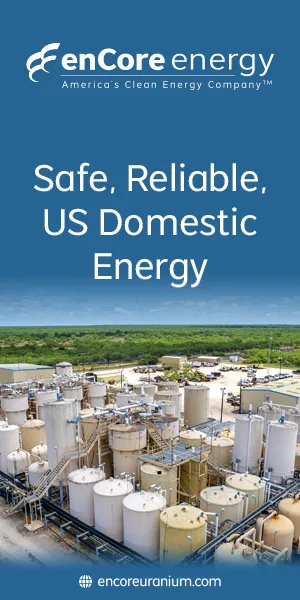
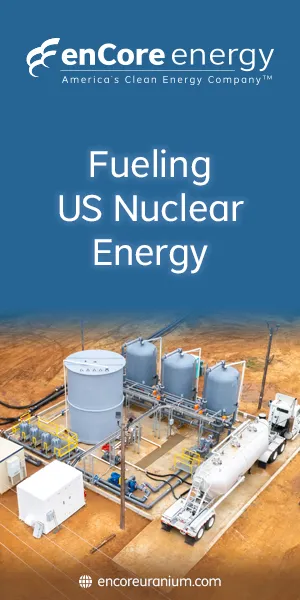
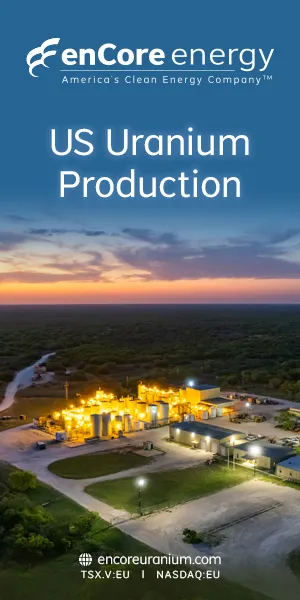
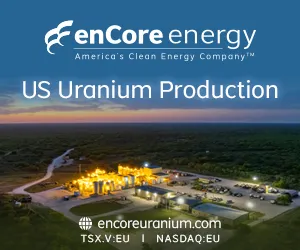
The company currently runs two operational CPPs in South Texas: the Alta Mesa CPP and the Rosita CPP. The Alta Mesa CPP began operations in the Second Quarter of 2024 under a 70/30 joint venture with Boss Energy Limited and was built with a total design capacity of two million pounds per year, though it is currently configured at one million pounds, meaning enCore can scale up production without building costly new infrastructure from scratch. The Rosita CPP carries an annual processing capacity of 800,000 pounds of U₃O₈ and operates a satellite Ion Exchange (IX) plant model, capturing uranium at remote wellfield locations on resin and trucking it back to the plant for processing. A third licensed plant at Kingsville Dome is held in reserve for future production.
Reflecting on the company's 2025 performance, Chief Executive Officer and Director of enCore Energy, Robert Willette, was direct about what the numbers showed. In the company's year-end financial results press release, Willette stated:
"Production from our South Texas operations continued to trend upward, with improvements in wellfield efficiency driving strong extraction results. With nearly 700,000 pounds extracted in 2025, and total liquidity of $96 million at year end, including marketable securities, our team continues to execute."
The Numbers Every Investor Should Know
At a market capitalisation of approximately $359 million as of March 24, 2026, with shares priced at $1.85, enCore carries a balance sheet that includes 194.2 million shares issued and outstanding, a fully diluted count of 204.8 million, and a convertible note of $115 million at 5.5% maturing in August 2030. The resource base behind those numbers is significant. The Alta Mesa Uranium Project in South Texas holds 2.585 million pounds of measured and indicated U₃O₈ resources, with an additional 5.2 million pounds in the inferred category. The Rosita Uranium Project adds over 3.5 million pounds of measured and indicated resources across the Upper Spring Creek and Rosita South areas.
Further along the development pipeline, the Dewey Burdock Project in South Dakota holds 17.1 million pounds of measured and indicated resources, with a pre-tax internal rate of return (IRR) of 39% at a long-term uranium price of $86.34 per pound and initial capital costs of $264.2 million. The Gas Hills Project in Wyoming carries a pre-tax IRR of 54.8% at $87 per pound, with lower initial capital costs of just $55.2 million. Together, these four projects form a production pipeline that stretches from current operations through to 2030 and beyond, giving investors exposure to both near-term production and longer-dated development upside within a single company.
On the sales side, enCore has deliberately kept less than 38% of its planned extraction contracted through 2033. That means the majority of future production remains uncontracted and open to spot market prices, a deliberate strategic choice that preserves significant upside if uranium prices continue to rise. Willette addressed that point and the company's longer-term role, saying:
"As the United States continues to recognize the importance of rebuilding a secure domestic nuclear fuel supply chain, enCore believes its portfolio of ISR uranium projects positions the Company to play a meaningful role in helping meet future US clean energy growth."
Why Washington Is on enCore's Side
The policy environment for domestic uranium production has shifted in a way that is difficult to overstate. Recent White House executive orders have prioritised uranium production, streamlined permitting regulations, and declared a national energy emergency. Uranium was also reinstated to the United States Geological Survey (USGS) final List of Critical Minerals for 2025, a move that directly supports faster permitting timelines and greater federal resource backing for producers like enCore.
The supply picture driving that urgency is well documented. According to the EIA's 2024 Uranium Marketing Annual Report, published in September 2025, Canada was the top source of uranium delivered to US reactors in 2024 at 36% of total deliveries, followed by Kazakhstan at 24%, Australia at 17%, Uzbekistan at 9%, and Russian-origin material at just 4%, down sharply from 12% in 2023. That drop reflects the import ban that came into effect in August 2024, although waiver provisions remain available through January 1, 2028, meaning the transition is still in progress. Combined, state-owned enterprises from Kazakhstan and Uzbekistan still account for 33% of 2024 US uranium deliveries, a geopolitical concentration that policymakers are actively working to reduce. The Russian import ban also triggered $2.72 billion in federal funding to build out the domestic nuclear fuel supply chain, per the EIA.
Willette connected enCore's position directly to that national security argument in a recent SEC press release, stating:
"enCore continues to make steady progress across our portfolio of US uranium projects as we work to expand domestic production capacity. At Dewey Burdock, we remain focused on advancing the project through the final regulatory milestones so that it can become an important future source of domestic uranium supply."
What Is Happening Right Now on the Ground
Operationally, 2025 was a year of consistent execution at enCore's South Texas sites. At Alta Mesa, a total of 270 new production wells were brought online during the year, averaging 22 per month or one every 1.35 days. Wellfield 7 produced throughout the full year, and additional wells are being brought online in the First Quarter of 2026. Work on Wellfield 3 Extension is well advanced, with monitoring wells and initial wellfield patterns nearing completion pending final permitting. Initial development has also commenced on Wellfield 8, including monitoring wells and the early stages of the permitting process.
At the Rosita project, the Upper Spring Creek (USC) project has been incorporated into the Rosita Radioactive Materials License (RML), with the first two trains of the IX plant completed and the remaining two under installation. That expansion will double processing capacity from 1,600 gallons per minute to 3,200 gallons per minute, giving the Rosita CPP the throughput capacity to absorb feed from a growing number of satellite wellfield sites across South Texas. Meanwhile, in South Dakota, the Dewey Burdock project received approval for US Government Fast Track Permitting in August 2025, cutting through what has historically been one of the longer regulatory processes in the uranium sector. State permitting is expected to complete by the end of 2027, with plant engineering beginning in 2026.
The Investment Thesis for enCore Energy
- Policy is actively working in enCore's favour: Executive orders, fast-track permitting, and the Russian import ban all direct attention and capital toward domestic producers, and enCore is already operational while most peers are not.
- ISR gives enCore a structural cost edge: At less than 15% of conventional mining CAPEX, enCore's projects are built to remain economically viable across a wider range of uranium price scenarios than conventional producers.
- Less than 38% contracted through 2033 means significant upside: If uranium prices move toward or beyond the January 2026 intraday high of $101.50 per pound, enCore stands to capture the majority of that gain on uncontracted volumes.
- Dewey Burdock is the single most important near-term growth catalyst: A 39% pre-tax IRR, fast-track federal permitting approval, and a projected 28-year mine life at 750,000 pounds of U₃O₈ per year make this the most consequential project in the development pipeline.
- Wellfield output in 2026 is the key operational signal to watch: The commissioning of Wellfield 3 Extension and Wellfield 8 at Alta Mesa will be the clearest near-term indicator of whether enCore is on track to meet its production targets.
- A sustained uranium price recovery above $100 per pound would likely re-rate the stock: Nuclear fuel market analysts note that the structural supply gap is expected to persist through 2040, and any sustained price recovery would accelerate development timelines across enCore's entire project portfolio.
enCore Energy is not a bet on a future mine. It is a bet on a company that is already producing uranium in the United States at a time when the US government is actively working to grow exactly that capacity. With two operational plants, a deep resource base totalling 30.94 million pounds of measured and indicated U₃O₈ across its South Texas, South Dakota, and Wyoming projects, and a sales strategy built to capture upside in a rising uranium market, the company offers something genuinely rare in the resource sector: current production combined with meaningful future growth. The risks, including permitting delays, uranium price volatility, and a $115 million debt obligation, are real and warrant careful attention. But the structural forces at work are not short-term trends. They are multi-year dynamics that enCore is built to benefit from, and for investors looking to gain direct, operationally grounded exposure to the uranium market, enCore Energy deserves serious consideration.
TL;DR
enCore Energy is one of the few actively producing US uranium companies, operating two ISR plants in South Texas at a fraction of conventional mining costs, while sitting on 30.94 million pounds of measured and indicated resources and a deep development pipeline - all at a moment when federal policy, a Russian import ban, and a structural global uranium supply gap are actively working in its favour.
FAQs (AI-Generated)
Analyst's Notes





Subscribe to Our Channel



Stay Informed