Falling Fed Hike Odds Open a Selective Contrarian Case for Gold Producers



Central bank buying supports gold demand, while mining costs, debt payments and spending determine how much revenue producers can retain for growth.
- Spot gold rose 0.6% to $4,165.49/oz by 0901 GMT on October 5 as October Fed hike odds fell to 18% from 64% a week earlier.
- The October 2 jobs release showed 29,000 September payroll additions against an 84,000 forecast, with July and August revised down by 60,000, reducing pressure for an immediate hike.
- On October 5, markets still priced a 69% probability of higher rates by December, keeping interest-paying assets competitive with gold.
- At October 5 spot, holding Q1 2026 all-in sustaining cost (AISC) of $1,785/oz unchanged gives a modeled $2,380/oz spread, about 23% below the Q1 record.
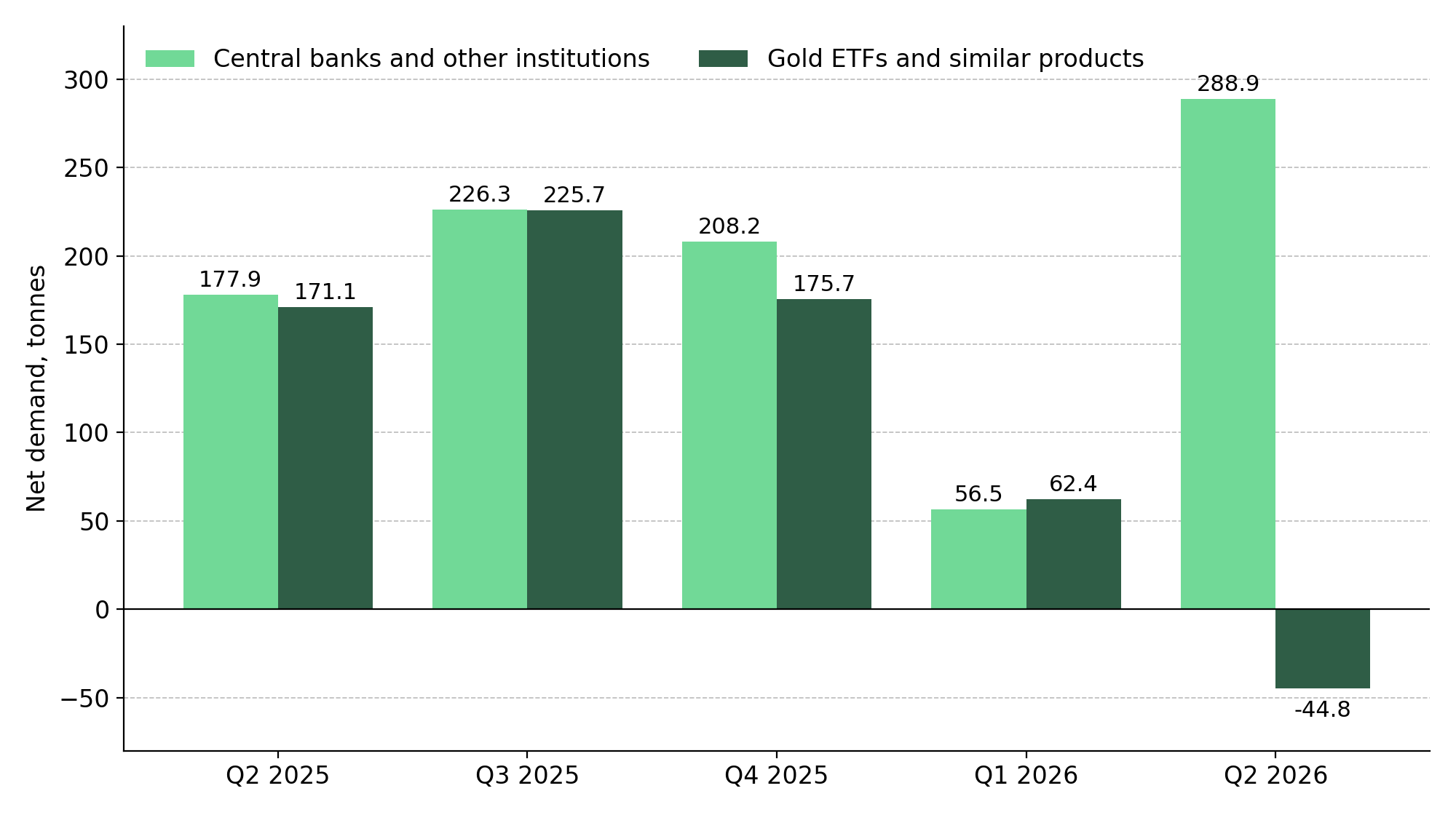
- Data published July 30 showed Q2 central bank purchases of 288.9 tonnes despite 44.8 tonnes of gold exchange-traded fund (ETF) outflows, supporting demand during fund selling.
Weaker Hiring Supports Gold as October Hike Odds Fall
Gold rose as October hike odds fell 46 percentage points, reducing near-term rate pressure on the metal. September hiring missed forecasts by 55,000 jobs, while downward revisions removed another 60,000 jobs from July and August. A 0.22% rise in the US dollar index limited gains by making gold more expensive in other currencies.
Gold remains 14.5% below its Q1 LBMA Gold Price PM average of $4,872.90. A return to that benchmark would add about $707/oz to unhedged sales revenue at unchanged volumes, before cost changes.
Central Bank Buying Supports Gold Despite ETF Selling
The Fed’s 0.25-percentage-point hike to 3.75%–4.00% increased the appeal of interest-paying assets relative to gold. Q2 gold ETFs lost 44.8 tonnes as weaker prices, higher rate expectations and a stronger dollar discouraged holdings.
Central banks bought 288.9 tonnes in Q2, a second-quarter record that supported demand while ETFs sold. Paul Brink, President and Chief Executive Officer of Franco-Nevada Corporation and Chair of the World Gold Council (WGC), said growth in official gold holdings reinforced gold’s role as a strategic reserve asset.
Giovanni Staunovo, Analyst at UBS, identified rising government debt as support for gold after US debt exceeded $40 trillion.
Lower Rate Expectations Offer a Conditional Gold Recovery Catalyst
The 69% probability of higher rates by December leaves gold exposed to further tightening. Tim Waterer, Chief Market Analyst at KCM Trade, said weaker hiring supported gold by reducing October hike expectations, while markets continued to price further tightening.
The base scenario assumes an October hold, a December hike, unchanged spot gold and unchanged Q1 AISC, producing a modeled $2,380/oz spread. A recovery to the Q2 LBMA Gold Price PM average of $4,506.29 would lift that spread to $2,721/oz, about 14% above the base scenario. An inflation surprise could revive hike expectations and pressure gold, while higher energy costs would reduce producer spreads.
The October 7 Fed minutes, October 28 decision and November 6 jobs report can change rate pricing before the December 8–9 meeting. This article uses a December hike probability below 50% after October 28 as a monitoring threshold for reduced tightening risk and a stronger gold recovery case.
Lower Costs Preserve More of a Gold Price Recovery
At unchanged costs, each $100/oz gold price increase adds $100/oz to the modeled AISC spread, about 4.2% of the current base. However, Q1 AISC rose 16% year over year, and royalties represented 12% of average costs, up from 6% five years earlier.
At equal realized gold prices, lower-AISC producers retain a larger margin cushion during price declines. Franco-Nevada describes its royalty and streaming model as limiting exposure to many operating-company risks, making operating-cost exposure another factor in company selection.
Company assessment should use current gold prices and company-specific costs alongside debt and growth spending, because an AISC spread is not cash available to shareholders.
Current Margins Support a Selective Gold Case
Reduced October hike odds and central bank buying support a conditional gold recovery case. The modeled $2,380/oz spread provides a basis for assessing lower-cost producers, while company-specific debt and spending determine their capacity to fund operations and growth.
The contrarian opportunity rests on selecting companies that can withstand lower gold prices and retain more revenue if gold recovers.
Analyst's Notes





Subscribe to Our Channel







Stay Informed