




Beaver Creek 2026 Recap: A Window to the Future of Junior Mining



Majors, governments and funds are backing multi-year junior mining builds, yet shares trade below asset value, leaving execution to drive the next re-rating.
- Capital has returned to junior mining selectively, funding multi-year development plans at a limited group of projects rather than a sector-wide recovery.
- Strategic equity, royalties, government grants, project debt and operating cash flow are replacing serial equity raises, though each carries its own cost to shareholders.
- Tier-1 institutions, strategic majors and generalist capital are entering, as market capitalizations reach mandate thresholds.
- Management teams with mine-building experience and personal share ownership are structuring projects around starter pits, restarts and existing infrastructure.
- Select juniors posted multi-fold share gains, while developers at 0.2x to 0.5x P/NAV retain room to re-rate as milestones advance.
Committed Capital Positions Select Juniors for Faster Development
Interviews conducted by Crux Investor at the 2026 Precious Metals Summit in Beaver Creek show capital returning to junior mining on different terms from prior cycles. Funding is concentrated in projects capable of absorbing multi-year budgets, and it is increasingly structured to limit equity dilution. Executives also point to broader institutional ownership, experienced mine-building teams and share-price gains yet to close valuation discounts.
Multi-Year Budgets Replace Single-Hole Raises & Compress Timelines
Juniors that finance one placement at a time have to schedule drilling, engineering, and permitting around market access, which raises the effective cost of each meter drilled. Multi-year budgets let companies secure drilling contractors, retain technical staff and run metallurgical testing and permitting in parallel. The funding shift favors companies with two- to three-year horizons and shortens the interval between discovery and a construction decision.
Westhaven Gold secured multi-year project-level funding, with Dundee Corporation able to earn up to 60% of four British Columbia gold properties by funding up to C$85 million in staged expenditures.
The shift is selective because construction costs and financing requirements continue to exclude weaker projects. Institutions must identify which projects satisfy financing mandates. Retail shareholders must judge whether each dollar raised advances the asset enough to justify its cost.
Discovery Group, a merchant group that incubates and finances junior mining companies, sees this change across its portfolio. Jim Paterson, Co-Founder and Principal of Discovery Group, describes the new planning horizon:
"Sometimes companies with no capital are just raising capital for one drill hole... whereas now you can say a 2-year or three-year plan, you can negotiate with your drilling contractors... cost of capital goes way down."
Strategic & Non-Dilutive Capital Replaces Serial Equity Raises
Funds raised by junior and intermediate miners rose 109% to US$21.43 billion in 2025, ending three consecutive years of decline and finishing just short of the US$21.65 billion peak set in 2021, according to S&P Global Market Intelligence's World Exploration Trends 2026 report, published in March 2026.
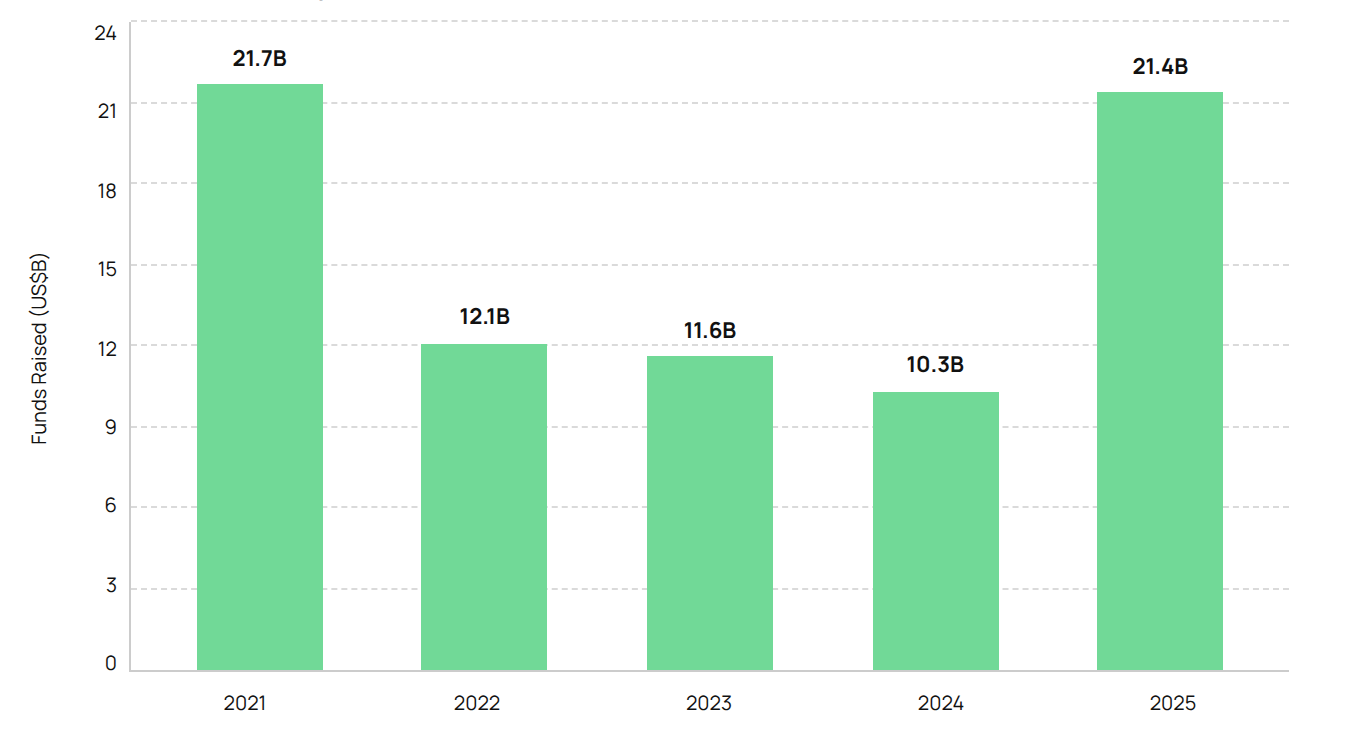
A sizable portion of the capital went to mine development rather than exploration, as junior exploration budgets fell 13% to US$4.39 billion. Exploration also shifted toward known deposits, as major producers lifted minesite work to a record 45% share of global exploration budgets. Gold financings reached US$10.17 billion, the highest in S&P records dating to 2014, positioning funded gold developers to move assets toward production while prices remain elevated.
Executives interviewed at Beaver Creek consistently prioritized funding that limits share issuance, drawing on strategic majors, royalty partners, government agencies and lenders. The terms, timing, and obligations attached to that capital determine whether it improves per-share value.
Majors Back Juniors Positioned to Feed Existing Mills & Shafts
Senior producers are taking cornerstone stakes in juniors to secure exposure to replacement ounces near their own operations. Strategic equity still dilutes existing holders. It typically arrives in larger tranches, though, and funds a complete work program rather than a single season. Funding runway is the period before additional capital is required, and it should be measured against committed expenditure rather than cash balance alone.
Radisson Mining Resources closed a C$57 million investment from Agnico Eagle on September 2, 2026, for a 10.5% stake with warrants to reach 14.90%, and President and Chief Executive Officer Matthew Manson links the investment to the O'Brien project's position beside Agnico Eagle's flagship LaRonde mine:
"Agnico is not just one of the world's biggest gold mining companies; they are the owners of the project, their flagship mothership mine, adjacent to our project, 3 km away. A lot of validation for the project and for everything we're trying to achieve."
Government & Royalty Capital Expand Funding Beyond Equity Markets
Government grants, export-credit interest, and royalty sales to partners such as Franco-Nevada and Wheaton Precious Metals avoid issuing new shares, but they do not eliminate financing costs. Reimbursable grants release cash only as conditions are met. A letter of interest is not a loan commitment. Royalties and streams permanently reduce the revenue attributable to equity.
Banyan Gold raised equity in a financing backed by Franco-Nevada, lifting its treasury to about C$100 million to fund work in the Yukon through 2028. Franco-Nevada separately bought an existing AurMac royalty for C$52.2 million in February. Atlas Salt holds over C$300 million in non-binding letters of intent from Export Development Canada, a second export credit agency and Sandvik, covering more than half of its C$589 million Great Atlantic Salt capital cost.
Highland Copper holds a US$50 million reimbursable infrastructure grant from the State of Michigan for its Copperwood project, and Chief Executive Officer Barry O'Shea connects its federal support to US supply priorities:
"They want to put money into projects that will assist with the near-term supply-demand imbalance in the US. That's mineral security. Then we have a $250 million letter of interest from the United States Export-Import Bank.”
Cash-Flow Bootstrapping Cuts Dilution as Producers Self-Fund Next Mines
Executives repeatedly described bootstrapping, using cash from operating mines, restarts, or bulk samples to fund the next phase. This reduces dilution but makes development dependent on metal prices, margins, and operating performance.
Producers interviewed are reinvesting cash flow from operating mines directly into new mine construction and regional exploration. Internal cash flow replaces the equity raise, which typically funds a developer's share of construction capital. Producer-developers are targeting a funding mix of operating cash flow and project debt, allowing existing shareholders to gain exposure to the next mine without issuing new shares.
Santacruz Silver Mining grew cash from US$73 million to nearly US$120 million in one quarter from operations and is pursuing acquisitions of underground mines producing over 3 million silver-equivalent ounces a year. Luca Mining acquired the Cozamin copper mine in Mexico from Capstone Copper for up to US$385 million, adding US$140-US$150 million per year in mine-site free cash flow to fund its other assets.
Heliostar Metals, a gold producer with two operating mines in Mexico, is targeting development of the Ana Paula project largely from internal cash flow, and Vice President Investor Relations & Development Steven Suk quantifies the contribution:
"The cash flow from those two over the next two years will fund about 150 million of the equity plug for Ana Paula [underground project] instead of going to market for that, as is typical for a developer."
Existing Infrastructure & Grade-First Drilling Lower Capital at Risk
Developers are cutting upfront capital in two ways: by designing around existing infrastructure and by directing drilling toward the ore that determines early payback. Both approaches lower the equity required before first production. US Gold Corp is positioning its permitted, $394 million CK Gold build in Wyoming for debt and a potential silver stream, as high-grade surface ore supports payback within 2.5 years.
Existing mills, shafts, power, and transport corridors reduce initial capital requirements. Fill-the-mill strategies send satellite ore to regional plants with spare capacity. Historical spending is not the same as current capital savings, however. Refurbishment, equipment reliability and tailings requirements set the actual restart cost, and reliance on a third-party mill exposes margins to treatment terms. Permitting windows are set by approval sequences, seasonal fieldwork and consultation, not by how close the infrastructure is.
Selkirk Copper is targeting production by mid-2028 at the past-producing Minto copper mine in Yukon, and President and Chief Executive Officer Colin Joudrie attributes the pace of work to the site's existing asset base:
"We've been able to drill over 105,000 meters in the last 12 months on an asset that hasn't seen a drill turn on it in four years... We're not building from the ground up. We're leveraging over $330 million of above-ground investment by prior operators."
Institutional, Strategic & Generalist Capital Broadens the Shareholder Base
The Beaver Creek interviews describe a shareholder base shifting from retail-dominated speculation to strategic, institutional, and cross-sector capital.
Executives reported natural resource funds, including Fidelity, Greenstone and Condire, adding positions. They also reported generalist and private-wealth capital seeking hard-asset exposure, including energy capital reallocating from Texas oil and gas.
Government lenders, including Export Development Canada, the US Department of Energy and the US Export-Import Bank are engaging directly with developers to support critical and strategic metal supply chains. Institutional and generalist participation is rising with company size, and executives report new fund positions as market capitalizations reach mandate thresholds. Experienced mining investors, including Michael Gentile, are also backing high-grade junior projects.
G Mining Ventures now counts Fidelity as its second-largest shareholder, and Louis-Pierre Gignac links generalist participation to corporate size:
"We have generalists that have been coming into the stock, and it has to do with size; you do need to get up to that scale where they see you as being of sufficient size to fit in their mandate."
Multi-Fold Share Gains Leave Developer NAV Discounts Open to Re-Rating
Executives interviewed at Beaver Creek reported share prices and market capitalizations rising five- to ten-fold at several companies during the current metals rally, on leverage to gold, silver and copper prices. Market capitalizations have, in some cases, risen faster than share prices as share counts grew. Valuation multiples have not kept pace, with executives citing net asset value and cash-flow multiples well below peer levels, leaving room for further re-rating as projects advance.
Many developers still trade at 0.2x to 0.5x price-to-net-asset-value (P/NAV) despite the rally. Higher metal prices raise the net present value (NPV) of a project's future cash flows, while share prices typically adjust as companies secure funding, publish updated studies and advance toward construction. Developers re-running project economics at current metal prices while closing funding gaps are positioned to narrow the discount to NAV.
Gunnison Copper, which is advancing copper assets in Arizona, trades at a fraction of the multiple of its copper peers on analyst estimates, and Chief Executive Officer Craig Hullworth quantifies the gap:
"We're trading at a valuation of 0.25 price to net asset value, and if you look at some of the peers, Faraday, Ivanhoe Electric, they're trading more at 0.8 or 0.9."
Management Teams From Majors Raise the Execution Bar for Juniors
More capital gives companies more options, but it also raises the cost of misallocating it. Many of the management teams interviewed at Beaver Creek come from Barrick, Kinross, Rio Tinto, Agnico Eagle, Capstone and Hudbay, and they focus on mine sequencing, metallurgical recovery and cost control rather than promotion. Amex Gold Mining management, led by President and Chief Executive Officer Victor Cantore, right-sized Phase 1 at Perron, targeting pre-commercial revenue to self-fund the C$194 million build without further equity dilution.
Revival Gold appointed general manager Tim Barnett to lead development of the Mercur gold project in Utah, and President and Chief Executive Officer Hugh Agro describes the depth of experience the team brings:
"Tim, who's done 14 commissionings across his career, comes to us from Rio Tinto. We've also brought in a lead on exploration coming out of Kinross Gold… under the direction of our Executive Vice President, Engineering & Development, John Meyer, who comes from Barrick [Gold]. This is the kind of team and the pedigree of people that we have."
As funded juniors move from exploration to construction, commissioning experience becomes a primary determinant of schedule and budget outcomes, provided it matches the project's geology, processing route and scale. Executives also stressed insider purchases of shares with personal cash, which aligns management more closely with shareholders than options do.
The Investment Thesis for Junior Mining's Next Development Cycle
- Multi-year funding tied to defined milestones lets developers run drilling, engineering and permitting in parallel, shortening the path from discovery to a construction decision.
- Cornerstone stakes from senior producers signal strategic value in projects near existing mills and shafts, positioning holders for fill-the-mill agreements and eventual consolidation.
- Government grants, export-credit support and royalty financing are expanding funding beyond equity markets for projects aligned with North American supply-security priorities.
- Producer-developers funding the next mine from operating cash flow and project debt offer growth exposure without new share issuance, with operating margins setting the pace of construction.
- Restarts and projects designed around existing infrastructure require less upfront capital and bring first production online sooner, with some developers targeting output by mid-2028.
- Juniors crossing institutional mandate thresholds gain access to Tier-1 and generalist funds, improving liquidity and lowering the cost of capital as market capitalizations grow.
- Developers trading at 0.2x to 0.5x P/NAV carry the widest re-rating potential as funding, updated studies, and construction milestones narrow the discount to NAV.
- Management teams with commissioning records at major producers and insider shares bought with personal cash mark the companies best positioned to deliver on schedule and within budget.
Junior mining's next cycle is taking shape around committed capital, lower-dilution funding, earlier production and broader institutional ownership, while valuation discounts remain wide at many developers. The re-rating ahead is set to reward companies that convert funding into measurable technical and operating progress per share, particularly when teams with proven mine-building records hold meaningful insider stakes. Where capital is spent without resolving a project's principal risks, discounts are likely to persist, as delivered milestones rather than metal prices alone set the pace of re-rating across the sector.
TL;DR
Interviews at the 2026 Precious Metals Summit in Beaver Creek show capital returning to junior mining selectively, funding multi-year development plans at a limited group of projects rather than a sector-wide recovery. Funds raised by junior and intermediate miners rose 109% to US$21.43 billion in 2025, with gold financings reaching a record US$10.17 billion. Strategic equity from majors, royalties, government grants, export-credit support and operating cash flow are replacing serial equity raises, though each carries costs. Restarts and projects built around existing infrastructure lower upfront capital, while Tier-1 and generalist funds enter as market capitalizations cross mandate thresholds. Developers trading at 0.2x to 0.5x P/NAV retain re-rating potential as funding, studies and construction milestones advance.
FAQs (AI-Generated)
Analyst's Notes





Subscribe to Our Channel


















Stay Informed






















