




Financing Is Now Crawford's Main Hurdle After Canada Nickel Loan Extension


Canada Nickel's Crawford nickel project has federal approval; its US$2.5B financing, targeted for the first quarter of 2027, is now the main near-term hurdle.
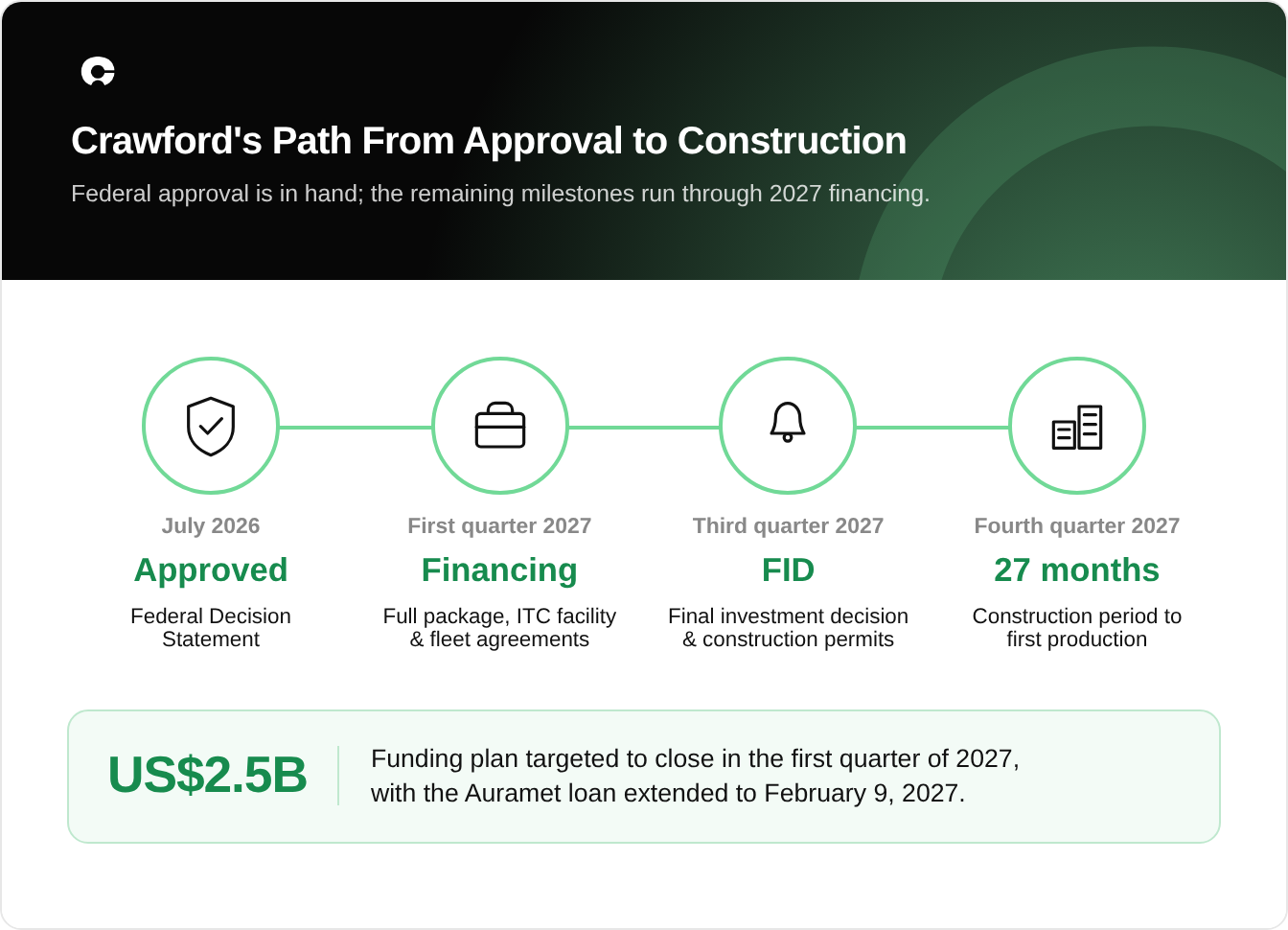
- Canada Nickel's Crawford nickel sulphide project in Ontario received its federal Decision Statement in July 2026, the first mining approval under Canada's amended Impact Assessment Act since 2019, with construction permits targeted for the third quarter of 2027.
- During 2026, the company awarded detailed process plant engineering to Ausenco, signed a grid connection engineering agreement with Hydro One, and selected Komatsu and SMS Equipment for the mining fleet.
- Front-end engineering and design lifted Crawford's after-tax net present value (NPV8%) to US$2.8 billion, with initial capital held at approximately US$2.0 billion.
- The US$2.5 billion funding plan targets an investment tax credit facility, definitive fleet agreements and a full financing package in the first quarter of 2027, ahead of a final investment decision (FID) in the third quarter of 2027.
- On November 9, 2026, Auramet International extended Canada Nickel's loan to February 9, 2027, after a partial repayment reduced the principal from US$32 million to US$27,777,299.
Crawford's Risk Profile in November 2026
Canada Nickel (TSXV: CNC | OTCQX: CNIKF) is developing the 100%-owned Crawford Nickel Sulphide Project in the Timmins-Cochrane mining camp of northern Ontario. Crawford's Proven and Probable reserves of 1.7 billion tonnes at 0.22% nickel contain 3.8 million tonnes of nickel, second globally behind Norilsk, according to Wood Mackenzie data. At a planned peak of 48,000 tonnes per year, the company is targeting the largest nickel sulphide operation in the Western world.
A developer at this scale faces risk on several fronts at once: permitting, engineering and procurement, operating cost, nickel price and financing. Through 2026, Canada Nickel cleared its main federal permitting hurdle and advanced engineering, power and fleet procurement. Financing is now the principal near-term constraint, with the investment tax credit (ITC) facility, definitive fleet agreements and the full financing package all targeted for the first quarter of 2027, ahead of a final investment decision (FID) targeted for the third quarter of 2027.
Other execution items remain open alongside financing. Construction permits are still to be issued, the fleet agreements are not yet definitive, and the project's low life-of-mine cost depends on a later expansion to Phase II.
Permitting: The Main Approval Is Behind the Project
The federal Decision Statement arrived in July 2026, following Ontario's designation of Crawford under its One Project, One Process framework in January 2026. Crawford is also 1 of 5 mining projects referred to the federal Major Projects Office (MPO) and the earliest-stage project among them, as the others had completed permitting and feasibility work before referral. At the provincial level, Crawford is 1 of 3 designated projects, alongside a lithium project in Thunder Bay and Kinross's Great Bear gold project in Northwestern Ontario.
Chief Executive Officer of Canada Nickel, Mark Selby, described what the federal decision settled and what remains to be filed:
"This is the main yes/no permit for the project. There are supplementary provincial permits and supplementary federal permits to get, but those are by and large compiling the technical data required to meet certain specifications. As long as you meet those requirements, you will be able to get your permits."
The remaining provincial and federal permits required for construction are targeted for the third quarter of 2027, the same quarter as the FID, and provincial operating permits are targeted for the second quarter of 2029. MPO selection and the Ontario designation are designed to coordinate federal review and shorten approval timelines. The project is located in Timmins, a camp with a long record of mine permitting and development, with direct access to road, rail, power and water.
Engineering, Power & Fleet Have Moved Into Execution
Canada Nickel made 3 contracting decisions in 2026 that moved Crawford from study into delivery. Ausenco was awarded detailed engineering for the process plant in January 2026, Hydro One signed a grid connection engineering agreement in March 2026, and Komatsu and SMS Equipment were selected for the mining fleet in September 2026. Definitive fleet agreements and Taykwa Tagamou Nation (TTN) fleet financing are targeted for the first quarter of 2027.
Detailed engineering sets the pace of construction readiness. Canada Nickel completed a C$21 million private placement in August 2026 as it moved into full detailed engineering.
Selby outlined the volume of work required before ground is broken:
"Detailed engineering requires hundreds of thousands of hours. You cannot ramp from zero to a hundred instantly; you need substantial engineering completed before construction begins so you can execute efficiently."
The company is targeting a 27-month construction period starting in the fourth quarter of 2027 and first production in the fourth quarter of 2029. Site work in Timmins follows seasonal windows, so a fourth-quarter start avoids losing a full construction year. The project team includes Senior Project Advisor Desmond Tranquilla, who delivered the Detour Gold project on time and on budget, and Chief Financial Officer Wendy Kaufman, who completed the $4 billion financing for Cobre Panama.
Cost Position After Front-End Engineering & Design
Front-end engineering and design (FEED) re-sequenced the mine plan to bring higher-value East Zone ore forward and cut pre-stripping by 30%. Initial capital rose 5% to approximately US$2.0 billion, while the after-tax net present value (NPV8%) increased by more than US$300 million to US$2.8 billion. Including expected carbon capture, utilization and storage (CCUS) tax credits, NPV8% rises to approximately US$2.9 billion and the after-tax internal rate of return (IRR) to approximately 18.9%.
On the 2023 Bankable Feasibility Study (BFS) basis, by-product credits from iron, chromium and cobalt bring the life-of-mine (LOM) net C1 cash cost to US$0.39 per pound of nickel and all-in sustaining cost (AISC) to US$1.54 per pound, in the first quartile of the global nickel cost curve on Wood Mackenzie 2022 data. That average does not describe the opening years. Phase I, at 60,000 tonnes per day for years 1 to 3.5, runs at a net C1 cash cost of US$2.67 per pound and AISC of US$2.96 per pound. Only after the mill expands to 120,000 tonnes per day does the Phase II net C1 cash cost fall to US$0.68 per pound.
Crawford's first-quartile LOM position therefore depends on delivering the Phase II expansion, for which the BFS schedules US$1.6 billion of expansion capital. As a bulk-tonnage operation with a LOM nickel head grade of 0.22% and nickel recovery of 41%, Crawford's returns also depend on sustained throughput. Reserves were estimated at a nickel price of US$15,650 per tonne.
Nickel Market Exposure & Downstream Commercial Position
On the supply side, Indonesia controls 67% of global nickel supply, 13 percentage points above OPEC's all-time peak share of oil supply, and has managed output actively since April 2025 through tiered export royalties, mining license terms cut from 3 years to 1, a ban on new nickel pig iron and high-pressure acid leach operations, ore quota cuts and a revised ore benchmark price formula. Indonesian saprolite ore grades fell 8% in 2025 and 16% over the last 3 years. The July 2026 average nickel price was approximately US$2,000 per tonne above the November 2025 low.
On the demand side, global nickel consumption has grown approximately 7% a year since 2019, and the company, citing International Nickel Study Group data, forecasts demand to double by 2030 to approximately 5 million tonnes. Crawford's revenue remains exposed to that price and demand outlook.
Separate from nickel price exposure, Crawford has a prospective downstream customer. Canada Nickel and Swiss Steel Group signed a framework agreement on October 23, 2026, announced on October 26, 2026, under which Swiss Steel would receive exclusive access to approximately 1 million tonnes per year of semi-finished steel products from 2030. Canada Nickel's wholly owned subsidiary NetZero Metals would produce that steel from Crawford's nickel-chromium magnetite concentrate. The agreement sets out a framework for envisaged cooperation and is not a nickel offtake contract; Samsung SDI is Crawford's anchor nickel offtake partner.
Financing: The Open Item Concentrated in the First Quarter of 2027
The US$2.5 billion funding plan is split 40% equity and 60% debt. On the equity side, approximately US$600 million is targeted from Clean Technology Manufacturing and CCUS ITCs, US$100 million from Samsung SDI's offtake-linked option, US$100 million to US$300 million from Canadian and international government programs, and up to US$200 million from a minority interest or joint venture (JV) pursued with Scotiabank and Deutsche Bank. On the debt side, Export Development Canada (EDC) has provided a letter of intent for US$500 million as Mandated Lead Arranger, a leading Canadian financing agency has issued a C$500 million support letter, and a further US$500 million is targeted from export credit agencies (ECAs) and private lenders.
SB1 Markets was mandated in June 2026 to arrange a facility of up to US$600 million that monetizes the ITCs during construction, ahead of their receipt after completion. Selby tied access to government capital to Crawford's designation status:
"Because Crawford is on a very short list at both levels, it is well positioned for the substantial pools of capital being allocated by federal and provincial governments."
Most layers are at letter-of-intent (LOI), support-letter, mandate or target stage, and in November 2026 Canada Nickel reported continuing discussions with offtake and joint venture partners and government funding programs. The EDC letter of intent, the Samsung SDI option and the SB1 Markets mandate give the company named counterparties on each side of the plan. Converting them into signed agreements on the first-quarter 2027 schedule is the main variable between the current stage and the FID.
The Auramet Extension Bridges the Balance Sheet to the Financing Window
Ahead of the full package, Canada Nickel reported pro forma cash and equivalents of C$29 million and debt of C$61 million, based on balances as of July 31, 2026 adjusted for the C$21 million private placement completed in August 2026. Part of that debt is the Auramet International loan, originally announced February 6, 2026 and previously due on November 9, 2026.
On November 9, 2026, Auramet extended the repayment date to February 9, 2027, after a partial repayment reduced the principal from US$32 million to US$27,777,299. Canada Nickel will pay an extension fee of US$694,432 and grant 7,500,000 warrants to Auramet, each exercisable for 1 year at $1.10 per share, a 10% premium to the 5-day volume-weighted average price ending November 6, 2026. The extension and warrants are subject to TSX Venture Exchange approval, and the 5,500,000 warrants at $1.52 per share issued to Auramet in August 2026 will be cancelled.
The new maturity falls inside the first quarter of 2027, the same window in which the company is targeting its ITC facility and full financing package. The extension provides time on the short-term facility; construction funding still depends on the project financing package.
Valuation Against the Remaining Risk
As of August 11, 2026, at C$1.30 per share and 258.8 million basic shares, Canada Nickel's market capitalization was approximately C$336 million, against a FEED NPV8% of US$2.8 billion. The 2 figures measure different things. NPV8% is a project-level discounted cash flow value for a fully financed, operating Crawford, while the market capitalization is a development-stage equity value before US$2.5 billion of project funding is in place. Converting project value into shareholder value depends on securing the financing package, managing dilution and delivering construction within the planned capital budget.
Third-party terms offer one reference point. Samsung SDI's US$100 million option to acquire a 10% direct interest in Crawford values the project at US$1 billion and includes 10% of LOM nickel offtake, plus a further 20% for 15 years. Strategic shareholders include Agnico Eagle at 8.7%, Samsung SDI at 6.0%, Anglo American at 5.3% and TTN at 6.1% on conversion of its equity participation agreement.
The wider Timmins Nickel District is optionality behind Crawford. Canada Nickel has published resources on 9 deposits totaling 10.3 million tonnes of Measured and Indicated nickel and 13.2 million tonnes of Inferred nickel, and Selby has said the company holds 3 or 4 projects it believes will ultimately be larger and higher-grade than Crawford, with Crawford built first. Those deposits do not change Crawford's own financing and construction requirements, and Crawford is the first potential production platform from which later district development would follow.
The Investment Thesis for Canada Nickel
- Crawford's Proven and Probable reserves contain 3.8 million tonnes of nickel, second globally behind Norilsk, and the company is targeting peak output of 48,000 tonnes per year from what would be the largest nickel sulphide operation in the Western world.
- The July 2026 federal Decision Statement cleared Crawford's main approval, while construction permits targeted for the third quarter of 2027 and operating permits targeted for the second quarter of 2029 are still to come.
- A life-of-mine net C1 cash cost of US$0.39 per pound places Crawford in the first quartile, but Phase I has a net C1 cash cost of US$2.67 per pound, so the low-cost case depends on the expansion to 120,000 tonnes per day.
- Process plant engineering, grid connection engineering and mining fleet selection advanced during 2026, with definitive fleet agreements targeted for the first quarter of 2027 and a 27-month build targeted from the fourth quarter of 2027.
- The US$2.5 billion funding plan is largely at letter-of-intent, mandate, option or target stage, and the Auramet loan of US$27,777,299 matures on February 9, 2027, inside the same quarter as the targeted financing close.
Signed financing agreements in the first quarter of 2027 would clear the path to a final investment decision in the third quarter of 2027 and a fourth-quarter construction start. Financing, more than geology or permitting, now sets Crawford's timetable.
TL;DR
Canada Nickel obtained federal approval for Crawford in July 2026 and advanced engineering, grid connection and fleet selection, making the US$2.5 billion funding plan the principal near-term constraint. The ITC facility, fleet agreements and full financing package are targeted for the first quarter of 2027, and the Auramet loan, reduced to US$27,777,299, now matures on February 9, 2027. Construction permits and the move from Phase I to lower-cost Phase II operations remain execution items, with the FID targeted for the third quarter of 2027.
FAQs (AI-Generated)
Analyst's Notes





Subscribe to Our Channel





Stay Informed


