




First Mining Gold Secures Federal Approval for Springpole After 8.5-Year Regulatory Journey


.jpg)
First Mining Gold's Springpole wins federal EA approval after 8.5 years; CEO cites major valuation gap vs. peers ahead of 18-month path to FID.
- First Mining Gold's Springpole gold project in Ontario has received federal environmental assessment (EA) approval, the culmination of an eight-and-a-half-year regulatory process that began in February 2018.
- The company has also announced term sheets and clear paths to agreements with three First Nations communities - Cat Lake, Lac Seul, and Slate Falls - addressing the social license component of the project.
- The Ontario provincial environmental assessment is still ongoing, with a draft decision document open for public comment until the end of July 2026; management is targeting a decision by the end of summer.
- CEO Dan Wilton points to a valuation gap versus peers, noting the company trades at roughly $50–60 per ounce of resource compared to $120–150 for early-stage projects and $300–400 for advanced-stage developers with permits in hand.
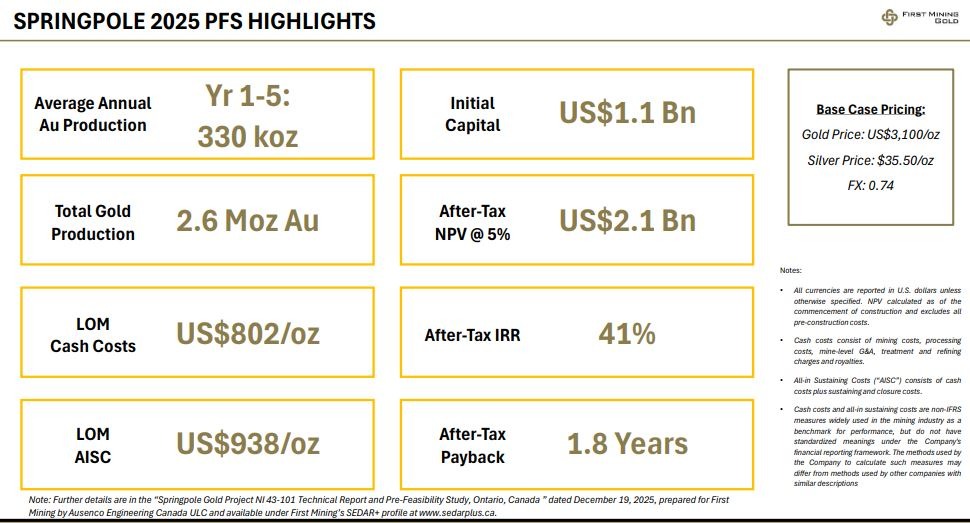
- A November 2025 pre-feasibility study (PFS) at a $3,100/oz gold price showed a 40% after-tax internal rate of return (IRR) and a $2.1 billion (US) net present value (NPV), with management targeting a final investment decision (FID) in approximately 18 months.
First Mining Gold (TSX:FF) is a Canadian gold developer advancing two of the largest undeveloped gold projects in the country: the Springpole project in Ontario and the Duparquet project in Quebec. In a recent interview, CEO Dan Wilton discussed the company's recent receipt of federal environmental assessment approval for Springpole, a milestone he described as removing one of the principal risks that has weighed on the stock for years. The conversation covered the regulatory path that led to this point, the permitting work still ahead, the project's financial profile, and how management views the company's valuation relative to peers.
An Eight-and-a-Half-Year Regulatory Process
Springpole was submitted into the combined federal-provincial environmental assessment process in February 2018. Wilton noted that the project did not have the funding or personnel to advance it effectively in the early years, a gap the company addressed by bringing on a dedicated permitting team, in 2020. From there, the company finalised terms of reference in 2021, completed a draft environmental assessment in 2022, and worked through roughly 3,500 comments and questions from regulators, communities, and their advisors before submitting a final environmental assessment in 2024. As Wilton put it,
"It's something we're immensely proud of our team for the tenacity and determination that it takes to get through a process like this."
Community Agreements and Social License
Alongside the federal EA decision, First Mining announced term sheets and stated it has clear paths to agreements with the Cat Lake and Lac Seul communities, announced a few weeks prior to the interview, and with Slate Falls, announced earlier in the same week. Wilton emphasised that these processes require time for communities to evaluate risks and negotiate benefit packages, noting that regulatory timelines need to build in time and capacity support so that communities can properly understand the risks before discussing what benefit packages would look like.
The company's near-term priority is converting these term sheets into full project agreements. Management's stated goal is to have both the social license and environmental licensing components in place by the end of the summer of 2026, which Wilton framed as a second major milestone running in parallel with the provincial regulatory process.
Remaining Permitting Steps
While the federal approval is complete, the Ontario provincial environmental assessment remains active. A draft decision document was published shortly before the interview and is open for public comment until the end of July 2026, after which the company expects to field additional questions before the file moves to Ontario's Minister of Environment for a final decision. Wilton indicated the company is optimistic this decision will arrive by the end of summer 2026. He noted that once the EA is secured, the subsequent permitting steps involve more detailed engineering work but carry comparatively lower regulatory risk, since the EA process establishes the scope and conditions that later permits must satisfy.
Interview with Dan Wilton, CEO of First Mining Gold
Development Timeline and Financing Considerations
Wilton estimated the process from the interview date to a final investment decision at approximately 18 months. The next major technical milestone is a feasibility study, expected around mid-2027, building on the pre-feasibility study (PFS) update released in November 2025. He indicated that engaging with project financing partners would logically follow in the final stages of the feasibility study, likely beginning around the end of 2026, with roughly six additional months of detailed engineering and permit applications to follow before construction financing is finalised. Wilton said the company is not rushing this process, but characterised it as a very logical sequence of steps, adding that the pool of potential financing partners has expanded now that the binary permitting risk has been resolved. He described a broader universe of mining-focused finance providers currently seeking to deploy substantial capital, and suggested a billion-dollar-plus construction budget is within reach given current industry conditions, even with gold prices having pulled back somewhat over the preceding month.
He also noted that a construction decision would likely require the company to add capacity to its team, stating that the current team has stayed together and delivered milestones over a period of years, but that building a mine would necessitate bringing on additional personnel. Wilton indicated that reaching agreements with communities, securing environmental assessments, and lining up funding would each make the company more attractive to prospective hires with large-scale construction experience, and that conversations on that front would likely begin following the federal EA decision.
Valuation and Peer Comparisons
A central theme of the interview was the gap between First Mining's current valuation and that of comparable advanced-stage gold developers. Wilton stated:
"The difference between the advanced stage comparables, which tend to trade at $300 to $400 an ounce, and the early stage projects, which trade at...like $120 to $150 an ounce. And today, I think we're trading at maybe we're above 50, but not that far. Like, maybe it's 60."
He argued that Springpole's roughly 5-million-ounce gold resource, now through the most difficult stage of federal permitting, should be evaluated on a comparable basis to these more advanced projects, even before ascribing any value to the Duparquet project in Quebec. The November 2025 PFS, based on a $3,100/oz gold price, indicated a 40% after-tax IRR, a $2.1 billion (US) NPV, and a payback period of under two years, with potential production of 300,000 ounces or more annually.
Wilton also referenced what he called a persistent discount applied to the stock, contrasting the current environment with a year earlier, when shares traded around $0.15 with an approximate $150 million market capitalisation. He suggested the company continues to trade at roughly a four-to-five-times discount to peer developers, and that the market has been slow to reprice the stock even after the federal EA decision, noting the announcement was only a day and a half old at the time of the interview.
Strategic Positioning
Wilton pointed to several Canadian gold mines - including Côté Gold, Detour Lake, Canadian Malartic, Valentine, Greenstone, and Magino - as projects that faced difficult construction periods but are now regarded as flagship assets, framing Springpole as a candidate for similar re-rating as it advances. He also noted that larger gold producers, many generating record free cash flow, have limited pipelines of comparable projects and face declining reserve bases, which he suggested increases the strategic relevance of large, permitted, tier-one-jurisdiction assets. On this point, Wilton said:
"I think it's one of the most strategic assets in the gold industry. Just stack up globally where you have 5 million oz projects in tier one jurisdictions that are through the most difficult parts of their permitting processes that you could get a shovel in the ground before 2030."
He noted the company has previously been open to a joint venture partner but said First Mining now has greater financial flexibility to consider advancing the project independently toward a final investment decision.
The Investment Thesis for First Mining Gold
- De-risking milestone achieved: Federal environmental assessment approval for Springpole removes what management describes as the project's single largest historical risk - securing authorization and social license to construct the mine.
- Progressing social license: Term sheets and stated clear paths to agreements with three affected First Nations communities (Cat Lake, Lac Seul, Slate Falls) address a key non-technical risk factor.
- Near-term catalyst: A provincial (Ontario) environmental assessment decision is targeted by the end of summer 2026, which would complete the regulatory approval process for Springpole.
- Defined project economics: The November 2025 PFS outlined a 40% after-tax IRR and $2.1 billion (US) NPV at a $3,100/oz gold price, with potential annual production above 300,000 ounces.
- Clear development timeline: Management has laid out an approximately 18-month path to a final investment decision, including a feasibility study expected around mid-2027 and project financing discussions anticipated to begin near year-end 2026.
- Valuation gap versus peers: Management estimates the company trades at roughly $50–60 per ounce of resource, versus $120–150 for early-stage projects and $300–400 for advanced-stage, permitted developers.
- Additional optionality: The Duparquet project in Quebec represents a second large undeveloped gold asset not yet reflected, according to management, in the current valuation.
- Strategic M&A backdrop: Sector-wide free cash flow generation and declining reserve bases among larger producers may increase interest in large, de-risked, tier-one-jurisdiction gold projects such as Springpole.
The interview reflects a broader dynamic in the gold sector: a scarcity of large, undeveloped, tier-one-jurisdiction projects that can realistically reach construction before 2030, set against a backdrop of elevated gold prices and record free cash flow among senior producers. Many established miners face declining reserve bases and limited organic growth pipelines, which has fueled a wave of mergers and acquisitions as companies seek to replace reserves. Assets like Springpole, having cleared federal environmental assessment, may become more visible to this pool of capital.
TL;DR
First Mining Gold's Springpole project has received federal environmental assessment approval after an eight-and-a-half-year process, alongside term sheets with three affected First Nations communities. Management targets a provincial EA decision and full social license by the end of summer 2026, with a feasibility study expected around mid-2027 and a final investment decision roughly 18 months out. A November 2025 PFS indicated a 40% after-tax IRR and $2.1 billion (US) NPV at $3,100/oz gold, and management believes the stock trades at a significant discount to advanced-stage developer peers.
FAQs (AI-Generated)
Analyst's Notes





Subscribe to Our Channel







Stay Informed






















