




GR Silver Mining Ltd. & The 12-Month Roadmap: Systematic Drilling De-Risks San Marcial


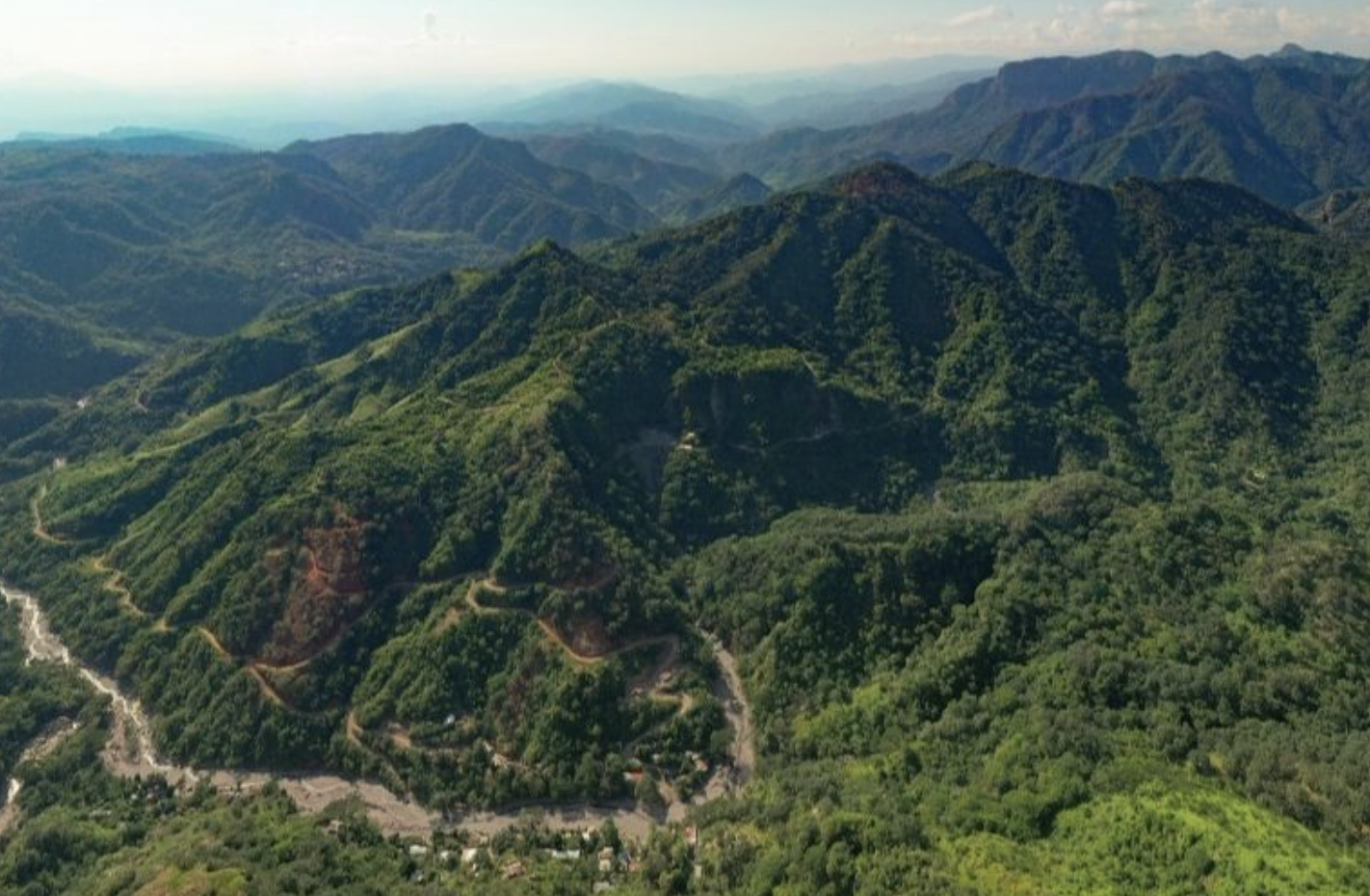
GR Silver Mining Ltd. is executing its 20,000-metre drilling campaign, leveraging Durango logistics & Plomosas' mine infrastructure.
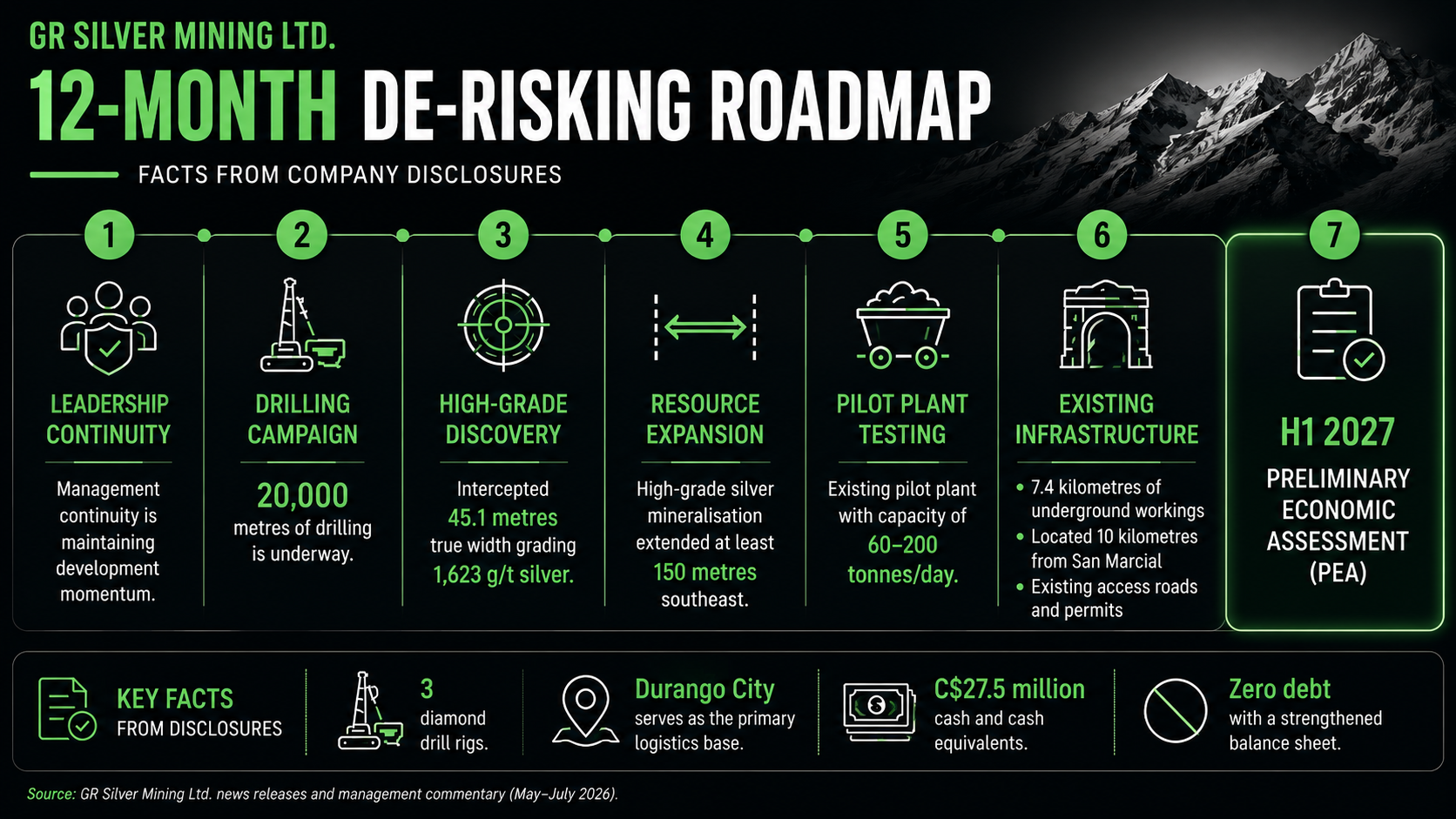
- 20,000 metres of drilling is underway to systematically expand resources at San Marcial.
- A structural dilation model has identified new high-grade targets, including a 45.1-metre intercept grading 1,623 grams per tonne of silver.
- Durango City now serves as the primary logistics base, helping maintain continuous drilling despite regional security risks.
- Reusing Plomosas' existing underground infrastructure and pilot plant could reduce capital and permitting requirements ahead of the Preliminary Economic Assessment (PEA).
- Remaining risks include metallurgical variability, untested exploration ground, weather-related access issues, and local security disruptions.
Continuity Under Transition Drives Exploration Strategy
GR Silver Mining Ltd. (TSXV: GRSL | OTCQX: GRSLF) stabilised its operational leadership in April 2026 by permanently appointing Eric Zaunscherb as President and Chief Executive Officer on July 6, 2026. Zaunscherb, who previously served as Chairman of the Board of Directors, stepped into the executive leadership role to maintain development momentum at the flagship Plomosas Project, located on the border of Sinaloa and Durango in Mexico. By maintaining the exploration team led by Vice President of Exploration Luis Coto, the company has prevented the technical delays and strategy shifts typically associated with sudden management turnarounds.
The leadership handoff followed the passing of the company's founder, Marcio Fonseca, at the end of March 2026. Under Zaunscherb's direction, the geological and operational teams remained intact, ensuring that the proprietary technical models developed over years of work at Plomosas continue to guide active field programs. This management continuity has provided institutional shareholders with a predictable operational pathway, enabling the company to advance its systematic resource expansion without logistical interruption.
President and Chief Executive Officer of GR Silver Mining Ltd., Eric Zaunscherb, confirmed the strategic focus of this transition:
"Obviously, we all miss the leadership that Marcio provided. He was the founder of the company, its president, and its CEO. Since his sudden and tragic passing at the end of March, my focus has been on continuity of the vision for the company, making sure our teams in the field and the market are aware of that continuity, that we have a plan and we have the resources to fulfil that plan."
Drilling San Marcial's Dilation Zones
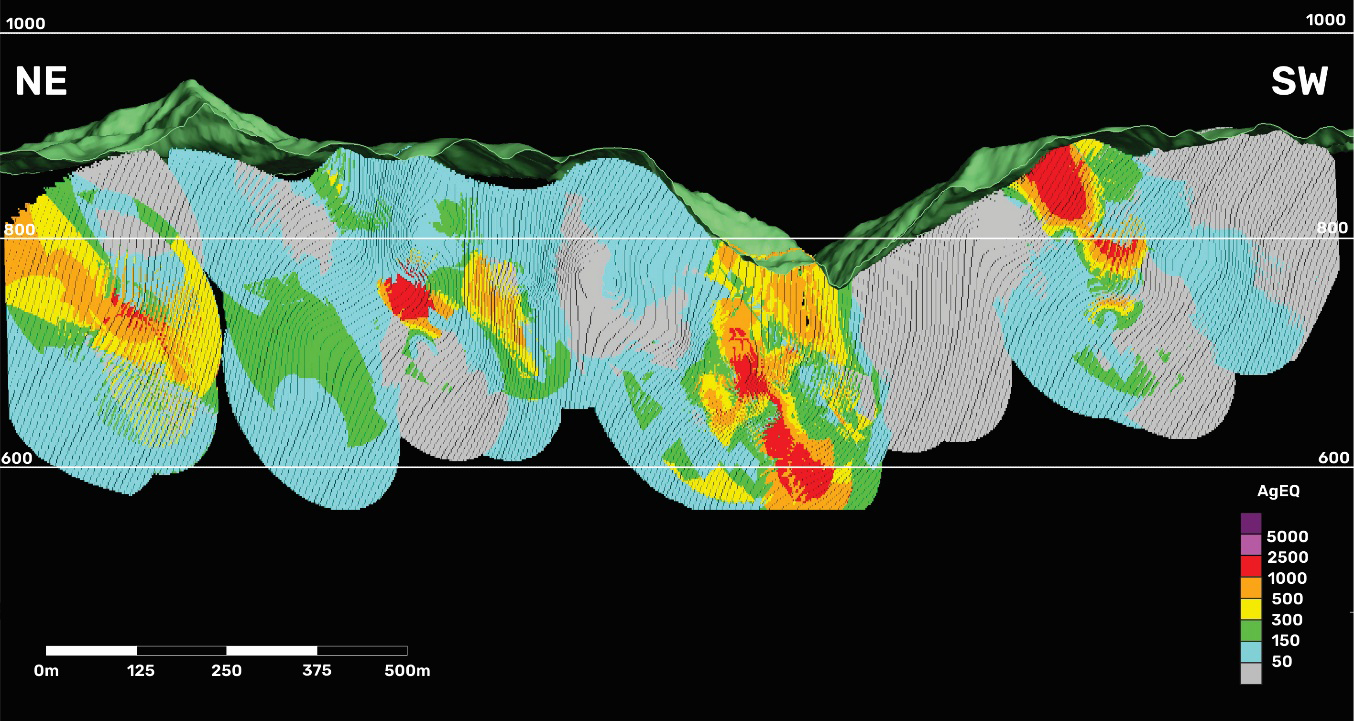
GR Silver Mining Ltd. is targeting high-grade resource expansion at the San Marcial Area by testing structural dilation zones where cross-cutting, northeasterly trending structures intersect the main northwest-trending hydrothermal breccia. This structural model was validated on May 19, 2026, when a step-out drill hole targeted a predicted fault intersection and intersected 45.1 metres true width grading 1,623 grams per tonne silver, including a high-grade core of 8.25 metres true width grading 8,579 grams per tonne silver. Defining these dilation traps increases the frequency of high-grade intercepts, reducing the total drilling metreage required to outline economic resource blocks.
The company's July 10, 2026, drill release confirmed that step-out drilling has extended high-grade silver mineralisation at least 150 metres southeast of the 2023 mineral resource estimate (MRE) boundary. A key step-out drill hole intersected 21.9 metres true width grading 168 grams per tonne silver and 1.41% zinc, proving the lateral continuity of the chlorite-hematite breccia outside the main dilation zones. Concurrently, drilling at the Parallel Breccia target closer to the central intrusive core returned 2.85 metres true width grading 340 grams per tonne silver and 0.32 grams per tonne gold in a deeper drill hole, identifying a gold-rich stockwork system at depth.
Zaunscherb explained the tactical necessity of adjusting drill layouts to follow these newly identified mineralised systems:
"The lesson is that you have to be pragmatic and follow where mother nature leads. Fortunately, we've got a really stellar exploration team that can deploy sophisticated techniques to follow up that new system."
Logistical Base Relocation Restores Operational Continuity
To eliminate regional security risks along the Rosario corridor in Sinaloa, which constrained transport during late 2025, GR Silver Mining Ltd. pivoted its primary logistics and exploration base to Durango City in November 2025. Bypassing the compromised access roads by routing personnel, equipment, and core samples through Durango state infrastructure restored operational predictability. This proactive infrastructure adjustment enabled the company to keep 3 diamond drill rigs operating continuously throughout its 20,000-metre 2026 campaign.
The company is also upgrading its secondary access road through Durango state, neutralising weather-induced delays during the heavy summer rain season and securing consistent core delivery to the SGS de México sample preparatory facility in Durango City. This logistics base relocation ensures safe and continuous field operations while stabilising assay turnaround times. Despite the increased transport distance from Durango City, the stabilised logistics corridor protects the exploration news flow required for ongoing project valuation updates.
The operational benefit of this base pivot is reflected in the company's continuous core recovery rates and the safety track record of its field crew. By establishing Durango City as its logistical anchor, the company has decoupled its exploration schedule from local security volatility. This stable operating framework has allowed the geology team to focus entirely on systematic step-out drilling, reducing administrative delays and maintaining the timeline for technical study deliverables.
Reusing Underground Workings Accelerates Project Economics
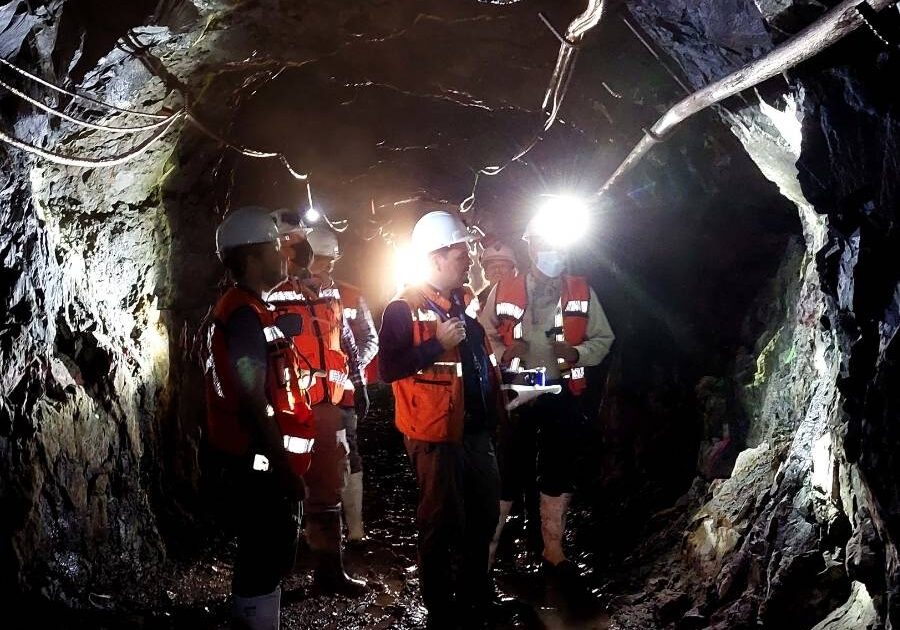
GR Silver Mining Ltd. is targeting a significant reduction in initial capital expenditure by planning to reuse the past-producing Plomosas Mine, which contains 7.4 kilometres of accessible, permitted underground workings located 10 kilometres north of San Marcial. This past-producing asset, operated by a subsidiary of Grupo México from 1986 to 2000, allows the company to bypass the 5- to 7-year environmental permitting timeline typical for Mexican greenfield concessions. The company is advancing a bulk-sample test-mining program utilising an on-site pilot plant with a processing capacity of 60 to 200 tonnes per day.
Mexico's Environment Ministry, Secretaría del Medio Ambiente & Recursos Naturales (SEMARNAT), ruled in a May 21, 2026, directive that no new Environmental Impact Authorisation, or Manifestación de Impacto Ambiental (MIA), is required for this pilot plant, eliminating regulatory delays ahead of the integrated Preliminary Economic Assessment (PEA). Generating permitted, underground metallurgical and processing data under existing permits systematically de-risks the technical parameters of both Plomosas and the adjacent San Marcial discovery. Reusing this extensive underground infrastructure minimises dilution and initial funding requirements ahead of development decisions.
According to its first-quarter financial disclosures dated March 31, 2026, GR Silver Mining Ltd. holds C$27.5 million in cash and zero debt, providing a fully funded runway to execute its 20,000-metre drill program and engineer the first-half-of-2027 Preliminary Economic Assessment (PEA). Gaining +75% over the 12-month period ending August 5, 2026, closing at C$0.355 to yield an undiluted market capitalisation of C$181 million, the company's stock trades on the TSX Venture Exchange under the ticker GRSL.
Residual Technical & Jurisdictional Risks
Evaluating GR Silver Mining Ltd. from an institutional compliance perspective requires balancing its rapid de-risking actions with several residual technical and jurisdictional risks. Metallurgical recoveries remain a key variable, with 2023 technical disclosures showing significant differences between the Plomosas Mine Area and San Marcial Area: Plomosas reports recoveries of 74% silver, 86% gold, 69% lead, 75% zinc, and 80% copper, compared with 94% silver, 0% gold, 59% lead, 80% zinc, and 0% copper at San Marcial. A unified processing sheet must reconcile these variances to minimise recovery penalties during bulk processing. Exploration also remains a risk, as approximately 80% of the prospective perimeter around the central intrusive body remains untested. Although the structural model has successfully identified dilation zones at fault intersections, future step-out drilling may not sustain the historical discovery rate of 4,000 ounces of silver equivalent per metre drilled. The newly identified Parallel Breccia targets add further complexity, requiring revised drill layouts and 90-degree orientation changes to follow shallow veins and deeper gold-rich stockwork systems.
The company also remains exposed to seasonal and localised operational risks. Relocating its primary operational base to Durango City helped circumvent cartel-related transport constraints along the Rosario corridor in Sinaloa, but increased the distance required to transport core and supplies. The longer corridor depends on continued local road upgrades to remain accessible during heavy summer rains. While preparatory work at the Durango facilities helps mitigate assay delays, severe security flare-ups or prolonged infrastructure damage could still disrupt core deliveries and delay technical study milestones.
FAQs (AI-Generated)
Analyst's Notes





Subscribe to Our Channel






Stay Informed






