




A 10% Gold Price Rise Adds About 25% to Florida Canyon's Value


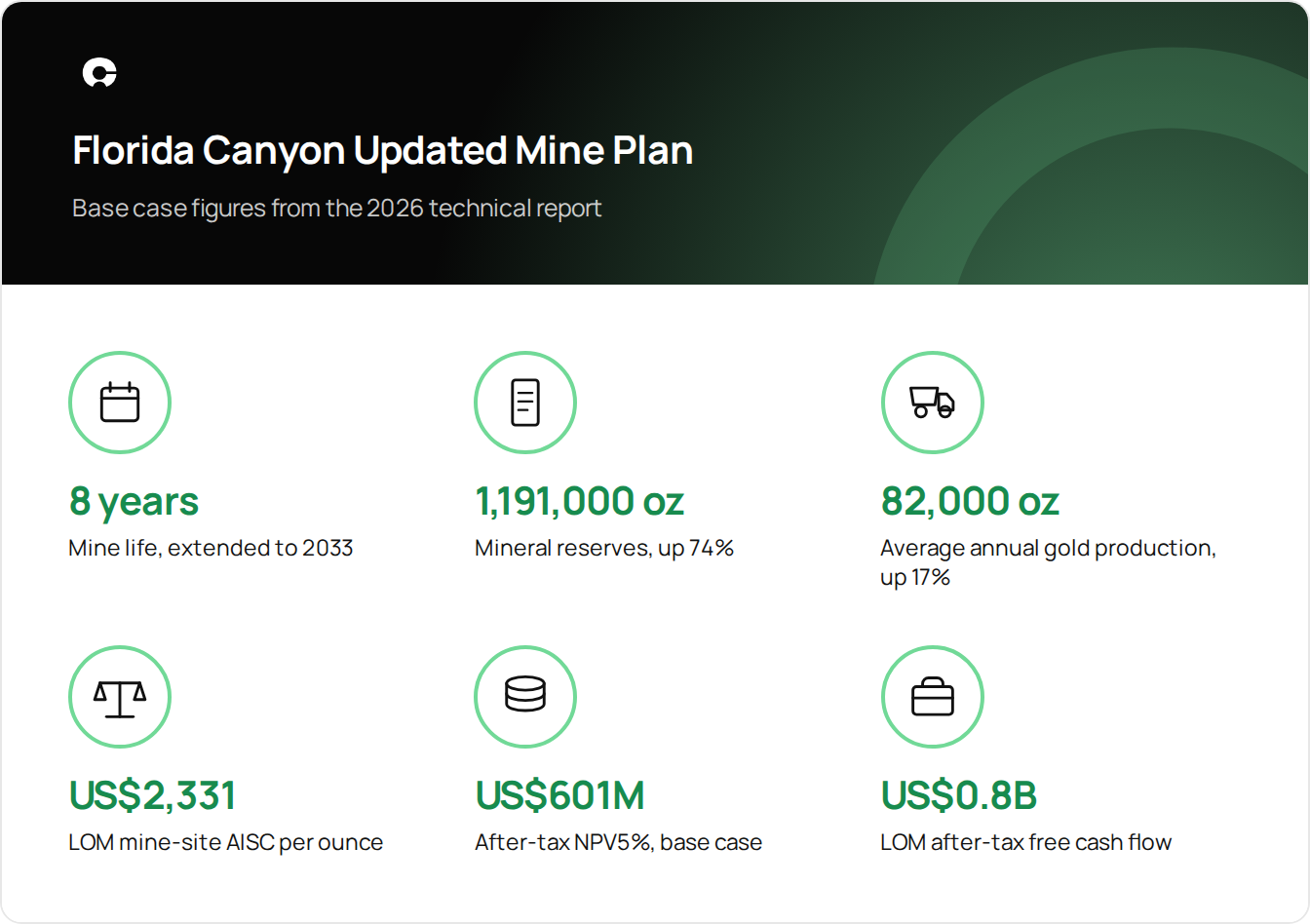
Florida Canyon's mine plan is valued at US$601 million and at US$723 million. Only the gold price assumption separates the two figures.
- Integra's Florida Canyon mine plan returns an after-tax net present value at a 5% discount rate (NPV5%) of US$601 million at base-case gold prices and US$723 million at current metal prices.
- The same reserve, the same mining schedule, and the same 8-year mine life underlie both figures.
- A 10% increase in the gold price raises NPV5% and life-of-mine (LOM) free cash flow by approximately 25%.
- A US$100-per-ounce change in the gold price alters cash costs and mine-site all-in sustaining cost (AISC) by an estimated US$7 per ounce.
- Cash of US$111.1 million as of June 30, 2026, stands against a DeLamar build with US$389 million in initial capital.
Two Valuations for One Mine Plan
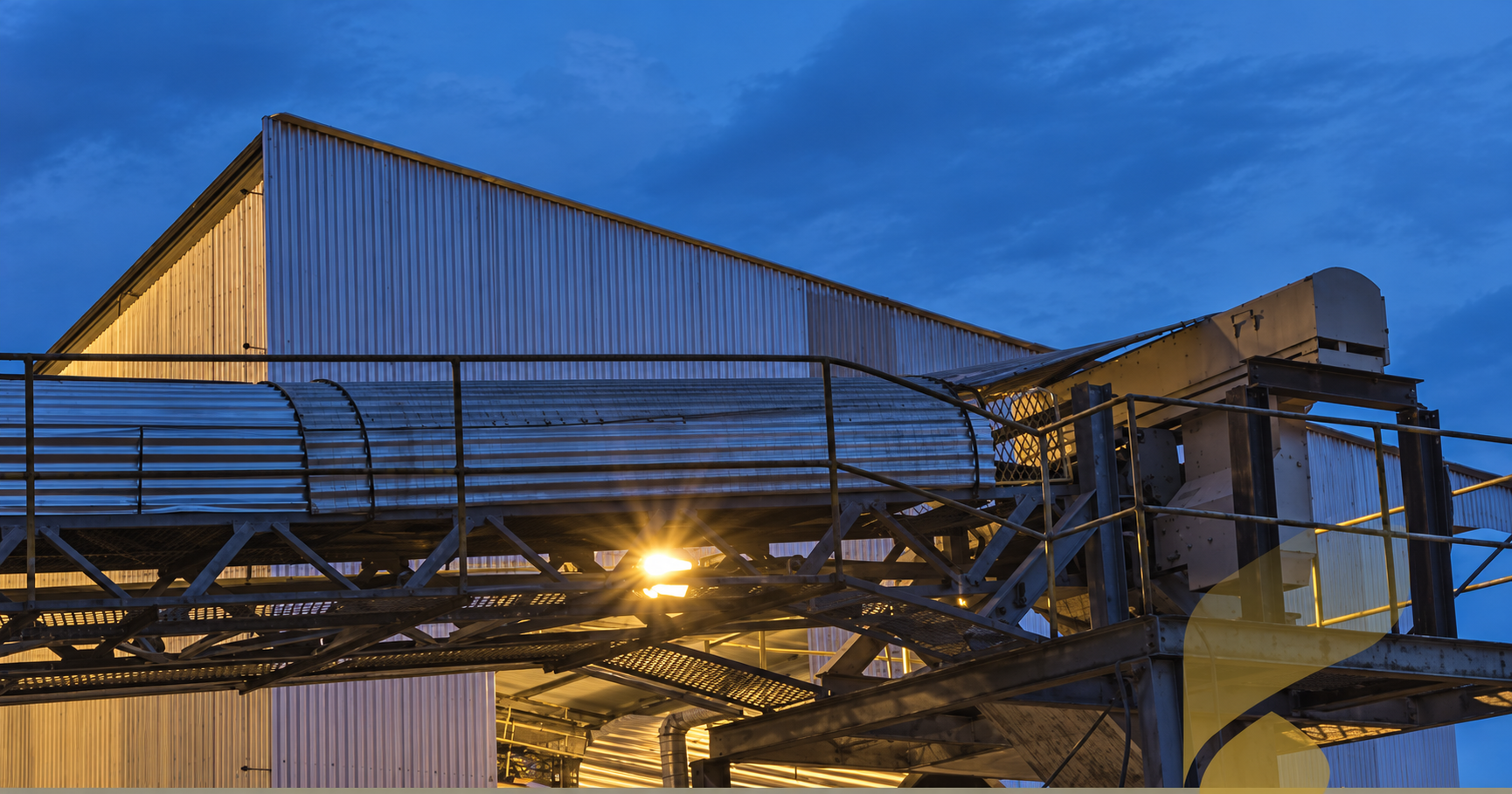
Integra Resources (TSXV: ITR | NYSE American: ITRG) values its producing Florida Canyon gold mine in Nevada at 2 different figures, and both describe the same plan. At base-case gold prices, the mine returns an after-tax net present value at a 5% discount rate (NPV5%) of US$601 million. At current metal prices, the identical plan returns US$723 million. Florida Canyon is a conventional open-pit heap leach operation in Pershing County, Nevada, about 45 miles southwest of Winnemucca and adjacent to Interstate Highway 80, and it operated continuously from 1986 to 2011 and intermittently until 2015, passing through several owners before Integra took over as operator in 2024.
Both figures come from the same updated mine plan, and the difference between them is a pricing choice, not an operating one. The base case steps gold down over time: US$4,344 per ounce in 2026, US$4,414 in 2027, US$4,169 in 2028, US$3,824 in 2029, and US$3,600 from 2030 to 2035, a weighted average of US$3,873 per ounce over the plan. That schedule prices the metal at approximately a 10% discount to the June 2026 consensus through 2029. The current-price case instead holds gold flat at US$4,200 per ounce from the middle of 2026 through 2035. Declining against flat is the entire distance between US$601 million and US$723 million.
The plan those decks are applied to is itself new. Mineral reserves rose 74% to 1,191,000 ounces of gold, contained in 118,471,000 metric tons (t) at 0.31 grams per metric ton (g/t), and the mine life extended from 2030 to 2033 with 2 further years of gold recovered from pads already stacked. A measured and indicated resource of 1,706,000 ounces of gold in 171,842,000 t at 0.31 g/t sits behind that reserve. Average annual gold production rose 17%, from 70,000 to 82,000 ounces, and total gold sold over the plan reaches 685,000 ounces at a life-of-mine (LOM) mine-site all-in sustaining cost (AISC) of US$2,331 per ounce. Against those inputs, Florida Canyon produces US$0.8 billion in after-tax free cash flow, averaging US$90 million per year, from an asset that Integra acquired in 2024 for US$68 million.
The Gold Price Sensitivity Band
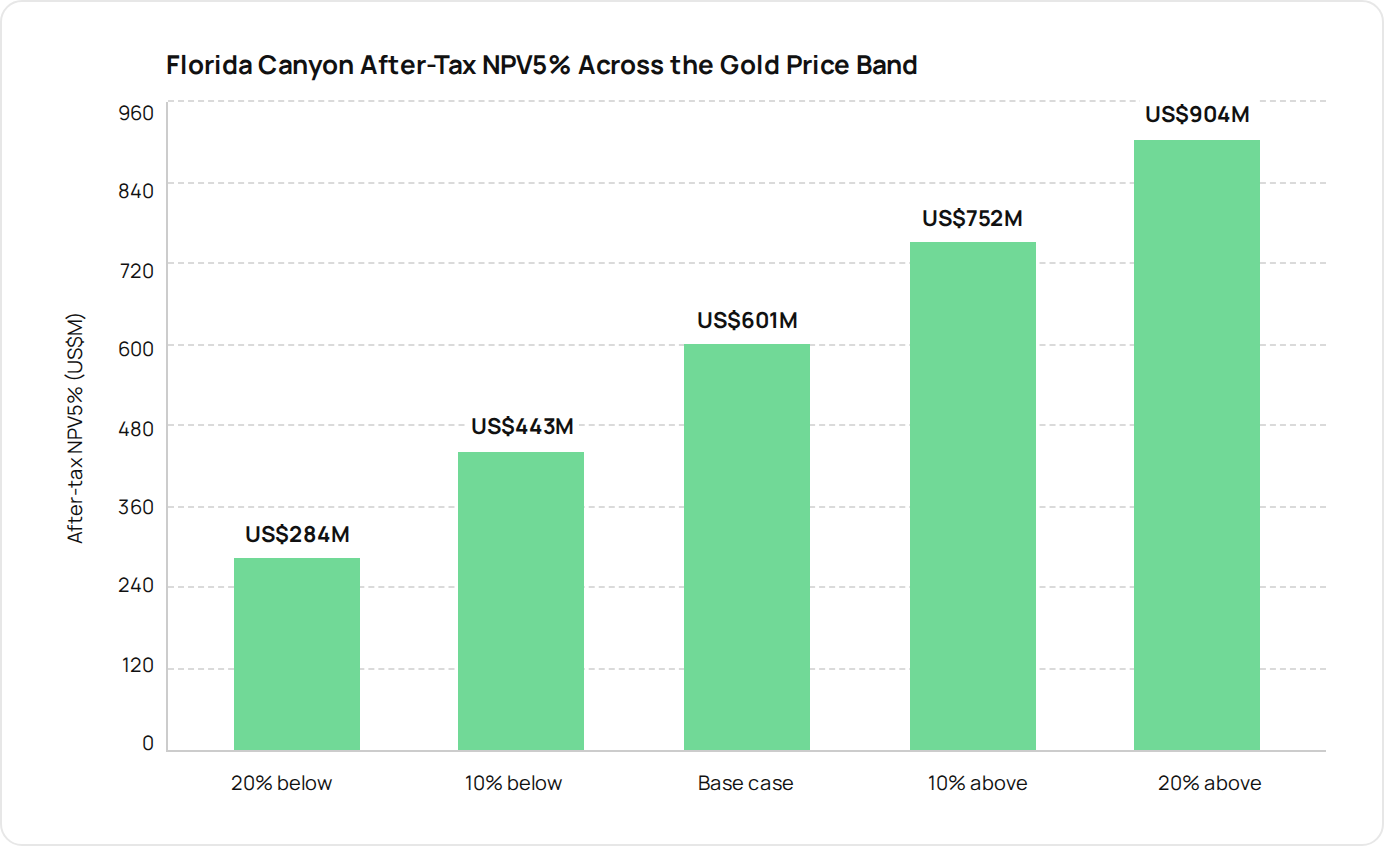
The disclosed sensitivity moves the gold price by 20% in each direction while holding the plan fixed. NPV5% reads US$284 million at 20% below base, US$443 million at 10% below, US$601 million at base, US$752 million at 10% above, and US$904 million at 20% above. After-tax free cash flow over the mine life tracks the same axis: US$375 million, US$573 million, US$770 million, US$959 million, and US$1,147 million. A 10% increase in the gold price raises both by approximately 25%. The band from lowest to highest is wider than the base-case valuation it brackets.
Nothing in the mine plan is re-cut anywhere along that axis. The open-pit design defining the reserve was drawn at US$2,400 per ounce for gold, counting only oxide material, and the conceptual open-pit outline constraining the resource was drawn at US$2,650 per ounce. Both fall below every price on the sensitivity band, so the ounces in the plan hold constant as the price moves, and only their value changes. Reserves are reported at a cut-off grade of 0.14 to 0.15 g/t and resources at 0.13 to 0.14 g/t for oxide material, thresholds set by those same low price assumptions rather than by the prices in either valuation case. Material outside the plan behaves differently: historical dump material at Florida Canyon was mined from the late 1980s to the mid-1990s, when gold traded at US$325 to US$450 per ounce and cut-off grades were 0.28 to 0.34 g/t of gold; conceptual estimates put the north and south dumps at a combined 34 million to 56 million t grading 0.11 to 0.25 g/t of gold, on drilling and metallurgical test work too limited to define a mineral resource.
President and Chief Executive Officer of Integra Resources, George Salamis, points to the material the price move has already reclassified:
"A lot of the material at Florida Canyon that you saw this morning during the visit was low-grade waste. Wasn't economic at lower gold prices, now is economic."
A gold price move therefore reaches the valuation along 2 paths: through the ounces already inside the plan, and through the volume of material that clears the cut-off grade and becomes a candidate for a later one.
How Much of a Gold Price Move Reaches Costs
The cost base responds to the same price at a rate nothing like that. Revised 2026 guidance assumes an average gold price of US$4,200 per ounce, and a US$100-per-ounce change in the gold price alters both cash costs and mine-site AISC by an estimated US$7 per ounce. Royalties and excise taxes are a material component of both measures and move directly with the metal price. Royalty costs of US$132.00 per ounce of recoverable gold are an input to the reserve pit design itself.
The remaining 2026 cost increase came from elsewhere. Total cash cost guidance moved from a range of US$1,900 to US$2,100 per ounce sold to US$2,300 to US$2,500, and mine-site AISC guidance moved from US$2,750 to US$2,950 to US$3,300 to US$3,500. Non-sustaining growth capital guidance moved from a range of US$7.5 million to US$9.5 million up to a range of US$16.5 million to US$18.5 million. The drivers named with the revision are higher metric tons mined, stacked, and processed; lower gold ounces sold in the first quarter; higher royalties and excise taxes on stronger gold prices; and higher diesel fuel and explosive costs. Gold production guidance of 70,000 to 75,000 ounces was left unchanged.
The second quarter of 2026 shows both effects at once. The realized gold price was US$4,426 per ounce, up from US$3,332 a year earlier, and it lifted revenue to US$70.8 million from US$61.1 million on fewer ounces sold, with 16,379 ounces of gold produced and 15,794 sold, down from 18,194 a year earlier. Mine operating earnings fell to US$23.4 million from US$25.2 million and operating margin to 33% from 41%, while operating cash flow rose to US$22.8 million from US$16.3 million, free cash flow to US$9.3 million from US$2.1 million, and net earnings to US$12.0 million from US$10.6 million. Over the first half of 2026, the same pattern held at a larger scale, with revenue of US$132.5 million, up from US$118.1 million a year earlier, at a realized price of US$4,615 per ounce, and an operating margin of 36%, up from 34%. Revenue takes almost the whole of a gold price move, and the cost base takes almost none of it.
Grade, Recovery & the Cost Base
Florida Canyon is a low-grade, high-volume heap leach operation, and its cost structure translates a modest price move into a large valuation move. In the second quarter of 2026, the mine processed ore at 0.23 g/t of gold and recovered 57.8% of it, moving 4.4 million t of ore and 3.6 million t of waste at a strip ratio of 0.81. Mining rates averaged 87,867 metric tons per day against 66,382 a year earlier, a record rate of total material movement at the mine. Recoveries applied in the reserve pit design range from 43% to 67%, depending on deposit and ore type.
Cash costs were US$2,495 per ounce sold in the quarter and mine-site AISC US$3,371, against US$1,849 and US$2,641 a year earlier; the half-year figures are US$2,463 and US$3,344. Integra plans for both to come down to LOM averages of US$1,940 and US$2,331 per ounce, with the step down arriving in 2027 as the sustaining capital program begun in 2025 completes. Sustaining capital of US$13.5 million in the quarter went to new equipment leases, stripping of waste to open future pit phases, and mobile equipment refurbishments, with a further US$0.8 million of non-sustaining growth capital. The plan calls for consistent annual gold production of approximately 82,000 ounces from 2027 onward, so the cost per ounce falls partly on the volume the current capital program is building toward.
General Manager of the Florida Canyon Mine, Greg Robinson, names the constraint that every one of those figures starts from:
"Our grades are low. We're one of the lowest grade operating mines in the US, and so we're definitely planning for the long term."
Against that grade profile, the plan's own economics arrive through 2 steps, neither of which depends on further help from the metal price: the targeted move to 80,000 to 85,000 ounces of annual production in 2027, and the fall in unit costs toward the LOM averages as the current capital program closes out.
What the Cash Flow Is Committed To
The US$0.8 billion Florida Canyon produces has a destination. Cash and cash equivalents stood at US$111.1 million on June 30, 2026, up from US$63.1 million at December 31, 2025, and were helped by a US$57.5 million bought-deal public offering completed in the first quarter. Working capital was US$146.5 million on June 30, 2026, up from US$92.9 million at the end of 2025. Over the long term Integra is targeting a multi-asset platform of 250,000 to 300,000 ounces of gold equivalent per year, funded by cash from the producing mine.
Salamis sizes the treasury against the building ahead of it:
"Our desire is to get to DeLamar when we decide to build DeLamar with something that looks like maybe 50% of the total CapEx for that project in our treasury that we can deploy. The balance will come from some form of debt."
Initial capital for the DeLamar gold-silver project in Idaho is US$389 million, with a further US$305 million of sustaining capital over a 10-year mine life producing an average of 106,000 ounces of gold equivalent a year, and 119,000 ounces across years 1 to 5, at a co-product mine-site AISC of US$1,480 per ounce of gold equivalent. That project carries an after-tax NPV5% of US$774 million and an after-tax internal rate of return (IRR) of 46% at US$3,000 per ounce for gold and US$35 per ounce for silver, improving to approximately US$1.9 billion and 97% at US$4,500 per ounce for gold and US$65 per ounce for silver. Payback is 1.8 years on the base case and 1.0 years at those current prices.
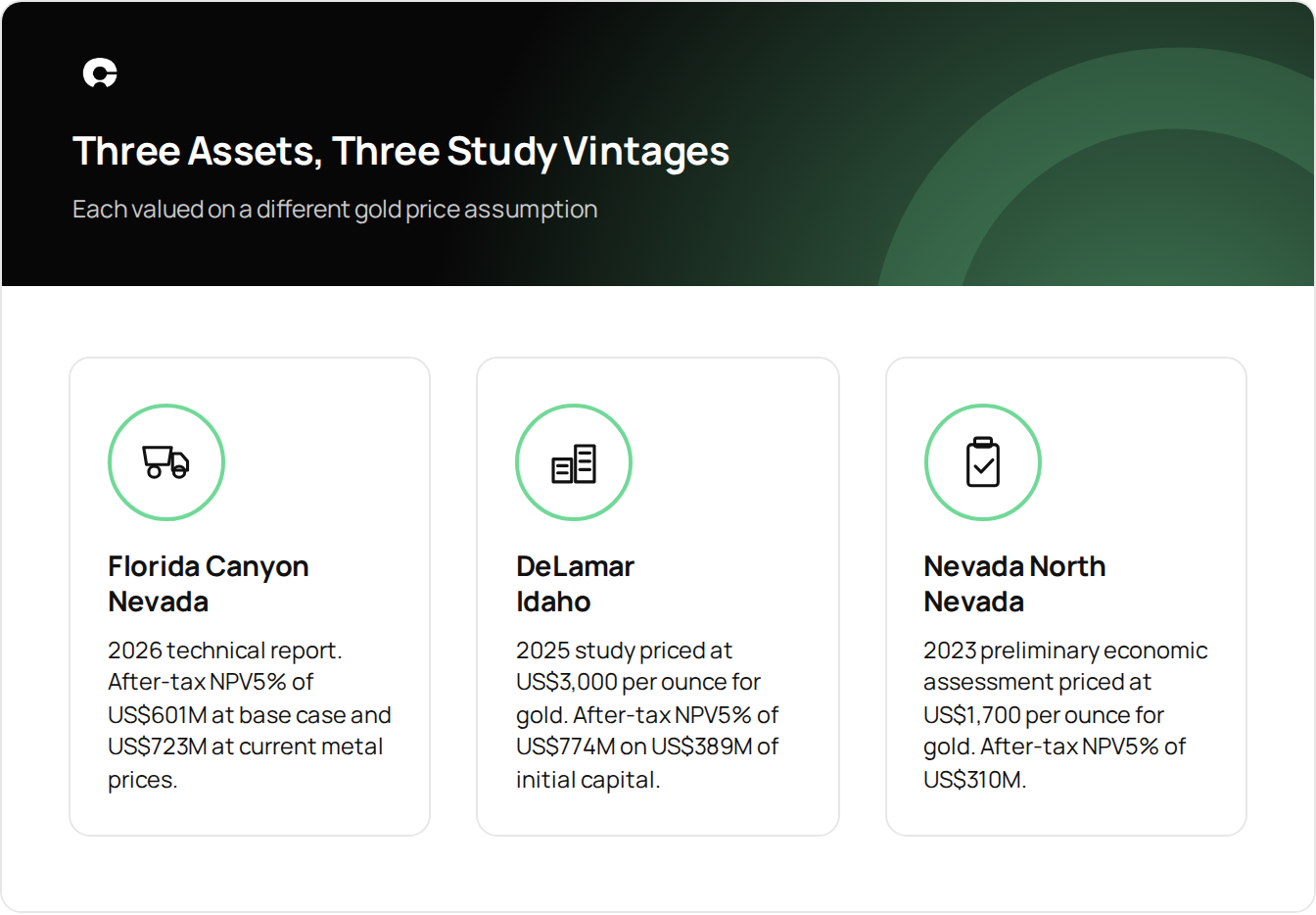
The third asset is priced off an older assumption again. Nevada North is valued on a 2023 preliminary economic assessment at an after-tax NPV5% of US$310 million, with a 37% IRR at US$1,700 per ounce for gold and a 3-year payback, over a 13-year mine life averaging approximately 80,000 ounces of gold equivalent a year at a co-product LOM AISC of US$973 per ounce of gold equivalent. Integra prices 3 assets off 3 study vintages and 3 gold price assumptions, and the funding chain that connects them begins with the one applied at Florida Canyon.
The Investment Thesis for Integra Resources
- Florida Canyon's updated mine plan returns an after-tax net present value at a 5% discount rate of US$601 million on a declining gold price deck and US$723 million on a flat US$4,200-per-ounce deck, with no change to the reserve or the schedule between them.
- A 10% increase in the gold price raises both the net present value and life-of-mine free cash flow by approximately 25%, within a disclosed band of US$284 million to US$904 million.
- A US$100-per-ounce change in the gold price alters cash costs and mine-site all-in sustaining cost by an estimated US$7 per ounce, so almost the whole of a price move lands in margin.
- Second-quarter 2026 cash costs of US$2,495 per ounce sold and mine-site all-in sustaining cost of US$3,371 compare with a processed grade of 0.23 grams per metric ton and life-of-mine plan averages of US$1,940 and US$2,331.
- Cash of US$111.1 million on June 30, 2026, and US$0.8 billion in life-of-mine free cash flow are what DeLamar's US$389 million in initial capital and, behind it, Nevada North are to be funded from.
- Florida Canyon is valued on a 2026 technical report, DeLamar on a 2025 study priced at US$3,000 per ounce for gold, and Nevada North on a 2023 preliminary economic assessment priced at US$1,700 per ounce.
The investment question at Florida Canyon is narrower than it looks. The mine plan is fixed; the reserve is drawn at a gold price far below that in either valuation case; and the cost base moves with the metal price, at an estimated US$7 per ounce for every US$100. What remains variable is the price deck: Integra publishes both a declining and a flat deck, with different answers under each. An investor taking a position is taking a view on which deck is closer to right, with the operating plan still underneath.
TL;DR
Florida Canyon is a low-grade, high-volume heap leach mine whose valuation is directly a function of the gold price assumption applied to a fixed 8-year plan. The same reserve and schedule produce an NPV5% of US$601 million on a declining price deck and US$723 million on a flat US$4,200-per-ounce deck, within a disclosed sensitivity band of US$284 million to US$904 million. Almost none of a gold price move reaches the cost base, at an estimated US$7 per ounce of cost for every US$100 of price, so the leverage appears almost entirely in margin. The view to hold is the gold price deck, and the plan underneath it is already set.
FAQs (AI-Generated)
Analyst's Notes





Subscribe to Our Channel



.png)


Stay Informed






















