




Higher-for-Longer Rates Constrain New Copper Supply Despite Prices Holding 35% Above Year-Ago Levels


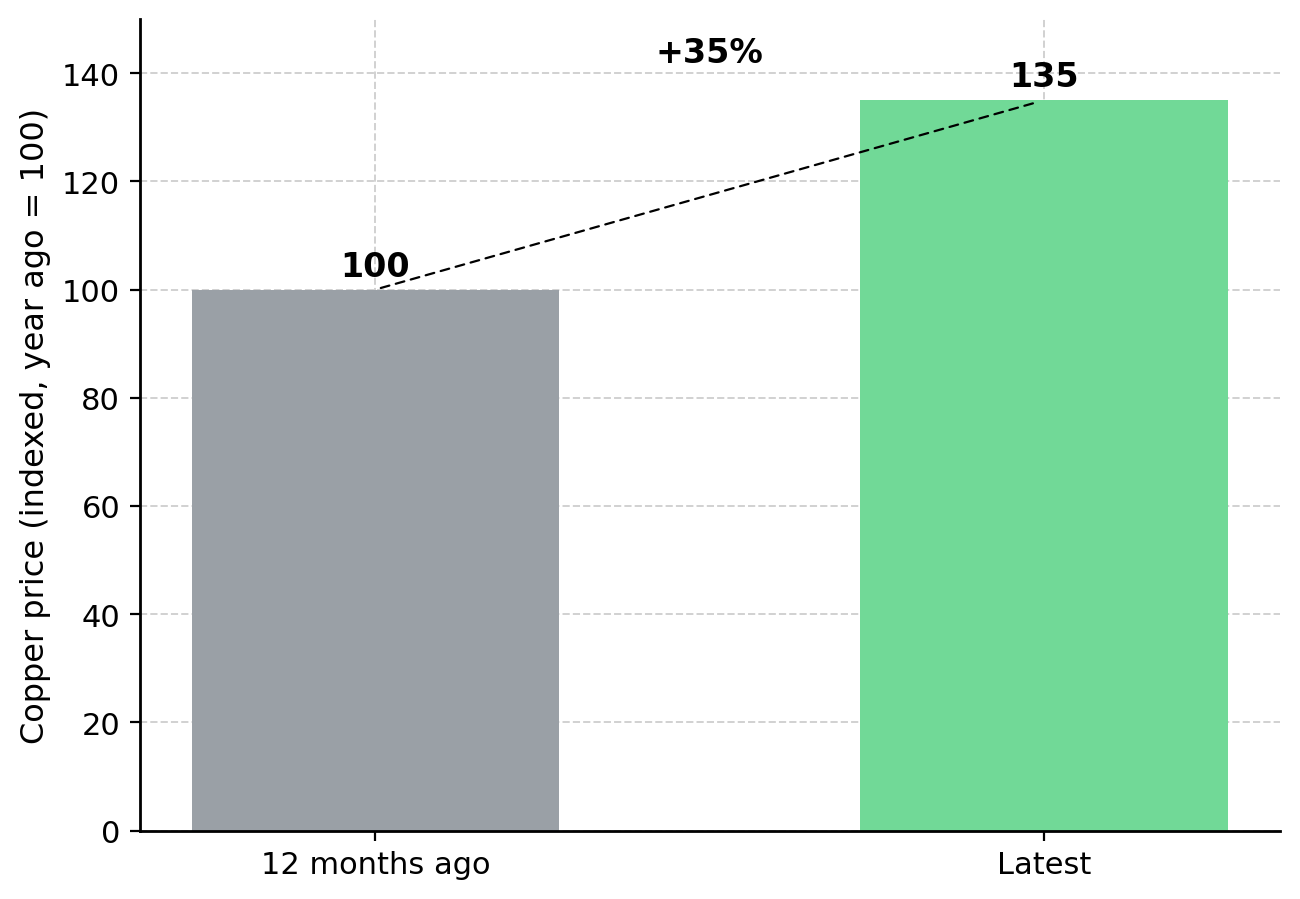
Copper prices remain 35% above year-ago levels, but higher financing costs are slowing new supply and favoring capital-efficient developers.
- Copper prices remain roughly 35% above year-ago levels amid a mine-supply deficit, but higher interest rates and a stronger US dollar are raising financing costs for the developers needed to bring new supply to market.
- A higher discount rate reduces project net present values and extends payback periods, hitting large, long-dated mine developments hardest as declining ore grades increase the capital required to bring new supply online.
- Higher financing costs are increasing the importance of financing structure, dilution control and capital intensity in valuing pre-production companies, often more than resource grade alone.
- Developers and explorers are reducing financing risk through low-capex processing, warrant-free financings, ring-fenced builds and brownfield restarts.
- The risk is that these companies are pre-revenue and sensitive to financing costs, making shareholder returns dependent on bringing projects into production without excessive dilution.
Copper Supply Deficit Collides With Higher Financing Costs
Copper prices remain roughly 35% above year-ago levels amid a mine-supply deficit, yet higher financing costs are making new supply more difficult to fund. Higher financing costs are increasing the capital required to advance new copper projects despite strong demand from electrification, grid expansion and data-centre investment.
Inflation driven by energy and supply constraints rather than demand growth has reduced the Federal Reserve's scope to cut rates, leading markets to price a near-term rate increase instead of the easing expected a year ago. A stronger US dollar adds to the pressure because copper is priced in dollars, increasing the metal's cost for non-dollar buyers. For developers, higher funding costs and discount rates reduce project valuations and make financing new mines more difficult.
Higher financing costs are restricting capital access for the developers needed to bring new copper supply to market. Pre-production copper projects are long-dated and capital-intensive, making them particularly sensitive to higher discount rates. Investors should assess copper developers and explorers on their ability to fund project development despite favourable supply-demand fundamentals. A rate increase is being priced by markets but is not guaranteed. Investors are placing greater weight on financing strategy and dilution risk alongside asset quality.
Higher Discount Rates Increase Financing Risk for Copper Projects
A project's net present value (NPV) falls as the discount rate rises, with the largest impact on assets whose cash flows are furthest in the future. Copper projects with large upfront capital requirements and multi-year construction timelines are among the most sensitive to higher discount rates. Higher discount rates also raise the internal rate of return (IRR) required for a project to attract financing. As the cost of capital rises, fewer projects meet financing thresholds.
Declining ore grades are increasing the capital required to add new copper supply. Capital intensity has increased as ore grades decline and copper deposits are mined deeper and at greater scale. Lower ore grades require more ore to be mined and processed per unit of copper, increasing both capital and operating costs. Cochilco projects that billions of dollars of investment through the next decade will deliver only limited growth in Chilean copper output, while BHP has guided to declining production at several of its largest operations. The capital needed simply to hold output flat is rising.
Fitzroy Minerals Targets Low-Capital-Intensity Copper Development
Fitzroy Minerals is prioritising a low-capital-intensity development strategy at its brownfield Buen Retiro copper project in Chile. Instead of building its own processing plant, the company is pursuing a heap-leach joint venture that would use a partner's existing solvent-extraction and electrowinning facility, reducing upfront capital requirements.
Merlin Marr-Johnson, President and Chief Executive Officer of Fitzroy Minerals, explains how the proposed heap-leach joint venture could reduce capital requirements and accelerate cash flow generation:
"This would give us non-operated cash flow and a very, very low capital intensity. This is a low-cost operation to bring into production."
Buen Retiro remains an early-stage project, with a maiden mineral resource estimate targeted for late 2026 and a pre-feasibility study to follow. A low-capital-intensity development route reduces financing requirements and limits the impact of higher discount rates on project economics.
Financing Structure & Dilution Control Drive Valuations
When financing costs are high, funding strategy can matter as much as asset quality. The variables that determine per-share outcomes are dilution, the issuance of new shares that shrinks each existing holder's claim on the asset, and warrants, which can create additional future dilution at a fixed price. A financing that funds a project through its next catalyst without warrants can preserve net present value per share, while a more dilutive financing can reduce per-share value even as the resource expands.
Enterprise value is only meaningful on a per-share basis if dilution is controlled, making treasury depth and financing terms key factors in evaluating pre-production companies when financing costs are high.
Funding Key Catalysts While Limiting Dilution
Abitibi Metals demonstrates this financing approach at its B26 polymetallic deposit in Quebec, which hosts 25.3 million tonnes grading above 2.1% copper equivalent across indicated and inferred resources. The company completed a $31 million warrant-free financing to fund drilling through a preliminary economic assessment targeted for Q1 2027 and added Discovery Silver as a 9.9% strategic shareholder.
Jonathon Deluce, Chief Executive Officer and Founder of Abitibi Metals, explains how the company balanced access to capital with dilution control:
"It's the right balance, considering our market cap, of getting a partner involved at the right time and cost of capital, but not going overboard."
B26 has no published economic study, making it an advanced exploration asset rather than a development-stage project today. The financing allows the company to reach those catalysts without raising additional capital at potentially lower share prices.
Exploration Success Can Offset Financing Risk at the Exploration Stage
Mogotes Metals offers a different form of exposure to the copper market than development-stage companies because its value is tied primarily to exploration success rather than near-term construction financing. At the Filo Sur project in Argentina's Vicuña district, the company reported an 86-metre intercept grading 0.70% copper, 0.55 g/t gold, 2.7 g/t silver and 169 ppm molybdenum from 108 metres depth at the Albor target, marking its second copper-gold-silver-molybdenum discovery during the 2025-2026 drill campaign.
The discovery confirmed mineralisation with geological characteristics comparable to the adjacent Filo del Sol system and validated previously identified geophysical targets. With approximately C$40.1 million in cash and 3,681 metres of drilling still awaiting assay results, Mogotes’ investment case may depend on whether ongoing drilling can demonstrate district-scale continuity and expand the discovery footprint rather than on financing a mine built in the current higher-rate environment.
Financing One Asset Without Diluting Another
Marimaca Copper is advancing its Marimaca Oxide Deposit in Chile toward development while the newer Pampa Medina discovery remains at the exploration stage. Management intends to finance the oxide deposit in a way that limits dilution of shareholder exposure to the Pampa Medina sulphide discovery.
Hayden Locke, President and Chief Executive Officer of Marimaca Copper, explains how the company intends to finance its oxide project while preserving shareholder exposure to the Pampa Medina discovery:
"We can effectively reduce the amount of dilution to this incredible upside opportunity while still progressing the MOD."
Access to existing power, water and logistics infrastructure reduces the capital required to develop the oxide project and lowers financing risk.
Existing Infrastructure Improves Brownfield Project Economics
When financing costs are high, projects that reuse existing infrastructure often require less capital to bring new copper supply to market. Brownfield projects typically have lower capital intensity, shorter payback periods and lower construction and financing risk than greenfield developments. When discount rates are high, these attributes can support higher project valuations and improve access to financing.
Brownfield restarts can inherit permitting requirements, closure liabilities and community obligations, while existing infrastructure must be verified before it is treated as a capital-saving advantage. Even after accounting for these risks, existing infrastructure can still reduce capital requirements and financing risk.
Existing Infrastructure Reduces Redevelopment Capital
Selkirk Copper is advancing the redevelopment of the past-producing Minto mine in Yukon. The mine has been inactive since the previous operator entered bankruptcy in 2023, a process that removed a precious-metals stream and an offtake agreement. Selkirk is drilling toward a preliminary economic assessment targeted for mid-2026 based on a resource of 12.6 million indicated tonnes at 1.20% copper and 23.7 million inferred tonnes at 1.05% copper.
M. Colin Joudrie, President and Chief Executive Officer of Selkirk Copper, explains how existing infrastructure reduces the capital required to restart the Minto mine:
"We don't have to build a power line, we don't have to build a road, we don't have to build the above-ground facility. Over $330 million has been spent on the above-ground infrastructure."
Against an estimated greenfield restart cost of US$800-900 million, the existing plant, mill and site infrastructure reduce the capital required to redevelop the project at current financing costs.
Low Operating Costs & Strong Balance Sheets Reduce Financing Risk
High financing costs increase the importance of operating costs and balance-sheet strength. Low all-in sustaining costs (AISC) and a debt-free balance sheet reduce a company's dependence on external funding when financing costs are high. A developer that can self-fund its next stage can avoid raising capital at lower share prices and reduce dilution risk.
Lower-cost processing methods such as heap leaching and in-situ recovery (ISR) can place an asset in the lower-cost segment of the industry cost curve, supporting margins during periods of weaker copper prices.
Low-Cost Processing Reduces Capital Requirements
Cobra Resources' copper exposure comes through the exploration-stage Manna Hill project in South Australia, which it holds under option rather than owning outright. Early drilling at the Blue Rose target intersected near-surface copper mineralisation, and management is targeting a low-cost development route.
Rupert Verco, Managing Director of Cobra Resources, explains how the proposed processing route could reduce development costs and upfront capital requirements:
"You've probably got a low-cost, low-capex startup treating it as heap leach for copper and possibly gold in some of the higher-grade zones, and then you have a standard flotation circuit to treat your primary sulfide mineralisation."
The copper project remains at an early stage and is held under option, while Cobra's more advanced asset is a separate rare-earth project, making it a lower-cost development example rather than a direct peer of the copper developers discussed.
Higher interest rates are constraining new copper supply despite prices remaining roughly 35% above year-ago levels. Rising financing costs reduce project valuations, extend payback periods and make capital-intensive mine developments harder to fund, increasing the importance of financing structure, dilution control and capital intensity.
The Investment Thesis for Copper
- When discount rates are high, funded status becomes a key screening factor because only companies that can finance construction can add new copper supply.
- Low-capital-intensity processing routes such as heap leaching on existing or partner infrastructure reduce financing requirements and can improve project economics more than grade alone.
- Financing structures that avoid warrants and fund a project through its next catalyst can protect net present value per share by reducing dilution.
- Brownfield redevelopments that reuse existing plant, power and access can reduce capital requirements, shorten payback periods and lower construction risk, though permitting and closure liabilities must still be assessed.
- A low all-in sustaining cost and a debt-free balance sheet reduce reliance on external funding, lowering dilution risk when financing costs are high.
- Electrification, grid expansion and data-centre investment support long-term copper demand, but pre-revenue companies remain exposed to execution, single-asset and interest-rate risks that can result in permanent capital loss.
The cost of capital is a key factor in evaluating copper developers and explorers. Investors must assess not only asset quality but also whether a company can build a mine without excessive dilution. Low-capital-intensity processing, warrant-free financings, ring-fenced development plans, brownfield redevelopments and debt-free balance sheets all reduce reliance on external funding when financing costs are high.
Strong copper demand can coexist with difficult financing conditions, making financing structure, capital intensity and balance-sheet strength key factors in evaluating pre-production companies. When financing costs remain high, companies that control dilution and capital requirements are better positioned to benefit from a copper supply deficit.
TL;DR
Copper prices remain about 35% above year-ago levels, supported by a supply deficit and long-term demand from electrification, grid expansion and data centres, but higher interest rates and a stronger US dollar are making new mine development harder to finance. Rising discount rates reduce project valuations and increase financing hurdles, particularly for capital-intensive projects. As a result, investors are placing greater emphasis on financing structure, dilution control, capital intensity and balance-sheet strength. Companies using low-capex processing, warrant-free financings, brownfield infrastructure and disciplined capital allocation may be better positioned to advance projects without excessive dilution in a higher-rate environment.
FAQs (AI-Generated)
Analyst's Notes





Subscribe to Our Channel













Stay Informed






















