How Coringa Transforms Serabi Gold Into a 60,000-Ounce Producer


Serabi Gold targets 60,000 oz production using Coringa ore sorting, Palito expansion, and a debt-free balance sheet with no external financing.
- Serabi Gold produced 44,169 oz in 2025, an 18% increase from 2024, and is targeting 53,000 to 57,000 oz in 2026 before reaching 60,000+ oz per annum from 2027, with incremental growth driven entirely by the ramp-up at Coringa.
- The Comex ore sorter at Coringa upgrades sub-2 grams per tonne (g/t) feed to a product grade of 10 g/t while rejecting over 90% of feed mass at a discard grade below 0.4 g/t, enabling the transport of pre-concentrated ore to the Palito Complex for final processing.
- A dormant ball mill from Coringa's pre-existing process plant is being relocated to the Palito Complex for an estimated US$5 million, expanding processing throughput from 650 to approximately 900 tonnes per day, with commissioning targeted for the fourth quarter of 2026.
- The hub-and-spoke processing model eliminates the need for a standalone process plant and a conventional tailings dam at Coringa, converting those capital requirements into variable transport costs that scale with throughput.
- Serabi repaid a US$5.3 million loan to Banco Santander in January 2026 and carried US$64.4 million in cash at the close of the first quarter of 2026, funding the organic growth programme entirely from the existing balance sheet with no external financing required.
Production Context: 44,000 oz to 60,000 oz
Serabi Gold’s (AIM: SRB | TSX: SBI) 2025 full-year production of 44,169 ounces (oz) was an 18% increase from 37,520 oz in 2024. The 2026 production guidance of 53,000 to 57,000 oz is an intermediate position; the near-term operational priority is achieving a 55,000 oz run rate at current 650 tonnes-per-day processing capacity through access to the Meio and Galena zones at Coringa, with the 60,000+ oz per annum target from 2027 as the programme's defined endpoint.
The structural distinction in Serabi's growth profile is the division of labour between its two producing operations. The Palito Complex provides a stable production base of 30,000 to 40,000 oz per year, a floor from which group output does not retreat, but is not the engine of growth to 60,000 oz. The path to 60,000+ oz from 2027 is driven entirely by Coringa's ramp-up, and the capital programme that supports it reflects that concentration: every significant infrastructure decision in the growth programme is directed at enabling, processing, or transporting Coringa ore.
Ore Sorting at Coringa: Pre-Concentration Before Transport
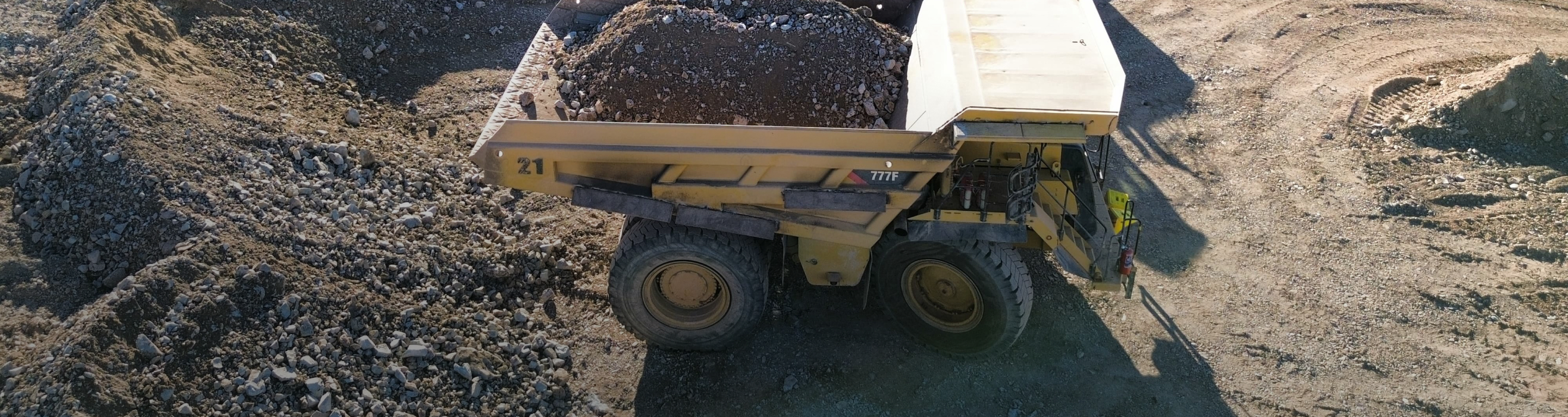
The Comex ore sorter at Coringa upgrades sub-2 grams per tonne (g/t) feed material to a product grade of 10 g/t while rejecting over 90% of feed mass at a discard grade below 0.4 g/t. The sorter separates material by colour and/or density, a method well-suited to Coringa's visually distinctive mineralisation. Commissioned in 2024 and operated continuously throughout 2025, the classification plant was built at a capital cost of less than US$10 million. For 2026 and beyond, the projected product grade exceeds 12 g/t, with mass rejection above 98%.
The downstream implications of that pre-concentration step extend across the system. The 2024 Preliminary Economic Assessment (PEA) recorded ore sorter efficiency of 61% by tonnes and a 1.59x upgrade factor, parameters that define the sorter's contribution to the system's cost structure. Pre-concentration reduces both the volume of material transported to Palito for final processing and the tailings tonnage generated at the Palito circuit, compressing processing load at the receiving end of the hub-and-spoke route.
Chief Executive Officer of Serabi Gold, Mike Hodgson, is direct about why maximizing the ore sorters is critical while the final processing plant remains constrained:
"What we're doing this year, our plant is absolutely maxed out. We're ore sorting all the Coringa ore, nearly all of it, and we're ore sorting some of the Palito ore. We can't really do anything more with that plant without expansion."
The constraint Hodgson describes reflects the classification of a plant operating at full utilisation across both producing operations simultaneously. The ball mill transfer at Palito is the downstream investment designed to absorb the volume that the sorter is already capable of producing.
Ball Mill Transfer: Capacity Expansion from a Dormant Asset
The additional ball mill being installed at the Palito Complex is sourced from Coringa's pre-existing process plant, acquired with the project when Coringa was purchased as a greenfield development that had already procured processing infrastructure. The relocation is estimated to cost US$5 million, with commissioning targeted for the fourth quarter of 2026. The throughput impact is a capacity increase from 650 tonnes per day to approximately 900 tonnes per day, equivalent to 330,000 tonnes per annum.
A capacity increase from 650 to approximately 900 tonnes per day at an estimated US$5 million represents a capital intensity that cannot be replicated through new equipment procurement. The asset was in serviceable condition at acquisition; the cost reflects relocation and installation, not procurement of comparable capacity from new stock.
Hodgson puts the origin of the asset plainly:
"When we bought Coringa, it came with a process plant, a greenfield project that had already procured processing infrastructure before we arrived, so it wasn't perfect, but the mills were in good condition, as were the crushing facilities. So we're moving one of those ball mills to Palito now."
The throughput increase from this relocation, from 650 to approximately 900 tonnes per day, is the mechanical precondition for Serabi's 60,000+ oz target. Without that capacity, processing throughput at Palito limits the production ceiling regardless of the mining rate at Coringa.
Hub-and-Spoke: Centralised Processing Architecture
Routing pre-concentrated Coringa ore to Palito for final processing eliminates two capital requirements that would otherwise define Coringa as a standalone development: a dedicated process plant on site and a conventional tailings dam. The model is enabled by three conditions in place at the time of structuring: a paved federal highway connecting the two operations across approximately 200 km, adequate regional availability of truck drivers, and the visual distinctiveness of Coringa's mineralisation, which makes it highly amenable to colour-and/or-density sorting that reduces transported volume before material leaves the mine.
The capital avoidance this model delivers is the structural argument for the hub-and-spoke approach over a conventional Coringa development path. A standalone process plant and tailings facility at Coringa would require a separate capital programme, its own permitting pathway for that infrastructure, and a construction timeline before Coringa ore could be processed at scale. The centralised model converts those requirements into a variable transport cost that scales with throughput rather than a fixed capital commitment that must be made before production begins.
Capital Efficiency & Balance Sheet Position
The two principal infrastructure costs in Serabi's growth programme, the Coringa classification plant at less than US$10 million and the ball mill relocation at an estimated US$5 million, represent a combined capital commitment materially smaller than the production increase they are designed to enable. Coringa's 2026 underground development capital is estimated at US$13 million, and the 2024 PEA projected life-of-mine (LOF) sustaining capital of US$87 million across an 11-year mine life, with a corresponding LOF all-in sustaining cost (AISC) of US$1,241 per oz. That figure sits below the group's 2025 actual AISC of US$1,816 per oz, reflecting the cost drag of the current ramp and pre-production capital phase at Coringa.
Serabi carried US$64.4 million in cash at the close of the first quarter of 2026 and repaid a US$5.3 million short-term loan to Banco Santander in January 2026, leaving the company debt-free. Management anticipates the group's AISC rising into the US$2,000 per oz range in 2026, driven by elevated exploration and pre-production capital spending, a profile expected to normalise as Coringa approaches steady-state output. The organic growth programme is funded entirely from the existing balance sheet, with no external financing required. The company paid its inaugural annual dividend of US$5.41 million, representing 20% of 2025 free cash flow, alongside continued investment in the growth programme, in line with a distribution policy targeting up to 20 to 30% of free cash flow annually.
Permitting Status & Risk Mitigation at Coringa
A major procedural condition for Coringa's final operating permit, the Licença de Instalação (LI), has been met: the required indigenous community impact study has been completed and signed with unanimous approval from the relevant indigenous groups. Coringa continues to operate under a 3-year trial mining licence (GUIA) pending issuance, with the delay in final permit receipt attributable to both the mandatory study requirement and the pace of government agency processing; legal counsel advises that receipt of the LI is expected by the end of 2026 or early 2027.
Serabi's decision to proceed with the Palito ball mill installation ahead of final LI receipt reflects a capital sequencing judgement grounded in the procedural record: the key indigenous study is complete, community approval is unanimous, and legal counsel has provided a dated timeline for permit receipt.
Resource Base & the Path Beyond 60,000 oz
The 60,000+ oz target for 2027 is supported by a brownfield exploration programme targeting consolidated resources of over 1.5 million oz, as well as the expansion of active mining fronts across Coringa's 8 km artisanal trend. The mechanism for achieving production at that scale is additive rather than transformational: additional underground faces and equipment are deployed within an infrastructure system whose processing and transport architecture is already being built. The artisanal trend's potential to host multiple discrete mining areas operating in parallel is the operational basis for the production target.
Hodgson frames the production ceiling in operational terms:
"It's perfectly doable. It's just more faces underground, more attack points. Coringa, for example, isn't really just one mine. It's a series, like four little mini mines. You just have more of them and more equipment, and likewise at Palito."
Whether the brownfield exploration programme delivers the consolidated resource base required to sustain 60,000+ oz from 2027 remains the open question in the investment case. The infrastructure designed to process and transport that output is being built in advance of that answer.
Investment Thesis for Serabi Gold
- Serabi Gold produced 44,169 ounces in 2025 and is targeting 60,000+ ounces per annum from 2027, with incremental growth above the Palito Complex's stable base of 30,000 to 40,000 ounces per year driven entirely by the Coringa ramp-up.
- The Comex ore sorter at Coringa, built for less than US$10 million, upgrades feed to a projected product grade above 12 grams per tonne from 2026 while rejecting over 98% of feed mass, enabling pre-concentrated ore to be transported to Palito for final processing and eliminating the need for on-site final processing infrastructure at Coringa.
- A dormant ball mill from the Coringa process plant acquired with the project is being relocated to the Palito Complex for an estimated US$5 million, delivering a capacity increase from 650 to approximately 900 tonnes per day at a capital intensity that greenfield procurement would not replicate.
- The hub-and-spoke architecture eliminates the need for a standalone process plant and a conventional tailings dam at Coringa, converting those capital and permitting requirements into variable transport costs.
- Serabi carried US$64.4 million in cash at the close of the first quarter of 2026 and no debt following the January 2026 repayment of a short-term loan to Banco Santander, with the organic growth programme funded in full from the existing balance sheet and no external financing required.
- The Licença de Instalação at Coringa remains outstanding, with the completed indigenous community impact study and unanimous community approval representing a key procedural milestone preceding issuance; legal counsel advises that receipt is expected by the end of 2026 or early 2027.
The capital programme to reach 60,000+ ounces per annum from 2027 is committed and funded from a debt-free balance sheet carrying US$64.4 million in cash, with each infrastructure component carrying a defined cost and commissioning timeline. Receipt of the LI at Coringa is the primary remaining execution gate.
TL;DR
Serabi Gold is targeting 60,000+ oz per annum from 2027, with 44,169 oz delivered in 2025 and 53,000 to 57,000 oz guided for 2026. The growth programme is built on infrastructure already within the portfolio: a Comex ore sorter at Coringa that upgrades feed to a product grade projected above 12 g/t from 2026 while rejecting over 98% of feed mass, and a dormant ball mill from that same project being relocated to the Palito Complex for an estimated US$5 million to expand processing throughput from 650 to approximately 900 tonnes per day. That programme is funded from a debt-free balance sheet carrying US$64.4 million in cash at the close of the first quarter of 2026, with no external financing required. The outstanding final operating permit, the LI, at Coringa is the primary execution risk; the completed indigenous community impact study with unanimous community approval represents the key procedural milestone, with legal counsel advising that receipt is expected by the end of 2026 or early 2027.
FAQs (AI-Generated)
Analyst's Notes





Subscribe to Our Channel

Stay Informed