




Iran Conflict Lifts Oil Prices but Pressures Gold: Higher Fed Rate Expectations Override Safe-Haven Demand



Gold fell below $4,000 as higher Fed rate expectations outweighed Iran-driven safe-haven demand, while central bank buying supported long-term prices.
- Spot gold traded at $4,001–$4,008, down over 3% for the week and briefly below $4,000 despite a sixth night of US strikes on Iran, as higher bond yields outweighed safe-haven demand.
- Higher oil prices lifted inflation expectations, pushing September Fed hike odds to 53% from 47% and raising the opportunity cost of holding gold.
- China added 14.93 tonnes to reserves in June, its largest monthly buy since October 2023, while 89% of surveyed reserve managers expect central banks to keep increasing gold holdings.
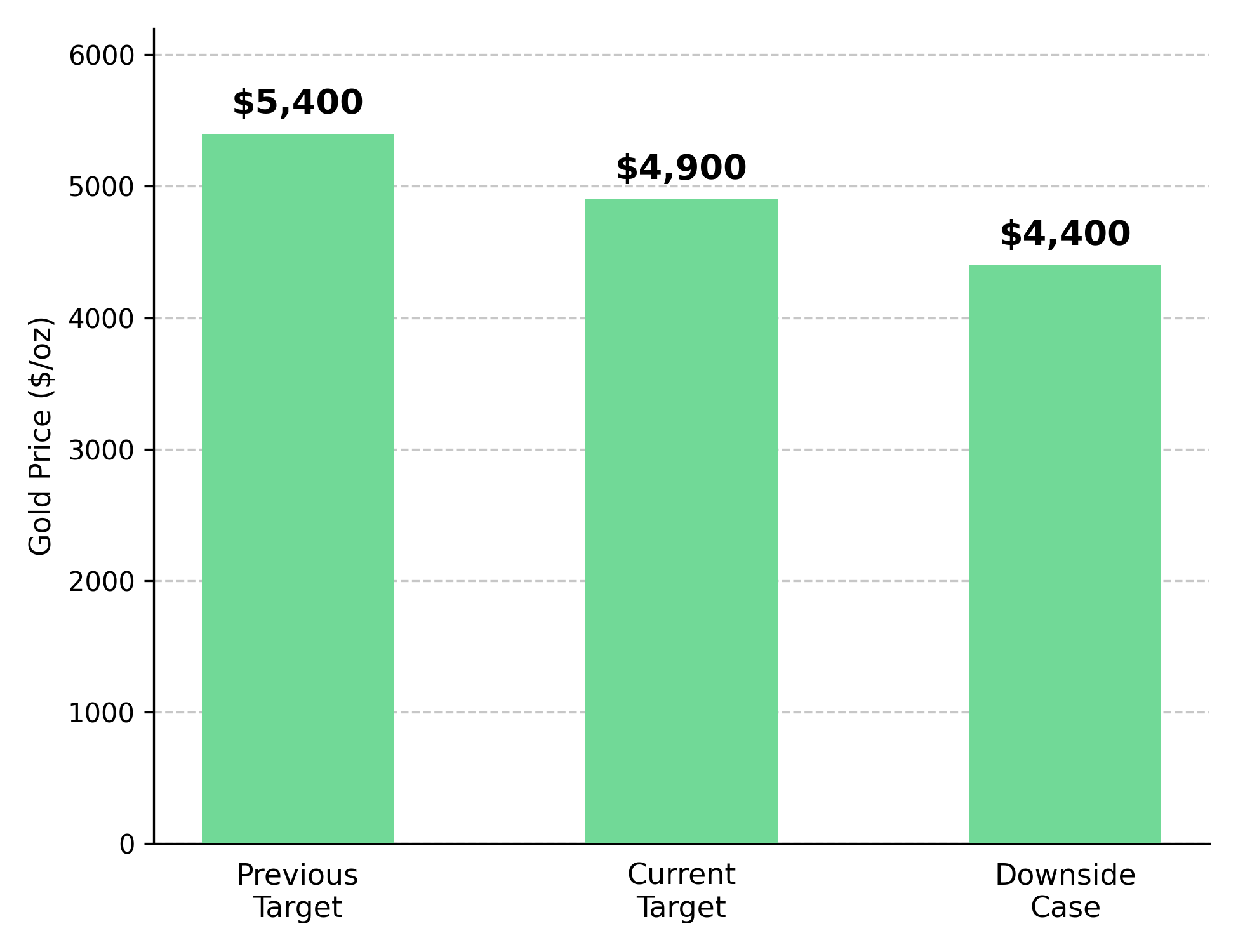
- Goldman Sachs cut its 2026 year-end gold target to $4,900 from $5,400, keeping a $4,400 downside case tied to an actual Fed hike rather than just hawkish talk.
- Development-stage projects with conservative price decks, some as low as $3,250/oz or AISC near $1,200/oz, have wider margin cushions than those priced closer to spot.
Oil-Driven Inflation Fears Override Safe-Haven Demand
Spot gold traded at $4,001 to $4,008 per ounce on July 20, down 0.4% on the day and over 3% for the week, its worst weekly decline in more than a month. Gold fell despite a sixth consecutive night of US strikes on Iranian military targets, a renewed naval blockade of Iranian shipping, and Iranian missile strikes on two tankers in Omani territorial waters. Those developments would normally lift demand for safe-haven assets. Instead, gold briefly fell below $4,000 for the first time in months, showing that higher rate expectations outweighed geopolitical demand.
The market's inflation and interest rate response, rather than the geopolitical headlines, is driving gold prices. Higher oil prices are lifting inflation expectations, increasing Fed rate-hike odds and pushing real yields and the US dollar higher, raising the opportunity cost of holding non-yielding gold. The key sequence to watch is oil prices, inflation expectations, Fed rate expectations, and then real yields and the US dollar. A resolution in the Strait of Hormuz could reduce oil prices, lower inflation expectations, and support gold by reducing pressure for higher Fed rates. Further escalation could keep gold under pressure until safe-haven demand outweighs the impact of higher real yields.
Hawkish Fed Signals Pressure Gold as Economic Data Looms
Fed officials strengthened rate-hike expectations ahead of the July 28–29 meeting, with Logan calling for another hike, Jefferson backing tighter policy if inflation persists, and Hammack flagging elevated inflation risks. Strong retail sales and higher Treasury yields pushed September hike odds to 53% from 47%, raising the opportunity cost of holding gold. With the Fed now in its quiet period, upcoming PMI, jobless claims, and ADP data will determine whether rate expectations climb further this week.
Despite gold's decline, official-sector demand stayed strong. China added 14.93 tonnes to reserves in June, its largest monthly purchase since October 2023 and 20th straight month of buying, even as gold posted its worst quarterly decline since the 2013 taper tantrum, underscoring that central banks buy for long-term diversification rather than short-term price signals.
The World Gold Council's 2026 survey found 89% of reserve managers expect global central bank gold holdings to rise over the next year, with a record 45% expecting their own institution to add reserves; gold has also overtaken US Treasuries as the world's largest reserve asset. The takeaway: short-term gold prices and long-term central bank demand respond to different drivers and should be read separately.
ETF Selling Eases but Gold Demand Remains Split: Central Bank Buying Continues to Offset Weak Investment Flows
SPDR Gold Shares recorded $14.4 billion in net outflows from March 1 to July 16, while net assets stood at $128.61 billion. Outflows slowed to $46 million through mid-July after March's record withdrawals. A $446.8 million weekly inflow also increased shares outstanding by 0.3%, suggesting ETF selling was slowing even as gold prices remained under pressure.
Slowing ETF outflows suggest leveraged Western gold demand is stabilizing despite weak short-term sentiment, while central bank buying continues to reflect long-term reserve diversification. Official-sector buying and ETF flows should be assessed separately because ETF demand responds to interest rate expectations, while central bank purchases reflect strategic reserve allocation.
Goldman Sachs Cuts Its Gold Target but Maintains a Reserve-Driven Floor: Central Bank Buying Continues to Limit Downside
Goldman Sachs Research cut its year-end 2026 gold price target to $4,900 per ounce from $5,400 after delaying its expected timing for Fed rate cuts, reflecting the impact of higher interest rates on gold prices. The bank's downside case values gold at $4,400 per ounce if the Fed delivers a rate hike rather than only signaling one. Goldman Sachs also noted that central banks bought 19 tonnes of gold in April 2026, providing continued official demand that could limit further downside even under its bearish scenario.
The World Gold Council's Gold Valuation Framework values gold near $4,100 per ounce (±5%), broadly in line with macro expectations, and even bearish sell-side forecasts assume central bank buying will limit further downside, a foundation that supports stronger economics for development-stage gold companies. Since recent weakness stems from higher rate expectations and positioning rather than weaker physical demand, developers that stay profitable well below current prices are better positioned to withstand the pullback, making margins based on conservative price assumptions a better gauge of equity risk than exposure to spot prices.
Conservative Price Decks Provide Downside Protection
Cabral Gold expects its Cuiú Cuiú project in Brazil to begin commercial production in the fourth quarter of 2026. Its July 2025 Pre-Feasibility Study projects a Phase 1 all-in sustaining cost of about $1,210 per ounce, including sustaining capital, placing projected production costs well below current gold prices.
Cabral Gold President and Chief Executive Officer Alan Carter said the project's low operating costs provide resilience even if gold prices remain below recent highs:
"We should be producing gold at an all-in sustaining cost of about $1,200 an ounce, even with the pullback in the gold price. There's an enormous profit margin on that gold that we expect to be producing very quickly."
With Fed rate expectations now the main driver of gold's pullback, Cabral's sub-$1,200 cost base gives it room to stay profitable even if further hawkish signals push gold lower.
U.S. Gold Corp based the definitive feasibility study for its fully permitted CK Gold project in Wyoming on a $3,250 per ounce gold price assumption, well below the roughly $3,800 per ounce market consensus at the time. Even under that conservative assumption, the study generated an after-tax net present value of about $630 million and an internal rate of return of about 30%, demonstrating that the project's economics do not depend on current spot prices. Because the study's $3,250 base case already sits below where gold could fall under Goldman's downside scenario, the project's returns are largely insulated from further Fed-driven price weakness.
Financing Readiness Separates the Development Cohort
Development-stage projects face different financing risks because higher Fed rate expectations increase both borrowing costs and the returns demanded by equity investors. Hycroft Mining Holding Corporation's latest technical study values its Nevada gold-silver project at an after-tax $4.3 billion using conservative planning gold and silver prices. At recent spot prices, the after-tax value increases to $10.0 billion, highlighting the project's sensitivity to higher metal prices. However, the project still requires financing that has not yet been fully secured, leaving it exposed to higher debt and equity financing costs.
Hycroft Mining Holding Corporation President and Chief Executive Officer Diane Garrett said the project's scale requires it to remain economically viable across both strong and weak gold markets:
"When you have an ore body of that size, you are going to go through the bull and bear markets in gold. As a low-grade system, you've got to build big to get economies of scale, but your margins also get squeezed if you're in a bear market in gold."
That margin sensitivity cuts both ways here, the swing from $4.3 billion to $10.0 billion in project value shows how directly Hycroft's economics track the same rate expectations now pressuring spot gold.
New Found Gold has fully funded Phase 1 development of its Queensway gold project in Newfoundland and Labrador, reducing the need to raise additional capital during a period of higher financing costs. The company has also received conditional approval to graduate from the TSX Venture Exchange to the Toronto Stock Exchange, a move that could improve trading liquidity and broaden access to institutional investors. This matters more as Fed rate-hike odds climb, since it shields New Found Gold from the higher borrowing and equity costs now facing unfunded developers.
Established Mining Camps Create Expansion Optionality Beyond Initial Development
Tudor Gold holds an 80% interest in the Treaty Creek project in British Columbia's Golden Triangle, next to Seabridge Gold's KSM and Newmont's Brucejack mine. That location gives access to existing infrastructure and mining expertise, lowering development risk and capital needs, an advantage as rising rate expectations push up financing costs sector-wide. P2 Gold is targeting a feasibility study for its Gabbs copper-gold porphyry project in Nevada by end-2026, building on a preliminary economic assessment now being revised for higher processing throughput; that efficiency gain could improve economics and give P2 Gold more cushion if gold stays pressured under a hawkish Fed.
Cobra Resources takes a different route to gold exposure, focusing on rare earths and copper, with Manna Hill's Golden Sophia zone showing a historic high-grade intercept of 48 metres at 2.2% copper and 78 g/t gold. After selling its gold assets in 2025, Cobra kept a stake in Barton Gold, a near-term South Australian developer, giving it indirect upside to a gold price recovery, avoiding near-term Fed-driven weakness while still benefiting if rate cuts return.
How Oil Prices Will Determine Gold's Next Direction
The Strait of Hormuz conflict remains the key variable, since gold is currently responding more to oil-driven inflation and Fed rate expectations than to traditional safe-haven demand: a ceasefire or reopened shipping lanes could lower oil prices and ease rate pressure, supporting gold, while further escalation could keep gold under pressure unless it eventually triggers stronger safe-haven buying, making this oil-to-rates dynamic more important through month-end than the Fed's July 29 decision alone.
The Investment Thesis for Gold
- Central bank buying continues to support long-term gold demand, while ETF flows respond primarily to Fed rate expectations and investor sentiment.
- Even bearish sell-side forecasts assume continued central bank buying will limit downside for gold prices.
- ETF outflows have slowed, suggesting investment demand is stabilizing and selling pressure is easing.
- Projects built on conservative gold price assumptions have wider operating margins and are more resilient to lower gold prices.
- Fully funded projects face lower financing risk and less exposure to higher borrowing costs and equity dilution.
- Exploration-stage and dual-commodity projects offer greater upside if gold prices recover or a second commodity strengthens.
- Predictable permitting and established infrastructure reduce development risk, capital costs, and construction delays.
Gold's move below $4,000 reflects higher Fed rate expectations and weaker investor positioning rather than a decline in official-sector demand. Central banks continue to accumulate gold for long-term reserve diversification, providing physical demand even as higher interest rates weigh on investment demand. The direction of the Strait of Hormuz conflict remains the key catalyst over the coming days because it will determine whether higher oil prices continue to lift inflation expectations and Fed rate expectations or whether easing tensions reduce pressure on real yields and support gold prices. For the development-stage projects discussed above, short-term gold price movements are less important than the conservative gold price assumptions used in their feasibility studies and financing plans. Projects designed to remain profitable at lower gold prices are better positioned to withstand short-term market volatility.
TL;DR
Gold fell below $4,000 despite escalating conflict in the Middle East because higher oil prices lifted inflation expectations and increased the likelihood of further Fed rate hikes, pushing real yields and the US dollar higher. While ETF demand remained weak, central banks continued accumulating gold, reinforcing long-term structural demand and limiting downside risk. Goldman Sachs lowered its year-end gold price target but maintained that official-sector buying would continue to provide support. The article also highlights that development-stage gold projects with conservative price assumptions, secured financing, and assets in established mining camps are better positioned to remain resilient during periods of weaker gold prices and tighter financial conditions.
FAQs (AI-Generated)
Analyst's Notes





Subscribe to Our Channel




.png)

.png)




Stay Informed






















