




Kingfisher Metals Launches Fully Funded 15,000m Drill Program in BC’s Golden Triangle


.jpg)
KFR: Fully funded ($30.6M cash), 15,000m drill program begins mid-June at Hank porphyry (425m/0.40% CuEq) + new Turquoise target. Catalysts ahead.
- Fully funded 2026 program: 15,000 m diamond drilling across three rigs at the Hank-Mary District, funded by ~$30.6M cash following the C$30.0M bought deal financing closed March 2026.
- Hank porphyry discovery validated: Final 2025 hole HW-25-011 returned 425 m at 0.40% CuEq (0.15% Cu, 0.21 g/t Au, 2.2 g/t Ag), with emplacement age (~190-186 Ma) overlapping the nearby Mitchell deposit (~196-189 Ma), Canada's largest undeveloped Cu-Au deposit.
- New Turquoise porphyry target identified (April 2026): a 0.5 x 2.0 km chargeability anomaly (>12 mV/V, peaking at 25 mV/V) only ~3.4 km from the Hank discovery and ~6 km from Highway 37 infrastructure.
- Three-pronged 2026 drill strategy: (1) expansion/delineation drilling at Hank porphyry, (2) Hank Au bulk-tonnage and structural high-grade targets (historical highlights include 133.0 g/t Au/263.0 g/t Ag over 0.8 m), and (3) first-pass discovery drilling at Turquoise, Rainbow, and regional porphyry targets.
- Strong institutional backing and tight capital structure: ~136.9M basic shares outstanding (~168.3M FD), ~$150M market cap at $1.10, top-20 shareholders controlling ~60%, with institutional holders including Konwave AG, Schroders, and IXIOS.
Kingfisher Metals operates within British Columbia's Golden Triangle, a mining district widely regarded as one of the most metal-endowed camps globally, hosting an estimated 310 million ounces of gold, 1,936 million ounces of silver, and 114 billion pounds of copper across major deposits including KSM, Brucejack, Red Chris, and Galore Creek.
Against a macro backdrop of elevated gold prices and structurally tight copper supply driven by electrification and grid infrastructure demand, junior explorers with district-scale, early-stage copper-gold porphyry exposure in tier-1 jurisdictions have become increasingly attractive to institutional capital seeking leverage to discovery-stage upside without sovereign or permitting risk. Kingfisher's positioning - holding 933 km² (HWY 37) and 202 km² (Forrest Kerr) of contiguous, infrastructure-proximal land within this district - represents one of the larger junior land packages in the camp, consolidated ahead of what management characterizes as a still-immature exploration cycle for the Hank-Mary corridor specifically.
The Hank Porphyry Discovery: Core Value Driver
The central catalyst underpinning Kingfisher's current valuation is the Hank porphyry copper-gold discovery, identified on the final hole of the 2025 drill program (HW-25-011). This hole returned 425 m at 0.40% CuEq (0.37 g/t AuEq), comprising 0.15% Cu, 0.21 g/t Au, and 2.2 g/t Ag - a broad, lower-grade intercept that management frames as a flanking position of a larger system, with intrusions limited to narrow meter-scale dykes interpreted as marginal to a more substantial porphyry complex at depth.
The strategic significance lies less in the grade of this single hole and more in the convergence of evidence supporting system-scale potential: kilometre-scale IP, magnetic, and MMT geophysical anomalies all coincide on the same target, and geochronology places porphyry emplacement at Hank, Williams, and Mary (~190-186 Ma) within the same window as the Mitchell deposit (~196-189 Ma), part of the KSM complex and the largest undeveloped Cu-Au deposit in Canada.
Multiple geophysical datasets define a system footprint exceeding 30 km², which, if validated by 2026 step-out and delineation drilling, would materially de-risk the asset's scale thesis. Investors should note explicitly that this remains a discovery-stage interpretation; no resource estimate exists, and the 2026 program is designed specifically to test whether grades increase toward the interpreted intrusive core, as alteration vectoring suggests.
2026 Exploration Program: Scope and Capital Efficiency
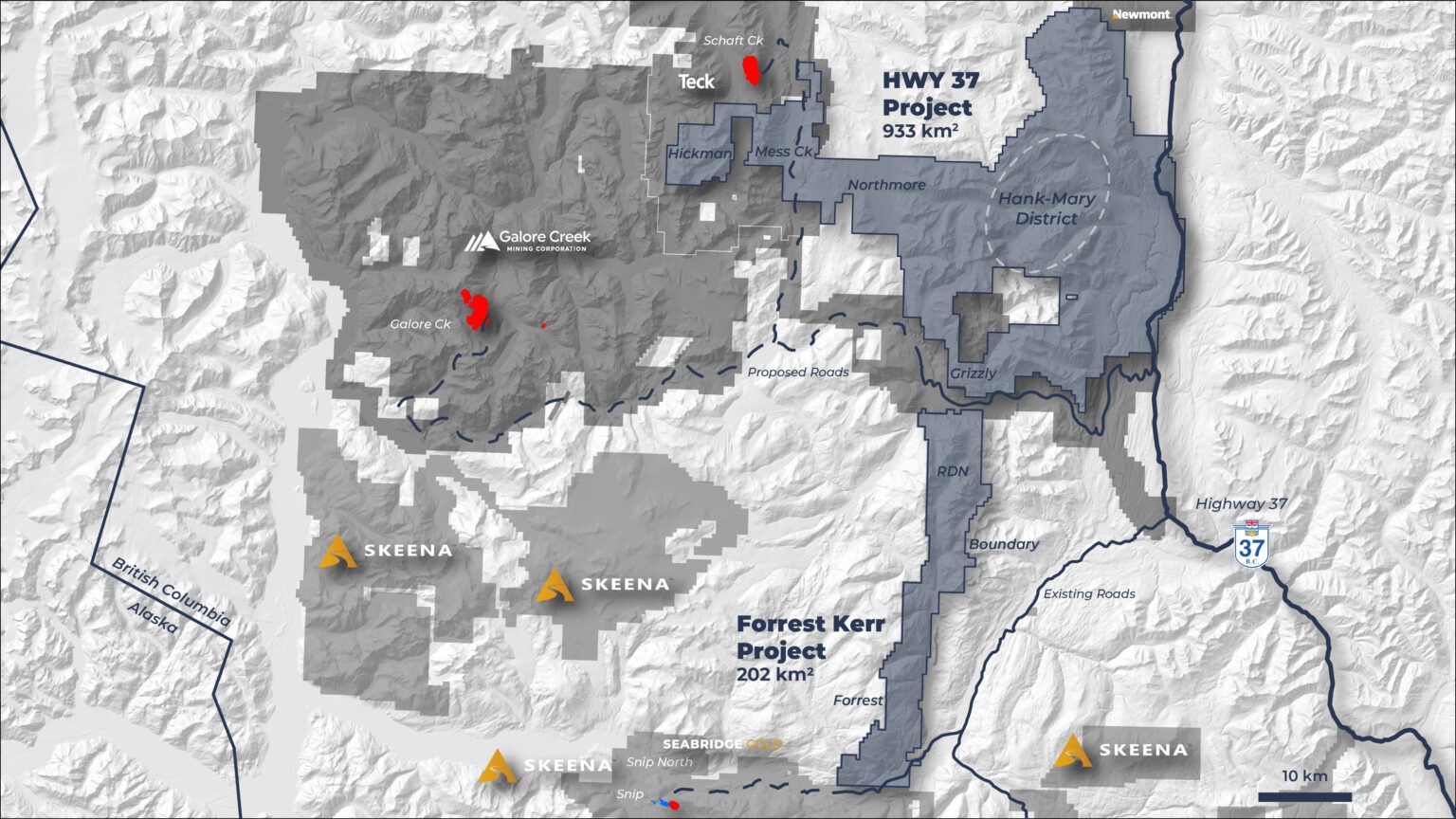
The 2026 program represents a substantial step-up in both scale and capital deployment relative to prior years. Three diamond drills will execute 15,000 m across three spatially distinct target areas within the Hank-Mary District, structured to diversify discovery risk across a single field season:
- Expansion and delineation drilling at the Hank porphyry target itself, testing the interpreted intrusive complex at depth;
- Testing of Hank's bulk-tonnage and structural high-grade gold targets, where historical drilling - some dating to the 1980s - returned wide intercepts (55.8 m at 1.38 g/t Au; 63.0 m at 1.86 g/t Au) with up to 500 m gaps between holes, alongside very high-grade structural hits (133.0 g/t Au and 263.0 g/t Ag over 0.8 m); and
- First-pass discovery drilling at the newly identified Turquoise target and the Rainbow target, both characterized by extensive surface cover (landslide and glacial till respectively) that historically limited exploration but is now addressable via modern geophysics. This third workstream is the highest-risk, highest-reward component, offering optionality for an entirely new discovery beyond Hank.
Supporting this drilling, the company plans ~1,350 line-km of airborne MMT/magnetic surveys over Forrest Kerr, ~550 km² of LiDAR acquisition, and expanded ground IP coverage, all aimed at generating additional drill-ready targets for subsequent seasons - indicating a multi-year pipeline-building approach rather than single-asset dependency.
The Turquoise Target: A Near-Term Catalyst
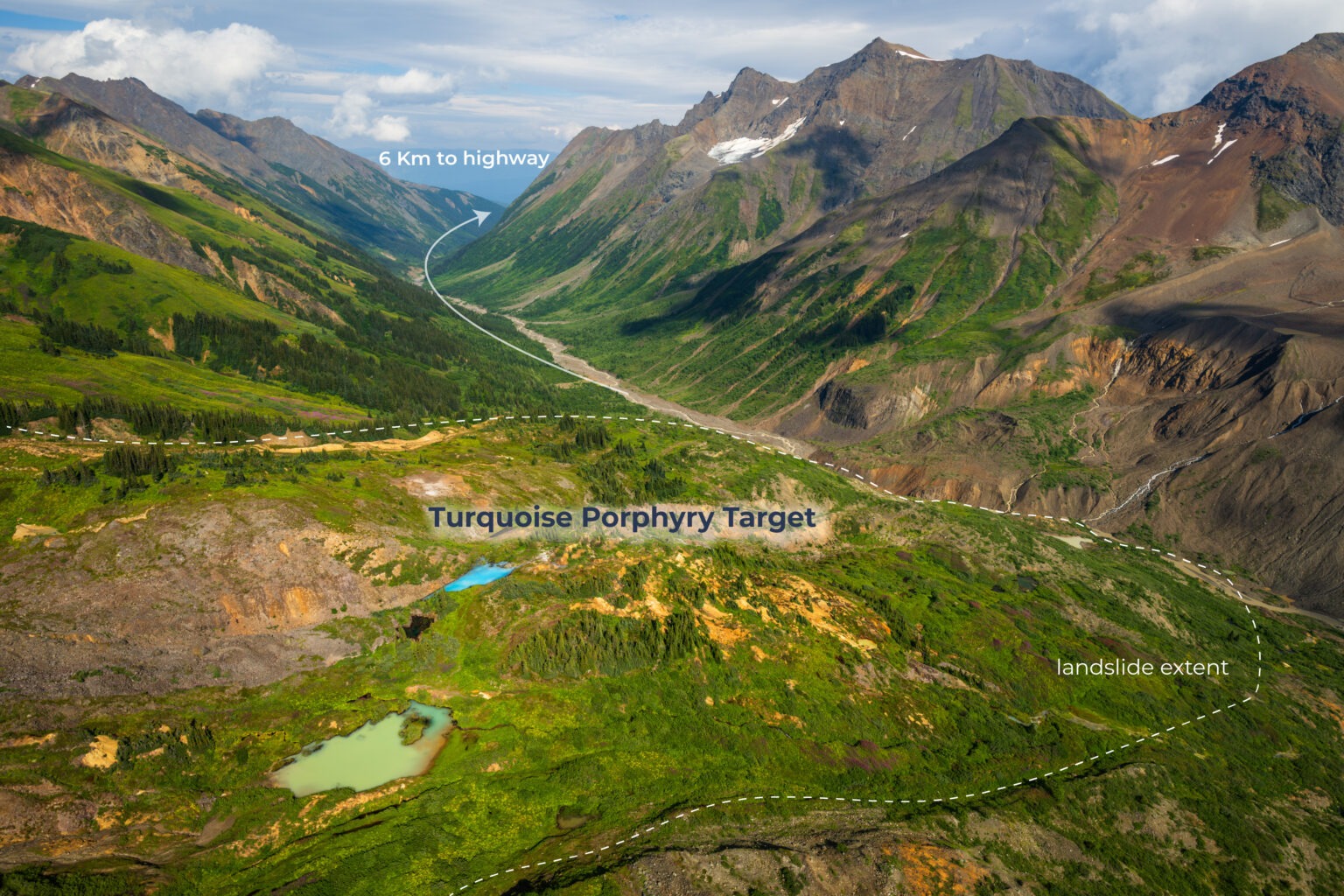
Announced in April 2026, the Turquoise target represents the most immediate new catalyst ahead of the main drill program. Located ~3.4 km east of the Hank discovery hole and only ~6 km from existing highway and power infrastructure, Turquoise is defined by a 0.5 x 2.0 km chargeability anomaly with peak values of 25 mV/V, supported by coincident MVI magnetic and MMT/DC resistivity data describing a classic porphyry architecture - a mushroom-shaped low-resistivity cap (1.0 km deep, 4.0 x 6.0 km) over an interpreted central fluid upwelling stem.
Surface mapping identified advanced argillic alteration (dickite, vuggy silica) and elevated pyrite (>5%) in proximal outcrops, though the core target is obscured by landslide and till cover, limiting direct surface verification. Management characterizes the target as near-surface and drill-ready, positioning it as a likely candidate for early testing within the 15,000 m program.
Balance Sheet and Ownership Structure
Following the March 2026 closing of a C$30.007M bought deal (comprising flow-through and hard-dollar shares at prices ranging C$0.65-C$1.04), Kingfisher reports approximately $30.6M in cash against a basic share count of 136,928,859 (168,329,314 fully diluted), yielding a market capitalization of approximately $150M at $1.10/share. This implies the company is funded through the 2026 field season without near-term dilution risk, a meaningful differentiator for junior explorers in a sector where financing risk often compresses valuations during active drill campaigns.
Ownership is concentrated, with the top 20 shareholders controlling approximately 60% and management/board/advisors holding ~7%, alongside a roster of specialist institutional holders (Konwave AG, Schroders, IXIOS, Vestcor) that may support share price stability but also implies elevated volatility around drill results given concentrated positioning.
Conclusion
Kingfisher's near-term trajectory is overwhelmingly tied to drill results from the 2026 program, with the Hank porphyry expansion and Turquoise first-pass holes representing the most consequential catalysts for re-rating. The cash position removes immediate financing overhang, and the technical team's prior involvement in the GT Gold discovery (sold to Newmont) lends credibility to the systematic exploration approach.
However, investors should weigh that all current data - including historical intercepts predating modern QA/QC - remains unverified by a qualified person per company disclosure, the Hank porphyry's high-grade core remains untested, and Turquoise/Rainbow are first-pass discovery plays with no confirmed mineralization at depth. Outcomes from mid-summer through fall 2026 drilling will likely determine whether the current ~$150M valuation is supported by resource-scale confirmation or whether the discovery thesis requires further refinement.
Executive Summary (TL;DR)
Kingfisher Metals enters its 2026 field season fully funded with ~$30.6M cash following a recently closed C$30M financing, positioning it to execute a 15,000 m, three-rig drilling program at the Hank-Mary District in BC's Golden Triangle. The core value driver is the expansion and delineation of the newly discovered Hank porphyry Cu-Au system (425 m at 0.40% CuEq), supported by converging IP, magnetic, and MMT geophysical anomalies and emplacement ages comparable to the nearby Mitchell deposit. Near-term catalysts include drill results from Hank expansion, first-pass testing of the newly identified Turquoise target, and continued regional geophysical surveys at Forrest Kerr. The investment thesis centers on district-scale discovery potential within an underexplored but historically prolific mining camp, backstopped by a technically strong team with prior Golden Triangle discovery experience (GT Gold alumni).
FAQs (AI Generated)
Analyst's Notes





Subscribe to Our Channel





Stay Informed






















