




Larak Strikes Push Brent Above $90, Boosting Oil Producer Revenue



Brent rose 2.4% above $90 after Larak strikes, while hidden Gulf export recovery and low distillate stocks favored fuel-hedged mines.
- Brent rose 2.4% to above $90 per barrel on August 31, 2026, after US forces struck two missile launchers on Larak Island and Iran attacked US forces in Jordan.
- Goldman Sachs estimated Gulf oil exports at 15 to 16 million barrels per day, 7 to 8 million below prewar levels but 5 to 6 million above the March trough.
- On August 31, 2026, ships reportedly traveled at night with transponders disabled, causing tracking sites to undercount Gulf oil flows.
- In the week ended August 21, 2026, US distillate inventories fell to 103.4 million barrels, 14% below the five-year average, even as refinery use reached a 2026 high of 97.4%.
- Markets priced a 58% probability of a Fed rate hike on September 16, while 10-year Treasury yields stood at their highest since 1996.
Larak Strikes Renew Hormuz Risk & Lift Brent Above $90
US strikes on two missile launchers on Larak Island and Iran’s attack on US forces in Jordan renewed conflict near the Strait of Hormuz, raising the risk of further oil supply disruption. In Monday Asian trade, front-month West Texas Intermediate (WTI) rose 1.7% to $84.84, while front-month Brent gained 1.8% to $88.70. Brent later extended its gain to 2.4% and moved above $90 per barrel, raising revenue on unhedged production while pressuring broader equities.
US Central Command said Islamic Revolutionary Guard Corps (IRGC) forces were preparing to deploy sea mines by rocket into the Strait of Hormuz, one week after US forces cleared its international shipping lanes. President Donald Trump claimed Kharg Island, Iran’s main oil terminal, was being destroyed, but the military did not confirm an attack, leaving its effect on Iranian exports unverified.
Disabled Transponders Hide Gulf Export Recovery Up to 16 Million Barrels Daily
Goldman Sachs estimated Gulf oil exports at 15 to 16 million barrels per day, 7 to 8 million below prewar levels but 5 to 6 million above the March trough, suggesting US escorts are helping restore lost flows.
Ships traveling at night with transponders disabled do not appear on tracking sites, causing visible vessel counts to understate Gulf oil flows. Tracking sites recorded 24 vessels last week, while prewar traffic averaged roughly 130 vessels per day. Gulf exports estimated at 15 to 16 million barrels per day therefore show that supply recovered more than visible vessel counts suggest.
Iran’s Ability to Redeploy Sea Mines Sustains Oil’s Geopolitical Premium
Clearing mines from the Strait of Hormuz once does not prevent Iran from deploying more. Wayne Cole, Columnist at Reuters, noted that Iran can repeatedly deploy mines from anywhere along its shoreline, requiring continuous military operations to keep oil routes open. The operation marked the first US strike in a month, and Iran responded within one day, sustaining a geopolitical premium in oil prices.
97.4% Refinery Use Fails to Rebuild Distillates, Favoring Fuel-Hedged Operators
Mine fuel costs depend on diesel availability, so commercial crude inventories can understate operating-cost pressure. Refineries ran at 97.4% of operable capacity, their highest weekly rate of 2026, yet distillate production fell for a third consecutive week to 5.1 million barrels per day, and inventories dropped 2.2 million barrels to 103.4 million, 14% below the five-year average. Commercial crude inventories stood at 428.9 million barrels, 1% above their five-year average, highlighting the gap between crude supply and the diesel price paid by mines.
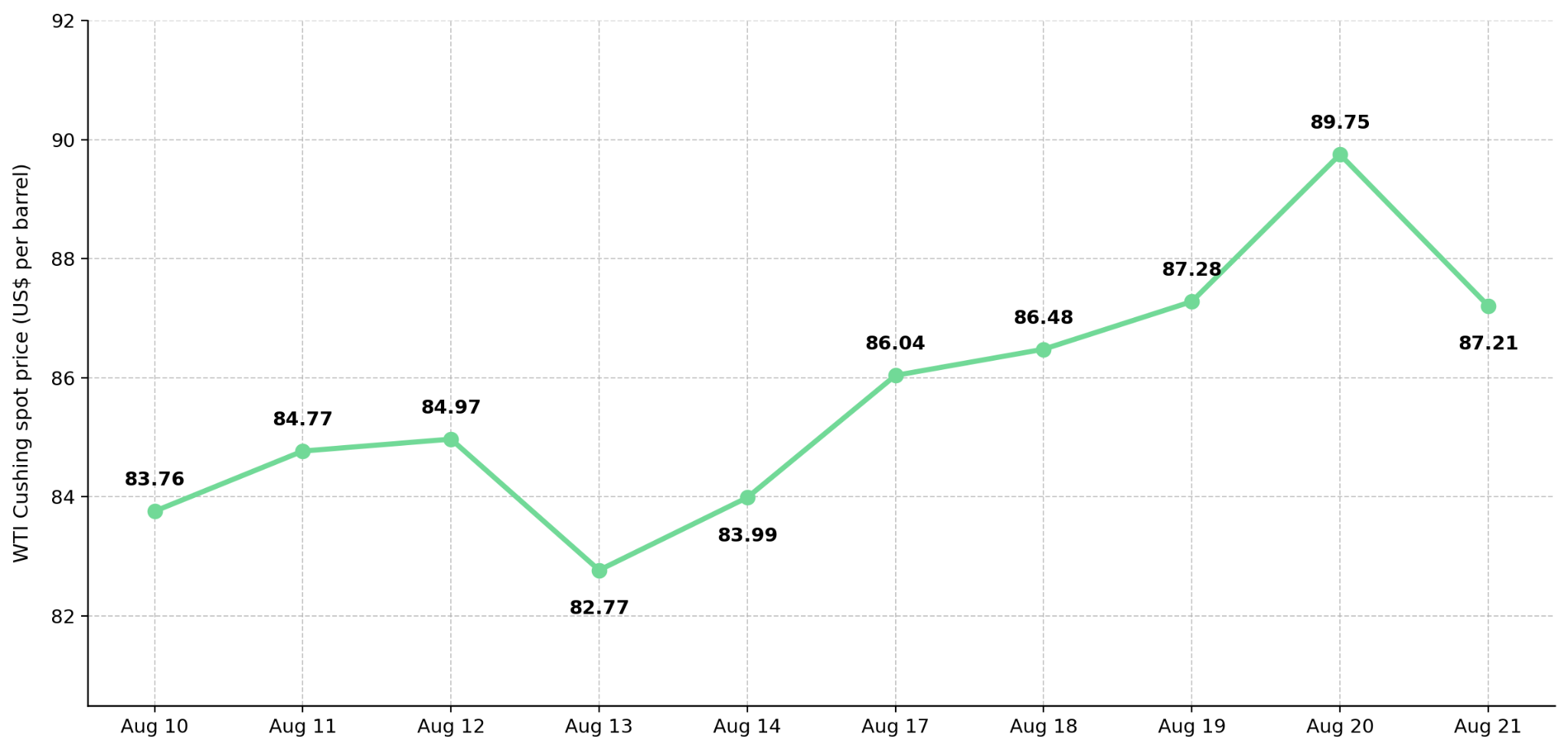
Mining cost models that use crude as a diesel proxy can understate fuel inflation. On August 21, West Texas Intermediate reached $87.21 per barrel, up from $64.08 a year earlier, while New York Harbor ultra-low-sulfur diesel reached $4.473 per gallon, up from $2.361. The national average retail diesel price reached $5.652 per gallon on August 24, up $1.944 from a year earlier. Budgets indexed only to crude therefore understate delivered fuel costs, favoring operations with fixed-price cover or lower diesel use.
The timing of when vessel counts reflect actual exports and crude benchmarks reflect delivered diesel costs remains uncertain. Mining cost models should therefore use the district ultra-low-sulfur diesel price strip and confirm fixed-price cover because operations pay delivered diesel prices, not crude benchmarks.
Fed's September 16 Decision Sets the Re-Rate Path for Fuel-Hedged Producers
Oil prices remain supported by Gulf exports of 15 to 16 million barrels per day, still 7 to 8 million below prewar levels, and US distillate inventories of 103.4 million barrels, 14% below the five-year average.
Markets priced a 58% probability of a Fed rate hike on September 16, while 10-year Treasury yields stood at their highest since 1996. A group of 20 finance ministers were meeting in North Carolina on Monday and Tuesday as Brent traded above $90, keeping energy costs and inflation in focus. Higher yields reduce valuations for mining projects years from production, while $90 oil raises operating costs, favoring producing mines with lower diesel use or fixed-price fuel contracts.
Track Gulf export estimates rather than vessel counts because disabled transponders cause tracking sites to undercount oil flows. Treat Gulf exports above 16 million barrels per day as further recovery and below 15 million as renewed disruption. Each Wednesday, compare EIA distillate inventories with 103.4 million barrels, as a higher reading reduces support for diesel prices while a lower reading reinforces it.
Analyst's Notes





Subscribe to Our Channel







Stay Informed


