




Marimaca Copper Reports Consistent Silver Grades Across Full Pampa Medina


Marimaca Copper confirms consistent silver grades across all Pampa Medina drilling, introducing potential upside pending metallurgical results.
- Marimaca Copper has completed inductively coupled plasma (ICP) silver assaying across all drilling completed to date at its Pampa Medina deposit in Chile's Antofagasta region.
- Silver grades are broadly correlated with copper grade across the deposit, with standout intercepts including 6 metres of 11.98% copper and 82 grams per tonne silver from 594 metres, and 18 metres of 5.11% copper and 53.4 grams per tonne silver from 320 metres.
- The silver assay results cover a consolidation of all Pampa Medina drilling results to date across a 3 kilometres by 2 kilometres area of interest, consistent with high-grade copper and silver mineralization
- Marimaca Copper references Mantos Blancos and Cachorro as analogues, nearby manto-type deposits in Chile where silver by-products are common.
- Drilling is ongoing with 5 rigs currently on site, with plans to increase rig count over April and May 2026 to accelerate the 2026 drilling program.
What Has Happened
Marimaca Copper Corp. (TSX: MARI, ASX: MC2) has released the complete silver assay results from all drilling completed to date at the Pampa Medina deposit in Chile, alongside a consolidation of all drill results to date. This confirms silver mineralization is present across the deposit in both oxide and sulphide copper-mineralized zones and is broadly correlated with copper grade. The consolidated database now spans across a 3 kilometre (km) by 2 km area of interest. While copper assays for these holes were previously released, this marks the first time Marimaca has published a complete silver dataset across the Pampa Medina system, confirming silver is consistently present across the deposit.
Silver Grades Validate a Deposit-Wide Pattern
The inductively coupled plasma (ICP) assaying confirms what Marimaca's exploration team had anticipated: silver is not an isolated occurrence at Pampa Medina but a deposit-wide feature. The correlation between silver and copper grades is consistent across both oxide and primary sulphide zones, and across the depth profile of the system. The drilling results returned 242 metres of 0.65% copper and 6.8 grams per tonne silver, including 20 metres of 2.25% copper and 25.9 grams per tonne silver from 298 metres, and 32 metres of 1.03% copper and 12.0 grams per tonne silver from 332 metres. Another result delivered 198 metres of 0.65% copper and 5.1 grams per tonne silver from 460 metres, including 30 metres of 1.70% copper and 20.9 grams per tonne silver from 548 metres.
The breadth of the silver signal makes these results distinct. Across the holes, from shallow oxide zones to deep sulphide intersections, silver appears in meaningful quantities tied consistently to copper mineralization. True widths are estimated at 80% to 90% of reported downhole intersection widths.
What the Manto-Type Setting Signals
Pampa Medina is a manto-style copper deposit hosted in Jurassic-Triassic sedimentary units. Copper mineralization spans both an oxide zone dominated by atacamite, chrysocolla, and secondary chalcocite, and a deeper sulphide-dominant zone.
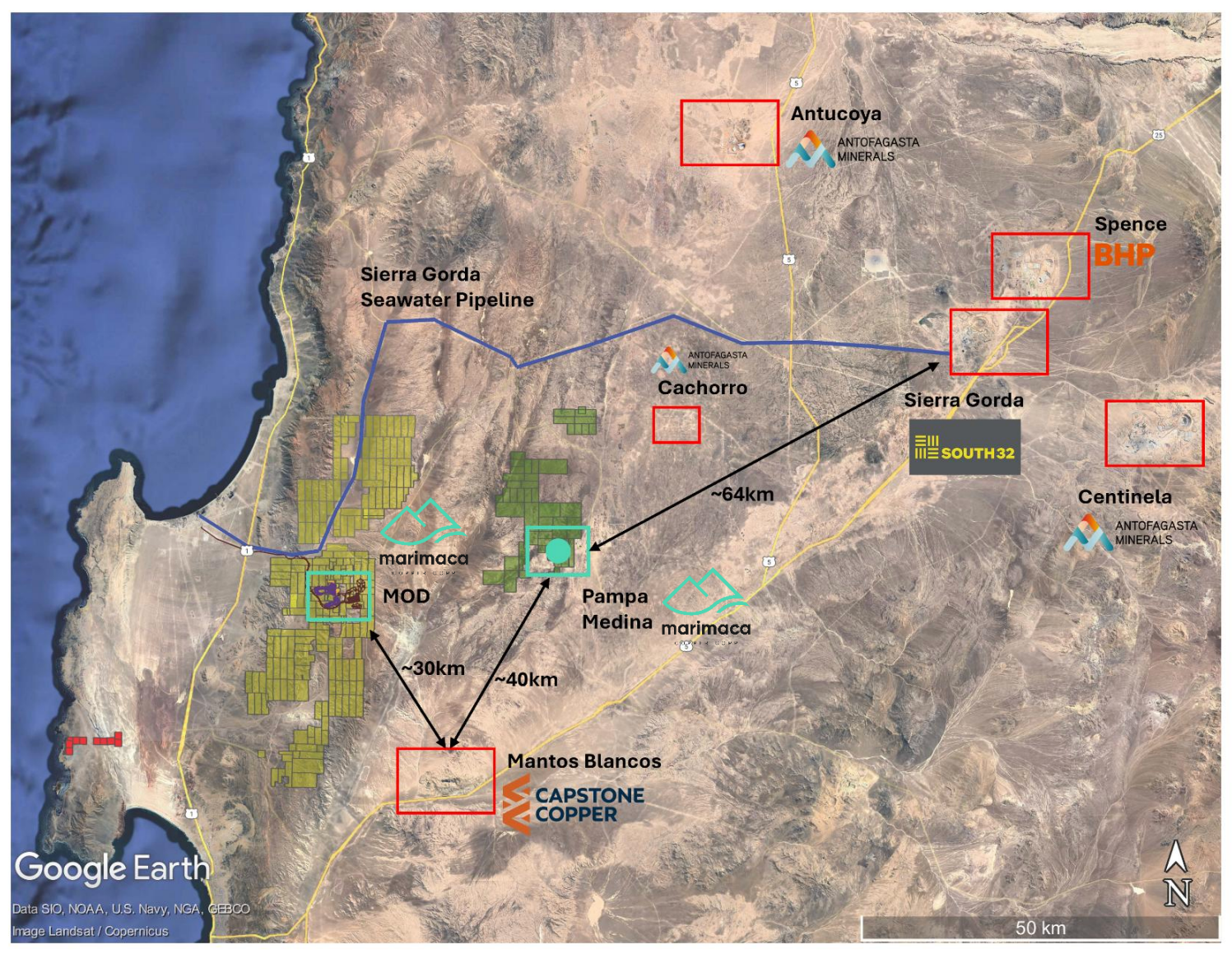
Marimaca references two operating manto-type deposits as regional comparators: Mantos Blancos, owned by Capstone Copper, and Cachorro, owned by Antofagasta Minerals, both located nearby in Chile's Antofagasta region and both carrying silver by-product credits. The Cachorro comparison is not incidental.
Director and Chief Executive Officer of Marimaca Copper, Hayden Locke, explained reinterpretation of the host rock sequence first pointed toward that analogue:
"We had the drill core which indicated that it was incorrectly logged as being hosted in volcanics rather than sediments. We viewed it as being hosted in sediments which was a completely different geological interpretation and much more akin to something like Cachorro. That was a real indicator that actually this might be a larger opportunity than we originally thought."
Elevated grades in both oxide and sulphide zones, broadly correlated with copper, suggest the silver is a feature of the mineralized system itself rather than a surface-level anomaly. Whether that relationship holds through metallurgical testing will determine its economic relevance.
Scale & the Consolidated Drilling Picture
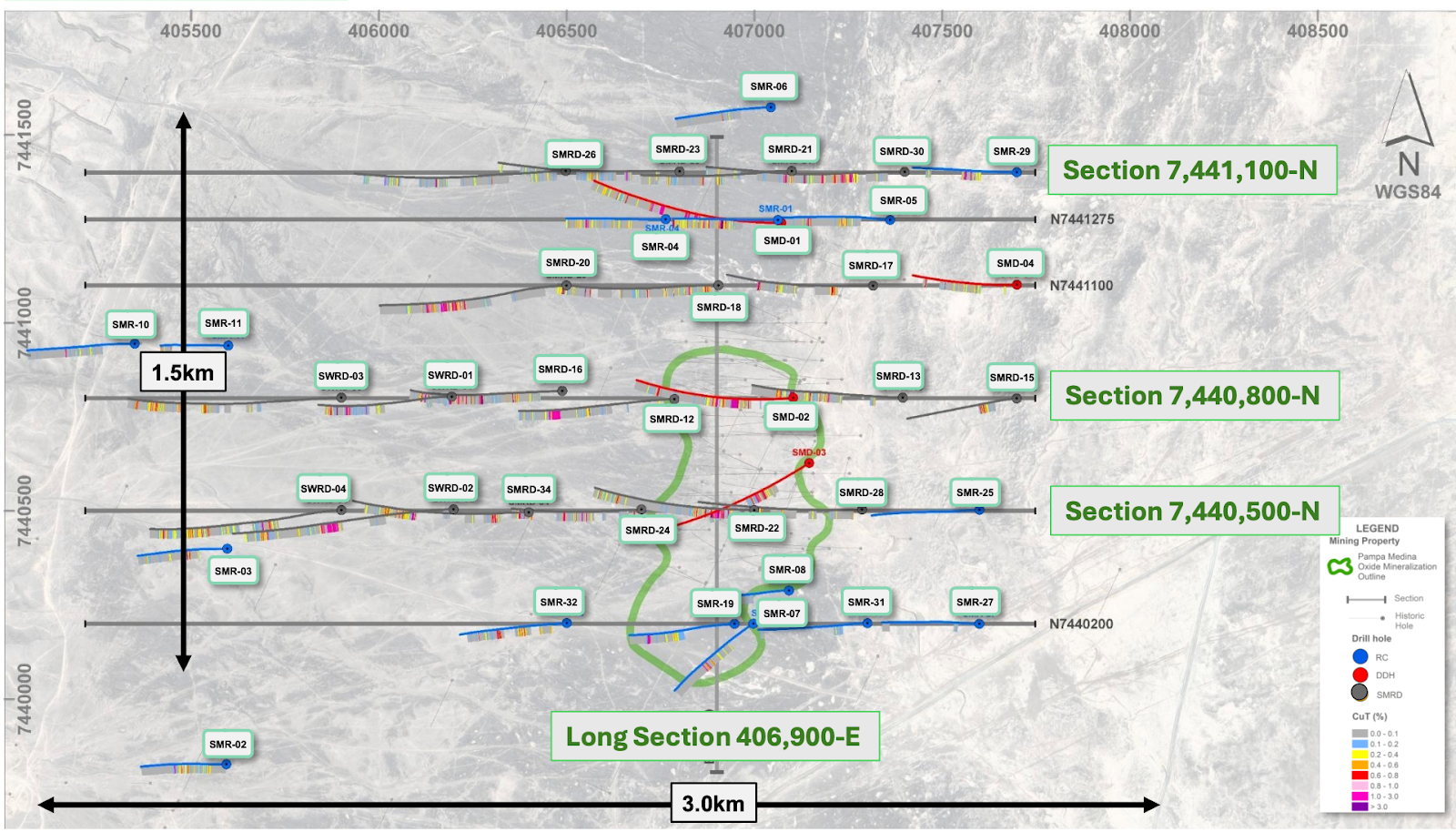
The consolidated dataset allows a coherent view of the system's scale and continuity. Multi-hole coverage now spans north-south and east-west orientations across the 3 km by 2 km area of interest, with step-out holes actively testing extensions to the west, northwest, and northeast.
The most recent results in the database are step-outs to the west, returning meaningful copper-silver intercepts at depth. The drill results returned 38 metres of 1.43% copper and 11.8 grams per tonne silver from 694 metres. Another result returned 74 metres of 1.21% copper and 7.9 grams per tonne silver from 520 metres. These western step-outs indicate that the system remains open in multiple directions.
Marimaca's 2026 drilling program is focused on 3 stated goals: definition of the high-grade sulphide-dominant central zone, delineation of identified oxide extensions, and further step-out drilling to test potential extensions of the broader system identified in geophysical work. The company has 5 rigs operating on site and intends to increase that count over April and May 2026.
Where Pampa Medina Fits in the Broader Marimaca Story
Pampa Medina sits approximately 28 km east of Marimaca's flagship Marimaca Oxide Deposit (MOD). The MOD has a Definitive Feasibility Study (DFS) completed in 2025 and has the potential to produce 50 kilotonnes per year starting within the next 3 years. Pampa Medina is at a different stage entirely but sits within the same Sierra de Medina region as part of a broader district-scale land package of approximately 14,500 hectares.
The company's consolidation of the Pampa Medina project area and surrounding land in 2024 enabled a reinterpretation of all available geological information, producing an updated geological model that identified lower sedimentary units as the priority target horizon. Those are the same units now returning the high-grade copper-silver intercepts.
The silver confirmation matters in this context because it adds a potential second value dimension to an asset that was already showing significant copper grades. While no resource estimate or economic study has been completed for Pampa Medina, the consistency of the silver signal across the full drilling database positions the deposit as a copper-silver system.
Locke framed the longer-term view of the asset:
"The broader Pampa Medina sulphide project, that's a longer gestation period, but it is already, we think, an incredibly strategic asset for us and we are growing in confidence that it will deliver a significant resource."
What to Watch Next
Marimaca intends to increase the number of rigs on site from the current 5 over the course of April and May 2026 to accelerate the 2026 drilling program, with current activity combining 300 metre to 150 metre spaced delineation of the interpreted higher-grade zones alongside step-out drilling focusing on extensions to the west, northwest, and northeast. Phase I metallurgical programs at Pampa Medina remain incomplete, and their completion will be required before the company can report copper equivalent grades or assess the commercial value of silver as a by-product credit. The company's stated exploration plans also include geophysical surveys to support targeting of potential extensions from the deposit to the north and west.
FAQs (AI-Generated)
Marimaca Copper released the complete inductively coupled plasma (ICP) silver assay results from all drilling completed to date at its Pampa Medina deposit in Chile's Antofagasta region. The results confirm silver mineralization is present across both oxide and sulphide copper-mineralized zones and is broadly correlated with copper grade across a 3 km by 2 km area of interest.
Silver by-products are common in nearby manto-type deposits in Chile's Antofagasta region, including Mantos Blancos and Cachorro. If Phase I metallurgical programs confirm the silver-copper relationship holds through processing, silver could become a by-product credit at scale.
No. Marimaca has not yet completed its Phase I metallurgical programs at Pampa Medina and is therefore not reporting copper equivalent grades at this time. The economic significance of the silver component will depend on how that silver translates through metallurgy.
Pampa Medina sits approximately 28 km east of the MOD, which has a DFS completed in 2025 and the potential to produce 50 kilotonnes per year starting within the next 3 years. Pampa Medina is a separate, earlier-stage asset with no resource estimate completed, but sits within the same Sierra de Medina district-scale land package of approximately 14,500 hectares.
Marimaca intends to increase its rig count from 5 over April and May 2026 to accelerate delineation and step-out drilling. Completion of Phase I metallurgical programs is the key pending milestone. Geophysical surveys targeting extensions to the north and west are also part of the stated exploration plan.
Analyst's Notes





Subscribe to Our Channel





Stay Informed


