Atomic Eagle's Capital & Technical Discipline: 6 Factors Behind the Muntanga Scale-Up


Atomic Eagle’s Muntanga scale-up hinges on metallurgy, capital discipline, geology, technical expertise, permitting, and ties to the Zambian government.
What Underwrites the Resource Story
Atomic Eagle Limited (ASX: AEU | OTCQX: AEUXF) has built its 2026 narrative around resource growth, permitting milestones, and portfolio optionality at its Muntanga Uranium Project in Zambia. The harder question is what that narrative is actually standing on. 6 factors determine whether the resource story converts into a bankable project: what remains technically unproven, how the company is spending relative to its own prospectus, and what execution capability, beyond the board table, is doing the work on the ground.
1. Metallurgy Is the Explicit Gap in an Otherwise De-Risked Growth Story
Start with what has not been tested. No metallurgical testwork has been carried out at Chisebuka, the target responsible for most of 2026's resource growth. Management's confidence that recoveries will match those of the existing Muntanga and Dibbwi East deposits, which achieved recoveries exceeding 90% in the 2025 Feasibility Study, rests on a host-rock analogy rather than direct testing, since all three targets sit within the same sandstone units.
Hoskins was direct about both the gap and the reasoning behind the confidence:
"Our expectation is that, being in these same sandstone units, the metallurgy is going to hang together. That's one of the real selling points of this project and what attracted Grant Davey, Keith Bowes, guys with proper uranium experience and development expertise to the project to begin with. It was the very simple heap leach processing, high recoveries, low acid consumption, very simple, low strip open pit mining."
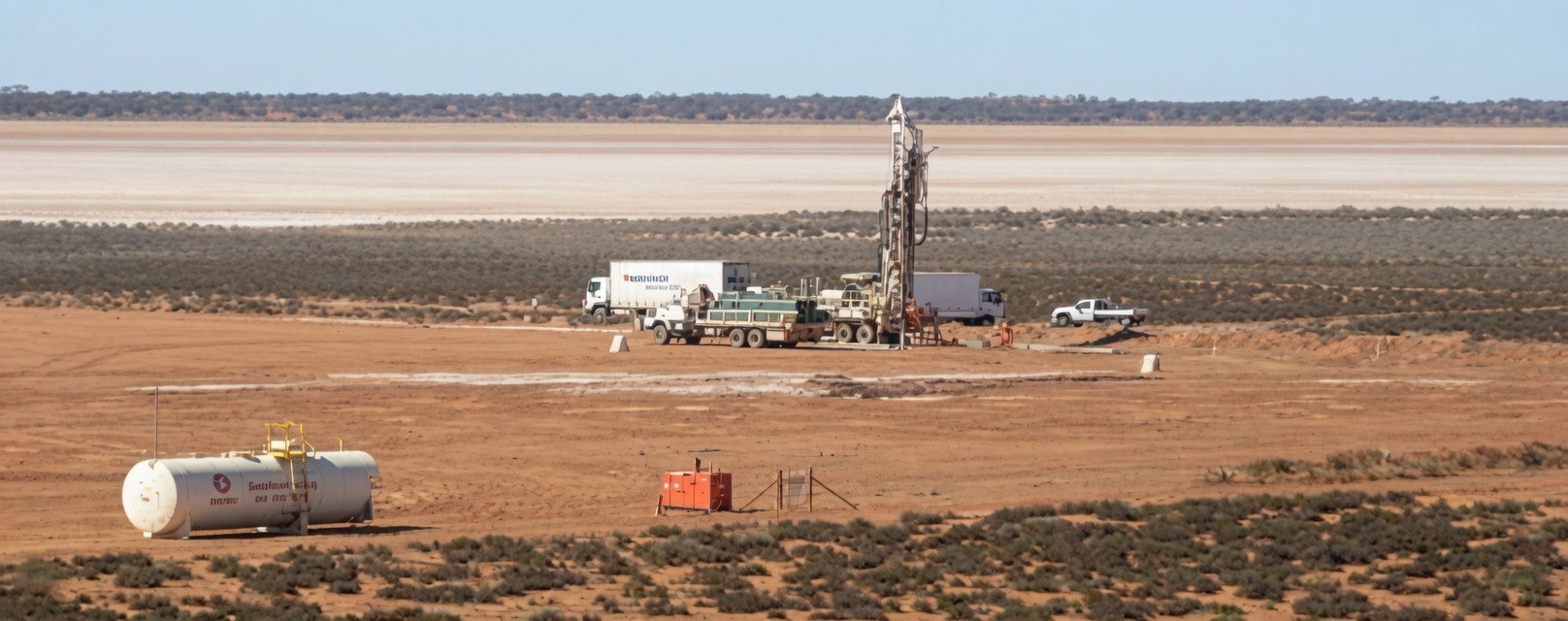
A reverse circulation program of 12 holes has commenced at Chisebuka, with diamond drilling and metallurgical testwork planned for a later stage. Until that testwork lands, Chisebuka's contribution to project scale answers a resource question while leaving a processing question open.
2. Heap Leach Economics Set Up a Bannerman-Style Capital Intensity Comparison
That flowsheet is also central to how large the project can become without a corresponding capital increase. The 2025 Feasibility Study outlined a pre-production capital cost of US$282 million for a 12-year operation processing 3.5 million tonnes per annum, built around low-strip open-pit mining and heap-leach processing rather than higher-capital milling and conventional tank leaching.
Hoskins pointed to Bannerman Energy Limited as the reference point for what that flowsheet choice could mean at greater scale:
"Bannerman is the typical example of that, more than twice the size of our project and only 20% higher capital. That's when the economics of the project will excel."
The comparison is management's own characterization, not an independently modeled outcome, and Atomic Eagle has not published its own capital estimate for an expanded operation. It sets the test for any future study update: whether resource growth from Chisebuka, Muntanga North, and Namakande adds to the mine plan without a proportional rise in pre-production capital. Whether the company can fund its way to that test is a separate, more immediate question, and one the numbers already answer.
3. Spending Against the Prospectus Shows Where Capital Is Deployed & Where It Isn't
Atomic Eagle's June 2026 quarterly report includes a Use of Funds comparison, required under ASX Listing Rule 5.3.4, tracking actual expenditure since the company's November 2025 re-admission against its prospectus estimates.
Against a total prospectus estimate of A$25.25 million, actual expenditure to June 30, 2026, totaled A$10.08 million. Muntanga project development costs show zero actual spend against an A$3.88 million estimate, consistent with no construction decision having been made. In comparison, exploration activities have absorbed A$3.37 million of an A$12.89 million estimate. There are 2 categories that exceeded their prospectus estimates: Madaouela legal costs, at A$1.09 million against an A$920,245 estimate, and a one-off A$1.68 million change-of-control and termination payment that was not budgeted at all. Both trace back to the GoviEx transaction, not to Muntanga field activity.
Capital discipline on the balance sheet is one form of durability. What happens on the ground at a second, geologically distinct project is another.
4. Sitwe's Basement-Hosted Geology Is a Structurally Different Bet Than Muntanga's Sandstones
Coverage of the Sitwe option has focused on its commercial structure: a capped-cost path to acquiring a large license package. That framing misses what the rock itself is doing. Sitwe's geology gives Atomic Eagle exposure to a different mineralization style than Muntanga, not simply more of the same.
Hoskins described the distinction directly:
"We are in slightly different geology, about 70 km away from Lotus Resources' Kayelekera mine in Malawi, on the other side of the border. You are still cross-cutting with various versions of the upper Karoo and the lower Karoo, but also there are basement rocks on the property, a bit more similar to the Athabasca style, where potential for higher grades."
Muntanga's resource sits entirely within Karoo sandstones. Sitwe's historical drilling instead targeted basement-hosted mineralization, a setting the company associates with higher-grade potential, though this has not been confirmed by its own drilling to date. Testing that ground still depends on people who know it, which is where the company's advantage runs deeper than its licenses.
5. A 15-Year-Deep Local Technical Team Is an Underweighted Execution Asset
Board additions have drawn most of the attention paid to Atomic Eagle's people this year. The less visible asset behind the company's early drilling hit rate is the continuity of its Zambian geological team.
Hoskins credited that team directly for the pace of results at Chisebuka:
"Spending a lot of time with our Zambian geological team who have been looking for uranium in this region for 15 years. These guys have all of the history. They know where all the nooks and crannies, all the historical data, and they're the ones leading the charge down there."
That institutional knowledge plausibly explains a result already on record: 13 of the first 15 holes at Chisebuka intersected uranium mineralization outside the existing resource boundary. A team with 15 years of regional history cuts guesswork out of targeting in a way an airborne survey alone cannot. The same logic, knowing the ground before drilling it, extends to the company's relationships above ground.
6. Government-Level Relationships Extend Beyond Standard Board Governance
Atomic Eagle's June 2026 board changes have been read primarily as a capital markets and mining-development skills upgrade, through Non-Executive Chairman Grant Davey. A separate dimension is represented by Non-Executive Director Muna Hantuba, whose value lies in direct government access.
Hantuba's formal background, a past Chairmanship of Zambia's Securities and Exchange Commission and a 40-year career across Zambian finance, mining, and corporate governance, is already on the public record. Management's own characterization goes further, describing Hantuba as maintaining close ties to the Zambian presidency. That access sits alongside the Chief Executive Officer's own direct engagement with regulators during the quarter, including in-person meetings with the Zambia Environmental Management Agency during his site visit. Together, they add a government-relations capability that runs alongside, not in place of, the formal permitting pathway the company has already secured.
Key Takeaways for Investors
- Chisebuka's resource growth raises an unresolved metallurgical question: no testwork has been completed, and management's confidence rests on analogy to Muntanga and Dibbwi East rather than direct data, with reverse circulation and diamond drilling programs set to close that gap.
- Management's own Bannerman comparison frames the capital-intensity test for future study updates: whether resource growth translates into mine-plan scale without a proportional rise in pre-production capital, a claim not yet independently modeled by the company.
- The prospectus Use of Funds comparison shows A$10.08 million spent against an A$25.25 million total estimate, tracking close to plan on core Muntanga exploration while ring-fencing legacy GoviEx integration costs separately.
- Sitwe's basement-hosted geology gives Atomic Eagle a structurally distinct exploration bet alongside Muntanga's Karoo sandstone-hosted resource, diversifying technical risk rather than simply adding tenure.
- A Zambian geological team with 15 years of regional experience is a plausible contributor to Chisebuka's early drilling hit rate, an execution capability that falls outside the metrics typically used to evaluate the company.
- Board-level government access, alongside the Chief Executive Officer's direct regulatory engagement, adds a layer of relationships to Muntanga's already-secured permitting pathway.
Bottom Line
Resource growth, permitting clearance, and low-cost portfolio optionality describe what Atomic Eagle has already achieved in 2026. The 6 factors above describe how durable that achievement is: an unresolved gap in metallurgical proof, a capital-intensity thesis borrowed from a peer, spending that is tracking close to its own prospectus, a structurally distinct geological bet at Sitwe, and execution capability, both technical and political, that sits outside the board table and the resource table alike. Each factor has its own resolution point ahead, from Chisebuka's metallurgical testwork to any updated capital estimate for an expanded operation, and together they set the terms on which 2026's resource growth will need to be judged in any future study update.
Analyst's Notes





Subscribe to Our Channel


Stay Informed