Fitzroy Minerals: The Cabral Gold Playbook, In Copper, Before The Market Catches Up


Fitzroy Minerals could follow Cabral Gold's re-rating path as Buen Retiro advances toward copper production, backed by Pucobre financing and key 2026 catalysts.
A financial comparison of Cabral Gold (TSXV: CBR | OTCQX: CBGZF) and Fitzroy Minerals (TSXV: FTZ | OTCQX: FTZFF | FSE: C3Y), and what a re-rating could look like when Fitzroy's business model is understood.
Cabral Gold, with its imminent production profile, has just been re-rated. Fitzroy Minerals has not yet reached that stage, but it has laid out a path to production in the fourth quarter of 2027. Both companies are executing the same low-capital, quick-to-cash-flow, heap-leach starter-project template in Latin America. One is 18 months further down the runway, and the market has priced it accordingly. The other has the same shape, but includes one structural financing advantage that the first company does not, and, for now, a market capitalization roughly a third of the size.
This article sets the two side by side and asks the obvious question: if the market gives Fitzroy the same read it has just given Cabral, what could that do to the share price if it continues to execute on its plan?
The Cabral Re-Rating: What The Market Just Paid For
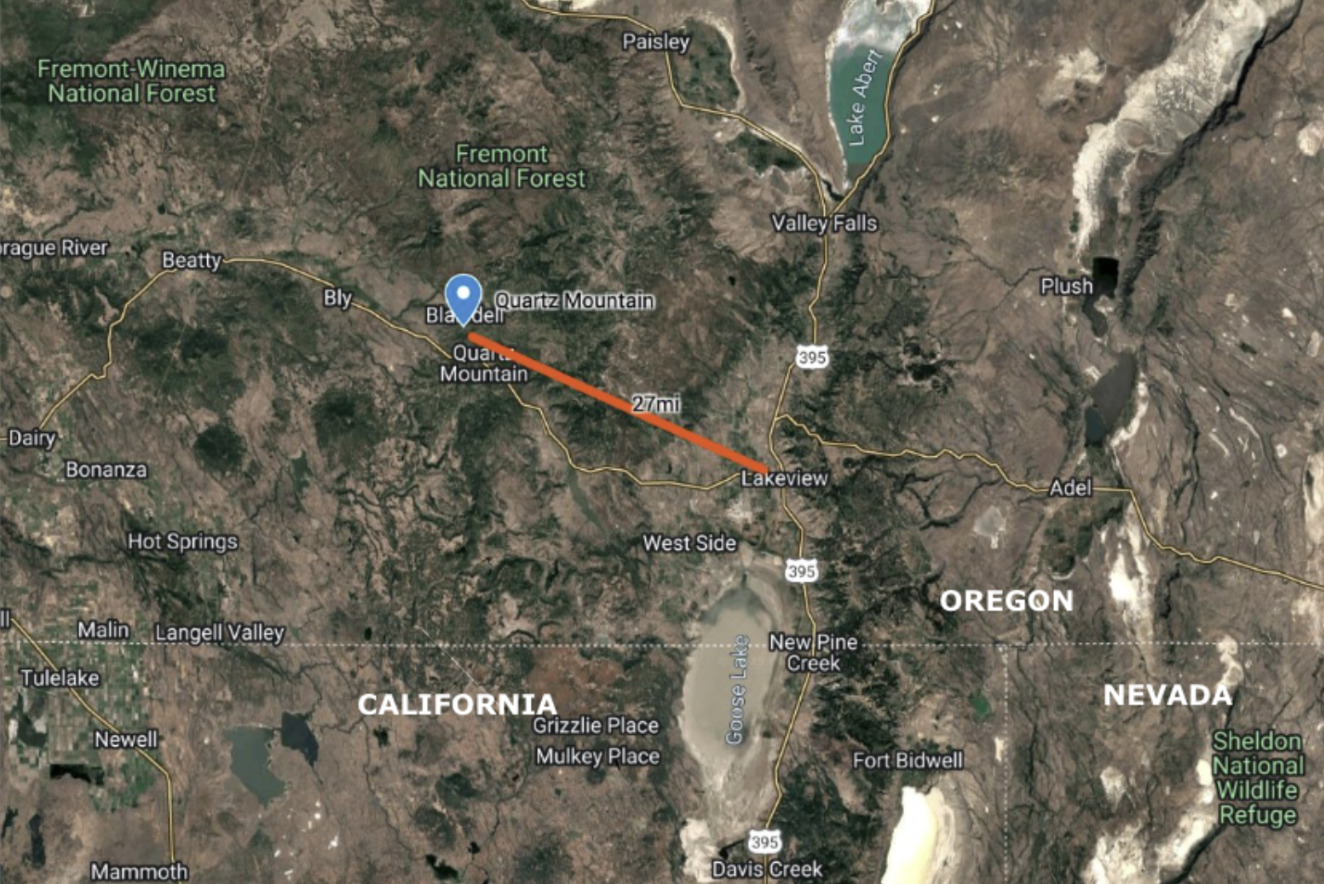
Cabral Gold Inc. received its Operating License (LO) from Pará State environmental authority SEMAS/PA on August 12, 2026, allowing use of cyanide in the leaching circuit and setting the first gold production for September 2026, 6 weeks ahead of schedule (Cabral news release). The shares closed at C$1.31 the next day, valuing the company at roughly C$306–$400 million on the different provider counts (Yahoo Finance, Investing.com). That is a 245% move from the C$0.38 52-week low and a ~3x re-rating from the ~C$110 million market cap the market was assigning as recently as August 2025.
What the market has now priced in is the July 2025 Updated Prefeasibility Study on the Cuiú
Cuiú gold-in-oxide starter operation (Cabral PFS release, PFS technical report):
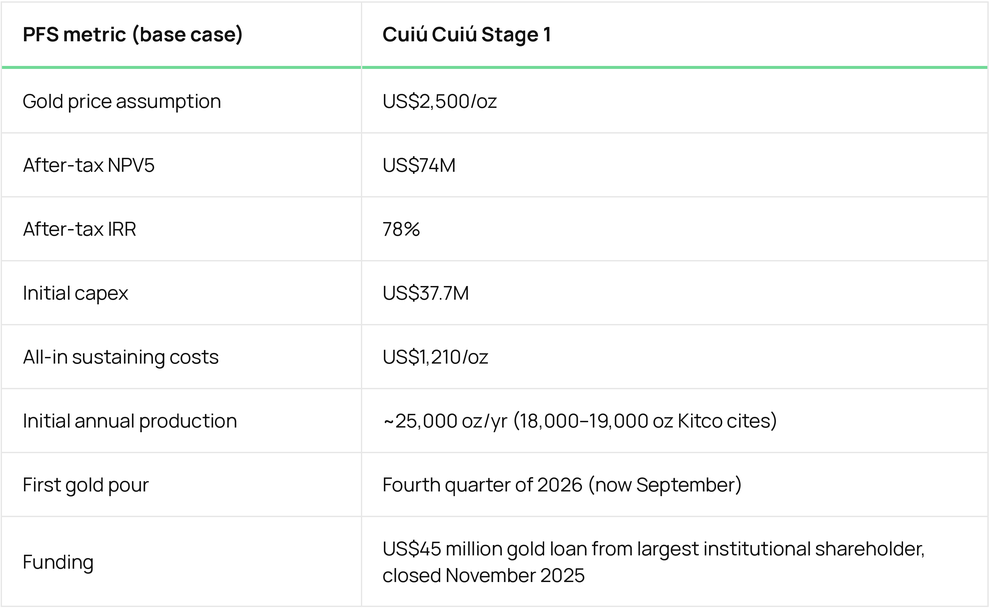
The PFS is modeled at US$2,500 per ounce (oz). Gold is currently trading in the US$4,000-4,400/oz range. At spot, the net present value (NPV) & internal rate of return (IRR) are dramatically higher than the base case, and the AISC-to-price margin is roughly US$3,000/oz rather than the US$1,290/oz margin the PFS priced in. The re-rating is largely the market applying PFS parameters to spot gold and adding the de-risking premium from the LO grant and completed plant construction. Indications are that they will exceed production targets with additional oxide blankets not yet included in the resource.
The Fitzroy Setup: Same Shape, Different Metal, One Extra Lever
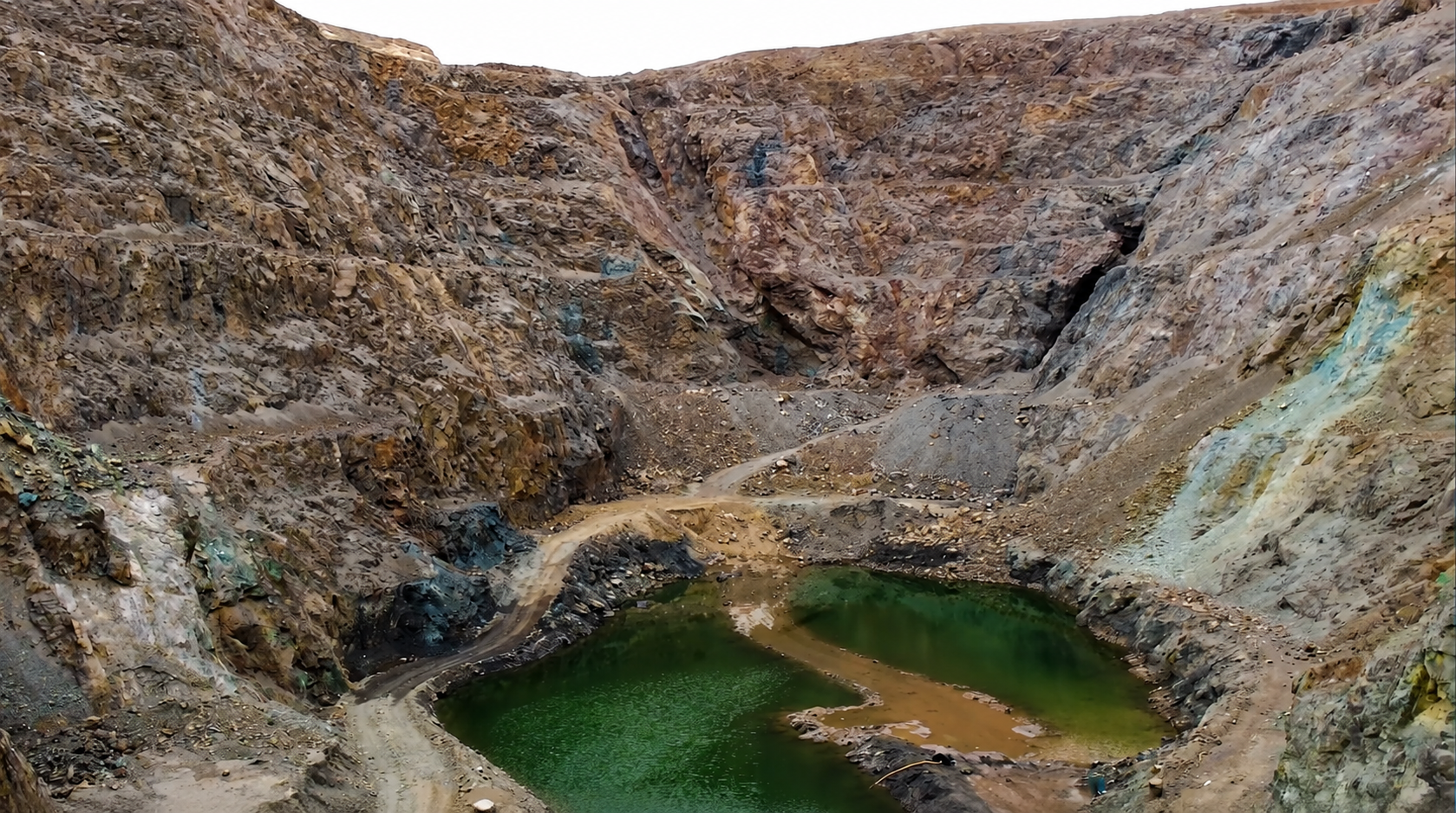
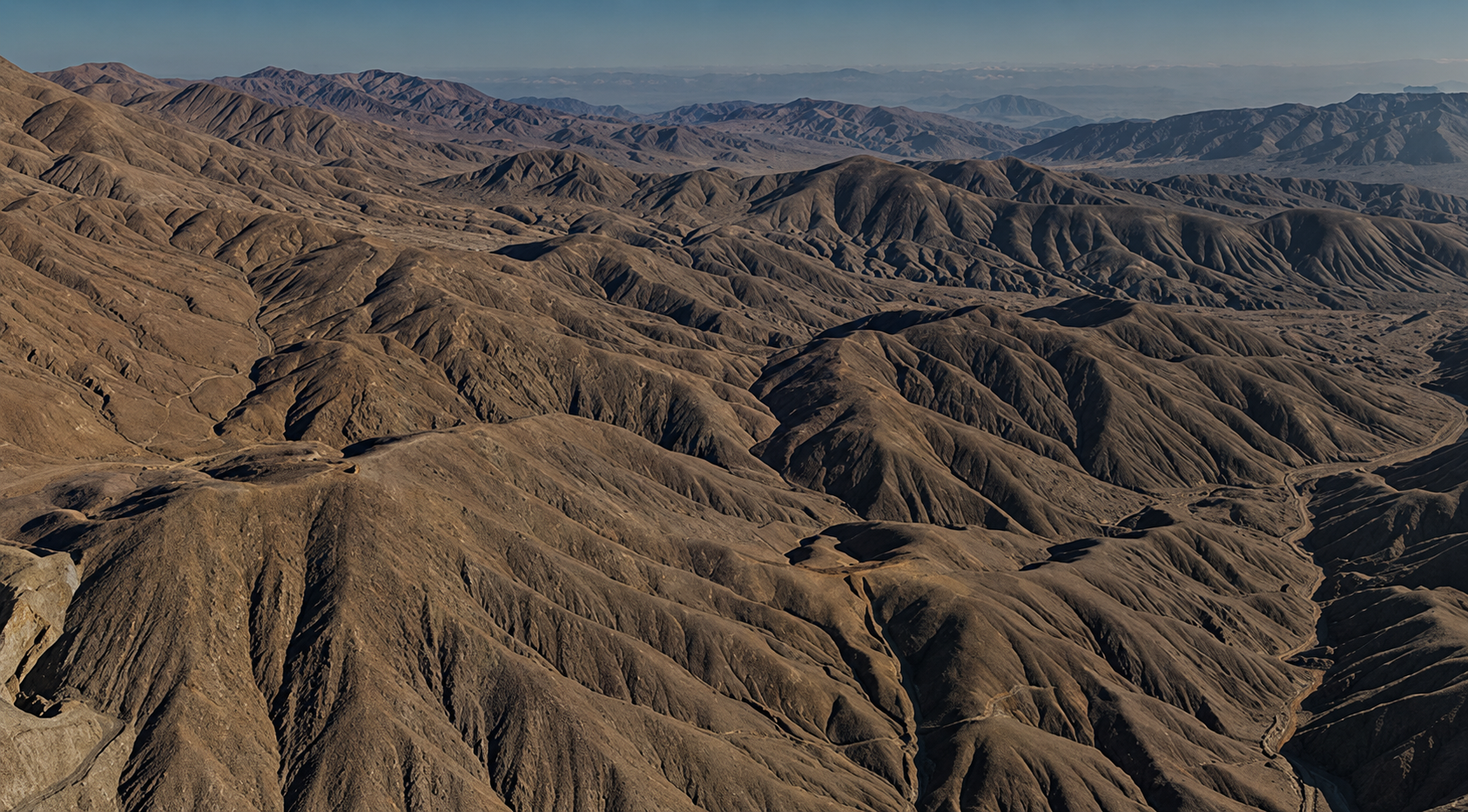
Fitzroy Minerals Inc. trades at roughly C$0.44 per share for a market capitalization of C$135-145 million and enterprise value of ~US$85 million as at May 2026. The primary asset is the Buen Retiro copper project near Copiapó, Chile, an iron-oxide-copper-gold system with a shallow, high-grade oxide corridor that supports a heap-leach starter operation.
The template is identical to Cabral's:
- Near-surface, leachable material amenable to low-cost heap-leach processing.
- Small capital expenditure (capex), high-margin starter operation ahead of a larger sulfide resource.
- Existing infrastructure and permitting position that shortens the runway to first metal.
- A financing structure designed to move to production without punitive dilution.
What Fitzroy adds is a structural feature Cabral does not have: a contractual right held by a producing neighbor, Sociedad Punta del Cobre S.A. (Pucobre), to buy back 30% of Buen Retiro by reimbursing 90% of Fitzroy's eligible expenses in cash, not by paying an appraised value (Fitzroy-Pucobre LOI news release). Management's working figure is a payment of roughly US$20 million (contractual minimum US$10.2 million) landing in the treasury during 2027, with no shares issued to receive it.
For a junior copper developer whose normal financing path is to issue equity into a rising capex, that is the equivalent of a partner-funded pre-production cash injection. It also removes a stand-alone US$70 million electrowinning capex line item because Fitzroy would feed a Pucobre plant currently running below capacity rather than build its own, a plant that management has said is costing the producer money to keep open (Crux Investor coverage).
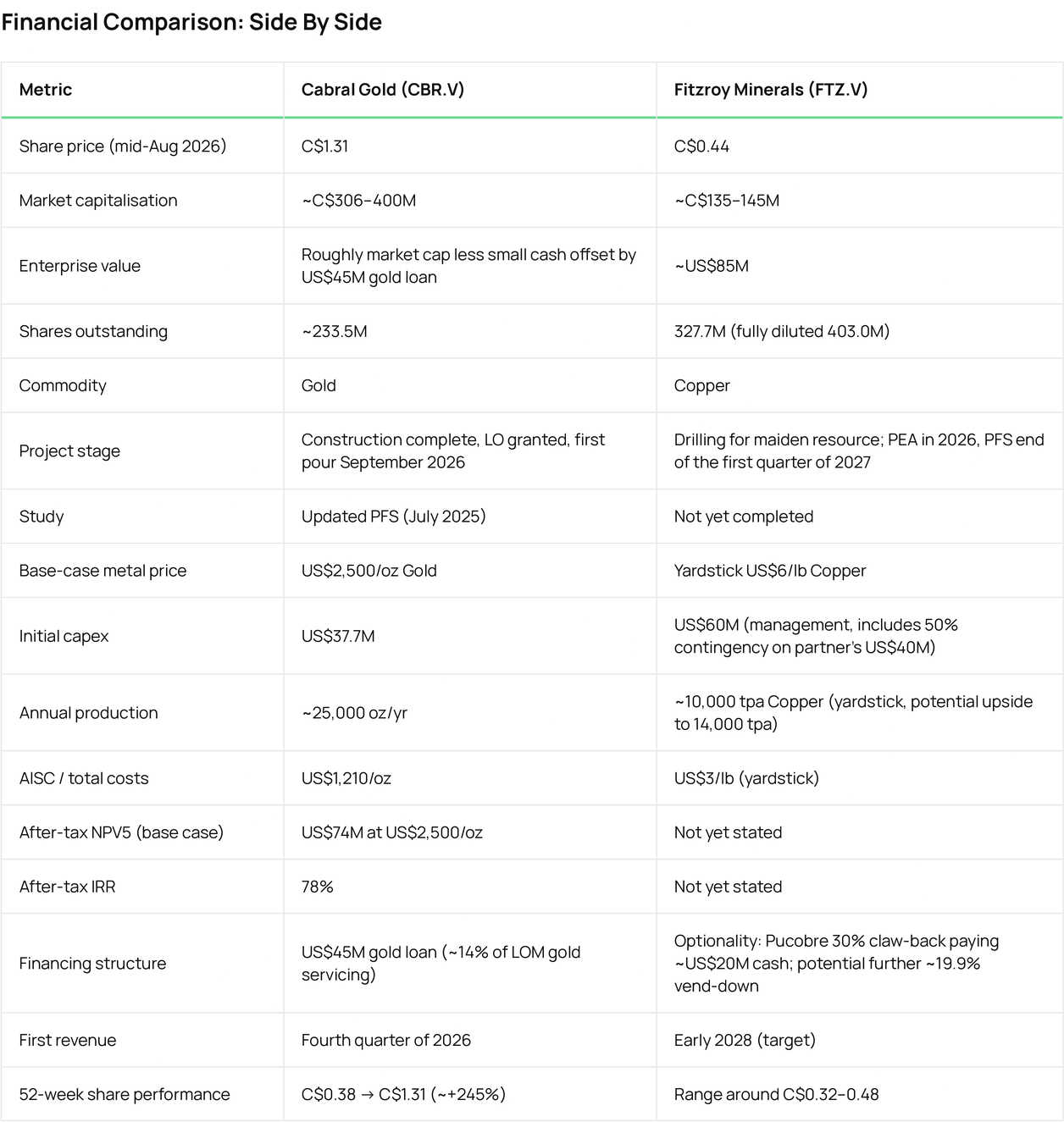
The two companies are not identical. Cabral is 18 months closer to cash flow, has a completed study, and is de-risked in a way Fitzroy is not. Fitzroy's economics remain management yardsticks pending the maiden resource (fourth quarter of 2026), the PEA/PFS (end of first quarter of 2027), and metallurgical work, a point Fitzroy management concedes plainly (Fitzroy exploration update). Those are the pieces of paper the market is waiting for, and they are the same pieces of paper Cabral had in hand ahead of its re-rating.
What Cabral Just Taught The Market
Cabral's price chart is the peer-group comp Fitzroy holders should be studying. The re-rating from ~C$110 million to ~C$306-$400 million (a ~3x move) happened over roughly 12 months and was driven by 3 sequential steps:
- PFS confirms the economics (July 2025). Modest capex, high IRR, short payback, and a fully permitted metallurgical route.
- Financing secured without heavy dilution (November 2025). A US$45 million gold loan from the largest institutional shareholder covering the construction spend, with ~14% of life-of-mine gold servicing the loan.
- Permitting & construction de-risking (March-August 2026). The LP was granted in March 2026; the LO was granted in August 2026; construction is complete; first gold is imminent.
Each step compressed the discount rate the market was applying. The re-rating did not require the mine to be producing; it required the market to believe the mine would produce, at the economics the PFS said it would, at a gold price the market found acceptable.
What The Same Sequence Looks Like For Fitzroy
Fitzroy's disclosed timeline runs on the same shape, delayed by roughly 18 months and with a different metal:
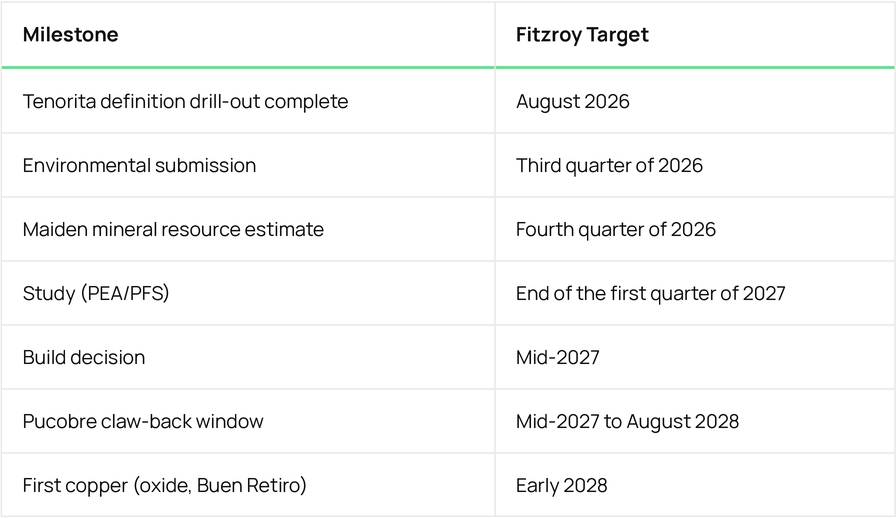
Fitzroy's financing setup differs from Cabral's in a way that matters. Cabral funded construction with a gold loan, non-share dilution, but the company services it out of ~14% of life-of-mine gold. Fitzroy has an alternative that Cabral did not: a cash payment from a producing partner, contractually pre-agreed, priced against Fitzroy's own spending rather than against a project appraisal. Layered on top is optionality on a further ~19.9% vend-down to that same partner, an off-take-equivalent processing agreement, and a US$5 million buy-back on 1% of the 2% Net Smelter Return (NSR) before construction. None of these is a share-issuance event.
The Valuation Gap & What A Re-Rating Could Do
Fitzroy management has cited a UBS copper sector valuation of approximately US$53,000 per tonne of annual production. Applied to a 10,000 tpa yardstick that implies ~US$530 million; applied to a 7,000-tonne attributable share (at 70% post-claw-back), it implies ~US$350 million,against Fitzroy's current ~US$85 million enterprise value and C$135–145 million market cap (Crux Investor).
Two caveats sit on that arithmetic, and they should be flagged because they matter:
- The US$53,000-per-ton (t) figure blends producers and near-producers. Development-stage copper companies trade at a fraction of producer multiples, roughly US$0.03-0.08 per pound of resource for developers versus US$0.12-0.18 per pound for seniors, and tier-1 jurisdictions carry a 30–50% valuation premium over emerging-market peers (Crux Investor). Chile sits in the tier-1 bucket.
- The comparison applies to production that does not yet exist. The point of the next 12 months of work, resource, metallurgy, and study is to move Buen Retiro from the discounted development bucket into the producing bucket that the benchmark actually describes.
Read that way, US$53,000/t is not a price target. It is the ceiling the market is paying for tonnes in production, and the gap between that ceiling and Fitzroy's current EV measures the re-rating available if the study lands and the build decision is taken.
Illustrative Re-Rating Scenarios
The exact multiple applied to Fitzroy will depend on the study, metallurgy, jurisdiction premium, and copper price at the time. The following are scenario ranges, not forecasts. All apply to the current 327.7 million shares issued (fully diluted 403 million), and none of them assumes dilution, a point that is only credible because of the Pucobre claw-back structure.
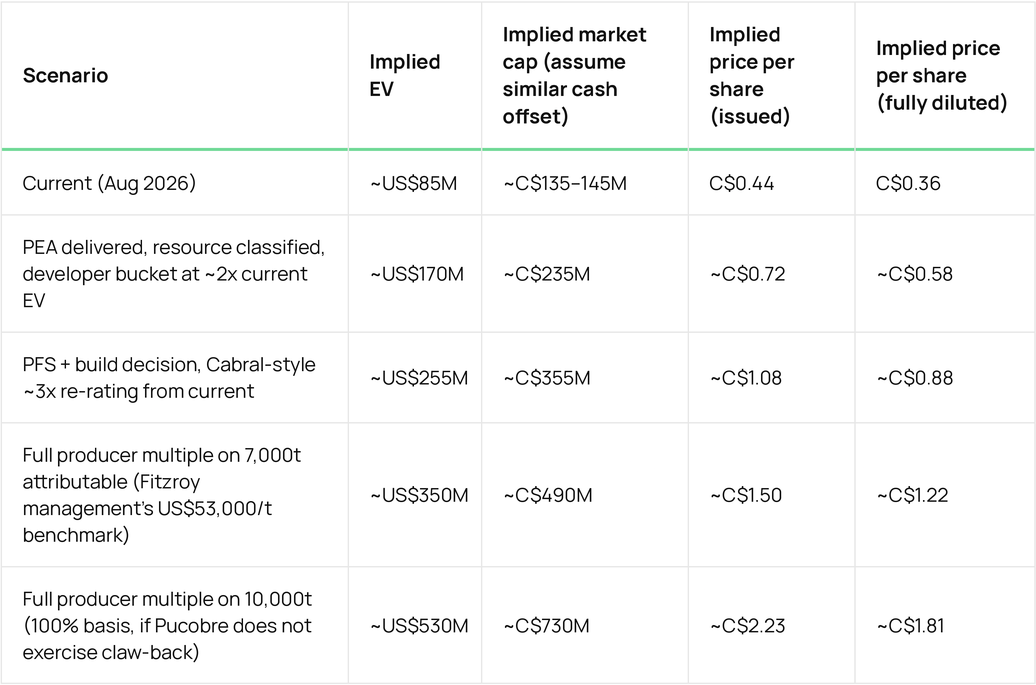
Scenario mechanics assume the current C range, the 327.7M/403.0M share counts, and no additional equity issuance, the last of which is the load-bearing assumption underlying the whole case.
Two anchors are worth pausing on:
- The Cabral-style ~3x re-rating comparison is the direct read-across. Cabral moved from ~C$110M to ~C$306-400M as the market moved from "possible" to "producing-in-months" on a US$37.7M capex, 78% IRR gold heap-leach. Fitzroy is on the same sequence with a US$60M capex copper heap-leach and 10,000 tpa target. If the market applies the same shape of re-rating between PFS and first metal, C$1.00-1.10 per share on the issued count is the read-across. That is not a target price. It is the exact same sequence that another company already paid for in 2026.
- The producer-multiple ceiling is what the sector is currently paying for tonnes in the ground and producing. That number is the aspiration, not the base case, and it requires Fitzroy to complete the study, take the build decision, and deliver the first copper. Copper spot at ~US$6.50/lb is roughly the price the yardstick is set at, so the arithmetic does not require a copper bull run to work.
Why The Pucobre Structure Changes The Downside, Not Just The Upside
Most junior copper developers walk into the study period, funding themselves with equity. Every study result they publish is filtered through the market's reasonable question: how many shares does this project cost before it produces? The Pucobre claw-back changes the answer to that question.
- The claw-back is a cash refund, not a valuation event. Pucobre reacquires 30% by paying 90% of Fitzroy's eligible expenses from 2023 to 2027, with a contractual minimum of US$10.2 million. Management's working number is around US$20 million, approximately C$15 million of which lands in the treasury during 2027 (Fitzroy-Pucobre LOI).
- The partner is motivated by its own cost problem. Pucobre's nearby Planta Biocobre, 9,600 tonnes per annum at 80% availability, is one of three under-utilized plants within 90 km. Feed from Buen Retiro solves an idle-plant problem for a producer with a stake in Fitzroy's project.
- A US$70 million electrowinning line item is avoided by feeding the Pucobre circuit rather than building a standalone one.
- Financing routes stay open. Management is weighing the claw-back, a further ~19.9% vend-down to Pucobre, bridge finance, structured products and equity, and says it will select whichever reads cheapest per share when the study lands.
That combination is what makes the "no dilution" line in the scenario table credible in a way that it is not for most junior developers. It does not remove risk; the study still has to land, the metallurgy still has to work, the maiden resource still has to size the heap-leach, but it does reduce the share count that a delivered project has to be divided across.
The Risks That Sit Under The Case
The valuation gap between Fitzroy and Cabral is not a mispricing. It is the market pricing the work that has not been done yet. Those pieces of work are:
- No mineral resource estimate. Targeted for the fourth quarter of 2026.
- No PEA or PFS. PEA targeted for 2026, PFS for the end of the first quarter of 2027.
- No reported metallurgical or recovery results. Bulk sample at SGS is in progress (Fitzroy release).
- No secondary-referee laboratory samples in this round of drilling (planned for the next stage).
- The Pucobre LOI is non-binding. The joint development pathway is conceptual, pending definitive terms.
- Capex and opex remain unverified management estimates. The Pucobre US$40M starting point is a partner's estimate with a 50% management contingency added to reach US$60M.
- Copper price sensitivity. The margin yardstick uses US$6/lb, which is roughly the current spot. A weaker copper price compresses the margin on which the whole case rests.
Each of these is a specific catalyst on a specific date rather than an open-ended question. The environmental submission (Q3 2026) is the first of the risk-reduction events; the maiden resource (Q4 2026) is the second; the study (end-Q1 2027) is the third; and the build decision (mid-2027) sits inside the Pucobre claw-back window (mid-2027 to August 2028).
Bottom Line
Cabral Gold has just been re-rated for doing exactly what Fitzroy Minerals is 18 months away from doing. The same low-capital heap-leach template, in the same investor-recognized category, with the same "quick to revenue" investment thesis, has moved from ~C$110 million to ~C$306-400 million as the market has moved from "possible" to "producing in weeks."
Fitzroy is trading at a C$135-$145 million market cap and a US$85 million enterprise value. It has one structural feature that Cabral does not: a partner-funded, non-dilutive 30% claw-back that puts roughly US$20 million of cash into the 2027 treasury without a share issuance. It has a second feature that Cabral does not have: the ability to use existing processing infrastructure and avoid a US$70 million electrowinning capex.
If the market gives Fitzroy the same shape of re-rating between PFS and first metal that it has just given Cabral, a Cabral-style 3x move points to a market capitalization in the C$355 million range and a share price around C$1.00-1.10 on the issued count. Fitzroy's own management cited a multiple ceiling for the 7,000-tonne attributable share, which sits at roughly C$490 million, implying ~C$1.50 per share on the issued count. Neither number is a forecast. They are what the sector has been paying, in 2026, for tonnes at those stages of the runway.
The catalysts to get there are dated, sequenced, and disclosed: environmental submission in the third quarter of 2026, resource in the fourth quarter of 2026, study at the end of the first quarter of 2027, build decision in mid-2027, first copper in early 2028. Each is the same kind of piece of paper the market has just paid Cabral to hand it.
Cabral has taught the market what the template is worth when the pieces of paper are in hand. Fitzroy is running the same template. The gap between the two is what remains to be closed.
FAQs (AI-Generated)
Analyst's Notes





Subscribe to Our Channel






Stay Informed