




Copper Usage Grows 4x Faster Than Supply: Can New Projects Close the Gap?


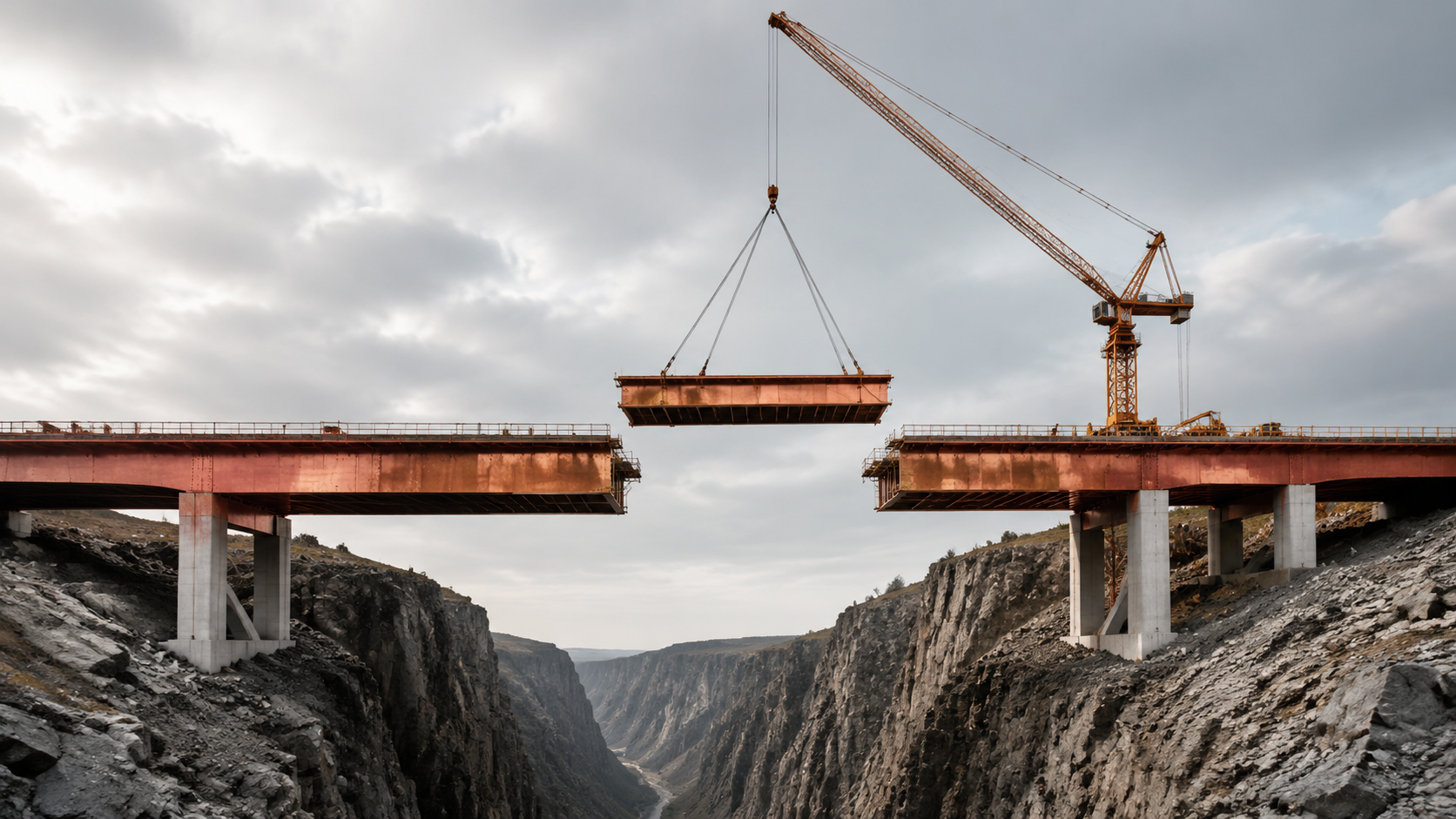
Copper usage is growing 4x faster than supply, favoring lower-capital projects with secured permits, infrastructure and shorter development timelines.
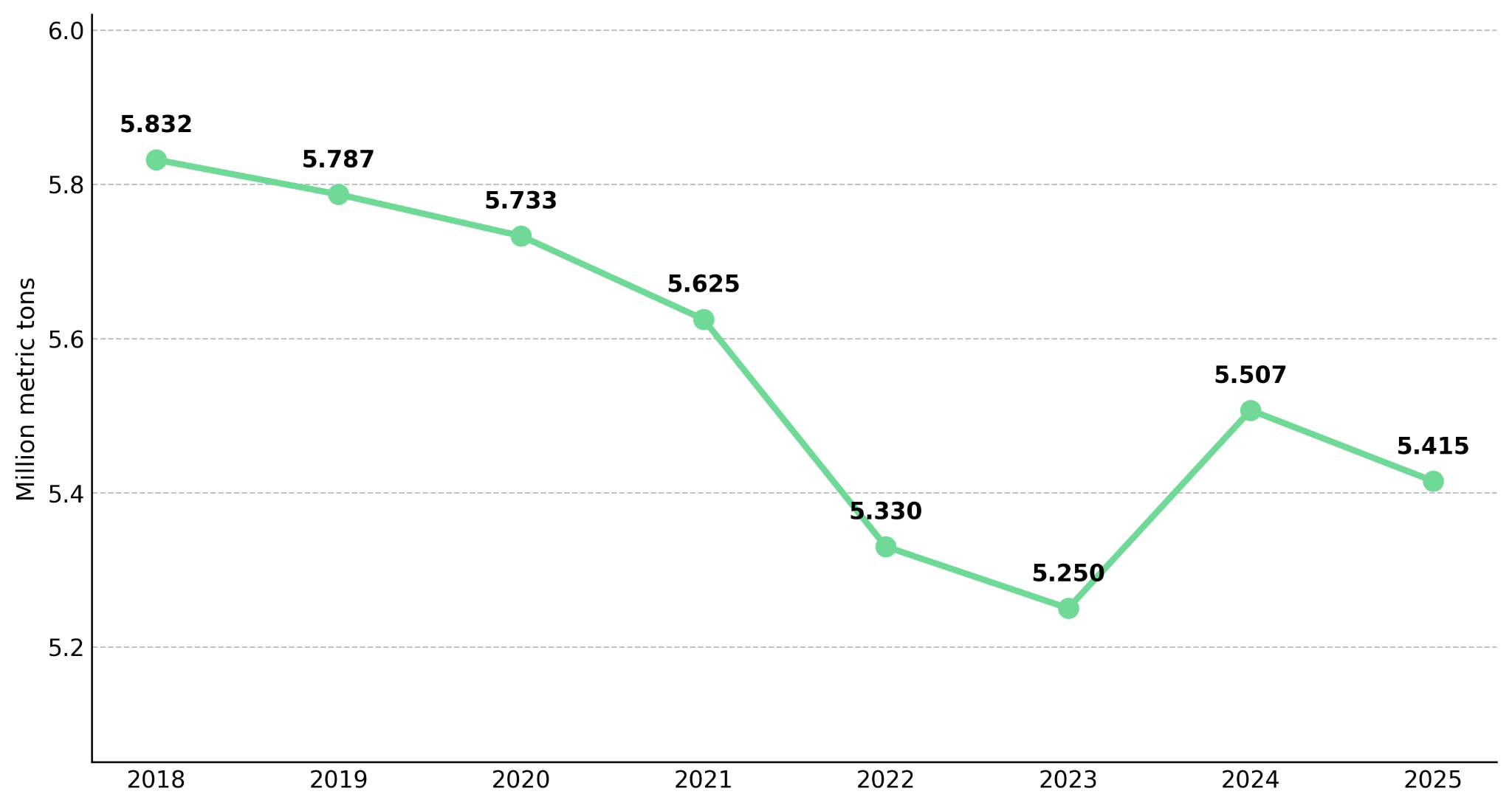
- Chile produced 5.415 million metric tons of copper in 2025, 7.1% below its 2018 peak of 5.831 million metric tons, while Codelco is no longer targeting annual output of 1.7 million metric tons by 2030, showing that record prices have not offset falling grades, weak exploration, and permitting delays.
- Chile’s approval process averages 147 approvals per mining project and can take more than 10 years, pushing first cash flow further into the future and reducing net present value (NPV) without changing the amount of contained copper.
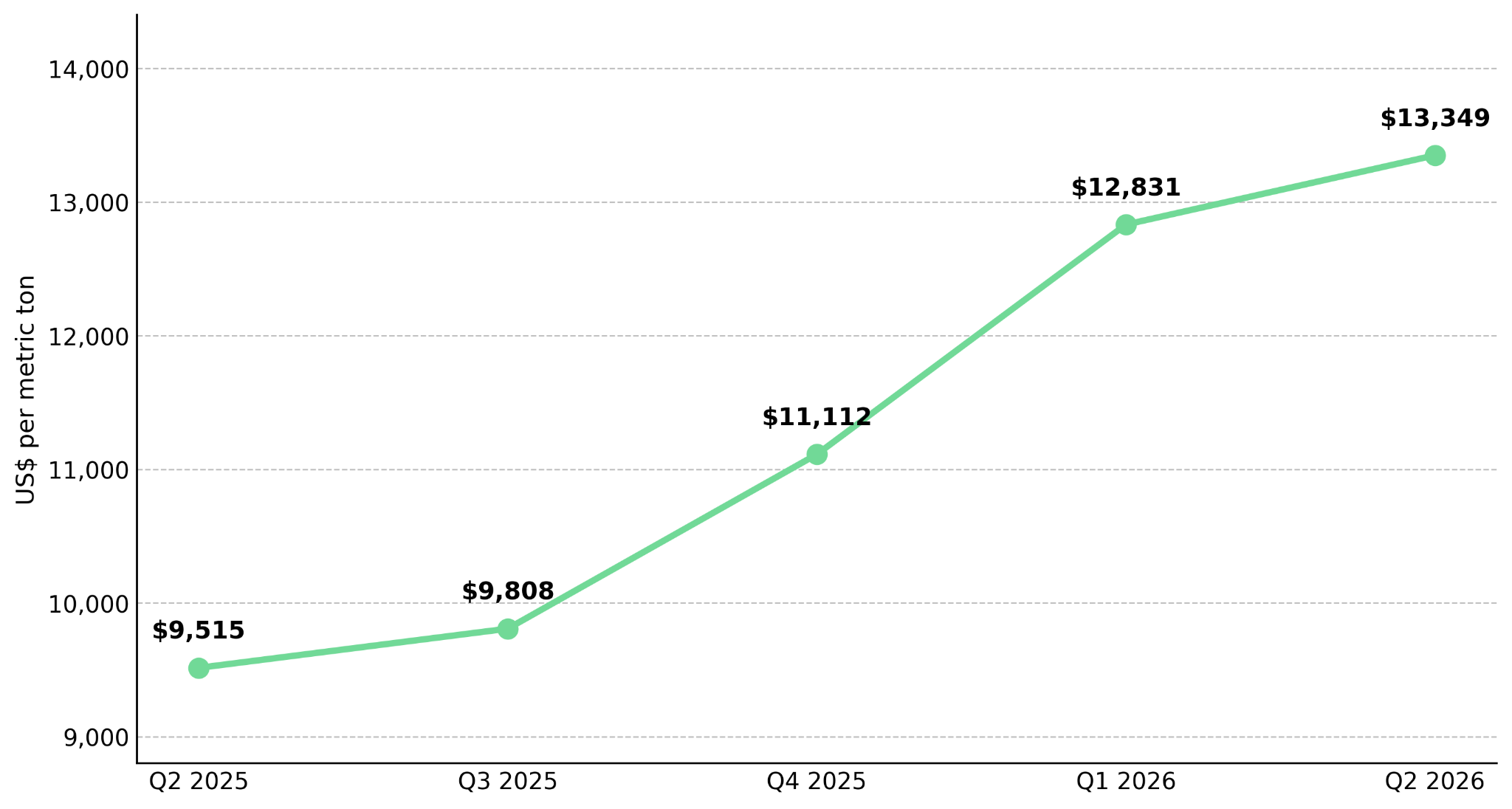
- London Metal Exchange (LME) cash copper traded at a $434-per-metric-ton premium to the three-month contract on August 14, 2026, a five-year high for the spread that shows buyers paying more for immediate cathode than for delivery three months later.
- Capital intensity is replacing deposit scale as the key financing test because projects requiring less upfront capital per metric ton of annual capacity can reach production with smaller funding gaps and less equity dilution.
- Across development stages, secured permits, settled land access, and reusable infrastructure reduce the capital and time required to advance a copper project, increasing its ability to secure funding and reach production.
Chile’s 7.1% Copper Output Shortfall Despite Record Prices Favors Lower-Capital Projects
On August 14, 2026, LME cash copper traded near a record $14,500 per metric ton, two days after the Commodity Exchange (COMEX) September contract reached a record $6.7140/lb. Despite those price records, Chilean output stood at 5.415 million metric tons in 2025, 7.1% below its 2018 peak of 5.831 million metric tons, as falling grades, weak exploration, and permitting delays restricted new supply. The gap between record prices and lower output shows that the main constraint is the capital and time required to convert a copper resource into market-ready cathode, rather than the amount of copper identified in the ground.
Codelco is no longer targeting its April 2026 production plan of 1.34 million metric tons, only 2.5% above revised 2025 output of 1.307 million metric tons, or annual output of 1.7 million metric tons by 2030. The loss of both targets increases the importance of smaller projects that require less capital and time to add annual copper capacity.
Chile’s 147-Approval Process & Geotechnical Risks Delay Copper Supply & Lower Project Values
Chile’s approval process averages 147 approvals per mining project and can take more than 10 years, while geotechnical problems can extend schedules further and delay construction and first cash flow. Codelco paused the Andes Norte expansion at El Teniente on August 4, 2026, after studies identified greater seismic risk than initially estimated, and now targets 2029 for production from the project. El Teniente output also fell about 27% year over year during the first five months of 2026, reducing near-term supply while the expansion remains delayed.
Approval Delays Reduce NPV & Give Permitted Copper Projects a Financing Advantage
A delayed approval or revised assessment of ground conditions does not change the amount of contained copper, but it pushes first cash flow further into the future and reduces NPV because cash received later is worth less in today’s dollars. Two projects with the same resource size and grade can therefore carry different valuations when one faces a longer permitting or engineering schedule.
Chile’s Economy and Mining Minister Daniel Mas is targeting approval-time reductions of up to 70%, a corporate tax rate cut to 23% from 27%, and 25-year stability contracts for strategic projects. Because these measures remain proposals, projects with approved environmental permits or settled land access retain a schedule and financing advantage over projects relying on future reforms.
Cathode Scarcity Drives $434 LME Backwardation
On August 14, 2026, the LME cash-to-three-month spread reached $434 per metric ton, a five-year high. This backwardation showed buyers paying more for immediate delivery than delivery three months later as available cathode tightened. LME stockpiles had fallen for 42 consecutive days to 204,975 metric tons, with nearly half earmarked for withdrawal.
Marimaca Copper has completed its Definitive Feasibility Study (DFS) and secured the key environmental approval for the 50,000-metric-ton-per-year Marimaca Oxide Deposit in Chile, leaving financing and construction as the next major steps. The 2025 DFS estimates $587 million of pre-production capital, equal to $11,700 per metric ton of annual capacity, with a post-tax net present value at an 8% discount rate (NPV8) of $709 million and a 31% internal rate of return (IRR) at $4.30/lb copper. A projected all-in sustaining cost (AISC) of $2.09/lb supports operating margins, while the lower capital requirement and existing approval reduce development risk relative to larger projects.
Hayden Locke, Chief Executive Officer of Marimaca Copper, explains why few copper projects reach production:
“In the copper space, there aren’t really any juniors with significant-scale development assets that can come into production. They’re either too small in terms of production, too big to finance, or they’re not permitted.”
China’s Acid Ban Raises Heap-Leach Costs, Favors Projects With Secured Supply
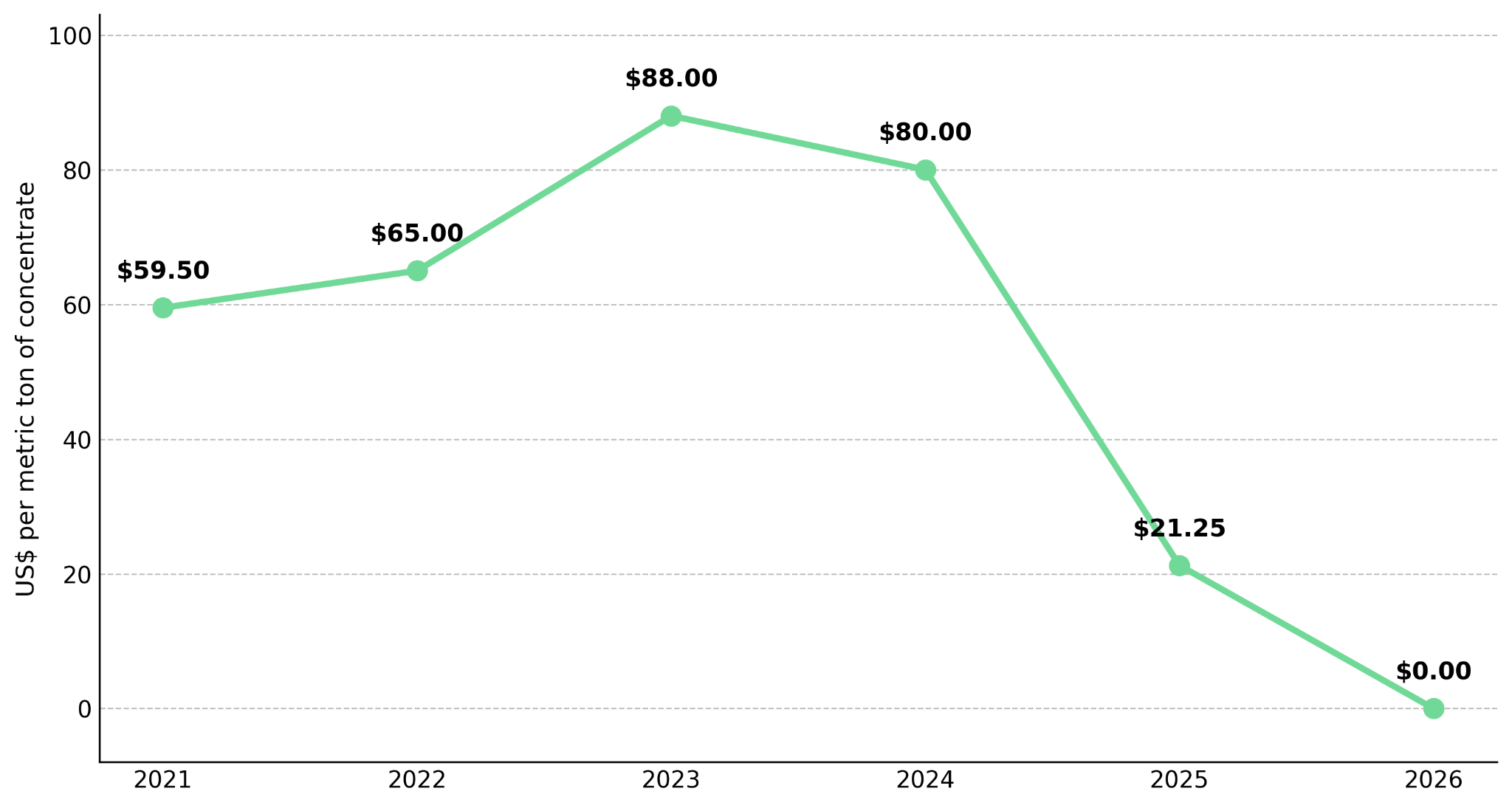
Kpler reported on June 4, 2026, that China’s April 10 sulfuric acid export ban replaced a 700,000-metric-ton annual quota with zero exports through August, raising costs for solvent extraction and electrowinning (SX-EW) operations reliant on imported acid. SX-EW produces roughly 15% of global copper cathode and consumes 3 to 22 metric tons of acid per metric ton of copper, depending on ore grade. S&P Global delivered a sulfuric acid benchmark for Mejillones doubled in less than seven weeks, widening the margin advantage of operations with integrated or secured acid supply. Expiration of the ban would restore seaborne supply and narrow that cost difference.
Fitzroy Minerals is advancing a proposed heap-leach joint venture at Buen Retiro that could generate non-operated cash flow, alongside a five-hole, approximately 5,514-meter drill program at Caballos planned from September 2026. The joint venture could reduce financing needs, while drilling will test whether the 3-kilometer-wide target supports a larger copper system.
Merlin Marr-Johnson, President and Chief Executive Officer of Fitzroy Minerals, explains why costly supply growth supports higher prices:
“Looking at the Cochilco report, they estimate that $83 billion is going to come into Chile, and over 75% of that goes into copper projects. It’s only an increase of about 100,000 tons after spending over $50 billion or $60 billion. Metal prices have to rise as demand is strong.”
Brownfield Infrastructure Lowers Capital & Shortens the Path to Near-Term Supply
When capital and schedule limit new copper supply, brownfield projects can lower the cost per metric ton of new annual capacity by reusing processing plants, power connections and roads. Reusing this infrastructure removes major construction packages from the project scope, reducing upfront funding requirements and shortening the route to production relative to a greenfield development.
Selkirk Copper increased Measured and Indicated contained copper at the Minto Project by 182% to 940 million pounds within 47.8 million metric tons grading 0.89% copper. The project can reuse an existing 4,100-metric-ton-per-day plant, camp, roads and power infrastructure, reducing construction scope and supporting its targeted mid-2028 restart. The Preliminary Economic Assessment (PEA) will test whether the larger resource and existing infrastructure support a financeable restart.
Colin Joudrie, Director and Chief Executive Officer of Selkirk Copper, explains why near-term copper supply attracts offtakers:
“This is a high-grade, quality concentrate. The market likes it, and they really are attracted to the timing. If we can get even close to our mid-2028 objective for the restart and be at full run rate by the end of that year or early 2029, that’s just anomalous in the market. There’s not much out there.”
Low Discovery Costs & Cleared Land Access Reduce Funding Needs & Dilution Risks
At the exploration stage, discovery cost per pound and secured land access show how efficiently capital can expand a copper resource before an economic study is completed. Lower discovery costs preserve cash, while settled land access allows drilling to proceed without access-related delays, reducing the need for additional financing before the project reaches its first economic assessment.
Abitibi Metals has expanded the B26 resource in Quebec by 124% since 2023 to 25.3 million metric tons grading 2.1% copper equivalent, at a stated discovery cost of C$0.025 per pound. Approximately C$44 million in cash can fund up to 80,000 meters of drilling through 2027 without an immediate equity raise, limiting near-term dilution. A PEA targeted for the first quarter of 2027 will begin translating the larger resource into project economics.
Cobra Resources has exercised its option to acquire the Manna Hill Copper Project after a four-hole, 1,465-meter program improved targeting for drilling planned for September 2026. Rail and highway access, an existing Native Title Agreement, and heritage-cleared drill sites reduce potential logistics and access delays. The company is targeting assay results from August, which will establish grades and direct drilling toward areas with the greatest potential to expand the project.
Major Producers Buy Ownership Stakes, Providing New Capital for Copper Exploration
Major copper producers can gain early exposure to exploration-stage projects through minority stakes, limiting upfront capital while retaining access to potential copper discoveries. These agreements may include technical collaboration, exclusivity and rights to increase ownership, allowing a producer to assess exploration results before deciding whether to fund development.
Mogotes Metals entered a binding term sheet for a US$15 million investment from Rio Tinto at C$0.70 per unit, giving Rio Tinto an initial interest of approximately 5% and funding additional exploration at Filo Sur. The arrangement includes a proposed joint technical committee, 15-month exclusivity, and access to Rio Tinto’s targeting tools. Warrants and top-up rights could increase Rio Tinto’s ownership to 9.99%, balancing additional capital and technical support against potential dilution.
Low Refined Copper Growth Trails 1.6% Usage, Increasing Supply Sensitivity to Disruptions
The International Copper Study Group (ICSG) projects global refined copper production to grow 0.4% in 2026 as limited concentrate availability offsets part of higher secondary output, against refined usage growth of 1.6%. Despite usage growing four times faster than production, ICSG forecasts headline surpluses of approximately 96,000 metric tons in 2026 and 377,000 metric tons in 2027. Alternative estimates point to tighter balances: Goldman Sachs estimates a 2026 deficit outside the US above 640,000 metric tons, while J.P. Morgan forecasts a 330,000-metric-ton refined shortfall. J.P. Morgan also estimates that one large-scale AI data center can require up to 50,000 metric tons of copper and projects data-center consumption to rise 332%, from approximately 110,000 metric tons in 2025 to 475,000 metric tons in 2026. Although these forecasts use different geographic scopes and balance assumptions, all show limited production growth leaving copper availability more exposed to project delays, inventory withdrawals, and operational disruptions.
Evidence of near-term copper scarcity would weaken if LME inventories rise above 255,000 metric tons, approximately 24% above the August 14 level, while backwardation falls below $150 per metric ton. A formal exemption for refined copper from US Section 232 measures would reduce the incentive to move metal into US warehouses, leaving more supply available in other markets. A Yangshan premium below $96 per metric ton would signal weaker Chinese demand for imported copper at current prices.
The Investment Thesis for Copper
- Chile’s copper output remained 7.1% below its 2018 peak despite record prices, increasing the funding advantage of projects that require less upfront capital per metric ton of annual cathode capacity.
- Developers with key environmental approval and a completed feasibility study have fewer steps remaining before financing and construction, giving them a shorter route to production than projects still relying on proposed permitting reforms.
- Projects using heap leaching and SX-EW produce cathode without a smelter, bypassing competition for scarce concentrate reflected in record negative treatment and refining charges, but their margins remain exposed to sulfuric acid prices.
- Brownfield restarts that reuse processing plants, camps, roads and power connections reduce construction scope, lowering upfront capital and shortening the route to production relative to comparable greenfield projects.
- Explorers with low discovery costs per pound, funded drilling programs, and settled land access can expand resources without an immediate equity raise, limiting dilution while advancing toward an economic assessment.
- Copper project valuations depend partly on refined production growth remaining near the ICSG’s 0.4% forecast, while LME inventories above 255,000 metric tons and backwardation below $150 per metric ton would signal greater availability and weaken valuation support.
Copper development is constrained less by resource size or record prices than by the capital and time required to produce market-ready cathode. Projects requiring less capital per metric ton of annual capacity, with secured permits and shorter development schedules, face fewer financing and approval hurdles before production. Project evaluation should therefore consider capital intensity, permit status, and development timeline alongside resource size because those factors determine whether new copper can reach the market during the current price cycle.
TL;DR
Global refined copper production is projected to grow 0.4% in 2026 against 1.6% usage growth, while record prices have failed to restore Chilean output to its 2018 peak. Permitting can require 147 approvals and more than a decade, delaying cash flow and reducing project value. A $434 LME backwardation also signals a premium for immediately available cathode. These conditions favor projects requiring less capital and time, particularly permitted developments, brownfield restarts and funded exploration programs with settled land access. However, sulfuric acid costs, financing needs and dilution remain important risks, while higher LME inventories and lower immediate-delivery premiums would indicate improving copper availability.
FAQs (AI-Generated)
Analyst's Notes





Subscribe to Our Channel













Stay Informed


