




Marimaca's 102-Meter Copper Hit Moves Pampa Medina Toward a Maiden Resource


Marimaca's 150-meter-spaced Pampa Medina drilling, led by 102 meters of 1.00% copper, moves the Chile copper discovery toward a maiden resource estimate.
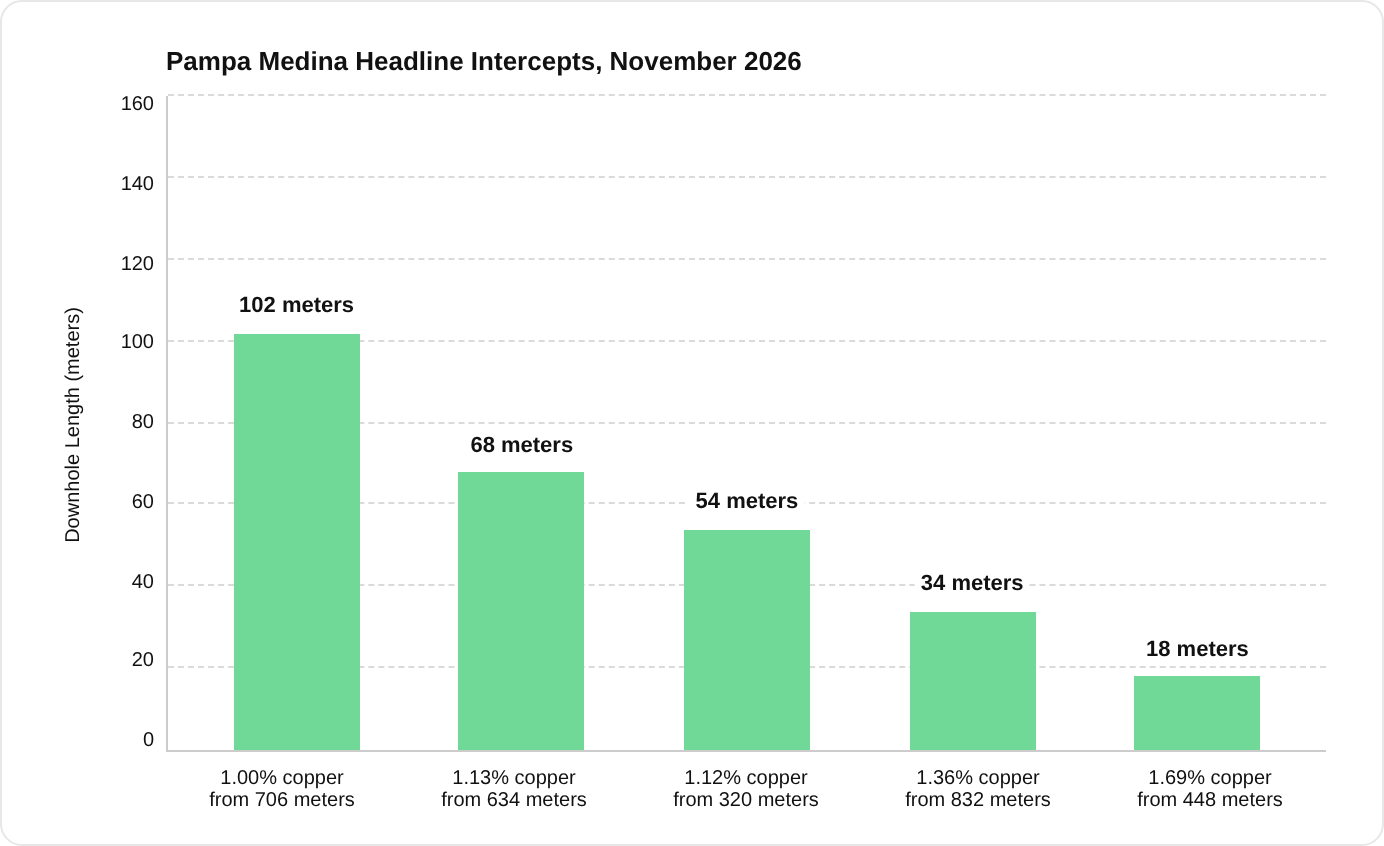
- Drilling on 150-meter centers across Pampa Medina's central zone returned 102 meters of 1.00% copper and 5.1 grams per tonne silver, with the copper-silver mantos holding continuity between holes.
- Central-zone drilling is nearing completion and will support a maiden resource estimate for a deposit the company describes as a potential Tier-1 discovery.
- Higher-grade intervals include 22 meters of 2.07% copper and 8 meters of 3.21% copper and 27.5 grams per tonne silver.
- Near-surface oxide mineralization now extends up to 300 meters west of the historical oxide footprint, in line with the company's plan to develop Pampa Medina oxides about 25 kilometers from its planned processing plant.
- Rigs are moving to step-out targets at Pampa Norte to the north and Sierra Norte to the west, while the company advances its US$587 million oxide project in Chile toward a final investment decision (FID).
Marimaca Copper Corp. (TSX: MARI | ASX: MC2 | OTCQX: MARIF) is moving Pampa Medina toward its first resource. Assays released on November 19, 2026, from 150-meter-spaced holes in the deposit's central zone show thick copper-silver mantos continuing from hole to hole, and the company is finishing the central-zone drilling it says will support a maiden resource estimate. Data spacing to date is not considered sufficient for resource estimation at the Inferred or Indicated category, and the maiden estimate will establish the project's first reported tonnage and grade.
Central Zone Drilling Holds Continuity at 150-Meter Spacing
The longest reported intercept was 102 meters of 1.00% copper and 5.1 grams per tonne silver from 706 meters downhole, including 72 meters of 1.24% copper from 710 meters and 14 meters of 1.80% copper and 10.4 grams per tonne silver from 760 meters. The hole intersected stacked mantos and extended mineralization into the basement units. 150 meters to the north, a second hole returned 68 meters of 1.13% copper and 8.7 grams per tonne silver from 634 meters, including 22 meters of 2.07% copper and 10.0 grams per tonne silver from 668 meters, confirming the higher-grade sulfide manto 300 meters east of earlier drilling.
Other holes filled gaps across the zone. One intersected 34 meters of 1.36% copper from 832 meters, including 18 meters of 2.07% copper, linking the mineralized horizon between 2 previously reported holes. Another cut multiple stacked mantos, including 18 meters of 1.69% copper and 13.3 grams per tonne silver from 448 meters, with 8 meters of 3.21% copper and 27.5 grams per tonne silver. In the north of the deposit, drilling returned 54 meters of 1.12% copper and 9.9 grams per tonne silver from 320 meters.
Deeper drilling also intersected the target mantos, with one hole returning 24 meters of 0.90% copper from 1,008 meters. True widths are estimated at about 80% of reported downhole intervals.
Vice President Exploration of Marimaca Copper, Sergio Rivera, tied the results to the geological interpretation behind the program:
"Just as importantly, the results are consistent with our geological model of multiple mineralized mantos within the target sedimentary sequence."
Oxide Extensions & Dike Interruptions
The near-surface results connect Pampa Medina to Marimaca's development plan for the Marimaca Oxide Deposit (MOD). The hole that returned the 68-meter sulfide interval also intersected 68 meters of 0.36% copper from 142 meters, extending the known oxide footprint by about 150 meters to the west. Another, drilled 300 meters west of the historical oxide footprint, returned 20 meters of 0.93% copper from 162 meters and 84 meters of 0.62% copper from 226 meters, including 46 meters of 1.06% copper.
Not every hole reached the target horizon. The hole drilled 300 meters west of the historical oxide footprint was interrupted at depth by a late west-northwest dike system, and 2 further holes intersected near-surface oxide mineralization before dikes cut them off at depth. Dike swarm intrudes Pampa Medina's host units, which are affected by post-mineral normal faulting.
From Central Zone to Step-Out Drilling
Marimaca's 2026 program has 3 goals: defining the high-grade central area of interest (AOI), delineating the oxide extensions, and stepping out to test extensions of the broader system identified in geophysical work. With central-zone drilling nearing completion inside the 3-kilometer by 1.5-kilometer AOI, rigs are moving north to Pampa Norte and west to Sierra Norte.
The step-outs test ground within the 14,500-hectare Sierra de Medina land package, which Marimaca consolidated under a single operator for the first time in 2024. The company's updated geological model identified the lower sedimentary units as the priority target horizons, the same units now returning the thick mantos.
Rivera linked the remaining central-zone work to both the resource and the oxide growth:
"We are nearing completion of the central-zone drilling that will support our maiden resource estimate, while also extending mineralization beyond the historical oxide footprint."
What a Maiden Resource Would Add to the MOD Case
Under the MOD's 2025 definitive feasibility study (DFS), Marimaca is targeting a 50,000-tonne-per-year cathode operation for US$587 million in initial capital. At US$4.30 per pound copper, Marimaca reports an after-tax net present value (NPV8%) of US$709 million and a 31% internal rate of return (IRR), rising to an NPV8% of US$1.1 billion and a 39% IRR at the 3-month average COMEX price of US$5.05 per pound. Those economics cover the MOD alone, and Pampa Medina remains at the resource-definition stage.
Marimaca's "hub and spoke" plan targets developing Pampa Medina and Madrugador oxides to grow cathode production and increase mine life, with both deposits about 25 kilometers from the planned MOD processing plant. The westward oxide extensions bear most directly on that plan, while the deeper sulfide intersections provide additional evidence of mineralization beyond the near-surface oxide targets.
Marimaca reported US$140.0 million in cash and no debt as of June 30, 2026, with MOD detailed engineering and project financing underway ahead of a final investment decision. A maiden Pampa Medina resource would give the company's second growth pillar a reported tonnage and grade to set alongside the MOD.
FAQs (AI-Generated)
Analyst's Notes





Subscribe to Our Channel






Stay Informed


