




Mogotes Pivots From District Exploration to Precision Targeting


Mogotes is refining exploration at Filo Sur, using its Albor discovery to focus future drilling on higher-priority targets while awaiting further assay results.
- Mogotes Metals reported a second high-grade discovery at its Albor target within the Filo Sur project, setting up a shift from broad regional testing to drilling focused on the most prospective zones.
- The Albor discovery hole returned 86 metres grading 0.7% copper, 0.55 grams per tonne (g/t) gold, 2.7 g/t silver and 169 parts per million (ppm) molybdenum, including a higher-grade section of 43 metres at 1.1% copper.
- Assays for the remaining 270 metres of the hole, and for 3,681 metres of drilling still to be reported across the campaign, are pending. The full scale of the discovery is not yet known.
- The result forms the basis for a more concentrated, capital-efficient drill program ahead of a next field season targeted for November 2026.
- The pivot follows 4 years of staged exploration, from mapping and geophysics to wide-spaced drilling, that has progressively narrowed the ground still considered prospective ahead of this more targeted phase.
A Discovery That Changes the Method, Not Just the Map
Mogotes Metals' (TSXV: MOG | FSE: OY4 | OTCQB: MOGMF) May 14, 2026, news release confirms a second high-grade intercept at its Albor target within the Filo Sur project in Argentina's Vicuña district. That result matters. But the sharper story for investors is what the Company says comes next: a pivot from wide-spaced, regional-scale drilling to a focused campaign built around confirmed targets.
Filo Sur has been under exploration for 4 years, progressing through soil sampling, geophysics and reconnaissance drilling across a large land package adjacent to Lundin Mining and BHP's Filo del Sol deposit. President and Chief Executive Officer Allen Sabet described the current stage as an inflexion point:
"We're now poised, and with that in our hands, to design a drill program that narrows the search space down to the places that are most prospective. And so we're hunting to kill here, and I think we're going to be able to go pretty hard on the following drill season, which will commence in probably November."
That is as much a capital-efficiency story as a geological one. Wide-spaced exploration across a large tenure is expensive and slow to produce conclusive answers. A narrower, target-driven program concentrates drilling dollars on ground the Company now has direct evidence for, rather than ground selected on inferred similarity to its neighbours.
What the Numbers Show & Where the Gaps Remain
The Albor discovery hole returned 86 metres at 0.7% copper, 0.55 grams per tonne (g/t) gold, 2.7 g/t silver and 169 parts per million (ppm) molybdenum from 108 metres downhole, including a higher grade section of 43 metres at 1.1% copper, 0.82 g/t gold, 4.0 g/t silver and 281 ppm molybdenum.
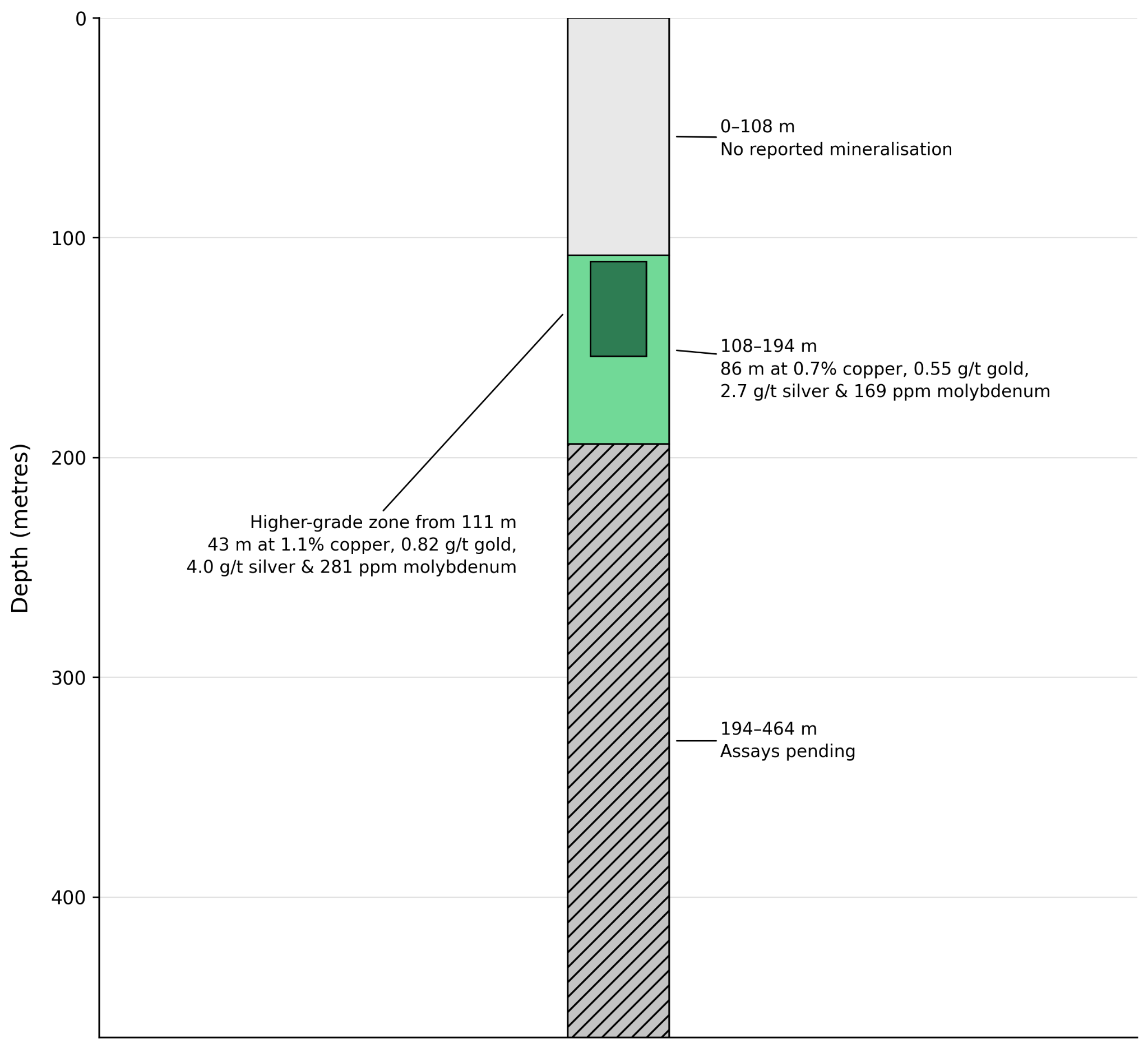
The interval ends in mineralisation. Assays for the remaining 270 metres of the 464-metre hole are still outstanding, and a further 3,681 metres of drilling from across the season, including holes in Chile, have yet to be reported.
That gap is the point. One hole, however strong, marks a location, not a resource. As Sabet put it:
"The scale of the anomalies is massive. You can see them on the map. But the ability to test them is also important, and it takes time. We're at the beginning of the race."
The surrounding area had only one historical drill hole to a depth of 300 metres before this season began. Across the wider property, management has identified around 10 targets, several of which remain entirely undrilled.
From Regional Net to Narrow Net
The Company now plans to apply what it learned at Albor to identify analogous settings elsewhere along the same structural trend, rather than testing the full land package uniformly, a shift that should reduce the number of exploratory holes needed to reach a conclusive result at any given target.
The pattern echoes the neighbouring Filo del Sol deposit, where early lower-grade results were followed by a multi-year narrowing process before its higher-grade zones were defined. Mogotes has disclosed no data indicating that Albor is at a comparable stage, and the Company has been explicit that the current result is early and partial.
What Comes Next
The near-term catalysts are procedural, not promotional. Remaining assays from the discovery hole, along with the balance of the season's metres, including Chile drilling, are still outstanding and will follow as laboratory results come in.
The real test is the next drill program itself: whether Mogotes follows through with a genuinely narrower, more targeted campaign for its November 2026 field season, or reverts to the wider-net approach that defined its earlier seasons.
FAQs (AI-Generated)
Analyst's Notes





Subscribe to Our Channel








Stay Informed


