




New Found Gold Drill Program Builds Consistent Catalyst Flow & Re-Rating Visibility


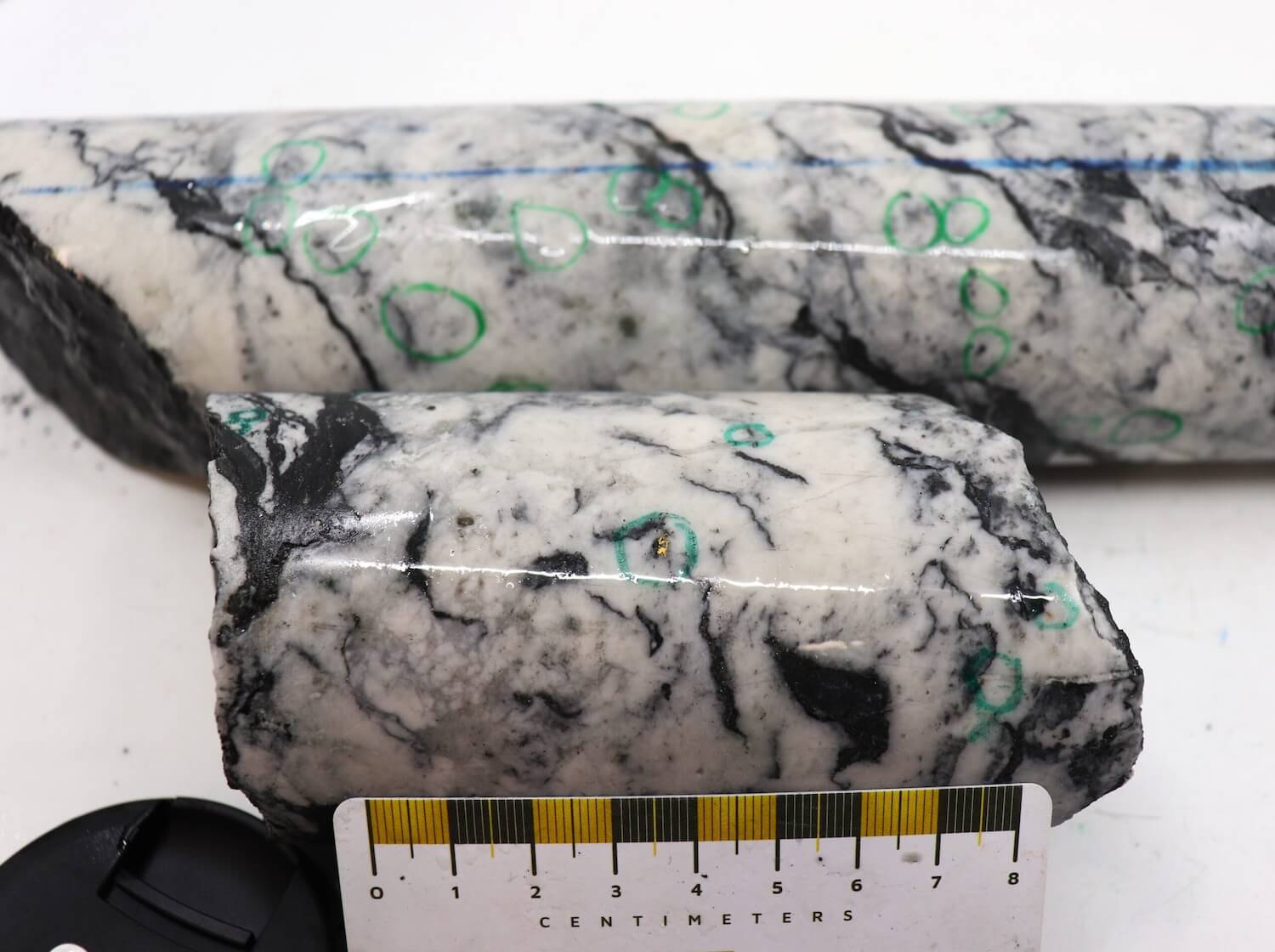
New Found Gold’s 2026 drill program combines infill and exploration across multiple zones, creating steady catalysts, sustained news flow, and clearer re-rating visibility.
- New Found Gold reported final 2025 Phase 1 infill results totalling 22,796 metres across 201 diamond drill holes (DDH) at Queensway's Appleton Fault Zone (AFZ) Core, with highlights including 36.1 grams per tonne (g/t) gold over 2.00 metres at Keats and 9.51 g/t gold over 19.85 metres at Keats West, confirming continuity of gold mineralisation within the Phase 1 open pit block model.
- The 2026 drill program allocates 75% to infill drilling for resource conversion and 25% to exploration, targeting both near-term de-risking and discovery-driven revaluations across Queensway and Hammerdown in Newfoundland.
- Step-out drilling below the Phase 2 open pits identified two areas of significant mineralisation for follow-up testing: 9.15 g/t gold over 7.15 metres below the northern Keats pit and 14.1 g/t gold over 2.40 metres below the central Iceberg pit.
- Active drilling spans dozens of widely separated zones, up to 11 kilometres from the AFZ Core, with the company tracking pending assay results to create a rolling pipeline of news releases that bridge gaps between major corporate milestones.
- Queensway operates in Newfoundland and Labrador, which is ranked among the top 10 jurisdictions in the Fraser Institute's 2025 Annual Survey of Mining Companies, with concurrent multi-zone operations, including post-MRE exploration at Dropkick and 7.5-metre-spaced channel sampling at Lotto.
Dual-Mandate Program Targets Resource Conversion & Discovery Upside
New Found Gold Corp. (TSX-V: NFG, NYSE American: NFGC) has launched a 2026 drill program across multiple deposit zones at its Queensway and Hammerdown projects in Newfoundland, Canada, running concurrently with environmental baseline and engineering studies. The program allocates capital to both infill drilling for near-term resource conversion and exploration targeting to expand the mineral inventory beyond the areas included in the company's maiden mineral resource estimate (MRE).
The strategic design of the drill program addresses a capital markets challenge common to discovery-stage explorers: maintaining investor engagement between major corporate milestones. By distributing drilling activity across dozens of widely separated targets and scheduling assay releases continuously, the company is attempting to create a sustained pipeline of market catalysts rather than relying on intermittent, isolated announcements.
Final 2025 Infill Results Confirm AFZ Core Continuity
The company announced final results from its 2025 Phase 1 infill drilling program on May 4, 2026, reporting 22,796 metres of drilling across 201 diamond drill holes (DDHs) at the Appleton Fault Zone (AFZ) Core. The results confirm the continuity of gold mineralisation within the Phase 1 open-pit block model at the Keats West, Iceberg, and Keats zones.
Keats West infill highlights include 9.51 grams per tonne (g/t) gold over 19.85 metres from 64.15 metres depth and 3.50 g/t gold over 20.45 metres from 14.00 metres. Iceberg returned 8.40 g/t gold over 12.45 metres from 35.55 metres and 5.59 g/t gold over 12.00 metres from 114.85 metres. Keats intersected 36.1 g/t gold over 2.00 metres from 32.40 metres and 9.15 g/t gold over 7.15 metres from 153.50 metres.
President of New Found Gold, Melissa Render, emphasised the alignment between infill drilling results and the company's mine plan development:
"These final Queensway Phase 1 Keats West, Iceberg and Keats open-pit infill results continue to demonstrate the continuity of gold mineralisation in the block model and mine plan. In addition, step-out drilling below the Phase 2 Iceberg and Keats open pits returned high gold grades over broad widths, demonstrating the potential to add to the resource base proximal to the AFZ Core. These new mineralised intercepts will be followed up as part of our 2026 program."
The 2025 program also targeted crown pillars directly below planned Phase 2 open pits, identifying two areas of significant mineralisation: 9.15 g/t gold over 7.15 metres below the northern extent of the Keats pit and 14.1 g/t gold over 2.40 metres below the central portion of the Iceberg pit. Both areas are being evaluated for follow-up testing in the 2026 program.
Program Allocation & Near-Term Priorities
According to the company disclosures, the completed 2025 program comprised more than 74,000 metres of diamond drilling, with 75% allocated to project-focused infill and development drilling and 25% to exploration. For the ongoing 2026 program, geology scheduling maintains a primary focus on the preliminary economic assessment (PEA) and project development, with a secondary focus on ongoing exploration.
This allocation ensures continuous, near-term de-risking of core assets while concurrently funding pure exploration work capable of delivering sudden, discovery-driven revaluations. The dual mandate creates two distinct mechanisms for share price appreciation: incremental confidence gains from infill drilling that reduces resource classification uncertainty, and step-change revaluations from new high-grade intercepts at under-drilled targets.
Multi-Zone Targeting & Assay Backlog Visibility
Active drilling spans core zones at Queensway, including Keats, Keats West, Iceberg, Lotto, Golden Joint, Dome, K2, and Jackpot. Drilling extends outward to peripheral targets such as Dropkick and Pistachio, located 11 kilometres from the core area, and stretches to southern targets including Astronaut, Nova, Camp Zone, and Devils Pond South. At the Hammerdown project, six distinct gold trends are being targeted across a 44,650-hectare package.
Advancing dozens of widely distributed zones simultaneously multiplies the probability of high-grade intercepts, meaning the company's news flow and valuation are not dependent on the success of a single deposit. The explicit tracking of pending results signals to the market that investors can expect a rolling pipeline of incoming data rather than isolated, infrequent updates. This approach directly addresses the volatility risk inherent in discovery-stage equities, where extended periods without news can lead to investor attrition and liquidity deterioration.
Post-Milestone Exploration & Continuous Sampling
New high-grade results have already been received from the Dropkick zone, specifically after the MRE cut-off date, according to company disclosures. Additionally, 7.5-metre spacing channel sampling is currently underway at the Lotto excavation. Releasing data post-MRE cut-off and maintaining continuous sampling ensures that news flow does not stall after major corporate milestones, providing an immediate, continuous bridge of data to the next catalyst.
This sequencing is deliberate: by commencing new drilling and sampling programs immediately following the publication of a resource estimate, the company prevents the market perception that exploration momentum has slowed until the next formal technical study. The strategy treats each milestone as a launching point for the next phase of data generation rather than as a conclusion to a discrete work program.
Growth Exploration Mindset at Hammerdown
The company’s exploration strategy emphasises significant resource expansion potential at both the near-MRE and camp-scale levels. Regarding the Hammerdown asset, the company has prioritised a growth-exploration mindset, noting that previous operators largely focused on de-risking through limited exploration drilling.
Framing the program with a growth-exploration mindset for historically under-explored assets resets market expectations, positioning upcoming drill programs as catalysts for net-new discovery rather than standard infill drilling. This distinction matters to institutional allocators who differentiate between resource conversion risk and exploration upside when building position limits and sector exposure.
Regional Context & Operational Capacity
Queensway is located in north-central Newfoundland and Labrador, Canada, and is ranked among the top 10 jurisdictions in the Fraser Institute's 2025 Annual Survey of Mining Companies. The project benefits from year-round road access, proximate infrastructure, and an established mining services sector that supports the region's active gold exploration and development.
The company is conducting concurrent drilling and sampling across distinct structural zones, including grade control programs at Iceberg and Keats and excavation operations at Lotto. Hundreds of grab samples and drill collars have been completed across Queensway North and South.
FAQs (AI-Generated)
Analyst's Notes





Subscribe to Our Channel







Stay Informed






















