




New Found Gold: Queensway’s $44m Exploration Expansion


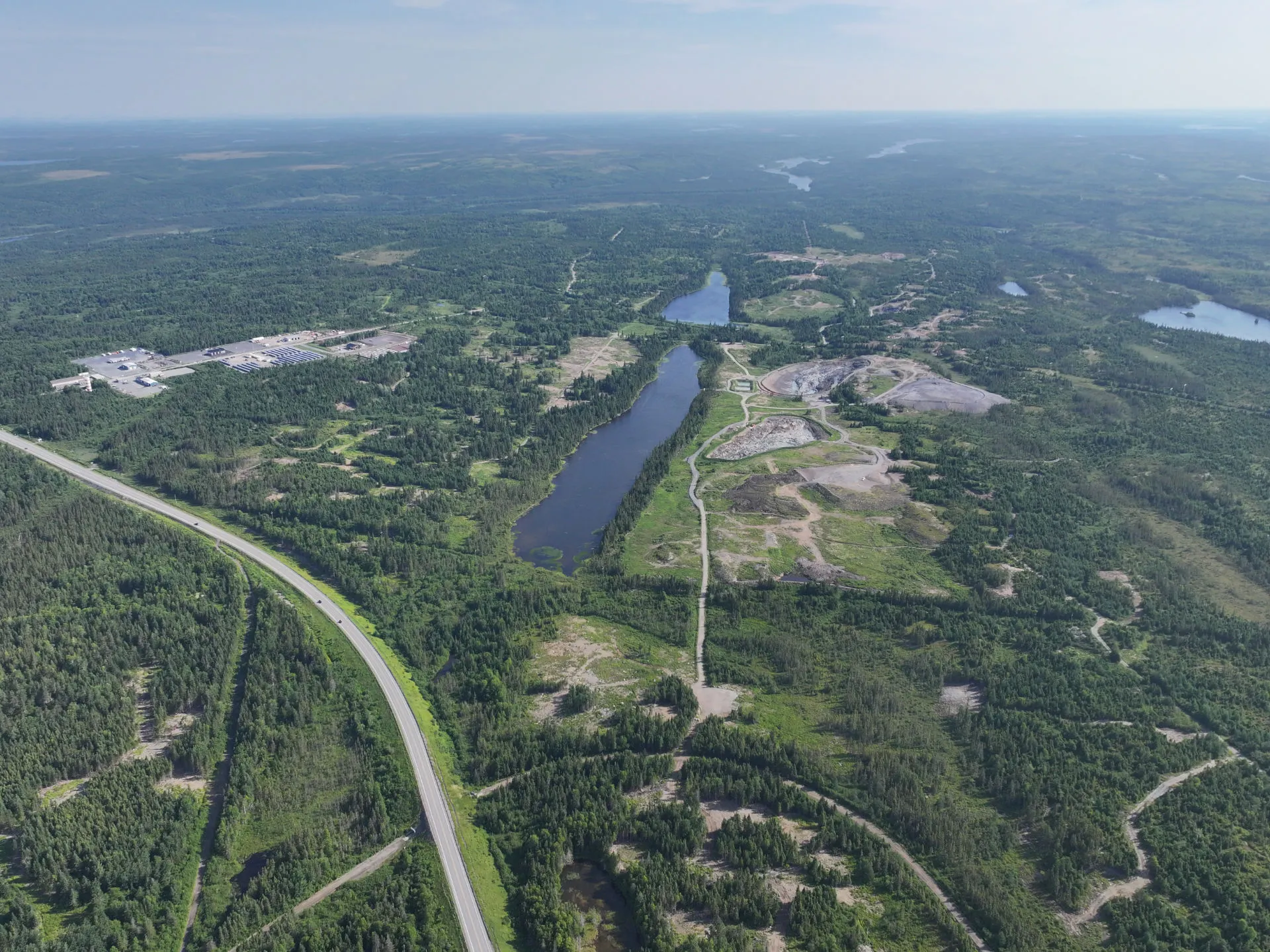
New Found Gold's fully funded $44M 2026 drill program targets resource growth and de-risking at Queensway, balancing exploration upside with near-term production readiness.
- The Queensway 2026 work program carries a $44 million budget covering approximately 90,000 metres of diamond drilling split evenly between project de-risking and new discovery work, reducing financing risk for investors monitoring capital discipline.
- Roughly half the program converts inferred ounces to indicated for the Phase 2 open-pit and Phase 3 underground, directly supporting the targeted 2027 production start, while the other half pursues district-scale expansion with targets that remain largely untested, creating asymmetric upside.
- The Dropkick zone, 11 kilometres along strike from the AFZ Core, has returned grades as high as 42.8 g/t Au over 14.7 metres and has been expanded to a strike length of approximately 1.4 kilometres, and was not included in the initial resource estimate, meaning the pending updated MRE carries a resource addition catalyst.
- Deep drilling in 2024 confirmed mineralisation continues below the existing resource to beyond one kilometre vertical with high-grade results, and the 2026 program is now systematically testing the 300–550 metre window in the AFZ KBFZ corridor, a zone with very limited prior drilling despite having returned some of the project's highest-grade intercepts.
- Physical exposure of the Iceberg, Keats, and Lotto, veins through large-scale excavations has allowed direct observation of vein geometry, coarse visible gold, and mineralisation continuity, replacing drill-model assumptions with real-world confirmation and reducing technical risk ahead of production.
Why Queensway Matters Right Now
Gold prices have sustained multi-year highs through 2025 and into 2026, driven by a combination of central bank accumulation, persistent inflation, and renewed institutional demand for hard assets. Against that backdrop, investor attention has shifted toward a specific category of gold developer: companies with near-surface, high-grade resources, credible production timelines, and exploration upside that has not yet been priced in. New Found Gold Corp (TSXV: NFG | NYSE-A: NFGC) is one of a small number of companies that fits that description.
The company holds the Queensway project in central Newfoundland, a 220,000-hectare land package that has been the subject of intensive drilling since 2019 and now hosts a NI 43-101 resource of 1.39 million ounces of indicated gold at 2.40 g/t and 0.61 million ounces of inferred gold at 1.77 g/t. In April 2026, New Found Gold closed a $220 million financing package to fund construction of Phase 1, with first ore to the mill targeted for late 2027. In parallel, the company is running a $44 million, 90,000-metre drill program designed to both advance the project toward that production start and continue expanding the resource base.
Melissa Render, President of New Found Gold, presented a detailed overview of the 2026 exploration program in June 2026, covering the structure of the drill program, the key target areas, and the geological rationale behind each.
Overview of the Queensway Gold Project
The Queensway Gold Project covers 220,000 hectares of ground in central Newfoundland and Labrador, straddling two regional-scale fault zones: the Appleton Fault Zone in the west and the JBP Fault Zone in the east. Together, these structures define a strike extent of more than 110 kilometres, along which New Found Gold has made a succession of high-grade gold discoveries since acquiring the project.
The project's current Mineral Resource Estimate, reported under NI 43-101 standards, hosts 1.39 million ounces of indicated gold at 2.40 g/t and 0.61 million ounces of inferred gold at 1.77 g/t. Mineralisation is characterised by coarse free gold hosted in quartz-carbonate veins within a damage zone proximal to the Appleton Fault, with grades that rank among the highest-confidence near-surface intercepts in the development-stage gold sector. Notably, this resource was established before results from several emerging target areas, including Dropkick, had been incorporated, meaning the upcoming updated resource estimate carries growth potential.
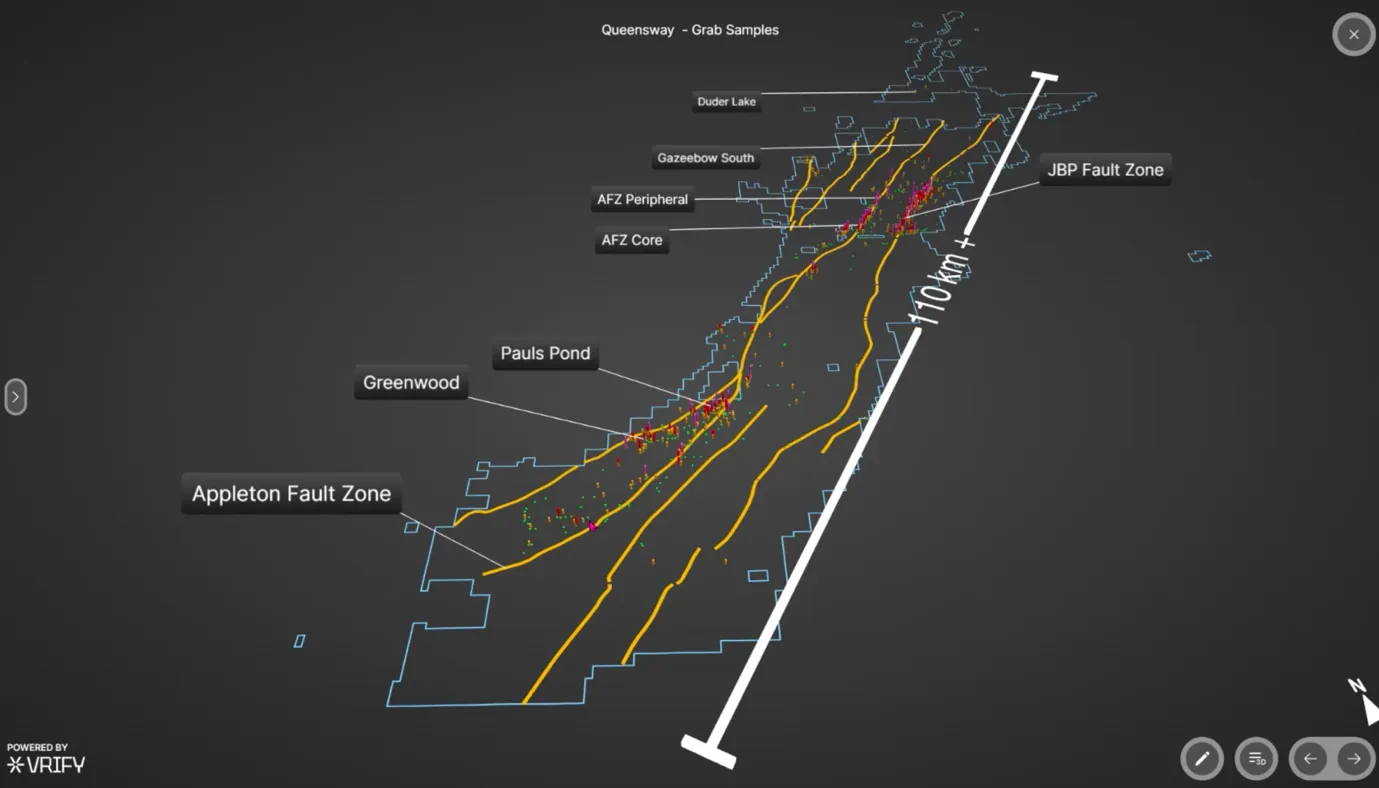
"The project straddles two regional scale fault zones, the Appleton Fault Zone here in the west and the JVP Fault Zone here in the east, over a strike length of about 110 kilometres. Why this is important is that these major structures are spatially associated with our major gold discoveries made to date."
Render's framing of the geological architecture is fundamental to understanding the investment opportunity: what has been found so far is the product of drilling a fraction of a very large, structurally controlled system. The 2026 program is designed to systematically test those untested areas while simultaneously converting the known resource into mineable confidence categories.
Interview with President, Melissa Render
Exploration & Growth Focus: Expanding the Resource Footprint
Approximately 50 per cent of the 2026 program - around 40,000 to 45,000 metres - is directed toward exploration and resource growth rather than resource conversion. This exploration component is itself structured across several distinct target areas, each with different geological rationale and different risk-reward profiles.
Within the AFZ Core, roughly 20,000 metres are allocated to step-out drilling around the existing resource outline. This work is focused on near-surface extensions along the recently acquired Bullseye land position, which adds approximately one kilometre of strike length along the Appleton Fault and provides access to mineralisation adjacent to the established mine shapes. Below the existing resource, the program targets a depth range of 300 to 550 metres in what Render describes as the AFZ KBFZ target area, a corridor centred on the intersection of the Appleton Fault Zone and the Keats Baseline Fault Zone.
"We've got a healthy budget of metres set aside to be testing kind of in that 300 to 550 metre vertical range and specifically in this area we call the AFZ KBFZ target area. The KBFZ is the Keats Baseline Fault Zone and it hosts the Keats and the Iceberg mineralisation. These three areas are some of our most significant mineralisation found to date on the project and they're located in close proximity to one another."
The significance of this targeting becomes clear when the 2024 deep drilling results are considered. Prior testing at depth, down to and beyond one kilometre vertical, returned intercepts including 51 g/t Au over 13 metres and approximately 10.5 g/t Au over 20.5 metres. These results confirmed that the system continues well below the current resource envelope with grades comparable to surface. The 2026 program is not chasing those extreme depths; it is systematically testing the much shallower, but equally under-drilled, window immediately below the resource; a target with direct resource addition potential.
The program also includes follow-up at Golden Dome, a newer high-grade discovery situated between the Dome and Golden Dome zones closer to surface, and at the downward extension of the Dome zone itself where significant high-grade mineralisation was identified in both 2024 and 2025. These areas sit outside the current block model but remain at depths accessible to near-term resource conversion once drilling density warrants it.
The Dropkick Discovery: A District-Scale Catalyst
Among the most consequential elements of the 2026 exploration program is the continued development of Dropkick, a high-grade discovery located approximately 11 kilometres north of the AFZ Core along strike of the Appleton Fault Zone. The zone was initially a low-grade mineralised structure identified by prior operators; New Found Gold began systematic step-out drilling in late 2024 and rapidly encountered a high-grade domain at the southern end of the structure.
The results from that initial phase of drilling established Dropkick as a discovery of genuine scale. Intercepts from 2024 included 42.8 g/t Au over 14.7 metres and 26 g/t Au over 16 metres. Follow-up drilling in 2025 extended the mineralisation both along strike and down-plunge, with further results including approximately 25 g/t Au over 14 metres. The zone has now been traced over a strike length of approximately 1.4 kilometres and to a vertical depth of just over 300 metres.
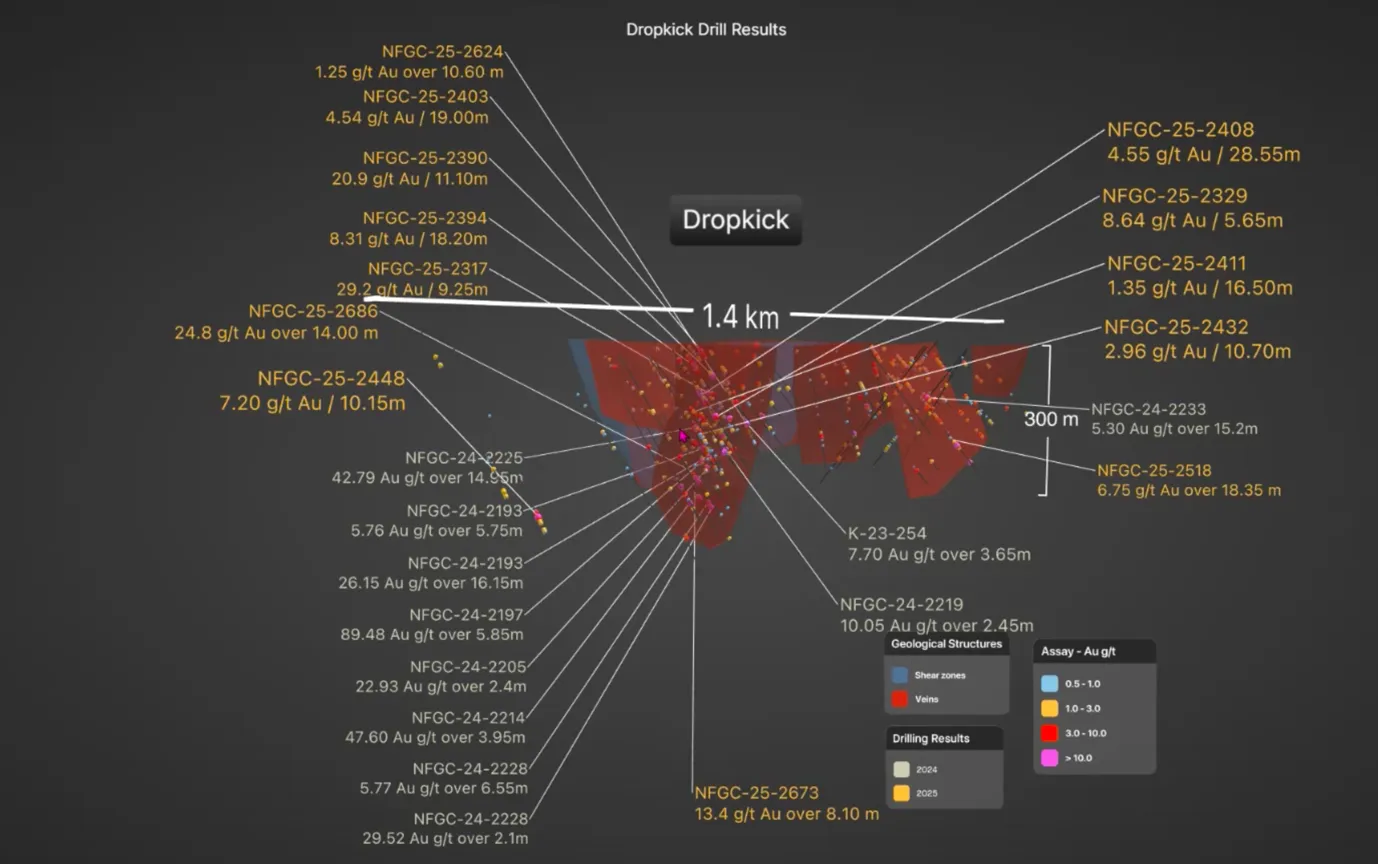
"In 2024 is when we had some of those initial very exciting high grade results, the best ever seen on this particular project. We're 11 kilometres along strike. The mineralisation is identical to the core area and we see this as a place that we can continue to grow our resource base."
For investors, the key contextual point is that Dropkick's results were not included in the company's initial Mineral Resource Estimate. The upcoming MRE update, which is in progress, will incorporate Dropkick for the first time, a development that could represent a material increase in the company's total ounce inventory without requiring any further discovery.
The 2026 program is allocating drill metres to step out further along the eastern stratigraphy at Dropkick, where the analogous relationship between host geology, gold-bearing veins, and the Appleton Fault is consistent with what is observed at Keats and Iceberg in the AFZ Core. Drilling on the eastern side of the fault at Dropkick, the side that hosts some of the core area's most significant mineralisation, remains very limited, with isolated intercepts of approximately 7 g/t Au over 10 metres and 7 g/t Au over 18 metres awaiting systematic follow-up.
Project-Focused Drilling: De-Risking the Path to Production
While exploration commands the narrative interest, the project-focused component of the 2026 program carries equal weight in the context of the investment thesis. The company has committed to sending first ore to the mill by the end of 2027, supported by a $220 million financing package, and the technical credibility of that timeline depends on the systematic conversion of inferred resources into indicated status and the collection of high-density geotechnical, hydrogeological, and grade control data.
Approximately 45 to 50 per cent of the 2026 metres are directed toward this work. Within the Phase 2 open-pit footprint, the program includes infill drilling to convert inferred resources to indicated, the category required for feasibility-level mine planning. For the Phase 3 underground, the company has commenced the first 50 per cent of the infill program, prioritising the Golden Joint panel as the highest-priority underground area under the preliminary economic assessment, before moving to Lotto, K2, Monte Carlo, and Keats South in sequence.
Grade control drilling, the tightly spaced sampling program designed to support mine planning and blast reconciliation, is underway at both Iceberg and Keats, with the program moving toward Lotto as exposures are completed. This work follows an extensive excavation program that has physically exposed the Iceberg, Keats, Lotto, and Keats West vein systems for the first time, allowing direct geological observation of the mineralisation at surface.
"This has been an extremely rewarding exercise as a geologist where we've drilled out these areas. None of these areas were previously exposed. So all of our models were fully developed from data from drill holes."
The value of that geological validation extends beyond data quality. For investors, physical exposure of the vein systems - confirming vein geometry, visible coarse gold content, and the spatial relationships between structures - materially reduces the modelling uncertainty that typically characterises pre-development gold projects. The mineralisation at Queensway has now been seen, not merely inferred, across its most important near-surface domains.
The company is also running an NQ drill hole test program to compare results from NQ and HQ diameter drilling and to optimise the grid spacing required to achieve production-grade geological confidence at the lowest cost and time. This kind of incremental technical optimisation, unglamorous but operationally important, reflects a management team focused on the practicalities of running a mine rather than simply advancing an exploration programme.
The program had ramped from four rigs at the start of January 2026 to six (as of June 2026), with two additional drills being mobilised to expand capacity on the exploration side. The scaling of the fleet, timed to coincide with the completion of the most critical early-year project drilling, reflects a deliberate prioritisation strategy.
"We started up with four drills at the beginning of January mostly project focused. Now we are looking to ramp up here and actually it's happening as we speak with two additional drills coming bringing us to six and we're looking to pivot and put more drills on the exploration side, so the new discoveries and the resource expansion work."
Regional Exploration Programs: District Upside Beyond the Core
The 2026 program allocates approximately 7,000 metres to regional exploration targets, areas outside both the AFZ Core and the AFZ Peripheral, representing a smaller but strategically important component of the overall work plan. These programmes are designed to advance targets from prospecting and soil sampling toward drill-readiness, and to follow up on existing drill results that have not been systematically tested.
Two areas feature prominently in the near-term plan. The Pauls Pond and Greenwood area, within the broader Queensway South region, returned broad low-grade mineralisation across more than 30 drill holes that contained visible gold during prior programmes, with high-grade cores emerging toward the most recent holes. The company has not drilled the area for several years, and the 2026 return is focused on understanding the structural controls that differentiate high-grade from low-grade domains - knowledge that has direct bearing on resource potential.
The second major focus is Gazeebow South, situated along the projected strike extension of the Appleton Fault beyond Dropkick. A significant soil and till geochemical anomaly occupies the projected fault corridor in this area, and the site benefits from access gained through the 2024 acquisition of licences from Exploits Discovery Corp. A drill is being mobilised to the area imminently, with surface trenching programs supporting target definition across multiple anomaly areas.
Render also highlighted Duder Lake, located further north on the North Dog Bay Line, where prior operators identified geochemical anomalies that have not been drill-tested. The company's systematic approach of blanketing areas with soil sampling before committing drill metres - walking targets progressively from prospecting through geochemistry to trenching to drilling - reflects a methodical regional exploration philosophy suited to a large, under-explored land position.
"We have no shortage of targets. But this year's program is going to consist of about 7,000 metres of diamond drilling. Through the summer, we'll be continuing with those boots on the ground activities to generate new drill targets."
What’s Next?
New Found Gold's 2026 exploration program represents a well-structured, fully funded effort to advance Queensway on two parallel tracks: converting known mineralisation into production-ready resource categories while simultaneously expanding the asset's geological footprint through a pipeline of exploration targets ranging from near-resource extensions to district-scale discoveries.
The geological system is larger than the current resource, the resource has significant growth potential beyond what was modelled in the initial MRE, and the company is advancing toward production with a financing package that was secured before completion of the drill season. For investors, the near-term catalysts are clear: the updated Mineral Resource Estimate incorporating Dropkick, ongoing grade control and infill results at Keats and Iceberg, high-grade intercepts from the AFZ KBFZ depth target, and initial results from Gazeebow South and Pauls Pond step-outs.
The production target of late 2027 creates a hard timeline against which execution progress can be measured. The 2026 drill program is the technical foundation on which that timeline depends, and, judging by both the scale of the program and the geological quality of the targets being tested, it is a foundation being built with considerable ambition.
What to Watch:
- Updated Mineral Resource Estimate which includes Dropkick for the first time; expected in 2026.
- AFZ KBFZ depth drilling results testing the 300–550m vertical window below the highest-grade surface zones.
- Gazeebow South initial drill results, the first test of the Appleton Fault projection beyond Dropkick.
- Grade control expansion at Lotto and Keats West which are important for mine planning confidence.
- Regulatory milestones include early works permit for Queensway expected Q3 2026; Pine Cove mill groundbreaking expected by end of Q2 2026.
Macro Thematic Analysis
The investment case for Queensway-stage gold assets in 2026 is inseparable from the macroeconomic environment in which it is being advanced. Gold prices have reached and sustained levels that were, until recently, regarded as cyclical peaks; they are now increasingly interpreted as a structural repricing of the metal's role in a monetary system characterised by persistent fiscal expansion, geopolitical fragmentation, and a secular shift in central bank reserve composition away from US dollar-denominated assets.
Within that environment, the market's premium has migrated toward a specific subset of gold developers: those with near-surface, high-grade, low-capital-intensity assets capable of generating substantial free cash flow per ounce within a near-term timeframe. Queensway, with its Phase 1 plan to process ore at 10 to 12 g/t through the existing Pine Cove mill infrastructure and all-in sustaining costs estimated at approximately $1,300 per ounce, sits at the highest-margin end of that subset. At current gold prices, the projected free cash flow per ounce, in excess of $2,300 on the company's own estimates, positions Queensway as one of the more compelling near-term cash flow generators in the development stage.
The geological structure of the asset also addresses one of the persistent concerns that has historically suppressed valuations for high-grade vein gold deposits: nugget effect and grade continuity risk. The combination of 5x5 metre grade control drilling, physical vein excavation, and consistent high-grade results across multiple separate structural domains at Queensway has progressively reduced that uncertainty. When Render notes that none of the key vein systems were previously exposed and that all prior models were built from drill data alone, the implication is that the physical confirmation now available represents a genuine de-risking that the market may not yet have fully priced.
At a district scale, the 110-kilometre strike length of the Queensway land package, the majority of which remains systematically underexplored, provides optionality that is rare in the development-stage universe. Most of the premium ascribed to Queensway to date reflects the known resource and the near-term production plan. The exploration upside, from Dropkick to Gazeebow South to the untested eastern stratigraphy along the AFZ Peripheral, represents a layer of value creation that could unfold independently of the production timeline and the gold price environment.
"The mineralisation is identical to the core area and we see this as a place that we can continue to grow our resource base, and keeping in mind that when we did the initial resource estimate we didn't have the results from this programme yet
This single observation, that the initial MRE was built without Dropkick's grades, encapsulates the asymmetry of the current investment case. The resource is already large enough to justify production; the exploration system is large enough to build something considerably bigger. The 2026 drill program is the mechanism through which both of those statements are being tested simultaneously.
Analyst's Notes





Subscribe to Our Channel






.jpg)
Stay Informed






















