




Americas Gold & Silver Sees Generalist Capital Drive Trading Liquidity Expansion Amid Silver Deficits


Americas Gold & Silver reports surging trading liquidity as institutional funds seek exposure to primary silver producers amid persistent global supply deficits.
- Daily trading liquidity increased from approximately US$400,000 to US$500,000 per day to between US$70 million and US$75 million per day, reflecting growing participation from institutional investors across North America and Europe.
- Silver demand is being supported by solar energy, AI data centres, and advanced battery technologies, with management highlighting silver's role in electrical systems and technology infrastructure.
- Silver supply remains constrained because approximately 70% of global production is a byproduct of other mining operations, limiting the industry's ability to respond quickly to rising demand.
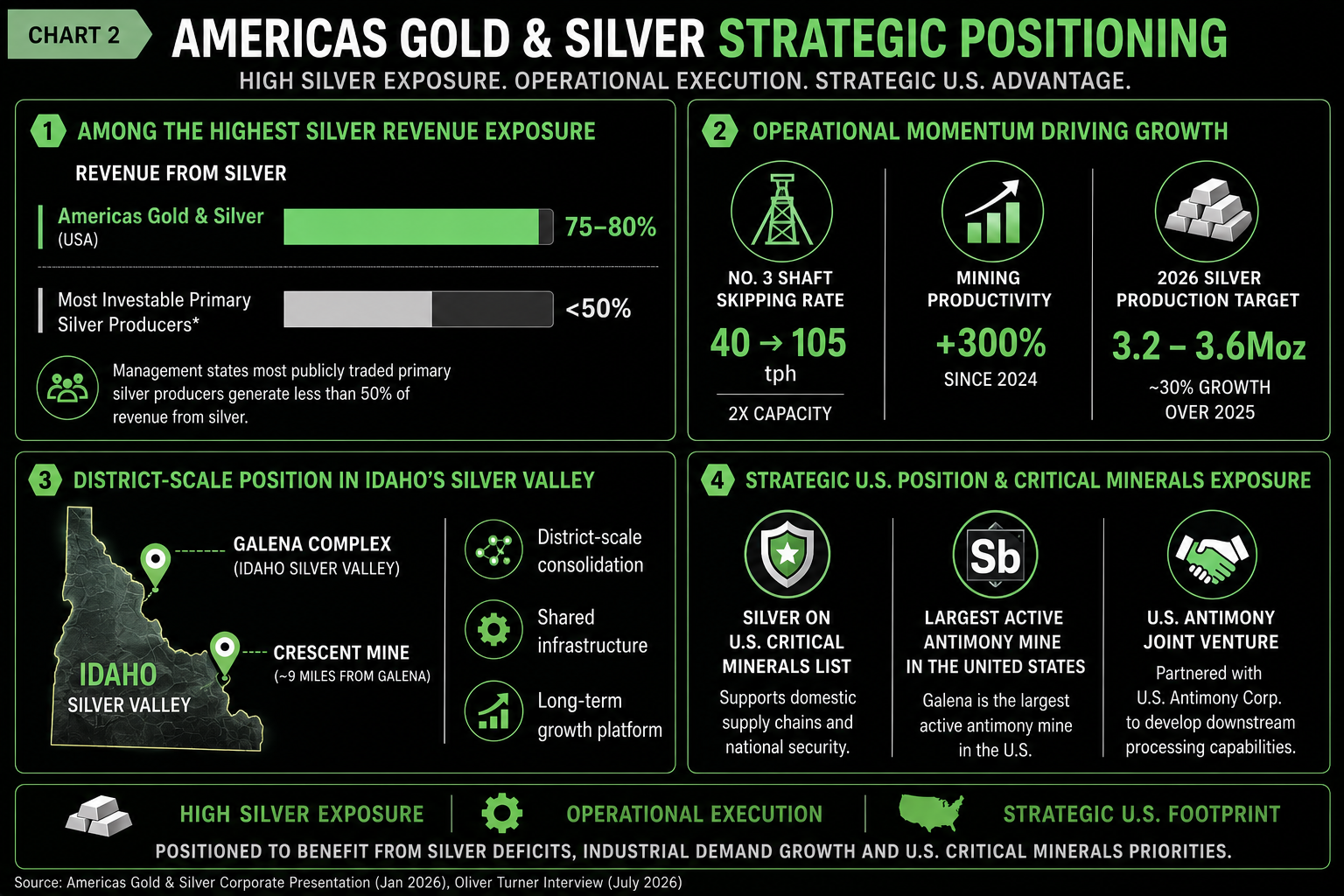
- Americas Gold & Silver is targeting 3.2 to 3.6 million ounces of silver production in 2026, supported by the completed No. 3 Shaft upgrade, which increased skip rates from 40 tonnes per hour to 105 tonnes per hour.
- The company has built a district-scale position in Idaho's Silver Valley through the Galena Complex and Crescent Mine, while also benefiting from silver's inclusion on the US critical minerals list and antimony production at Galena.
The Generalist Rotation Into Silver
A notable shift in investor participation is emerging across the precious metals sector as generalist funds expand beyond traditional gold exposure and seek additional leverage to rising metal prices. According to Americas Gold & Silver Corp. (TSX: USA | NYSE American: USAS), institutional investors that previously focused on larger gold producers are increasingly evaluating primary silver companies. The trend has coincided with a substantial increase in trading activity for the company. Management noted that daily trading liquidity expanded from approximately US$400,000 to US$500,000 per day when the current leadership team arrived, and is now between US$70 million and US$75 million per day. The company also reports growing ownership from major institutions across North America, the United Kingdom, Switzerland, Austria, and Germany.
Executive Vice President of Corporate Development at Americas Gold & Silver, Oliver Turner, described the changing investor landscape:
"We're trading around US$400,000 to US$500,000 per day when we stepped into the business. We're now trading between US$70 and US$75 million per day."
The company highlights a broader transformation under the current management team, including more than US$300 million raised through financings, increasing institutional ownership, and significant share price outperformance relative to the VanEck Junior Gold Miners ETF. With approximately 65% of shares held by management, institutions, insiders, and exchange-traded funds, the shareholder register increasingly reflects long-term capital rather than short-term trading activity.
Industrial Demand Continues to Reshape the Silver Narrative
While silver has historically benefited from monetary demand, many investors are increasingly focused on industrial consumption trends. Solar panel manufacturing remains one of the largest drivers of demand, while emerging applications linked to artificial intelligence infrastructure and advanced battery technologies are creating additional demand centres. The company points to continued solar deployment, AI-related data centre construction, and next-generation battery technologies as overlapping drivers that could support long-term growth in silver demand.
Turner argued that silver occupies a unique position within the broader electrification and digital infrastructure buildout:
"And the old adage is, copper is the highway, but silver is the glue. You need silver in all of these circuit boards and in any of this technology rollout as well."
Silver demand is increasingly tied to technologies that require conductivity, reliability, and energy efficiency. At the same time, Americas Gold & Silver maintains one of the highest levels of direct silver exposure among publicly traded producers. Silver accounts for approximately 80% of revenue as of January 2026, placing the company above many sector peers whose production profiles remain more heavily weighted toward other metals.

Supply Constraints Highlight the Value of Primary Producers
The demand story is only one side of the equation. The more important consideration may be the industry's limited ability to rapidly increase supply. Approximately 70% of global silver production is produced as a byproduct of other mining operations, with a significant portion coming from copper mines. As a result, silver supply growth often depends on copper economics rather than silver fundamentals, creating a structural disconnect between rising demand and available supply.
This dynamic is contributing to persistent deficits across the silver market. While new industrial applications continue to emerge, supply remains relatively inelastic because operators cannot simply increase silver production in response to higher prices. This has increased investor focus on companies whose revenues are primarily derived from silver rather than diversified mining portfolios.
Americas Gold & Silver currently operates the Galena Complex in Idaho and the Cosalá Operations in Mexico while advancing growth initiatives at the nearby Crescent Mine. The company is targeting consolidated silver production of 3.2 to 3.6 million ounces in 2026, representing approximately 30% growth over 2025 production. Management also notes that only a limited number of publicly traded primary silver producers remain available to investors, increasing the strategic value of companies with high direct exposure to the metal.
Execution Becomes the Key Differentiator
While the macro environment has attracted new investors to the sector, management repeatedly emphasises that valuation expansion ultimately depends on operational execution. The company's strategy centres on converting favourable market conditions into sustainable production growth through modernisation projects, productivity improvements, and district-scale development initiatives.
A major milestone was achieved in June when Americas Gold & Silver announced completion of Phase 2 upgrades to the No. 3 Shaft at the Galena Complex. The project doubled the current hoisting capacity and forms part of a broader modernisation program designed to support higher mining rates and long-hole stoping operations. The completed upgrades increased skipping rates from 40 tonnes per hour to 105 tonnes per hour, while broader operational initiatives have contributed to a more than 300% increase in mining productivity since 2024. Additional projects include the construction of a paste fill plant, the deployment of modern underground equipment, the development of fibre-optic communications infrastructure, and mill optimisation initiatives to improve operating efficiency.
The company is targeting approximately 1,200 tonnes per day of milling capacity by the end of 2026 while continuing its transition toward predominantly long-hole stoping methods. In evaluating the company's growth strategy, the focus increasingly appears to be shifting from turnaround planning to execution against clearly defined operational milestones. Management's objective remains to grow annual silver production toward the 5 million ounces level over the coming years while leveraging existing infrastructure across the district.
The United States Jurisdictional Advantage
Another theme attracting institutional interest is the company's position within Idaho's historic Silver Valley. Americas Gold & Silver has assembled a significant district-scale footprint in one of North America's most established silver-producing regions. The consolidation strategy provides access to existing infrastructure, operational synergies, and future growth opportunities within a jurisdiction already familiar to institutional investors.
Turner pointed to evolving US government policy surrounding critical minerals and strategic reserves as an increasingly important factor for domestic producers:
"They started talking about building, quote and quote, ‘critical metal stockpiles’. There's a strategic reserve of oil. There always has been."
Silver's inclusion on the US critical minerals list has strengthened interest in domestic supply chains, particularly as governments and industries focus on energy security, electrification, and advanced manufacturing. The company has also expanded its exposure to critical minerals through antimony production at Galena and a joint venture (JV) with U.S. Antimony Corp. to develop downstream processing capabilities. Americas Gold & Silver describes Galena as the largest active antimony mine in the United States, positioning the operation within a broader strategic-minerals framework that goes beyond silver alone. The combination of high silver exposure, district-scale consolidation, and operations located within North America may provide a differentiated investment profile as capital continues to rotate toward companies positioned to benefit from both precious metals and critical minerals themes.
FAQs (AI-Generated)
Analyst's Notes





Subscribe to Our Channel



.jpg)
Stay Informed






















