Record Uranium Term Price Puts Premium on Strong Jurisdictions and Processing Capacity



Uranium term prices hit $94 as producer constraints, processing bottlenecks and nuclear growth keep long-term supply tight.
- Uranium's long-term price reached a nominal all-time high of $96 per pound, above its previous $95 per pound record from 2007, while spot uranium traded near $89.60 per pound on September 10, 2026, leaving a term premium of about $6.40 per pound.
- Kazatomprom is holding 2026 output guidance at 27,500 to 29,000 tonnes despite uranium term prices reaching a record $96 per pound, while sulfuric acid constraints at Taikonur continue to limit leaching capacity.
- Cameco's McArthur River mine is targeting 19.5 to 21.5 million pounds of 2026 production against 25 million pounds of licensed annual capacity, keeping output below the mine's permitted limit.
- Niger's transfer of the former Somair concession and the US gap between roughly 50 million pounds of uranium requirements and White Mesa's 8 million pounds of licensed processing capacity are increasing the value of supply with lower jurisdictional and processing risk.
- The Fed's September 15 to 16 meeting is the nearest macro catalyst, as a hawkish outcome could strengthen the US dollar and raise financing costs for uranium developers.
Record Uranium Term Price Widens Premium Over Spot & Favors Market-Exposed Supply
Uranium trades on separate spot and term markets, and the spread between them shows whether utilities are paying more to secure future supply than buyers are paying for immediate delivery. Spot pricing reflects thin, largely uncontracted volumes changing hands for near-term delivery, while term pricing reflects multi-year contracts that utilities use to secure future reactor fuel, making the term market more relevant to long-cycle producer revenues. The latest long-term price reached a nominal record of $96 per pound, surpassing the previous $95 per pound high from 2007, while spot uranium traded near $89.60 per pound on September 10, 2026. That leaves a term premium of about $6.40 per pound and extends the long-term benchmark's rise from $80 per pound in June 2025.
The roughly $6.40 term premium matters because it reflects the higher price utilities are willing to commit to for future deliveries, making the term market more relevant to new contract economics than daily spot pricing. More importantly, the $96 per pound benchmark establishes a new nominal high even as reported term contracting remains below previous peaks, indicating that constrained available supply is supporting contract pricing.
Kazakhstan Caps Uranium Growth & Brings New Supply Into Focus
Kazatomprom accounts for roughly 40% of global primary uranium supply, giving changes to its production guidance an outsized effect on near-term market availability. The company has maintained 2026 production guidance at 27,500 to 29,000 tonnes on a 100% basis while sulfuric acid availability at Taikonur continues to limit leaching capacity. Meanwhile, 38 countries representing more than 70% of global gross domestic product have committed to tripling nuclear capacity by 2050, yet Kazatomprom has not raised its 2026 production range in response to that longer-term demand target.
With Kazatomprom holding its 2026 production range, the timing of new development projects becomes more important to the medium-term uranium supply outlook. Atomic Eagle's Madaouela project has a 116.5 million-pound mineral resource estimate grading 1,282 parts per million uranium oxide, based on a historical pit-shell optimization using a $70-per-pound uranium price assumption. With the latest long-term uranium price at a record $96 per pound, the historical assumption is $26 per pound below the current benchmark.
Atomic Eagle Chief Executive Officer Phil Hoskins links Madaouela's timing to the projected uranium supply deficit:
"Particularly in a uranium market where the deficit comes at the time that this project's capability of coming online is going to be significant."
Stable Uranium Jurisdictions Gain Value as Supply Security Becomes More Important
As utilities seek reliable long-term uranium supply, jurisdiction is becoming an important factor alongside resource size and project economics. Countries with established mining laws, secure ownership rights, and predictable regulatory frameworks can reduce the political uncertainty surrounding project development and future supply. Canada stands out in this respect, combining a long uranium mining history with established permitting and regulatory systems.
ATHA Energy controls a 6.8 million-acre exploration portfolio across the Athabasca Basin in Saskatchewan, the Thelon and Baker Lake basins in Nunavut, and the Central Mineral Belt in Labrador. This gives ATHA substantial uranium exposure within Canada, where jurisdictional stability strengthens the value of exploration success by reducing the sovereign and ownership risks that can complicate uranium development elsewhere.
US Uranium Shortfall Exposes Processing Constraint & Raises the Value of New Capacity
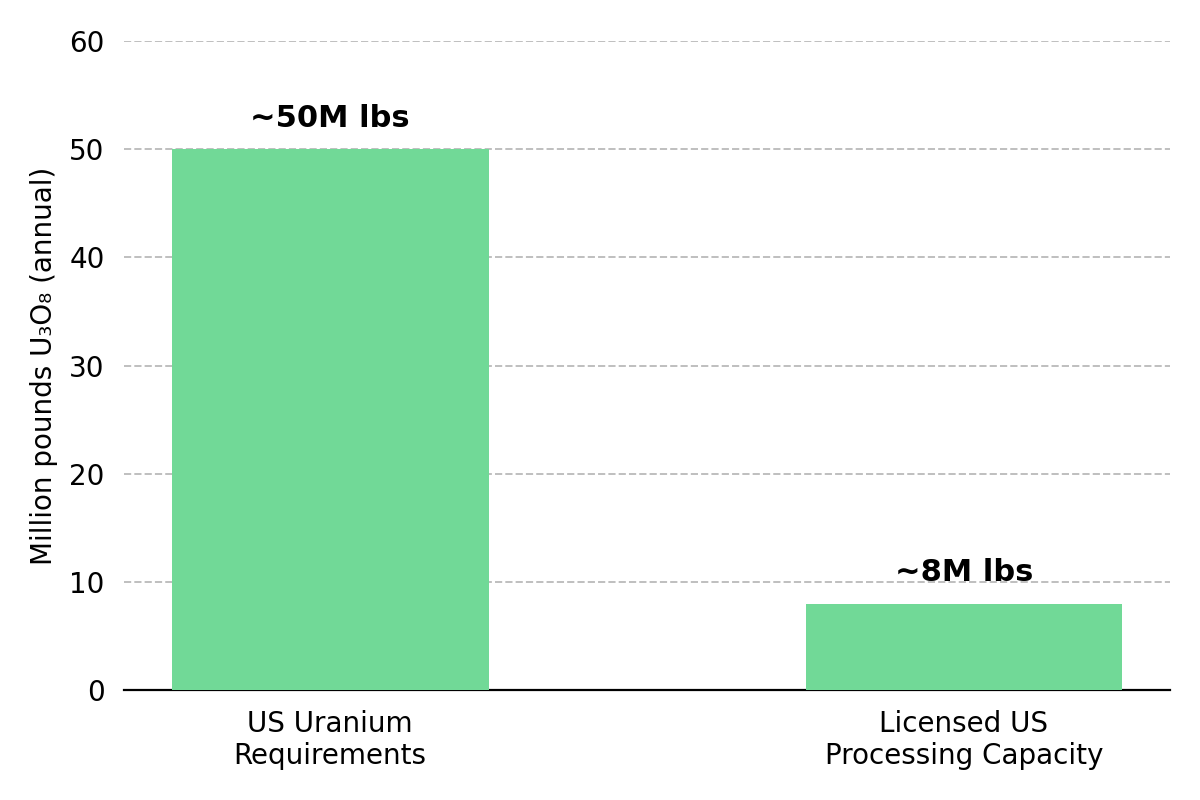
The US faces a separate supply constraint, with roughly 50 million pounds of uranium requirements compared with about 8 million pounds of licensed annual processing capacity at White Mesa, leaving domestic supply dependent on additional milling capacity.
IsoEnergy Chief Executive Officer Philip Williams argues that higher US uranium production will also require additional domestic processing capacity:
"There's a massive disconnect between the domestic requirements and domestic production, and the gap is not going to be filled by just one processing facility. White Mesa has a license for about eight million pounds a year, and we need fifty million pounds of production in the United States, so a new processing facility is required."
White Mesa Mill is the only fully licensed and operating conventional uranium processing facility in the US, making milling capacity a separate constraint on how quickly additional domestic production can reach the market.
Larger Uranium Projects Gain Contracting Leverage & Shift Focus to Permitting
Scale is becoming a key commercial consideration for US in-situ recovery producers because larger operations can support stronger credit profiles and negotiate larger contracts with nuclear utilities.
enCore Energy's Dewey Burdock completed its federal permitting requirements, including a 20-year Source Materials License renewal from the US Nuclear Regulatory Commission that remains valid through June 2046. South Dakota state review is the remaining permitting step, making its completion a key milestone for determining when the project can advance toward production.
Nuclear Expansion Extends Uranium Demand & Strengthens Long-Term Contracting
Record nuclear generation and planned reactor capacity growth are extending uranium demand beyond short-term utility restocking. The World Nuclear Association reports that global nuclear generation reached a record 2,702 terawatt-hours in 2025, supplying roughly 9% of world electricity. Operable nuclear capacity is projected to reach 1,457 gigawatts by 2050 if current construction and reactor life-extension trends continue, increasing the uranium required to fuel the global reactor fleet.
Chinese nuclear buyers are also locking in multi-year uranium supply, extending the demand signal beyond Western utility contracting. CGN Mining's 3-year supply agreement with parent CGNPC, effective January 2026, prices 30% of contracted volume at about $94.20 per pound with a 4% annual escalation, while the remaining 70% is linked to spot pricing. The $94.20 fixed-price component was roughly 18% above the prevailing term price and 30% above spot at the time of signing, showing that willingness to secure future uranium supply is not limited to Western utilities.
The Investment Thesis for Uranium
- Uranium demand is extending beyond cyclical utility restocking as multi-decade nuclear capacity commitments and artificial intelligence-driven electricity demand increase the need for long-term fuel supply.
- Major producers retain potential output above current or guided levels, but operating constraints and production decisions continue to limit near-term supply even as uranium term prices hold above spot.
- Government intervention in Niger has increased the importance of ownership security and regulatory stability when uranium projects are compared, distinguishing Canadian and US assets from supply exposed to expropriation or state-ownership risk.
- Development-stage project economics remain tied to the commodity-price assumptions used in their underlying studies, so higher uranium prices only affect reported net present value or internal rate of return after those assumptions are updated.
- Greater scale can improve credit quality, lower financing costs, and strengthen negotiating leverage with nuclear utilities, giving larger US in-situ recovery producers a commercial advantage when competing for term contracts.
- US processing capacity remains a constraint alongside mine supply, making permitting and expansion of domestic mills important to how quickly additional uranium production can reach the market.
Taken together, these dynamics point to a uranium market where near-term supply remains constrained even though major producers retain potential output above current or guided levels. How quickly the deficit narrows will depend on whether existing producers can lift output, development projects can advance on schedule, and processing capacity can expand fast enough to convert new resources into deliverable supply. Until those constraints are resolved, long-term contracting demand and limited near-term availability can continue to support the term market even if spot prices remain more volatile.
TL;DR
Uranium's long-term price reached a nominal record of $96 per pound, surpassing its previous $95 per pound high from 2007, while spot traded near $89.60 per pound on September 10. The resulting term premium of about $6.40 per pound strengthens the contracting signal as major producers keep output below potential levels. Kazatomprom's constrained 2026 guidance, limited US processing capacity, and jurisdictional considerations reinforce near-term supply tightness, while expanding nuclear capacity and multi-year contracting support longer-term demand. However, the deficit is not necessarily permanent, as higher producer output, new projects, additional processing capacity, and financing conditions could determine how quickly supply catches up.
FAQs (AI-Generated)
Analyst's Notes





Subscribe to Our Channel









Stay Informed