




Selkirk Copper's 15.1% Copper Equivalent Hit Tests a Structural Model for Minto's Feasibility Plan


Selkirk Copper's 15.1% copper equivalent hit at Minto North tests a north-northwest structural model feeding the Minto Feasibility Study.
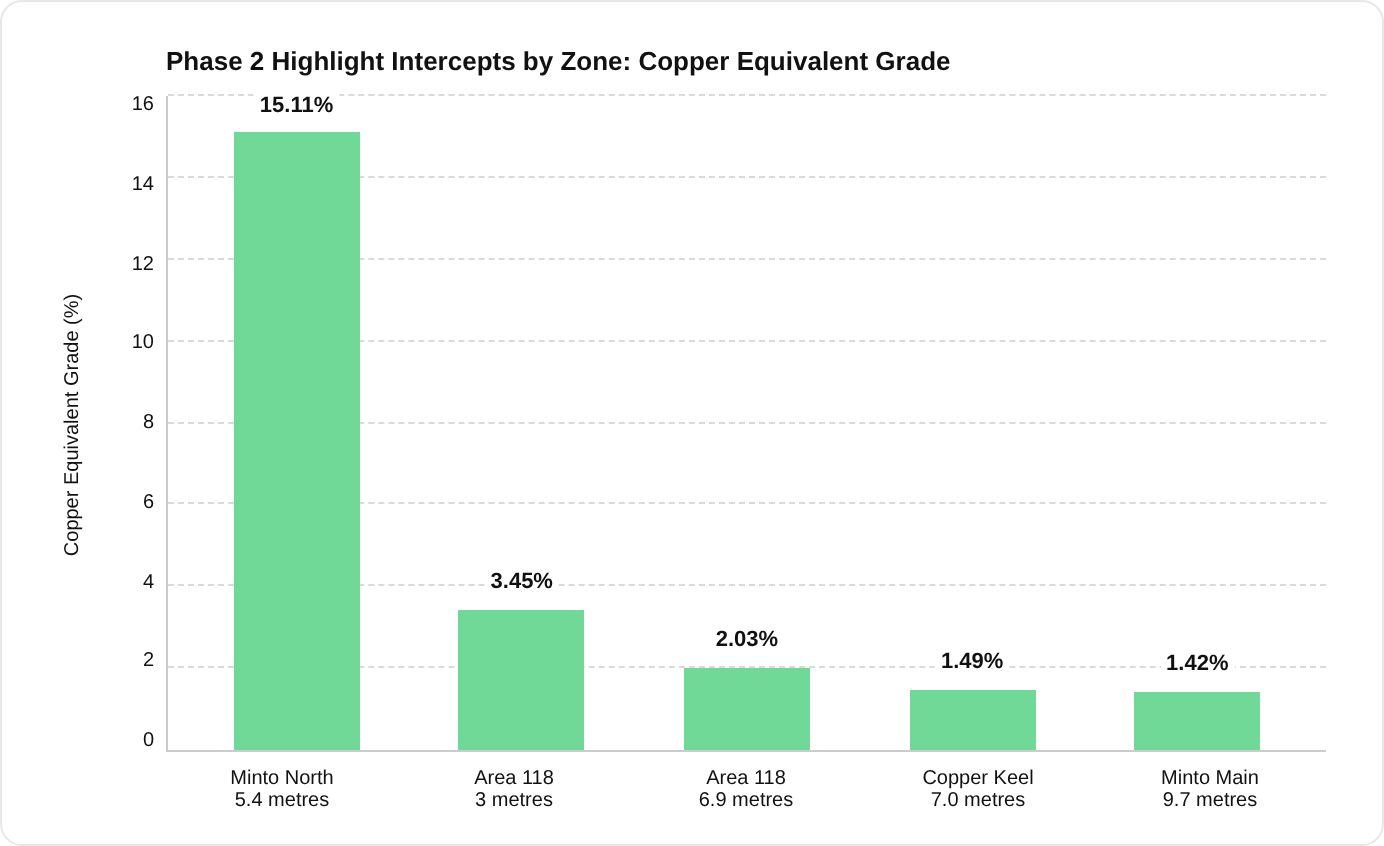
- A step-out hole at Minto North returned 15.11% copper equivalent over 5.4 meters, a grade in the 99th percentile of more than 4,300 historical significant intercepts at Minto.
- Higher-grade and thicker mineralization in the 202 Lens follows a north-northwest trend, and the same pattern is observed at Minto Main, Area 118, and Copper Keel.
- Phase 2 has completed 52,485 meters in 224 holes, 105% of planned meterage, with drilling designed to upgrade resources to Measured & Indicated (M&I) for the Feasibility Study (FS).
- Area 118 intercepts of up to 3.45% copper equivalent sit within 100 meters of the existing underground decline, with mineralization open to the south and southeast.
- Lower-grade results at Copper Keel and Minto Main show that the same infill drilling is narrowing which domains belong in a mine plan.
What Has Happened
Selkirk Copper Mines (TSXV: SCMI | OTCQX: SKRKF | FRA: IO20) reported Phase 2 assay results from the Minto Project in central Yukon on September 29, 2026. The results cover holes drilled in June 2026. The standout was a 35-meter step-out at the southern margin of the 202 Lens at Minto North. It returned 9.27% copper, 7.43 grams per tonne of gold, and 54.9 grams per tonne of silver, or 15.11% copper equivalent, over a depth of 5.4 meters. A second interval in the same hole returned 3.11% copper equivalent over 9.0 meters.
That grade ranks in the 99th percentile of a historical Minto database of more than 4,300 significant intercepts. Individual 1-meter samples within the interval peaked at 17.5% copper, 15.9 grams per tonne of gold, and 81.9 grams per tonne of silver. The host is semi-massive bornite, chalcopyrite, and magnetite within migmatite. Selkirk has completed further drilling south of the hole, and those assays are pending.
The batch covered 4 zones. At Area 118, one infill hole returned 3.45% copper equivalent over 3 meters, and another returned 2.03% copper equivalent over 6.9 meters. A Minto Main hole returned 1.42% copper equivalent over 9.7 meters and 0.94% copper equivalent over 32.1 meters. At Copper Keel, one hole returned 1.49% copper equivalent over 7.0 meters, within a broader interval of 0.94% copper equivalent over 18.0 meters, and another returned 2.29% copper equivalent over 5 meters. True widths are estimated at about 80% to 90% of the reported core lengths.
A North-Northwest Trend in the Grade
The geology behind the Minto North intercept may prove more useful than the headline grade. In the 202 Lens, higher-grade and thicker mineralization is concentrated along a north-northwest trend. A second 35-meter step-out, in the northwestern part of the lens, returned 1.25% copper equivalent over 17.6 meters. That leaves the lens open in that direction, and Selkirk has proposed more drilling there.
The pattern repeats at core scale. Across the deposit, tight to isoclinal folds commonly have north-northwest fold axes, and in some of them chalcopyrite and bornite accumulate in the fold hinge. The same north-northwest trend in higher grade and thickness is observed at Minto Main, Area 118, and Copper Keel. Selkirk's exploration team is testing a hypothesis: that the high-grade Minto North intercept is a larger version of this fold-related control on grade in the 202 Lens. The company has not yet adopted this as its model.
If the hypothesis holds, Selkirk would have a rule for predicting where high grade should repeat across the mine area. Selkirk says it inherited a structural model built mainly around brittle faults in the Copper Keel and Minto East underground areas, with no robust model for Minto North, Area 118, or Ridgetop. Through 2025 and 2026, the company has been building a replacement using oriented core logging, structural mapping, drone photogrammetry and an updated 3D fault model.
Why Infill Drilling Feeds the Feasibility Study
Phase 2 was planned at 50,000 metres. By September 28, 2026, Selkirk had completed 52,485 metres in 224 holes, or 105% of plan, and drilling is scheduled to continue until mid-October. The company cut the program from 4 rigs to 2 in late August. The remaining work covers geotechnical holes, water monitoring wells and newly identified geophysical targets. Selkirk reports higher drilling productivity and a lower average cost per metre than in Phase 1.
Phase 2 combines expansion, exploration and infill drilling with geotechnical data collection for the Feasibility Study (FS), and its infill component is designed to upgrade Indicated & Inferred Resources to Measured & Indicated. The preliminary economic assessment (PEA) mine plan does not include Phase 2 drilling. The FS objectives focus on improving grade. The FS also targets lifting mine and mill throughput from 4,100 tonnes per day to between 4,500 and 4,900 tonnes per day, improving copper recovery by 3% to 4%, and producing about 30,000 tonnes per year of copper equivalent in concentrate, compared with the PEA peak of 27,200 tonnes per year.
President & Chief Executive Officer of Selkirk Copper, M. Colin Joudrie, linked the Phase 2 intercepts directly to the FS mine plan and to metallurgy.
"Results from the Phase 2 drill program, particularly high-grade copper-gold-silver intercepts at Minto North and Area 118, are an integral part of Minto Project restart plan providing the information necessary to inform and refine our upcoming Feasibility-level mine planning and development plans. The material being collected in the Phase 2 drill program, along with upgrading our resource modeling work, will be used for a geometallurgical test program that will increase our confidence in expected copper, gold, and silver recoveries."
Where Drilling Is Narrowing the Mine Plan
Some holes in the batch returned lower grades. At Minto Main, all 4 holes intersected mineralization, but 2 returned below the expected grade. At the infill location, disseminated to foliolithic chalcopyrite and bornite occur in foliated granodiorite with a weaker, more diffuse foliation than elsewhere in the mine area. At Copper Keel, 5 of 9 holes intersected mineralization. Selkirk states that some areas there contain grades that may not warrant inclusion in a mine plan, and it plans more geological modeling to define the economic domains.
These lower-grade results still help the FS. In both zones, infill drilling confirmed the modeled lens geometry, so the FS mine plan can be drawn more precisely. The Minto Main result also matches Selkirk's conceptual exploration model. That model ties lower copper grades to disseminated sulfides and weaker foliation, and higher grades to stronger foliation, migmatite banding, and semi-massive sulfides.
At Area 118, all 5 infill holes intersected mineralization. Another hole returned 1.94% copper equivalent over 9.1 meters in the 114 Lens, within 100 meters of the existing underground decline, and mineralization remains open to the south and southeast.
Director of Geoscience & Exploration Leif Bailey described what the first year of drilling has shown about the property.
"The results of this drill program demonstrate that considerable potential still exists at Minto for discovery and delineation of high-grade copper, gold, and silver mineralization."
Broader Context
Selkirk Copper is advancing a restart plan for the former Minto copper-gold-silver mine. The Selkirk First Nation indirectly holds a controlling equity stake in the company. Selkirk lists C$ 330 million in infrastructure in place, including a 4,100-tonne-per-day processing plant, a 400-person camp, water treatment facilities, and open-pit and underground workings. The PEA outlines a 13-year mine life on C$186 million of initial capital, and restart production is targeted for the second half of 2028.
The June 10, 2026 Mineral Resource Estimate reports Measured & Indicated resources of 940 million pounds of copper, 530,000 ounces of gold and 4.9 million ounces of silver. Those figures are up 182%, 184% and 188% from 2025. In late August 2026, Selkirk marked 1 year of drilling since August 23, 2025: 365 diamond drill holes totaling 98,467 meters. The company describes this as one of the largest single-year drill programs in Yukon history, representing about 45 million Canadian dollars of investment.
Exploration now extends beyond the mine site. From July to September 2026, Selkirk ran a helicopter-supported program across its 26,850-hectare claim package. The district contains numerous Minto-style copper-gold occurrences, many of which have seen no substantial exploration in more than 10 years. Selkirk flew 2 airborne surveys, both using Superconducting Quantum Interference Device sensors: a QMAGT full-tensor magnetic gradiometric survey and a QAMT passive electromagnetic survey. According to the company, the QAMT survey is one of the first applications of that technology to a Canadian mineral exploration project.
What to Watch Next
The next test of the structural hypothesis is the pending assays from drilling south of the high-grade Minto North intercept. If high grade continues along the north-northwest trend, that would support it. Selkirk has also proposed more drilling in the northwestern 202 Lens to test how large the lens could be. Assays currently take about 8 weeks, and Selkirk is targeting releases through fall and winter 2026.
Metallurgy is the second strand. Phase 2 metallurgical testing involves collecting samples from 5 master composites, focusing on areas expected to be mined in the first 5 years of production. Results are targeted for this fall and will feed an updated recovery formula for the 2027 FS. Selkirk is also improving how it models copper oxides, because the ratio of soluble copper to total copper is a main input to its recovery estimates.
Regional interpretation is the third. Selkirk plans to work through the airborne survey results over the winter and generate targets for testing in 2027. The FS objectives set the benchmark for the drilling and metallurgical results: about 30,000 tonnes per year of copper equivalent, a 13-year mine life, and restart capital held at nearly 200 million Canadian dollars.
FAQs (AI-Generated)
Analyst's Notes





Subscribe to Our Channel





Stay Informed


