




Silver’s Supply Shortfall Puts Mine Expansion & Funded Development in Focus



Dollar funding could buy more Mexican silver project work, with savings dependent on local prices, currency exposure, hedges and payment timing.
- September’s weaker peso could reduce the dollars needed to pay unchanged peso-priced mining expenses, cushioning costs for silver businesses with dollar revenue or funding.
- Calculations using Banco de México’s August and September 2026 exchange-rate tables imply approximately 6.0% lower dollar costs for an unchanged peso expense using month-end rates, versus 1.2% using monthly averages.
- Producers could lower the dollar cost of operations, developers of local project work, and explorers of field services where spending is priced in pesos and local prices remain unchanged.
- Dollar-priced equipment, supplier price increases, and contracts that lock in exchange rates can reduce or delay currency savings.
- Spending currencies should be assessed alongside cash available to fund planned work, because peso depreciation alone does not establish company savings or higher margins.
Peso Weakness Could Cushion Silver Mining Costs as Prices Fall
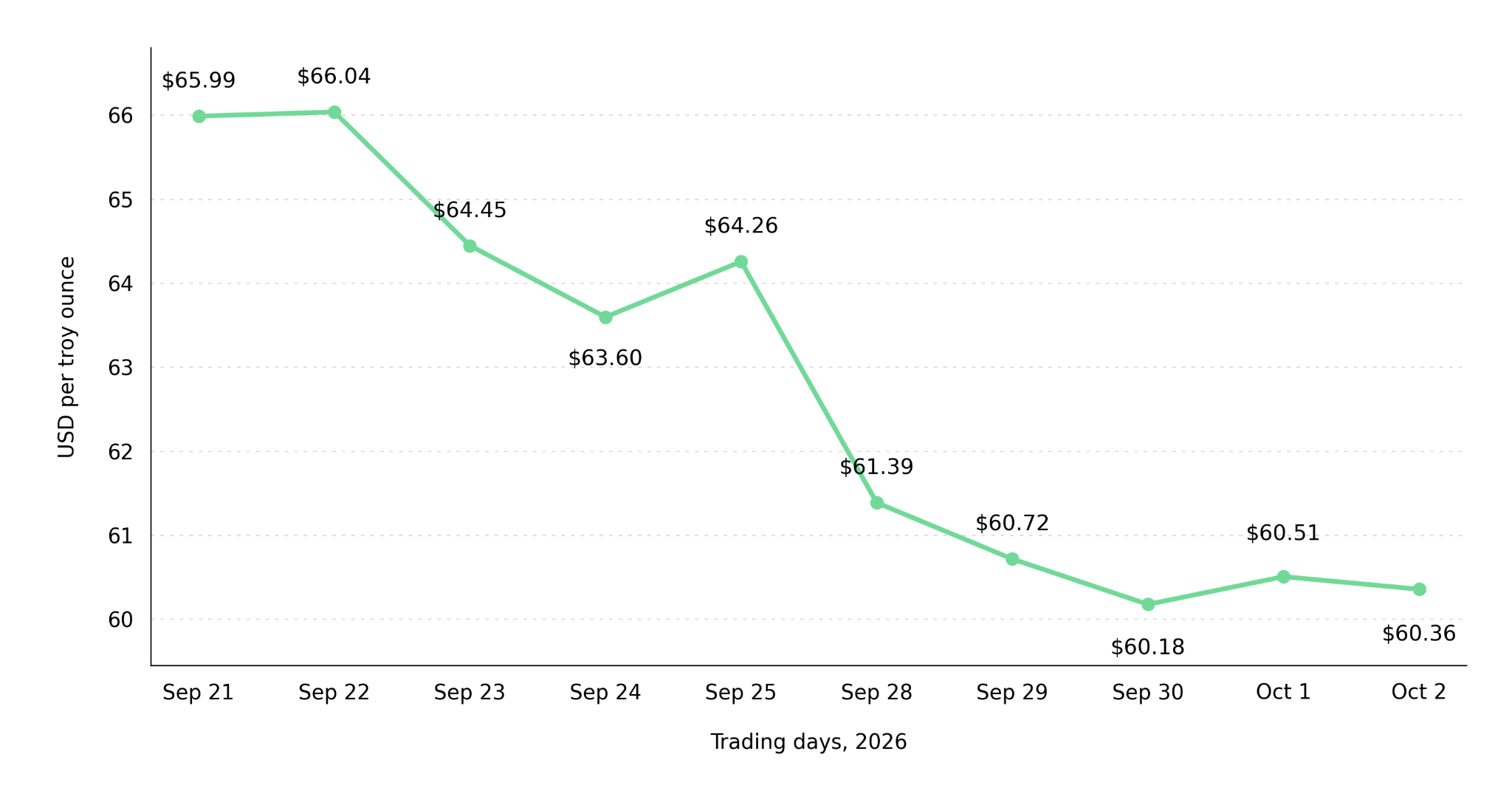
Reuters reported spot silver at US$61.21 per troy ounce in its October 2, 2026 morning update, with the metal heading for a weekly loss as the dollar strengthened. Lower silver prices reduce dollar revenue per payable ounce, while peso depreciation can cushion costs by reducing the dollars needed to pay unchanged peso-priced mining expenses in Mexico.
Banco de México’s month-end exchange rates show how the dollar cost of an unchanged peso expense differs between two dates. Actual company savings depend on the rates used for payments and how much spending is priced in pesos.
Month-End Peso Weakness Could Cut Dollar Costs of Peso Expenses by 6%
Banco de México’s end-of-period exchange-rate table records 16.9971 Mexican pesos (MXN) per US dollar (USD) at August-end 2026 and 18.0808 at September-end 2026. An unchanged peso invoice converted at the September-end rate would require approximately 6.0% fewer dollars, assuming conversion at the quoted rates without a currency hedge.
For an illustrative MXN1 million invoice covering the same goods or services, the USD cost would fall from US$58,833.57 to US$55,307.29, a reduction of US$3,526.28.
Monthly Peso Averages Imply 1.2% Lower USD Costs on Fixed MXN Expenses
Banco de México’s monthly-average exchange-rate table records 17.0632 MXN per USD in August 2026 and 17.2744 in September 2026. Converting an unchanged MXN expense at these average rates implies approximately 1.2% lower USD costs, compared with 6.0% using month-end rates.
Actual savings depend on the amount of MXN-priced spending and the exchange rates used to fund payments, because invoice timing and earlier currency purchases can produce costs that differ from either comparison.
Peso Weakness Could Cut Mining Costs & Increase Budget Purchasing Power
For producers with USD revenue, peso depreciation can reduce the USD cost of unchanged MXN-priced operating expenses. For developers and explorers with USD funding, it can stretch budgets for project work and field services priced in MXN, provided local prices remain unchanged.
At an operating mine, unchanged labor or service expenses priced in MXN could cost less in USD when paid at a weaker peso exchange rate. However, costs per saleable ounce would still rise if output fell by a larger proportion than total spending.
Americas Gold & Silver is scaling EC120, its high-grade silver-copper mine at Cosalá in Sinaloa, supporting its strategy to increase silver production. Its fully permitted Crescent mine in Idaho offers additional growth potential through shared infrastructure and processing, providing another route to expand output.
Peso Weakness Could Increase USD Buying Power for Silver Development
A developer with a fixed USD budget could purchase more MXN-priced services if the peso weakens and local prices remain unchanged. Equipment and contracts priced in USD receive no direct benefit from peso depreciation, limiting the additional purchasing power to MXN-priced spending.
Vizsla Silver appointed Luis Lázaro as President, Mexico on August 5, adding 30 years of leadership and operational experience to Panuco’s development team. His oversight of local operations, permitting, and stakeholder relationships strengthens the company’s capacity to advance the project toward potential construction and production.
Peso Weakness Could Increase USD Buying Power for Silver Exploration
An explorer funded in USD could purchase more MXN-priced field services if the peso weakens against USD and local prices remain unchanged. When funding is held in Canadian dollars, the budget benefit instead depends on that currency’s exchange rate against MXN.
GR Silver Mining granted executive performance awards on September 9 that vest after one year, subject to achieving defined short-term targets. The grants link part of executive compensation to performance as the company pursues silver-gold resource expansion at its 100%-owned Plomosas Project in Sinaloa.
Eric Zaunscherb, President and Chief Executive Officer, discusses industrial uses supporting his positive silver outlook:
“With regard to the industrial uses, we continue to see growth in silver consumption in photovoltaics, solar cells, and in EVs.”
USD Pricing & Local Price Increases Can Limit Savings from Peso Weakness
USD-priced purchases limit the share of spending that benefits from peso depreciation. Higher MXN prices can reduce or eliminate the USD savings on local expenses.
Equipment and contracts priced in USD receive no direct savings from peso depreciation. MXN invoices linked to a USD benchmark can also limit the benefit, requiring separate assumptions for fixed MXN expenses and USD-linked costs.
In an illustrative budget, assume fixed, unhedged MXN expenses account for 50% of its initial USD value. A 6.0% reduction in that portion would lower total USD costs by approximately 3.0%, assuming all remaining costs stay unchanged.
Wage Increases & Hedging Can Limit Savings from Peso Weakness
Higher MXN wages or contractor charges can reduce or eliminate the USD savings from peso depreciation by raising the local cost of the same work.
Buying MXN in advance or locking in an exchange rate through a hedge can delay or prevent savings from subsequent peso depreciation. Calculations of cash savings must therefore use actual conversion dates and effective exchange rates, including any hedges, rather than month-end rates alone.
Peso Weakness Could Improve Silver Margins & Reduce Project Funding Needs
For an operating mine, currency savings must be compared with changes in realized silver revenue to determine their net effect on operating cash flow. For developers and explorers, revised USD costs must be compared with available funding to establish how much planned work can be financed.
Lower Silver Prices Can Reduce Margins Despite Peso Savings
A lower realized silver price reduces revenue per payable ounce, while peso depreciation can reduce the USD cost of unchanged MXN-priced expenses. The margin per ounce still falls if the USD revenue loss per ounce exceeds the cost saving per ounce, assuming unchanged volumes, other costs, and sales terms.
The August-to-September exchange-rate comparison and Reuters’ October 2, 2026 morning silver quote cover different periods, so combining them cannot establish a net change in operating margins. That calculation requires realized revenue and actual operating costs measured over matching periods.
Peso Scenarios Test Silver Project Values & Fieldwork Buying Power
Project valuations need to be recalculated from revised cash flows that incorporate the affected MXN-priced expenses, spending dates, and taxes; applying an exchange-rate change directly to a published valuation would misstate the benefit.
Compare weaker, unchanged, and recovering peso scenarios while holding other assumptions constant and separating fixed MXN expenses from USD-linked costs. For explorers, compare how much planned fieldwork available funding can purchase under each exchange-rate scenario.
Sustained Peso Weakness Could Preserve USD Budget Buying Power
A USD-funded budget can cover more MXN-priced work if the exchange rate at conversion buys more MXN than the budget assumed and local prices remain unchanged.
USD/MXN at or above Banco de México’s September-end 2026 closing rate of 18.0808 in the coming trading week would preserve or increase purchasing power for unhedged USD-funded spending, assuming unchanged MXN prices. A lower rate would reduce purchasing power relative to that benchmark.
The Investment Thesis for Silver
- Producers with USD revenue, stable output, and unchanged, unhedged MXN expenses could use currency savings to cushion cash flow when silver prices fall.
- Developers with USD funding could reduce the cost of fixed MXN-priced project work. Financing and permitting schedules determine when those savings can support planned construction.
- Explorers with USD funding could purchase more field services within the same budget if MXN prices remain unchanged and the peso weakens.
- Disclosed spending amounts, pricing currencies, hedge rates, and payment dates allow currency savings to be estimated from exposed expenses rather than the total budget.
- A stronger-peso scenario can show whether available funding would still cover committed work if the currency advantage reverses.
A weaker peso can cushion producers’ USD operating costs and stretch development and exploration budgets when spending is fixed in MXN and funded in USD. The size of the benefit depends on spending amounts, actual conversion rates, hedges, and payment dates. Compare those potential savings with changes in silver revenue and test whether available funding covers committed work if the peso strengthens.
TL;DR
September’s weaker peso could lower the dollar cost of unchanged, unhedged peso-priced expenses for silver businesses with dollar revenue or funding. Banco de México’s August and September 2026 exchange-rate tables imply a 6.0% reduction using month-end figures, versus 1.2% using monthly averages. These are illustrative calculations, not reported company savings. Producers could cushion operating costs, while developers and explorers could purchase more local services within existing budgets. Dollar-priced equipment, local price increases, hedges and payment timing can limit the benefit. Lower silver revenue can still outweigh cost savings, so company spending disclosures and matching reporting periods are essential to assess the net effect.
FAQs (AI-Generated)
Analyst's Notes





Subscribe to Our Channel





%20(1)%20(1).jpg)


Stay Informed






