




Sovereign Puts Kasiya's US$727M Build Under Kwale Mine-Builder Tim Carstens


Sovereign Metals names Kwale builder Tim Carstens Executive Chair to take Kasiya's US$727M build toward a 2027 final investment decision.
- Sovereign Metals has appointed Tim Carstens, who led Base Resources through the financing, construction and operation of Kenya's Kwale mineral sands mine, as Executive Chair to take Kasiya through development, financing and construction.
- Carstens' equity package comprises 2,000,000 performance rights tied to a "Financing and Construction Milestone" expiring by June 30, 2028, and 3,000,000 options exercisable at A$0.60.
- Chair Ben Stoikovich and founding director Mark Pearce are retiring from the board in November 2026, removing 2 directors who oversaw Kasiya's study phase.
- With Rio Tinto no longer involved in the project, an owner's team with more than 200 years of combined experience and more than 10 projects taken from feasibility to construction or operation is running Kasiya.
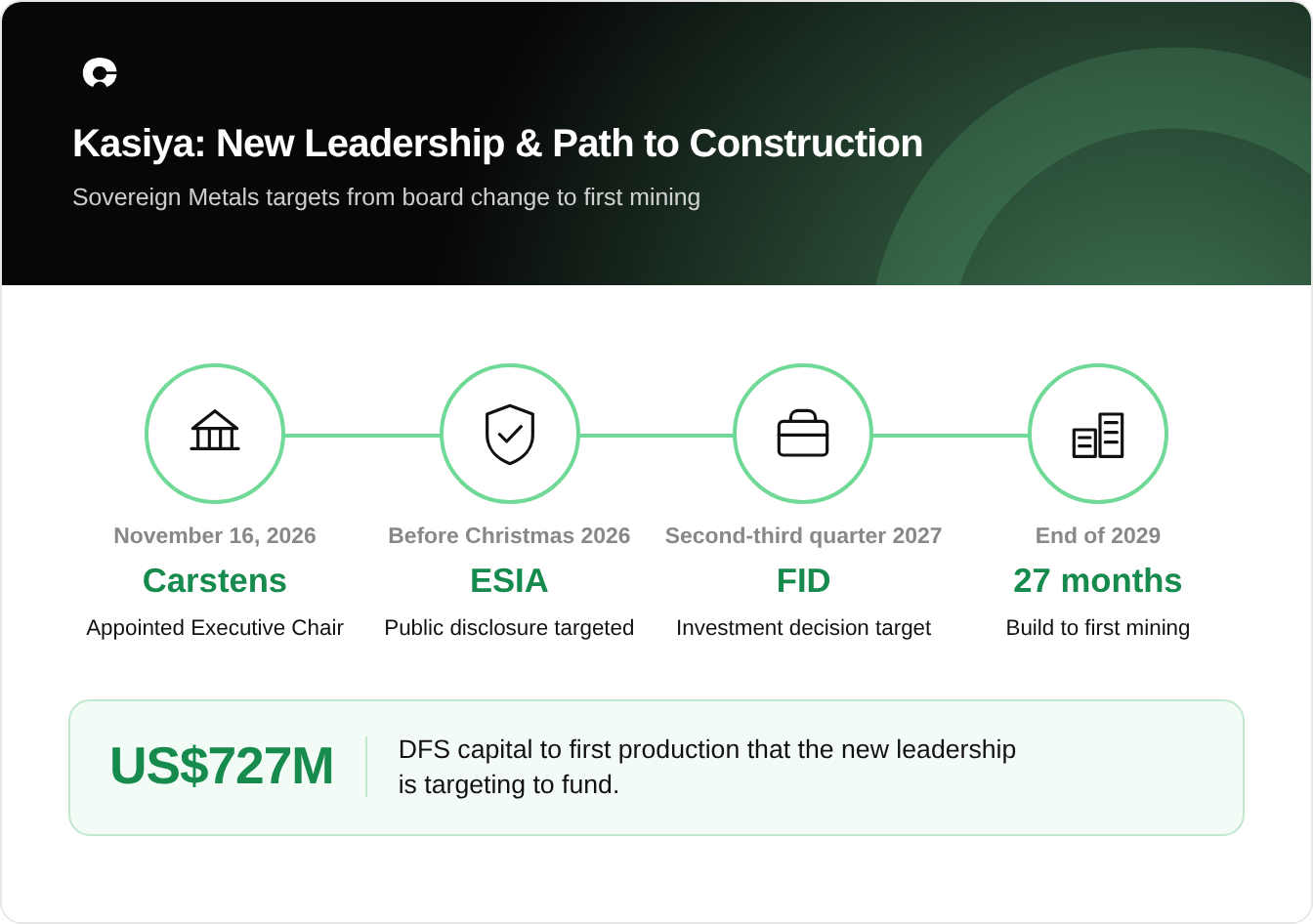
- Sovereign is targeting a final investment decision (FID) in the second or third quarter of 2027, followed by a 27-month build of a project with a pre-tax net present value (NPV8%) of US$2.2 billion.
A Mine-Builder Takes the Chair at Kasiya
Sovereign Metals (ASX: SVM | AIM: SVML | OTCQX: SVMLF) appointed Tim Carstens as Executive Chair on November 16, 2026, with a mandate to lead the Kasiya Critical Minerals Project in Malawi through development, financing and construction. The appointment follows completion of the Kasiya Definitive Feasibility Study (DFS) in April 2026, which outlines a 25-year initial mine life producing 222,000 tonnes per year of rutile and 275,000 tonnes per year of graphite at steady state.
The DFS reports a pre-tax net present value (NPV8%) of US$2.2 billion, a pre-tax internal rate of return (IRR) of 23%, and US$727 million in capital to first production. Sovereign's market capitalization was approximately US$210 million on October 13, 2026, and the company held A$25 million in cash with no debt at June 30, 2026. The remaining steps between the DFS and production are permits, binding offtake, and project finance, each of which is an execution task for management.
The new structure has 3 parts. Carstens' incentives are tied to financing and construction, the board that oversaw Kasiya through its study stages is turning over, and an owner's team is now responsible for the project without Rio Tinto's technical involvement.
Carstens' Record: Kwale, Toliara & a US Sale
Carstens has more than 25 years of experience in senior resources roles in Australia and internationally, including with Perilya, North Limited, Robe River Iron Associates, Iron Ore Company of Canada and St Barbara Mines. His most recent role was Managing Director of Base Resources, an ASX- and AIM-listed titanium feedstock producer, from its inception in 2008 until its acquisition by US critical minerals company Energy Fuels in October 2024.
At Base Resources, Carstens led the financing, construction and operation of the Kwale Mineral Sands Mine, Kenya's first large-scale commercial mine, and the acquisition and advancement of the Toliara Mineral Sands and Rare Earths Project in Madagascar. Kwale is the direct evidence: an African mineral sands mine that Carstens took from financing through construction into operation. Toliara is relevant development experience with a rutile and rare earths product mix similar to Kasiya's, but it has not been built; Sovereign's own peer comparison lists it, now an Energy Fuels project, at the DFS stage with 1.1 million tonnes of contained rutile, against 26.3 million tonnes at Kasiya.
The sale of Base Resources to a US critical minerals company and Carstens' US relationships across industry, government and capital markets are commercial credentials, not construction ones. Their value to Sovereign lies in customer and financing discussions tied to its US-focused strategy. The company already holds a non-binding graphite memorandum of understanding (MOU) with Traxys linked to Project Vault, a US critical mineral stockpile initiative, and its executives hold meetings on Capitol Hill, at the Pentagon and at the White House on titanium supply.
Pay Linked to Financing & Construction
Carstens will receive an annual director's fee of A$125,000 and A$175,000 per year under a consulting services arrangement, for total fixed remuneration of A$300,000. He held no ordinary shares in Sovereign as at November 16, 2026.
His equity incentives sit under the company's shareholder-approved long-term incentive plan. They comprise 2,000,000 performance rights subject to a Financing and Construction Milestone, expiring on or before June 30, 2028, and 3,000,000 incentive options exercisable at A$0.60 each on or before November 16, 2031.
The rights depend on a financing and construction outcome with a mid-2028 expiry, and the options are struck above the A$0.46 share price recorded on October 13, 2026. Board and management together hold approximately 11% of the 656 million shares on issue, while Rio Tinto holds approximately 18%.
Board Renewal for the Build Phase
Ben Stoikovich will step down as Chair and retire from the board effective November 19, 2026, to focus on his role as Chief Executive Officer of GreenX Metals. He joined the board in October 2020 and became Chair in December 2021, following the company's admission to AIM, and oversaw Kasiya through its Scoping Study, Pre-Feasibility Study (PFS) and the April 2026 DFS. He will continue to provide consulting services to Sovereign.
Mark Pearce, a founding director since July 2006, retires as a Non-Executive Director at the close of the Annual General Meeting on November 18, 2026. Pearce guided Sovereign's expansion into Malawi in 2012 and also steps down as Chair of the Audit Committee, with Ian Middlemas taking over.
Frank Eagar remains Managing Director and Chief Executive Officer. The board change replaces a study-phase chair with an executive chair whose career includes taking an African titanium feedstock mine from financing to operation, while Stoikovich's consulting role keeps access to the person who chaired the board through the DFS.
An Owner's Team Without Rio Tinto
Rio Tinto's exit changes who develops Kasiya, not who owns part of it. Under a new Chief Executive Officer, Rio Tinto has focused on copper, aluminum, iron ore and lithium, put titanium under strategic review and stated in its recent quarterly that Kasiya is no longer considered one of its own projects, and its project-level technical involvement has ended. It retains its approximately 18% stake, Sovereign does not expect it to sell those shares on market, and some former Rio Tinto project staff have moved into Sovereign's own team.
Chief Commercial Officer of Sovereign Metals, Sapan Ghai, described how the project team was rebuilt after the partnership:
"We worked hand in glove with the Rio Tinto team. In fact, some of that team now is embedded within our own company, specifically on the environmental and social side. But we do have an owner's team, and we do have individuals within that team, from our COO Rob Slater all the way down, who have built and operated tier-one deposits in Africa. They've at least built and operated 10 mining projects over the last 20 years, and they are, for lack of a better phrase, chomping at the bit to get going on this one too."
Sovereign credits the team with more than 200 years of mine feasibility, financing, construction and operating experience, more than 10 mining projects taken from feasibility to construction or operation, and a track record of financing mine developments through debt, offtake, strategic investment and equity. Those credentials were built at other companies and projects. Sovereign itself has not yet built a mine, so the open question is whether this team can coordinate engineering, procurement, financing and construction at Kasiya's scale. In Malawi, Country Manager Maxwell Kazako presides over the Malawi Chamber of Mines and Energy, and the company has worked with the Ministry of Mines on its revised mining framework.
The environmental and social team includes former Rio Tinto and First Quantum staff, and the International Finance Corporation (IFC) has embedded itself in the project under a Collaboration Agreement to make the DFS and the environmental and social impact assessment (ESIA) bankable to World Bank standards. Sovereign identifies environmental and social risk, more than infrastructure, as the main concern for development finance institutions and export credit agencies.
A Simple Flowsheet, a Large Build
Kasiya's design removes several conventional components from an owner-led build. Mining is dry, using draglines and 100-tonne dump trucks, with no drilling, blasting, crushing or grinding and an average pit depth of 14 meters. The 2024 pilot mining program confirmed that the fleet, using civil engineering equipment, and gravity separation recovers 97.6% of rutile with no chemical processes in the primary circuit. Tailings return to mined-out pits, with no tailings dam.
The supporting infrastructure is largely in place. A 6-kilometer rail spur connects the plant to the operating Nacala corridor and a deep-water port, at a product transport cost of US$117 per tonne. Phase 1 requires 30 megawatts from a national grid supplying 560 megawatts, and Phase 2 requires 60 megawatts from year 5, when a 375-megawatt hydropower project targeted for 2030 is due to add capacity.
The simpler flowsheet reduces engineering complexity, and the rail link reduces greenfield infrastructure, but neither changes the size of the build. Throughput is 12 million tonnes per year in years 1 to 4, rising to 24 million tonnes per year from year 5 with a second 12 million tonne per year plant, and the DFS puts total life-of-mine (LOM) development capital at US$1,239 million against US$727 million to first production, so construction continues after first output.
Ghai addressed whether the DFS is too large for Sovereign to build without Rio Tinto as operator:
"No, we think that it is actually the right size for what the market is going to require by 2029, both in terms of rutile and graphite. We are having those discussions with our future customers, and in both rutile and graphite they will require very much those volumes that we are looking to produce out of Sovereign."
What the New Leadership Has to Deliver Before a 2027 Funding Decision
Carstens has named permitting, financing, commercial arrangements and organization building as his priorities. Carstens described that focus on joining Sovereign:
"With the DFS now complete, our focus will be on advancing the key permitting, financing and commercial arrangements as well as building the organisation required to move the Project towards construction. I look forward to working with Frank, the Board and the wider Sovereign team to deliver the next stage of Kasiya's development and create long-term value for shareholders and our stakeholders in Malawi."
On permits, Sovereign expects the ESIA assessment to be completed, followed by public disclosure before Christmas 2026. Malawi's Ministry of Mines is reorganizing its mining framework with World Bank support; industry submissions closed on October 10, 2026, and mining license grants follow once the framework is finalized. On offtake, rutile is covered by a non-binding MOU with Mitsui, graphite by a non-binding MOU with Traxys, and the rare earth concentrate is uncommitted, with testwork underway with Western refiners. Sovereign's aim is binding offtake that lenders can count in debt sizing.
Sovereign is working on a 60/40 debt-to-equity split as its base case for roughly US$750 million of capital, with the IFC holding financing rights on both debt and equity. The company is targeting a final investment decision (FID) in the second or third quarter of 2027, followed by a 27-month build, which would put first mining toward the end of 2029 if each step lands on schedule.
Risks the New Leadership Inherits
Funding is the largest gap. Sovereign held A$25 million in cash at June 30, 2026, and Kasiya requires US$727 million of capital to first production. The company's 60/40 working assumption on roughly US$750 million implies about US$300 million of equity financing, while Sovereign's market capitalization was approximately US$210 million. The source and structure of that equity are unresolved: Sovereign identifies offtake prepayments and project-level or corporate equity linked to its rare earth concentrate as possible routes alongside a market raise, and the company does not plan a large equity request before permits, debt and binding offtake are in place.
Permitting timing is not fixed. Sovereign has not given a timeline for outstanding permits because Malawi's revised mining framework must be finalized before mining licenses are granted. The rare earth circuit, which adds approximately US$722 million to pre-tax NPV8% for approximately US$29 million of capital, is based on a Scoping Study with ±30% accuracy and is not supported by Ore Reserves.
The leadership transition also concentrates change in a short period. Stoikovich and Pearce leave the board in the same week the Executive Chair joins, and Carstens holds no shares at appointment. Consulting roles for Stoikovich, an unchanged executive team under Eagar and Ghai, and Rio Tinto's retained shareholding of approximately 18% provide continuity through the handover.
The Investment Thesis for Sovereign Metals
- Sovereign Metals has appointed Tim Carstens as Executive Chair, who led Base Resources through the financing, construction and operation of the Kwale Mineral Sands Mine in Kenya and advanced the Toliara Mineral Sands and Rare Earths Project in Madagascar.
- Carstens' long-term equity is tied to delivery, with 2,000,000 performance rights subject to a financing and construction milestone and 3,000,000 options exercisable at A$0.60.
- An owner's team with more than 200 years of combined experience and more than 10 projects taken from feasibility to construction or operation is running Kasiya now that Rio Tinto is no longer involved.
- The Definitive Feasibility Study outlines a pre-tax net present value at an 8% discount rate of US$2.2 billion and a pre-tax internal rate of return of 23% for US$727 million of capital to first production.
- Kasiya's dry mining approach, gravity separation flowsheet and a 6-kilometer spur to an existing rail corridor remove several conventional mining and infrastructure components, although a second processing plant in year 5 means construction continues after first production.
- Sovereign is targeting a final investment decision in the second or third quarter of 2027, subject to permits, binding offtake and project debt.
Sovereign's leadership changes align the board and incentives with financing and construction. The test for the new Executive Chair and the owner's team is converting non-binding offtake into contracts, securing a mining license under Malawi's revised framework and arranging project debt ahead of a 2027 FID.
TL;DR
Sovereign has made Tim Carstens, who built Kenya's Kwale mineral sands mine, Executive Chair to lead Kasiya through financing and construction, with its owner's team now developing the project without Rio Tinto's technical involvement. The project's design is simple, but its scale is not, and funding the equity share of the build remains the largest open question ahead of an FID targeted for the second or third quarter of 2027.
FAQs (AI-Generated)
Analyst's Notes





Subscribe to Our Channel




Stay Informed


