



Sovereign's Kasiya Targets 3 US Import Gaps; Binding Offtake Is the Next Test


Sovereign Metals is targeting US rutile, graphite and rare earth supply gaps at Kasiya, with Mitsui and Traxys agreements still non-binding.
- Sovereign Metals is marketing Kasiya's rutile, natural graphite and heavy rare earth concentrate as non-Chinese feedstock for 3 downstream US markets with 100% import reliance: titanium sponge, natural graphite and heavy rare earths.
- None of the 3 product routes is under binding contract, and converting them into contracted demand is the next commercial test.
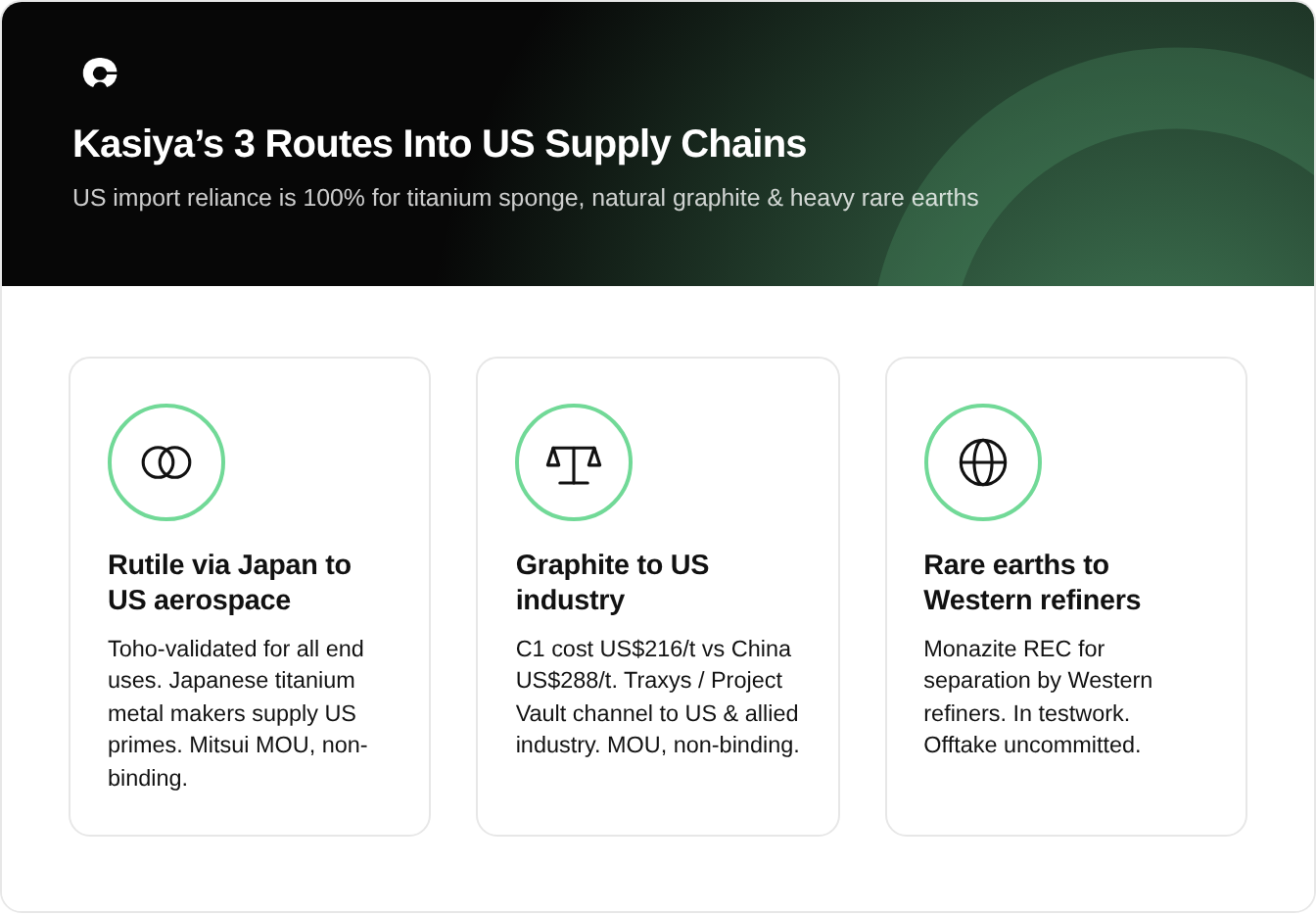
- Rutile has the most advanced route: Toho has validated it for all end uses; most is expected to reach US aerospace and defense primes as Japanese titanium metal, and Mitsui holds a non-binding agreement.
- Kasiya graphite, 70% industrial grade, has a C1 cash cost of US$216 per tonne against a Chinese weighted average of US$288 per tonne, with a non-binding Traxys North America channel linked to Project Vault.
- A monazite concentrate holding 5 of the 7 rare earths under Chinese export controls could supply about 35% of current annual US yttrium demand, but it is at scoping level, uncommitted and still in testwork with Western refiners.
What Has Happened
Sovereign Metals (ASX: SVM | AIM: SVML | OTCQX: SVMLF) confirmed in its September 2026 quarterly report, released October 30, 2026, that it is prioritizing a US-focused critical minerals strategy for the Kasiya project in Malawi. The company is marketing Kasiya as a non-Chinese source of 3 products: rutile, the cleanest and highest-grade titanium mineral; natural flake graphite; and a monazite rare earth concentrate (REC) weighted toward heavy rare earths. None of the 3 is yet under a binding contract.
The shift follows direct US Government engagement. Sovereign's Chief Commercial Officer, Sapan Ghai, said the US State Department and other agencies approached the company roughly 9 months before October 2026 to work out how Kasiya's output could be processed into products for US aerospace, defense and industrial use. Sovereign now takes part in US legislative and executive discussions on critical mineral supply chains, including Project Vault.
Technical work is further advanced for rutile and graphite than for rare earths. An April 2026 Definitive Feasibility Study (DFS) covers the first 2 products and reports a pre-tax net present value at an 8% discount rate (NPV8%) of US2.2billiononUS727 million of capital to first production. The REC circuit rests on a September 2026 Scoping Study accurate to plus or minus 30%. Sovereign's open task is commercial: moving from product qualification to binding contracts with buyers in the US and allied markets.
Why the US Starts From Zero in All 3 Downstream Markets
The US Geological Survey's Mineral Commodity Summaries 2026 lists US import reliance at 100% for titanium sponge, natural graphite and heavy rare earths. Kasiya will not produce those finished materials directly. It produces the feedstock: rutile for titanium metal makers, flake graphite for industrial users and anode processors, and monazite concentrate for rare earth separation. The US import gaps are downstream markets that Kasiya could help supply through established processing chains.
Each gap has a different shape. Titanium sponge, the metal used in airframes and in naval and aerospace systems for US defense and aerospace primes, is produced by Japan, and Japan needs unencumbered feedstock to keep that supply running. China accounts for about 77% of flake graphite production and about 100% of anode processing and has applied export controls to graphite. The US has no commercial-scale production of dysprosium, terbium or yttrium; overall US rare earth import reliance is about 67%, and China continues to restrict rare earth supply through export controls.
The entry points differ as a result. Rutile reaches the US one step removed, as titanium metal made in Japan. Graphite can be sold to industrial users and processors in the US or allied countries, and the REC must pass through a refiner that separates it into individual rare earth oxides.
Rutile: A Route Through Japan's Titanium Industry
Kasiya contains 26.3 million tonnes of rutile, the world's largest natural rutile resource and the first major rutile discovery since the 1970s. The DFS outlines steady-state production of 222,000 tonnes per year at more than 95% titanium dioxide. Toho has validated the rutile for all end uses, and the company reports the product has also been verified as a premium welding material.
Ghai explained why Japan, not a new titanium metal producer, is the expected destination:
"We know that most, if not all, of our rutile will end up in Japan to produce titanium metal because it meets all the requirements of that chemistry set and that titanium industry that's been around for 30, 40 years. I wouldn't want to be starting a titanium metal division today, because those things don't get validated for the best part of 20 years."
Toho's qualification puts Kasiya rutile inside an established airframe supply chain without waiting on a new metal producer to be certified. Sovereign equates its rutile to about 55,000 F-35-class airframes at about 92 tonnes of rutile per airframe, a material-equivalent comparison, not a measure of F-35 demand or contracted supply. Rutile offtake is covered by a non-binding memorandum of understanding (MOU) with Mitsui & Co.
Graphite: Industrial Grade First, at a Cost Below China
Kasiya holds 37.3 million tonnes of contained graphite, the world's second-largest flake graphite resource, with planned steady-state output of 275,000 tonnes per year at 96% total graphitic carbon. The DFS gives a C1 cash cost of US$216 per tonne, against US$288 per tonne for the weighted average of active Chinese producers, both on a C1 free-on-board basis, with the Chinese figure from Benchmark Resource Intelligence 2025 data.
Production cost is one test and market access is another. The larger market for Kasiya graphite is industrial, not battery anodes, and Ghai described where most of it is headed:
"70% of our graphite is what's called refractory grade or industrial grade graphite that ends up lining the insides of your electric arc furnaces for smelting copper, steel, aluminum. So as long as we're doing that and we're processing and we're refining in the US and US allied nations, they'll need that graphite, and we can provide that. Currently it all comes from China."
The US channel for that material is a non-binding MOU with Traxys North America, linked to Project Vault, with further US and US-allied offtake discussions underway. Ghai said Project Vault, under which Traxys is one of a handful of traders tasked by the US Government with securing critical mineral supply, is backstopped by the US Export-Import Bank with about US$12 billion.
Heavy Rare Earths: The Uncommitted Third Route
The Scoping Study outlines about 2,626 tonnes per year of REC at about 57% total rare earth oxides over a 23-year life. The basket includes dysprosium, terbium, yttrium, samarium and gadolinium, 5 of the 7 rare earths under Chinese export controls since April 2025, with about 193 tonnes per year of contained yttrium oxide.
The base case adds a pre-tax NPV8% of about US$722 million and an internal rate of return (IRR) of about 151% for about US$29 million of capital, at an all-in cost of about US$3.68 per kilogram of REC landed in Texas. Those figures are scoping-level, the circuit is not supported by Ore Reserves, and no offtake is committed. At US Government floor prices the circuit still returns a pre-tax NPV8% of about US$183 million and an IRR of about 43%, although Kasiya is not party to any floor arrangement.
Yttrium is the clearest link to US defense demand. Ghai described its main use:
"That yttrium mainly goes into jet engine coatings. The last thing you want on your fighter jet is, when you put the afterburners on, for it to melt the entire plane."
Sovereign estimates the REC could supply about 35% of current annual US yttrium demand, and ex-China prices are at record highs, with terbium at US$7,500 per kilogram and dysprosium at US$3,250 per kilogram on S&P Global Platts North American assessments of September 30, 2026. The value of that basket depends on a refiner accepting the concentrate as feed and contracting to buy it. Samples are in testwork with Western refiners, and that qualification is the commercial bottleneck for the third route.
Where Each Route Stands Commercially
The 3 products sit at 3 different stages. Rutile has full product qualification and a named counterparty in Mitsui. Graphite has a cost advantage and a named US marketing channel tied to a US Government program. The REC is at customer qualification, with study-level economics and no buyer. None of the 3 is under binding contract.
Sovereign's stated path to financing follows the same order. Customer qualification establishes that a product is technically acceptable; binding offtake turns that into contracted demand; and binding offtake is, in the company's words, revenue lenders can count in debt sizing, which supports progression to DFS integration and a Final Investment Decision. The company adds that scarce ex-China heavy rare earth feed could attract prepayments or project-level or corporate equity, while describing those funding outcomes as illustrative and not assured.
On that sequence, rutile is closest to bankable revenue and the REC is furthest from it. Sovereign is working with the International Finance Corporation on development financing.
Broader Context & What to Watch Next
The physical route to export is largely in place. A heavy-haul rail line to the deep-water Port of Nacala is operational today, and Kasiya needs a 6 km spur to connect to it, with a DFS product transport cost of US$117 per tonne. The Sena line to Beira offers a secondary port route. A Japan-led US$7 billion Nacala corridor upgrade is under way.
Permitting and fiscal terms remain open. The large-scale mining license application is pending. Under the Mines and Minerals Act 2023 the government has a participation entitlement of up to 15% in large-scale licenses.
The markers to track are the conversion of the Mitsui rutile MOU and the Traxys graphite MOU into binding contracts, the first REC qualification results and offtake with Western refiners, the mining license and fiscal terms, and a Pre-Feasibility Study incorporating rare earths, targeted for 2027. Sovereign ended September 2026 with A$20.681 million in cash, which it estimates provides 5 quarters of funding at the current spending rate.
FAQs (AI-Generated)
Analyst's Notes


Subscribe to Our Channel




Stay Informed


