




Grid Storage Expands Lithium & Graphite Demand Beyond Electric Cars


Grid storage expands lithium and graphite demand beyond electric cars, with costs, battery chemistry, and delivery timing shaping future mineral sales.
- Lithium-ion grid batteries store electricity for later use, creating demand for lithium and graphite beyond vehicle manufacturing.
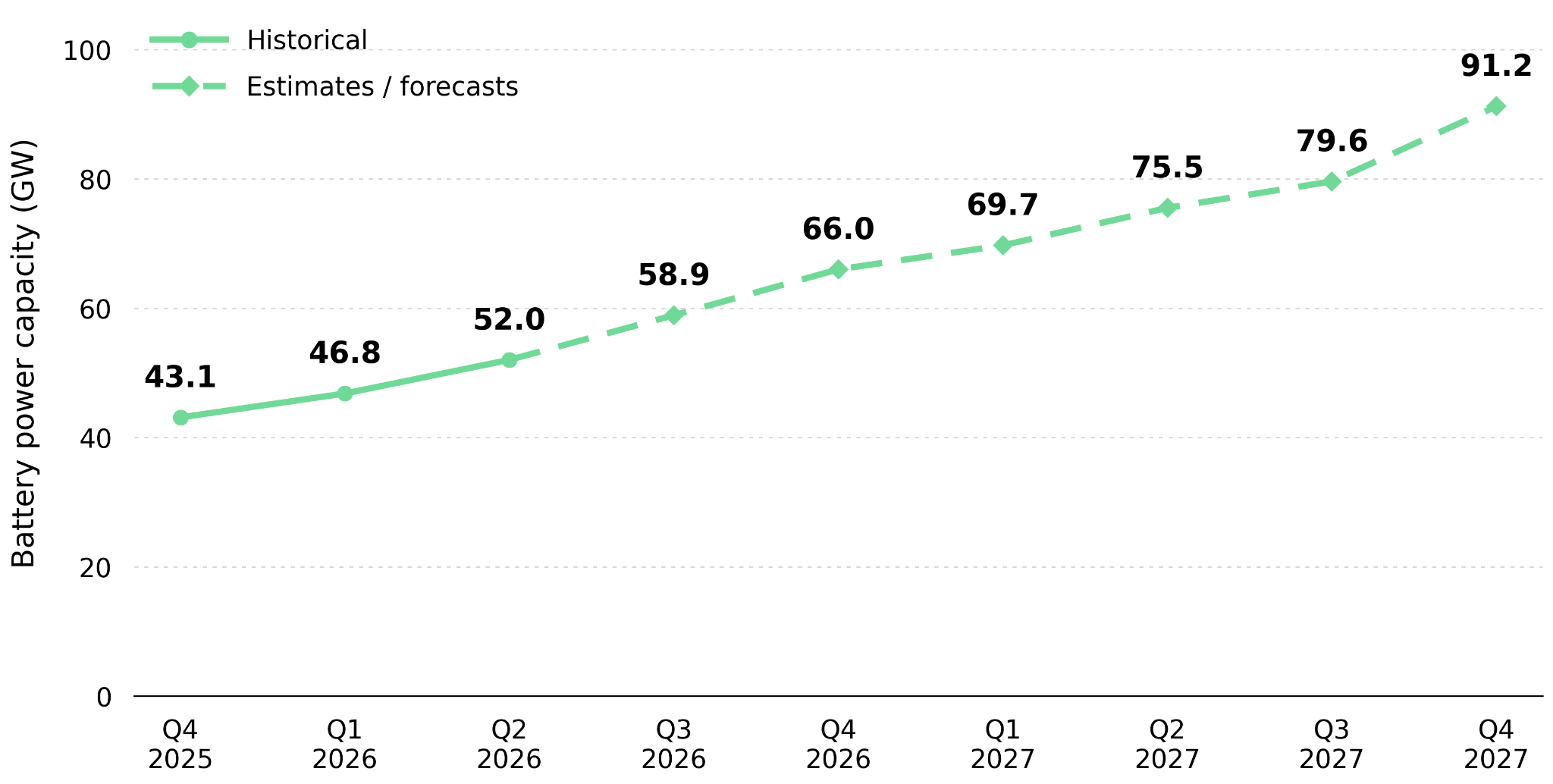
- The US Energy Information Administration (EIA), in its October 2026 outlook, forecasts electric-power-sector battery capacity rising from 43.1 gigawatts (GW) at end-2025 to 91.2 GW at end-2027, expanding the potential market for battery materials.
- Longer storage duration requires more energy capacity at the same power rating, while battery chemistry determines which minerals those installations require.
- Competitive operating costs and disciplined construction spending can support project margins and limit financing needs, while processing access helps prospective suppliers deliver products that meet customer requirements.
- Grid-connection schedules influence when battery purchases occur, while alternative chemistries can change lithium and graphite requirements, making both factors important when assessing future mineral sales.
Grid Flexibility Needs Expand Lithium, Graphite Demand
Grid batteries can store daytime solar generation and discharge it during higher-priced hours, increasing the potential sales value of that electricity. Building these lithium-ion systems creates demand for lithium and graphite, linking mineral purchases to electricity infrastructure spending alongside electric vehicle (EV) manufacturing.
Storage Growth Expands the Market for Battery Materials
EIA’s October 2026 Short-Term Energy Outlook (STEO) puts US electric-power-sector battery capacity at 43.1 GW at end-2025 and forecasts 66.0 GW at end-2026 and 91.2 GW at end-2027. That would add 48.1 GW over two years, more than doubling the installed base and expanding the potential market for battery materials.
The International Energy Agency (IEA), in its Global Energy Review 2026, estimates that 108 GW of new battery-storage capacity was installed worldwide in 2025, 40% more than in 2024. Around 80% of those additions were large projects serving electricity grids, with the remainder installed by businesses and households.
Battery manufacturers may order materials before storage projects enter service, so commissioning dates do not identify when mineral purchases occur. Storage duration and chemistry determine material requirements, while inventories, manufacturing schedules, and project delays influence the timing of new orders.
Longer Storage Duration Raises Potential Material Requirements
Power capacity measures the rate at which a battery supplies electricity, while energy capacity measures how much electricity it stores. At the same power rating, longer discharge duration requires more cells and mineral inputs when battery chemistry and design are comparable.
Lawrence Berkeley National Laboratory (LBNL), in its September 2026 Hybrid Power Plants assessment, records a sample of 436 operating US solar-plus-storage projects at end-2025. Their batteries combined approximately 16.9 GW of power capacity with 56.7 gigawatt-hours (GWh) of energy capacity, equivalent to about 3.4 hours of output at rated power.
Lower Installation Costs Support Grid Storage Deployment
The International Renewable Energy Agency (IRENA), in its July 2026 report Renewable Power Generation Costs in 2025, estimates installed costs for four-hour utility-scale batteries at approximately US$140 per kilowatt-hour (kWh), down nearly 30% from 2024. Around 25% of newly commissioned utility-scale solar capacity in 2025 was paired with storage. Lower installation costs reduce the upfront investment storage projects must recover through operating revenue, which can support additional battery purchases.
Local construction costs, financing terms, and revenue from electricity sales or grid services determine whether a storage project earns a return on its installation cost.
Storage Chemistry Determines Lithium, Graphite Demand
Cell chemistry and component design determine which minerals battery manufacturers purchase, so estimating lithium, nickel, cobalt, and graphite demand requires knowing which battery types storage projects install.
IEA’s Global Energy Review 2026 identifies lithium iron phosphate (LFP) as the chemistry used in approximately 90% of battery-storage deployments. Compared with other common EV battery chemistries, LFP typically costs less and is better suited to frequent charging and discharging. LFP cathodes require lithium but no nickel or cobalt, linking these installations directly to lithium purchases.
Lithium concentrate requires chemical processing before battery use, so prospective suppliers need customers or processing partners that provide that conversion. Processing yields and customer specifications influence how much battery-grade material can be sold, connecting mine output to sales further along the supply chain.
LFP Storage Growth Supports Graphite Anode Demand
LFP batteries typically use graphite in their negative electrode, or anode, so storage installations create demand for both graphite and lithium.
Both natural and synthetic graphite supply battery anodes, so additional storage demand can be met through either route. For natural graphite, processing losses and customer quality requirements determine how much mined concentrate becomes saleable anode material.
Project Readiness Supports Future Mineral Sales
Meeting additional battery demand requires financing, processing capacity, and projects ready to deliver customer-approved products. Across the wider battery-metals sector, permitting milestones and existing infrastructure support construction planning, while lower future payment obligations can reduce cash requirements.
Engineering Progress Supports Future Lithium Supply
Engineering work translates a proposed mine plan into construction requirements and procurement schedules. Those requirements help determine how much capital must be raised before future sales can begin.
Lithium Ionic received US$30 million in non-dilutive proceeds from its August 25, 2026 Salinas sale, strengthening its balance sheet as it advances Bandeira toward a construction decision. Its October 2026 presentation reports engineering approximately 65% complete and reproduces the US$191 million initial-capital estimate from its September 2025 feasibility study.
Multiple Revenue Streams Support Future Graphite Supply
Graphite projects serving both industrial and battery markets can draw on several sources of demand, while revenue from other minerals can strengthen development economics. The contribution to battery supply depends on the share of graphite that meets processing and customer requirements.
Sovereign Metals’ September 25, 2026 annual results summarize Kasiya’s definitive feasibility study, which models an initial 25-year rutile and graphite operation. The study projects steady-state annual output of 275,000 metric tons of graphite and 222,000 metric tons of rutile, with US$727 million in capital to first production. The two-product model provides separate potential revenue streams, while the company targets binding sales agreements to support development and financing.
Sapan Ghai, Chief Commercial Officer, explains which industries use its industrial graphite:
“70% of our graphite is what's called refractory grade or industrial grade graphite that ends up lining the insides of your electric arc furnaces for smelting copper, steel, aluminum.”
Grid-Connection Delays Can Postpone Mineral Orders
Storage projects need connection agreements before supplying electricity to the grid, making approval schedules relevant to battery procurement and associated mineral orders.
IEA’s February 2026 sodium-ion assessment states that these batteries require neither lithium nor graphite. Global sodium-ion production in 2025 was less than 1% of lithium-ion production, with less-developed supply chains limiting large-scale adoption. A larger sodium-ion share could reduce lithium and graphite purchases for a given amount of new storage capacity.
Battery Procurement Converts Storage Plans Into Mineral Orders
Battery energy capacity and chemistry determine the potential volume of lithium and graphite required for storage, while procurement schedules determine when orders reach suppliers. For prospective mineral projects, permits, financing, and product approval determine when output can reach those customers.
Permits, financing, and processing arrangements determine when planned mineral output can reach buyers. Customer acceptance affects saleable volumes, while selling prices relative to production and delivery costs determine margins.
The Investment Thesis for Battery Metals
- Lithium and graphite suppliers can serve EV manufacturing and lithium-ion grid storage, linking potential sales to both vehicle demand and electricity-system spending.
- Competitive operating costs, existing infrastructure, and controlled construction spending can support projected margins and reduce financing needs for developers and explorers.
- Permitting and engineering milestones help establish potential production dates, allowing delivery plans to be compared with customers’ procurement schedules.
- Processing arrangements and customer approval determine which mineral products can enter battery supply chains and generate sales.
- Valuations should test whether projected revenue covers construction, operating, financing, and delivery costs under different commodity prices and production start dates.
Grid storage broadens lithium and graphite demand by linking battery purchases to electricity infrastructure alongside EV manufacturing. The investment opportunity centers on supplying these markets at competitive delivered costs, turning demand from multiple applications into profitable sales and positive cash flow.
TL;DR
Grid battery storage expands lithium and graphite demand beyond electric vehicles as electricity systems invest in storing power for later use. Longer storage durations can require more cells at a given power rating, while lithium iron phosphate (LFP) batteries support demand for both minerals. Lower installation costs can encourage deployment, but material purchases depend on chemistry, project schedules, and inventories. For future suppliers, competitive costs, financing, permitting, processing access, and customer approval determine whether this broader market translates into sales and cash flow. Sodium-ion adoption could change mineral requirements per unit of storage capacity.
FAQs (AI-Generated)
Analyst's Notes





Subscribe to Our Channel













Stay Informed


