



Sovereign Metals' Kasiya Funding Hinges on Binding Offtakes, Not Further Drilling


Sovereign Metals' Kasiya DFS defines the project; funding now depends on binding rutile, graphite, and rare earth offtakes, permits, and lender assessment.
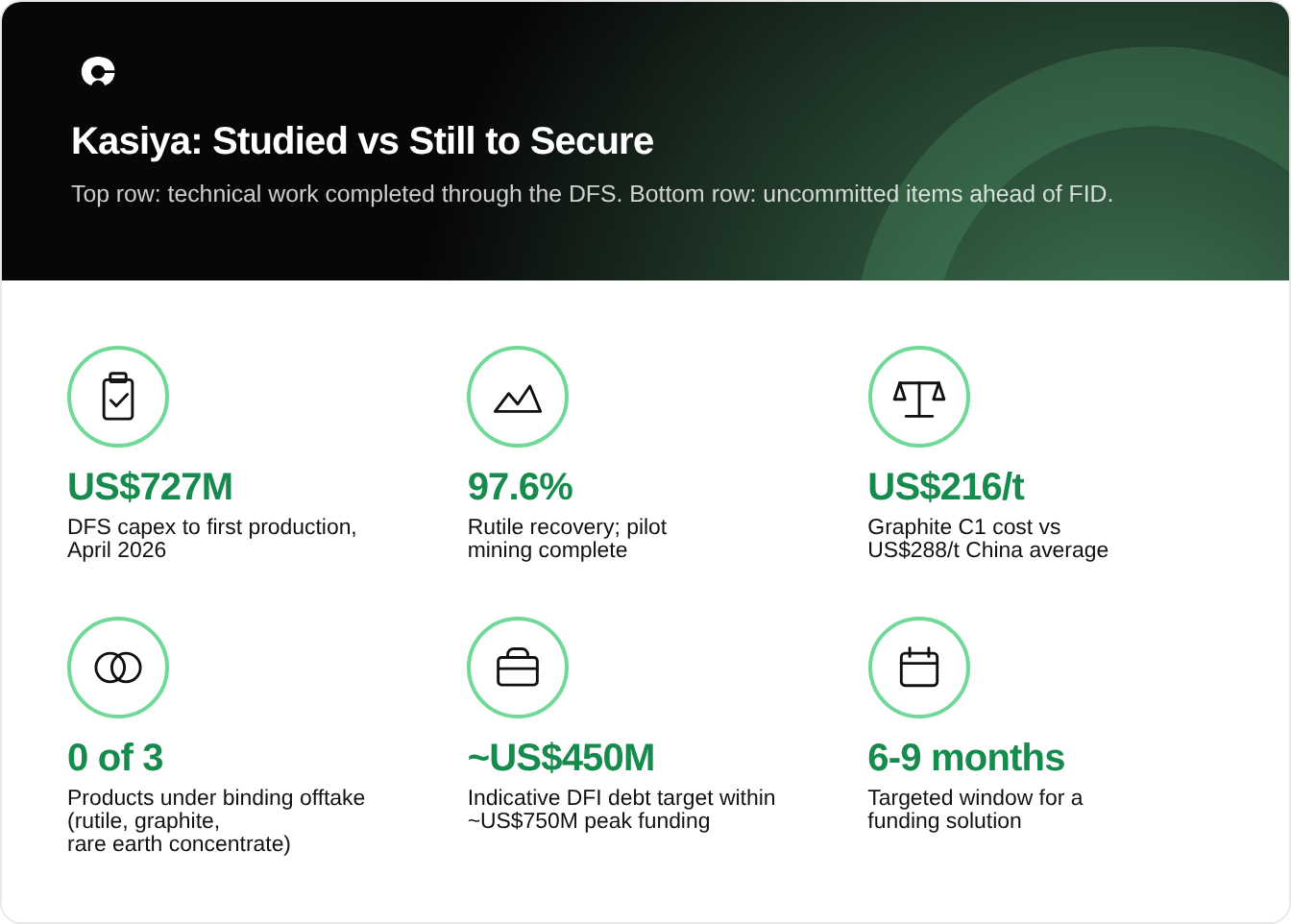
- Sovereign Metals completed the definitive feasibility study (DFS) for Kasiya in April 2026, defining a 25-year operation producing 222,000 tonnes per annum of rutile and 275,000 tonnes per annum of graphite for US$727 million to first production.
- Management states that no further drilling or geological work is required and attributes Rio Tinto's decision not to take on operatorship to Rio Tinto's narrower commodity focus.
- Mitsui for rutile and Traxys for graphite hold non-binding memoranda of understanding (MOU), and the heavy rare earth concentrate has no committed buyer.
- Management's indicative funding structure targets about US$750 million of peak funding, with roughly US$450 million of development finance debt and roughly US$300 million from equity, offtake and prepayments, none of it yet committed.
- Binding offtakes, permits and a final investment decision (FID) are the next milestones, with management targeting a funding solution within 6 to 9 months.
Kasiya's Financing Bottleneck
Sovereign Metals (ASX: SVM | AIM: SVML | OTCQX: SVMLF) has moved Kasiya, its titanium, graphite and heavy rare earths project in Malawi, from resource definition into feasibility and commercial development planning. The definitive feasibility study (DFS) completed in April 2026 defines the proposed operation, and pilot mining and product testwork provide evidence on the mining method and product suitability. Management states that no further drilling or geological work is needed, with product testwork continuing for marketing purposes.
The financing case now depends on a different set of conditions. Sovereign's offtake arrangements for rutile and graphite are non-binding, its rare earth concentrate has no committed buyer, and its indicative funding plan relies on roughly US$450 million of development finance debt that has not been described as committed. Permitting, lender due diligence and a final investment decision (FID) also remain outstanding.
What the Definitive Feasibility Study Establishes
The DFS defines a 25-year initial operation built on an Ore Reserve of 536 million tonnes, within a 3.4 billion tonne resource containing 26.3 million tonnes of rutile and 37.3 million tonnes of flake graphite. At steady state, the operation is designed to produce 222,000 tonnes per annum of rutile grading more than 95% titanium dioxide and 275,000 tonnes per annum of graphite at 96% total graphitic carbon. The study shows a pre-tax net present value at an 8% discount rate (NPV8%) of US$2.2 billion, a pre-tax internal rate of return (IRR) of 23% and annual earnings before interest, taxes, depreciation and amortization of US$476 million, against capital expenditure (capex) of US$727 million to first production.
The operating model affects how lenders will assess delivery risk. Mining is dry and mechanical, using draglines and 100-tonne trucks with no drilling, blasting, crushing or grinding, and processing uses gravity separation with no chemical processes in the primary circuit. The DFS assumes recoveries of 97.6% recovery for rutile and an average of 70.4% for graphite, with product railed to the Port of Nacala at a transport cost of US$117 per tonne. The 2024 pilot mining program confirmed the mining fleet. Commercial-scale construction, commissioning and ramp-up to those design recoveries still lie ahead.
Product testing has extended to end users. Toho has validated Kasiya rutile for all end uses, graphite has qualified for refractory, expandable and high-purity applications, and battery-grade testwork has produced results in line with, or better than, BTR, China's largest anode producer. The DFS puts graphite C1 cash costs at US$216 per tonne, against a weighted average of US$288 per tonne for active Chinese producers.
Chief Commercial Officer of Sovereign Metals, Sapan Ghai, described the study stage and its implications for further exploration:
"We're at DFS stage on the bulk of the project, and what that essentially entails is we know what this is going to look like both operationally and economically. We know the financing requirements of the project, and remember we had Rio Tinto help us put that DFS together, so for all intents and purposes you can take this DFS as a Rio Tinto level of understanding of the project."
What Rio Tinto's Decision Means
Rio Tinto declined operatorship of Kasiya after investing A$60 million, and it holds about 18% of Sovereign.
Ghai attributed the decision to Rio Tinto's portfolio strategy:
"Rio Tinto has not stepped away from the project from a technical perspective because of any technical red flags or anything to do with the project, the company itself. This is completely because of a change in guard at Rio Tinto, a new strategy for them where they are basically focused on copper, aluminum, iron ore and some lithium."
That explanation is management's account of Rio Tinto's reasoning. The surrounding facts give context without settling the question: Rio Tinto provided technical input on mining, processing and environmental, social and governance work and retains its shareholding. Sovereign has taken on the intellectual property from that work, hired former Rio Tinto staff including in corporate affairs, and brought the World Bank in on environmental and social work while Rio Tinto was involved. Other chemical, metals and mining companies have returned to discuss involvement, and the company states that active discussions are taking place, though no further detail has been given.
Three Products, Three Commercial Positions
Each of Kasiya's 3 products is at a different stage of commercial readiness. Rutile and graphite each have a named counterparty under a non-binding memorandum of understanding (MOU). Most of the rutile is intended for Japan for conversion to titanium metal used by US defense and aerospace manufacturers. Toho has validated the product, and Mitsui holds the rutile MOU.
Graphite is covered by a non-binding MOU with Traxys North America, which operates under Project Vault, a US$12 billion supply chain vehicle backed by the US Export-Import Bank. About 70% of planned graphite output is refractory or industrial grade. The heavy rare earth concentrate is the least advanced: it has no committed buyer, testwork is under way with Western refiners, and offtake discussions are in progress.
Sovereign lists binding offtake agreements, rare earth studies and testwork, permitting and an FID as its next catalysts. Management does not identify further drilling or geological work as a prerequisite for any of them.
How Offtakes Could Shape the Funding Mix
Management's indicative funding structure targets about US$750 million of peak funding. The target debt component is roughly US$450 million from development finance institutions (DFIs) such as the International Finance Corporation (IFC), the US International Development Finance Corporation and the Africa Finance Corporation, with the remaining US$300 million or so targeted from equity, offtake arrangements and prepayments. Ghai favors DFIs over commercial banks, citing a lower cost of debt. The peak funding figure and the DFS capex of US$727 million to first production are different measures, and no breakdown between the two has been given. Sovereign has a collaboration agreement with the IFC and the World Bank that includes financing rights to fund Kasiya through debt and equity, and it held A$25 million in cash with no debt at June 30, 2026.
Ghai described where equity falls in the sequence:
"We're hoping that we can get to a position where that equity check is going to be the last dollar in. Everything else will be aligned: a fully permitted project, the offtake agreements are fully bound, so we understand how much revenue and where the product is going to go."
Sovereign's position is that binding offtake provides revenue lenders can count in debt sizing, and that scarce ex-China heavy rare earth feed could attract prepayments or equity. The company describes these funding outcomes as illustrative and not assured. The final debt amount remains subject to lender assessment, with equity sequenced after both binding offtakes and permits. Management is targeting a funding solution within 6 to 9 months and, separately, line of sight on every funding component except final equity by the first half of 2027.
The Rare Earth Option & Its Limits
A September 2026 scoping study prepared to ±30% accuracy, assessed recovering monazite concentrate from a tailings stream already generated in the DFS flowsheet. At that preliminary level of definition, the circuit targets about 2,626 tonnes per annum of concentrate at about 57% total rare earth oxide over 23 years, for incremental capital to first production of about US$29 million. The scoping-level base case shows an NPV8% of about US$722 million, an IRR of 151% and a 1.5-year payback, and a downside case using US Government floor prices returns about US$183 million NPV8% and a 43% IRR. Kasiya is not party to any floor price arrangement.
The concentrate contains dysprosium, terbium, yttrium, samarium and gadolinium, 5 of the 7 rare earths China placed under export controls in April 2025. Sovereign estimates output equal to about 35% of current annual US yttrium demand, a material used in thermal barrier coatings for jet engines. The monazite resource is 74% Indicated, and the study is not sufficient to support Ore Reserves for the additional product.
Valuation, Risks & Catalysts
Sovereign's market capitalization was A$300 million, or about US$210 million, on October 13, 2026, with Rio Tinto holding about 18% and the board and management about 11%. The DFS NPV8% of US$2.2 billion is a pre-tax, project-level study value under stated price and cost assumptions, while market capitalization is the market value of the company's equity, so the two are not directly comparable.
The risks fall into 3 groups. All 3 products still lack binding offtake, so commercial risk remains open. Debt, equity and prepayments are uncommitted, and permits and an FID are outstanding. Technical and execution risk is reduced but not eliminated: the DFS and pilot mining support the development plan, the rare earth circuit sits at scoping level, management expects to refine DFS costings in a front-end engineering design study, and construction, commissioning and operating performance remain to be demonstrated.
The milestones that would change the financing outlook are binding offtakes for rutile and graphite, a first committed buyer for the rare earth concentrate, permits, funding commitments and an FID. Sovereign states that its team has more than 200 years of combined feasibility, financing, construction and operating experience and has taken more than 10 mining projects from feasibility to construction or operation.
The Investment Thesis for Sovereign Metals
- Sovereign Metals completed a definitive feasibility study for Kasiya in April 2026 showing a pre-tax net present value at an 8% discount rate of US$2.2 billion against US$727 million of capital expenditure to first production, and management states that no further drilling or geological work is required.
- Mitsui for rutile and Traxys for graphite hold non-binding memoranda of understanding, and the heavy rare earth concentrate has no committed buyer, so revenue certainty for lenders is not yet established.
- Management's indicative funding structure targets about US$750 million of peak funding, including roughly US$450 million of development finance institution debt, with equity entering last after binding offtakes and permits, and none of these sources is yet committed.
- Management attributes Rio Tinto's decision not to operate Kasiya to a strategic focus on copper, aluminum, iron ore and lithium, and Rio Tinto retains about 18% of the company.
- A scoping study at ±30% accuracy shows a base case pre-tax net present value at an 8% discount rate uplift of about US$722 million from a rare earth concentrate, against incremental capital to first production of about US$29 million, subject to further studies and a committed buyer.
Kasiya has completed its feasibility work, but its path to a financed mine depends on binding offtakes, lender assessment, permits, and a final investment decision. The terms of those contracts will shape how much of the funding comes from debt and how much from shareholders.
TL;DR
Kasiya has a completed DFS, finished pilot mining and buyer-tested products, and management says no further drilling is needed. Funding depends on converting non-binding rutile and graphite MOUs into binding contracts, securing a buyer for the rare earth concentrate, permits, and lender assessment of a roughly US$450 million DFI debt target within about US$750 million of peak funding. Rio Tinto's step-back is attributed by management to its commodity focus. Sovereign is targeting a funding solution within 6 to 9 months.
FAQs (AI-Generated)
Analyst's Notes


Subscribe to Our Channel




Stay Informed


