




Three Export Corridor Disruptions Push Brent Above $100, Favoring Oil Assets Outside Maritime Chokepoints



Three export corridor disruptions pushed Brent above $100, favoring onshore oil assets outside maritime chokepoints.
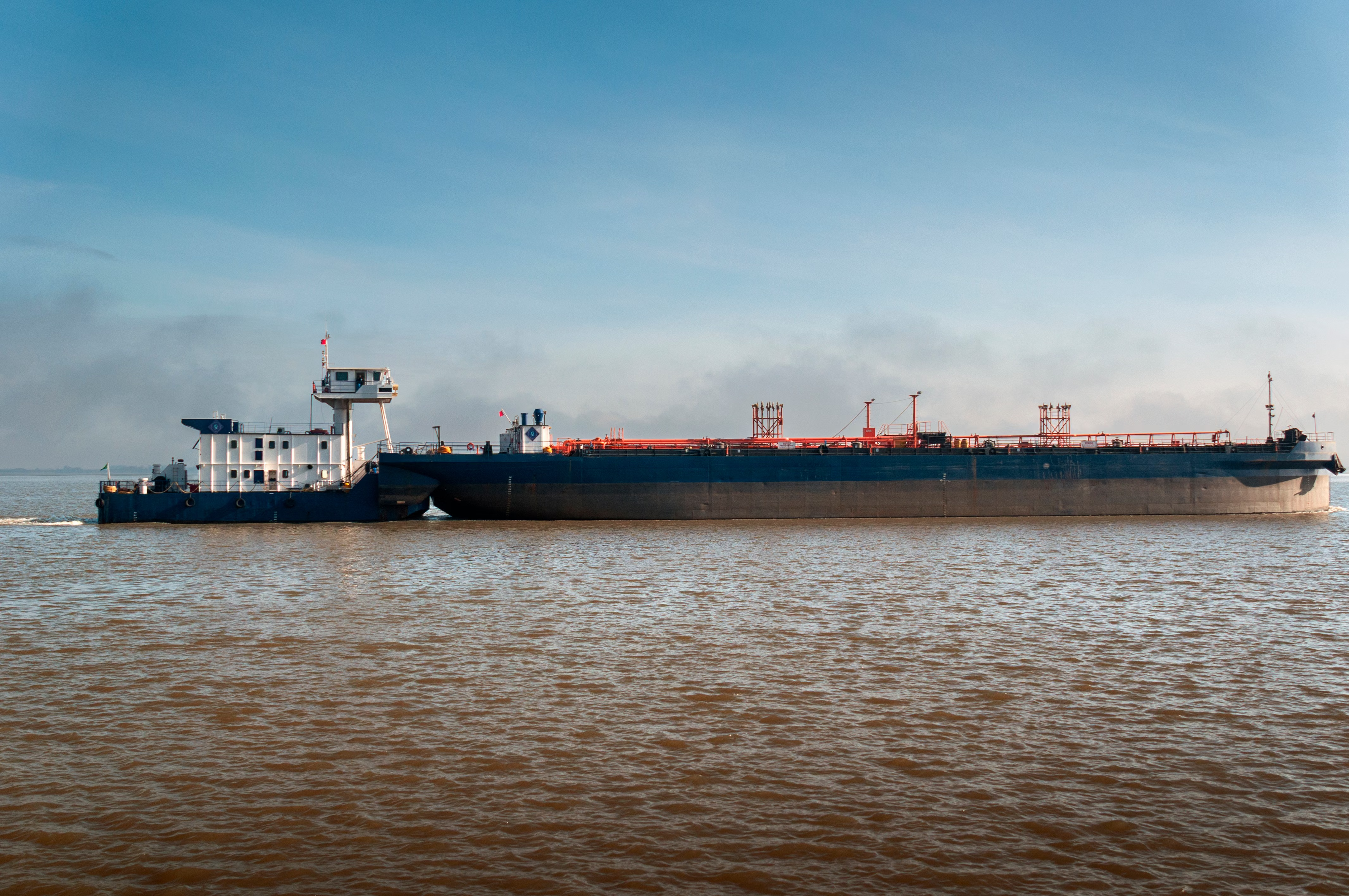
- A major shipping trade group confirmed on July 23, 2026 that marine insurers can cancel coverage for vessels transiting the Strait of Hormuz, allowing war-risk insurance costs to be repriced for oil cargoes using the route.
- Houthi forces struck two Saudi tankers in the Bab el-Mandeb while drone strikes forced a fifth suspension of loadings at the Caspian Pipeline Consortium's (CPC) Black Sea terminal, extending disruption from the Strait of Hormuz to three key oil export corridors.
- Brent crude closed at $100.69 a barrel on July 23, 2026, up roughly 7% on the session and more than 30% for the month, while Goldman Sachs and J.P. Morgan both maintained Q4 Brent forecasts near $80, suggesting current prices reflect geopolitical disruption rather than a sustained tightening of the global oil market.
- Onshore oil production serving domestic or regional markets avoids the insurance, freight, and blockade costs affecting crude shipments through the Strait of Hormuz, Bab el-Mandeb, and the CPC export route.
- OPEC+'s August 2, 2026 production meeting, together with Hormuz and Bab el-Mandeb transit data in the following weeks, will show whether current oil prices continue to reflect route disruption or move back toward underlying supply-demand fundamentals.
Hormuz Insurance Repricing Lifts Landed Crude Costs for Gulf Refiners
On July 23, 2026, a major shipping trade group confirmed that marine insurers can cancel policies covering vessels transiting the Strait of Hormuz, increasing the risk of higher war-risk premiums and freight costs. The change raises the delivered cost of Gulf crude before those costs are fully reflected in benchmark oil prices, signaling that physical transit risk has become a priced component of the market.
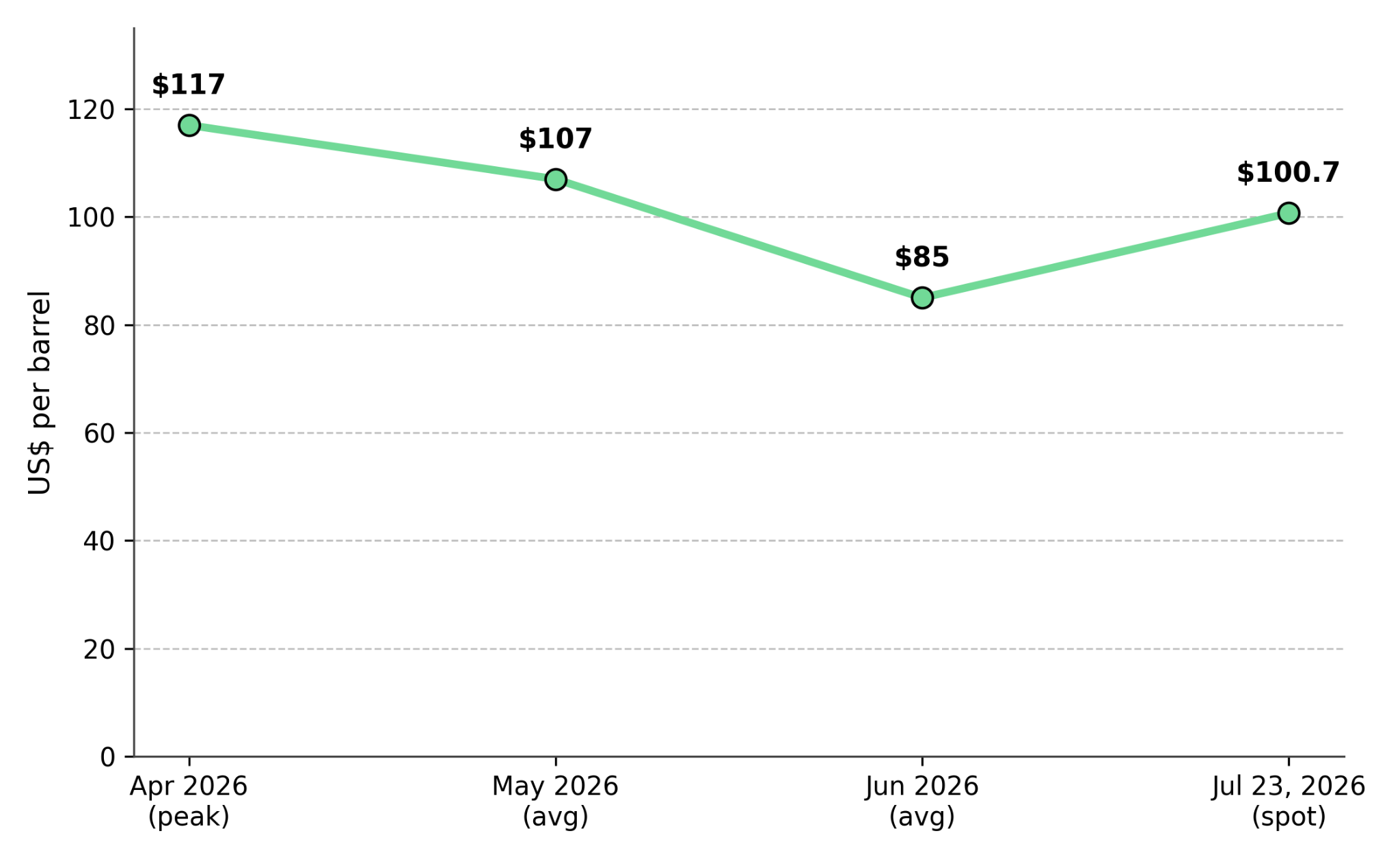
The price outcome followed within days as Brent crude futures crossed $100 a barrel on July 23, 2026 for the first time since May 26, closing up roughly 7% on the session at $100.69, while West Texas Intermediate (WTI) settled near $92.19. Brent is now up more than 30% for the month. Viewed alongside the insurance repricing described above, the move suggests markets are incorporating higher transportation costs associated with shipping crude through affected routes.
Houthi & CPC Attacks Spread Route Risk Across Three Oil Export Corridors
The Strait of Hormuz was not the only oil transit route affected, as disruptions within days of the insurance repricing also hit two additional routes carrying Middle Eastern and Central Asian crude to global buyers, extending route-risk concerns across three major export corridors.
Houthi Blockade Threat Raises Red Sea Export Risk
Houthi forces said they struck two Saudi oil tankers in the Red Sea on July 23, 2026 to enforce a newly declared blockade of Saudi ports. President Trump said the US would hold Iran responsible for any further Houthi attacks and threatened further military action against Tehran. The Bab el-Mandeb has served as Saudi Arabia's principal alternative to the Strait of Hormuz for Red Sea exports, so a blockade threat against the corridor reduces export route flexibility and increases the risk of supply disruptions reaching global markets.
Drone Strikes Disrupt Black Sea Exports, Broadening Route Risk
Drone strikes on two tankers loading at the CPC Black Sea terminal near Novorossiysk forced a suspension of loadings on July 19, 2026, marking the fifth attack on CPC facilities this year. The CPC route carries roughly 80% of Kazakhstan's crude exports and more than 1% of global supply. Kazakhstan also produced roughly 25,839 tonnes of uranium in 2025, an 11% increase over the prior year, making Kazatomprom the world's largest single-country uranium producer. Repeated disruptions to a major export corridor highlight broader infrastructure and geopolitical risks affecting commodity exports. Across the Strait of Hormuz, Bab el-Mandeb, and the CPC export route, transportation risk is no longer concentrated in a single corridor but spans multiple export routes serving global energy markets.
Brent Rally Leaves Year-End Forecasts Near $80, Pointing to a Temporary Risk Premium
Goldman Sachs maintained its Brent forecast of $80 a barrel for the fourth quarter of 2026, arguing that lower Middle East supply should support prices only if US-Iran tensions ease by year-end, while separately stating that Brent could exceed $120 in the same quarter if the Strait of Hormuz remains disrupted. Maintaining both scenarios indicates that the current price premium depends on how geopolitical risks evolve rather than reflecting a lasting change in the underlying supply-demand balance.
J.P. Morgan also projects Brent to average $86 a barrel in the third quarter of 2026, $80 in the fourth quarter, and $78 by year end. Higher oil prices also factor into inflation expectations ahead of the Fed's July 28-29 policy meeting, although the primary driver of the recent price action remains supply and transportation risk.
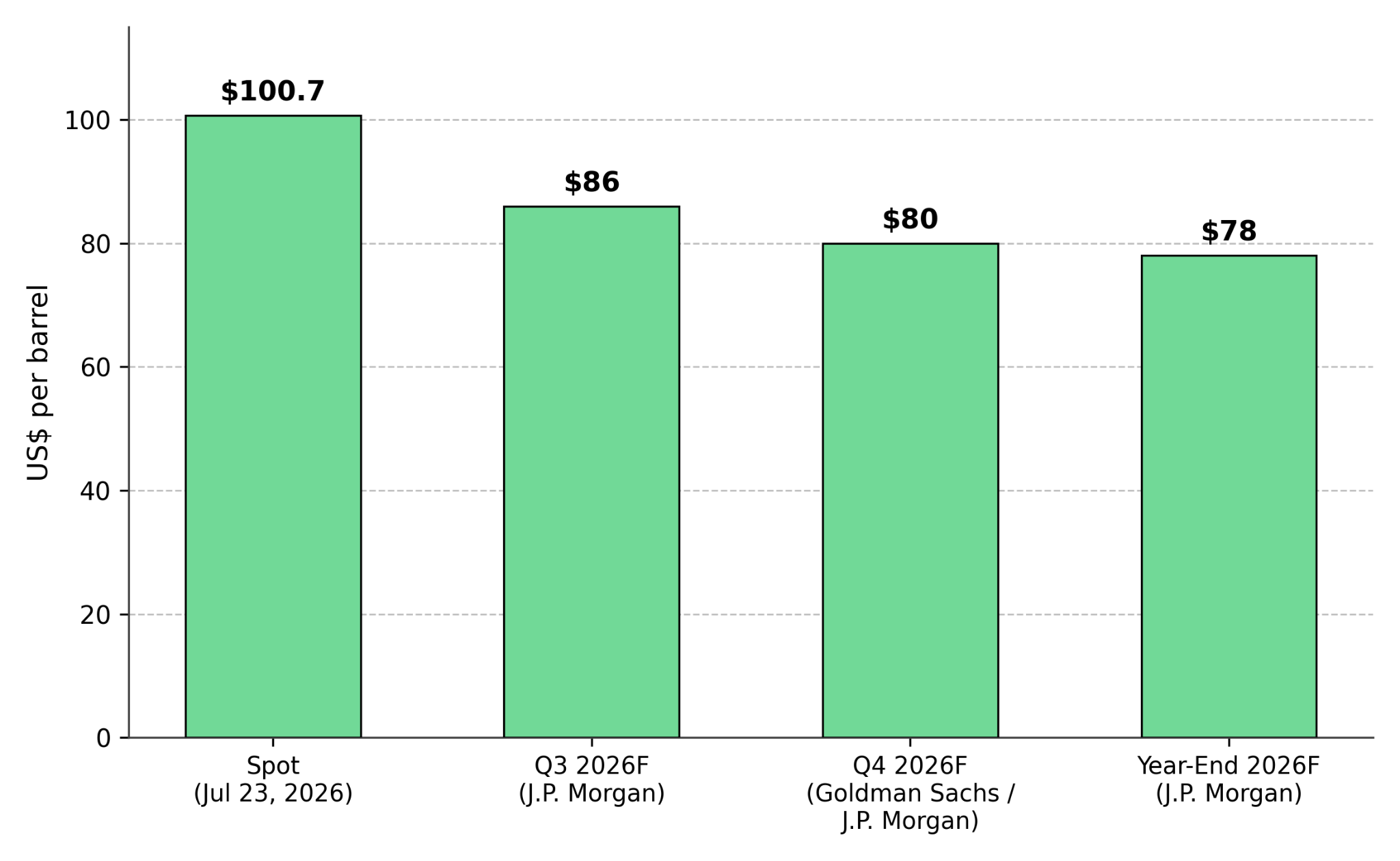
The gap between Brent prices above $100 a barrel and year-end forecasts of $78 to $80 from Goldman Sachs and J.P. Morgan suggests that both banks view the recent rally as a geopolitical risk premium rather than a lasting change in the oil supply-demand balance. If Brent remains above those forecasts into the first quarter of 2027, it would suggest that route disruption is exerting a more persistent influence on oil prices. By contrast, if prices move back toward $80, it would be more consistent with a temporary geopolitical premium.
Route Risk Raises Seaborne Costs, Strengthening the Relative Advantage of Onshore Supply
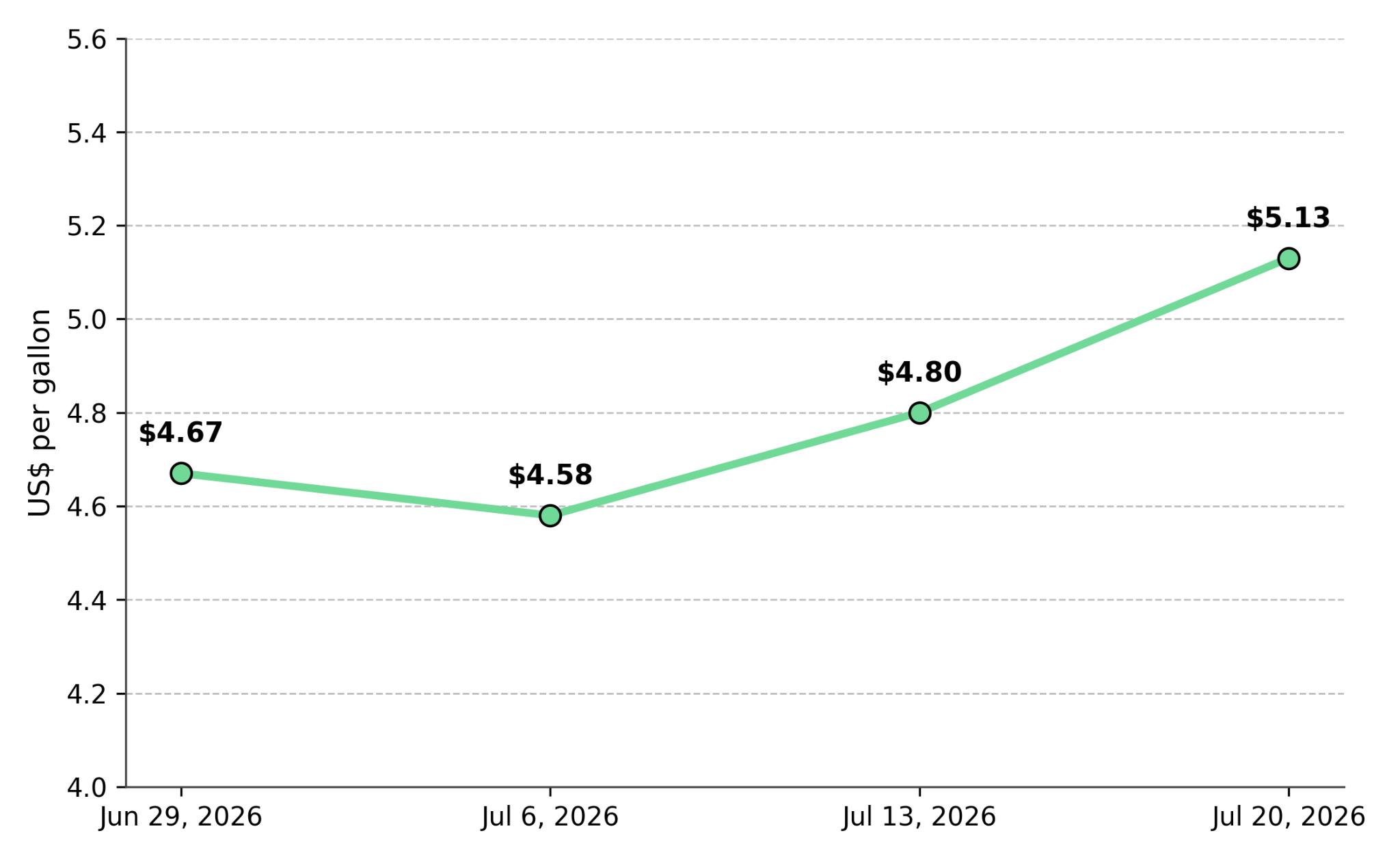
An onshore discovery supplying domestic or regional markets without transiting the Strait of Hormuz, Bab el-Mandeb, or the Black Sea avoids the insurance, freight, and blockade exposure associated with seaborne cargoes, regardless of the benchmark oil price. The distinction applies across resource industries, including mining and refining. US retail diesel averaged $5.134 a gallon for the week of July 20, 2026, according to the US Energy Information Administration (EIA), raising operating costs for diesel-dependent haul fleets, drill rigs, and site generators regardless of whether the company producing the ore ships crude through a contested corridor. Higher fuel costs represent a different transmission channel from higher insurance and freight costs, but both originate from the same increase in benchmark oil prices.
Conventional Light Oil Discovery Signals Favorable Project Economics
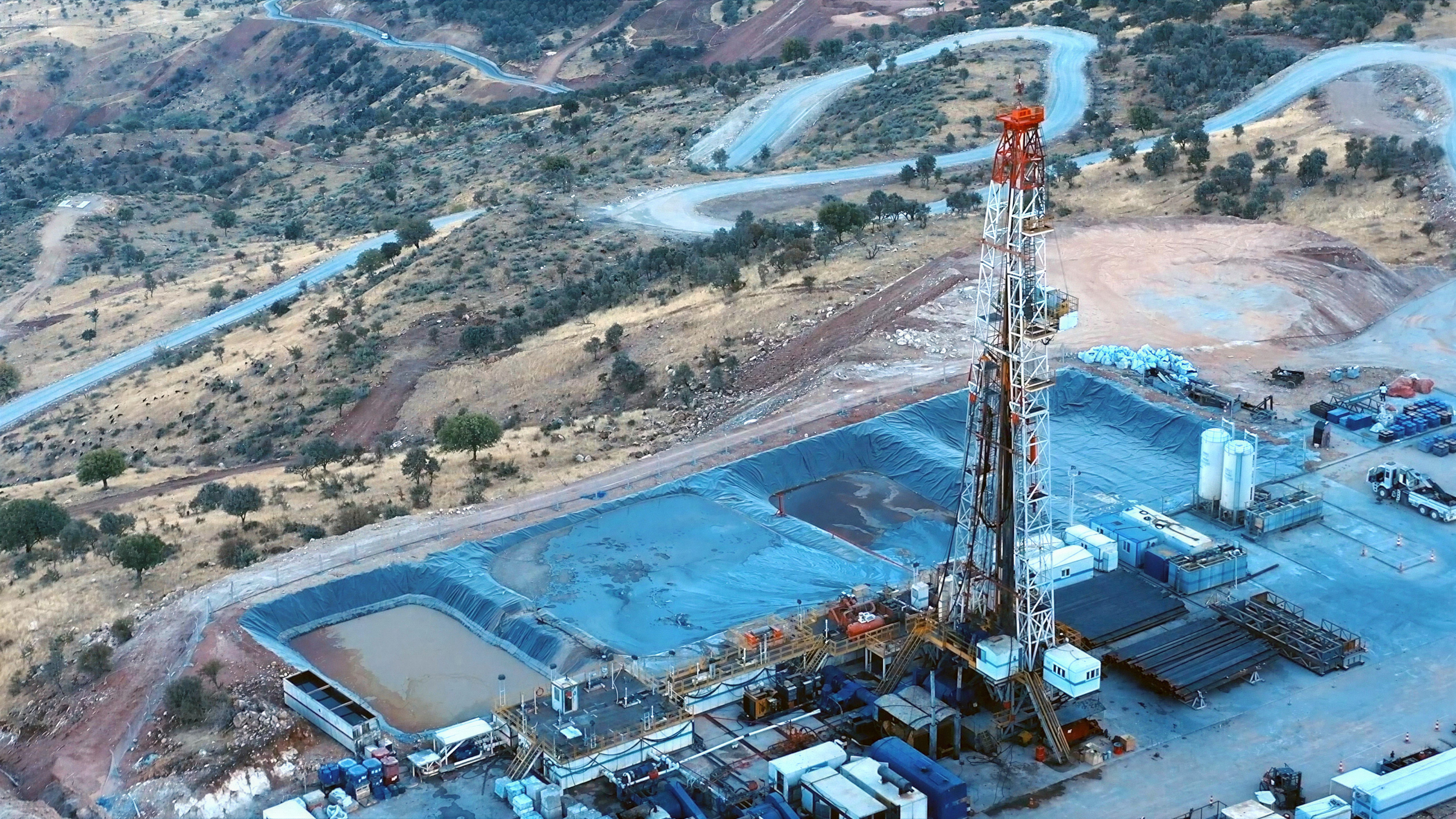
Trillion Energy holds an agreement to earn up to a 29% working interest in an onshore oil discovery in southeastern Turkey that is less exposed to the maritime route disruptions driving higher insurance and freight costs for seaborne crude. An independent evaluation assigned the North Discovery an unrisked NPV-10 of US$733.5 million based on a gross contingent resource of 27.6 million barrels (24.2 million barrels net to Trillion), providing a commercial benchmark as the company advances the project toward reserve classification through appraisal and development.
Scott Lower, President of Trillion Energy, explains the cost advantage of conventional light oil production:
"We're estimating production costs of about $10 a barrel, compared with around $50 a barrel in North America. The best thing to ever have a discovery on is light oil, onshore, conventional resource, because the margins are so good."
OPEC+ Output Decisions & Hormuz Transit Data Will Determine Whether Route Risk Persists
The Organization of the Petroleum Exporting Countries and its allies (OPEC+) supplies the next dated test of whether producers are treating the current disruption as short-term or long-term. The group's seven-nation core, Saudi Arabia, Russia, Iraq, Kuwait, Kazakhstan, Algeria, and Oman, agreed on July 5, 2026 to raise output by 188,000 barrels per day for August, a fifth consecutive monthly increase made while the conflict was already active. The group reconvenes on August 2, 2026 to set September production levels, where a further increase or hold would be consistent with a view that the disruption is temporary, while a pause or reversal would suggest corridor risk is playing a larger role in supply planning.
Three regularly published indicators provide a framework for assessing whether the current route-risk premium persists ahead of that meeting and beyond. Hormuz and Bab el-Mandeb tanker transit volumes are tracked in the IEA's monthly Oil Market Report. US commercial crude and diesel inventories are published each Wednesday in the US EIA's Weekly Petroleum Status Report. Goldman Sachs's estimate that Persian Gulf flows remained below 45% of pre-war levels in its July 20, 2026 note provides a benchmark for assessing recovery or further deterioration.
If Hormuz and Bab el-Mandeb transit volumes recover toward pre-war levels over the next one to two months, the route-risk premium would likely narrow toward the $78 to $80 year-end forecasts from Goldman Sachs and J.P. Morgan. In that scenario, exposure to maritime route risk would become a less important differentiator, shifting attention back to cost curves, reserve quality, and project economics. If transit volumes remain depressed or a fourth export corridor is disrupted, the case for a more sustained route-risk premium in seaborne crude pricing would strengthen.
The Investment Thesis for Oil & Gas
- Route risk has become a measurable component of delivered oil costs as insurers cancel cover on disrupted corridors, differentiating supply that reaches buyers without transiting a maritime chokepoint from supply that does.
- Onshore production supplying domestic or regional markets carries different transportation costs and route-risk exposure than crude shipped through the maritime corridors because it is not subject to the same insurance repricing, blockade threats, or terminal suspensions.
- Higher benchmark oil prices also affect mining operating margins through diesel-linked input costs, as haul fleets, drill rigs, and site power at open-pit and remote operations consume fuel priced against the same benchmark regardless of whether the operator's output transits a contested maritime corridor.
- Once route-risk exposure is removed from the comparison, capital efficiency becomes a primary differentiator, as onshore conventional production in established basins typically achieves faster capital recovery than tight or extra-heavy oil developments requiring intensive stimulation or thermal recovery.
- Capital discipline is reflected in the sequencing of resource conversion, advancing contingent resources toward reserves through staged development rather than committing capital ahead of technical and commercial validation, which can reduce external financing requirements during early project stages.
- Assets with shorter payback periods and long-lived conventional reservoirs are generally better positioned to sustain production through commodity cycles because early cash flow can fund follow-on drilling without relying on a sustained high price environment.
This quarter, the more informative market signal has been the cost and availability of insurance for shipments transiting three export corridors facing simultaneous disruption, rather than Brent's price alone. Brent above $100 reflects tighter market conditions, but insurers withdrawing cover for certain Hormuz-linked shipments indicates that route risk is now influencing delivered oil costs before crude reaches a refinery. Diesel prices near $5.13 per gallon extend that effect to mining operations, where fuel is a major operating expense. Whether the current premium favoring onshore supply persists will depend not only on Brent prices, but also on transit volumes, insurance costs, and shipping conditions across the affected export corridors.
TL;DR
Marine insurance repricing, Houthi attacks in the Bab el-Mandeb, and repeated disruptions at the CPC Black Sea terminal expanded route risk across three major oil export corridors, helping lift Brent crude above $100 a barrel. The article argues that higher prices primarily reflect increased transportation and insurance costs rather than a tightening of global oil supply. As a result, onshore oil assets serving domestic or regional markets gain a relative advantage because they avoid maritime chokepoint exposure. The next OPEC+ production decision and tanker transit data through Hormuz and the Bab el-Mandeb will indicate whether the current route-risk premium is temporary or becomes a more persistent feature of oil markets.
FAQs (AI-Generated)
Analyst's Notes





Subscribe to Our Channel

.png)




Stay Informed


