




Treasury Buyback Supports Gold Above $4,600 Despite Fed Tightening Risk



Treasury buybacks support gold above $4,600 as central bank demand rises, supply stays tight, and stronger prices boost producer cash flow.
- The US Treasury's August 19, 2026 decision to raise its long-dated bond buyback cap from $2 billion to $4 billion per operation, effective September 9, was followed by a 5.7-basis-point decline in the 10-year Treasury yield and a 9-basis-point decline in the 30-year yield, helping support spot gold above $4,600 per ounce without a Fed rate decision.
- Central banks bought a net 288.9 tonnes of gold in the second quarter of 2026, up 62% year over year according to World Gold Council data published July 30, adding a demand source independent of the Treasury and Fed catalysts driving near-term gold prices.
- Total gold supply held at 1,269 tonnes in the second quarter of 2026, as a 2% year-over-year rise in mine output was offset by a 6% decline in recycling, showing that higher gold prices have not produced a comparable near-term increase in physical supply.
- Production-stage companies are advancing growth without immediate equity issuance, with Integra Resources generating free cash flow at current gold prices and i-80 Gold stating that its three-phase development plan requires no further equity funding.
- Mineros S.A. is production-stage at the group level, but its development-stage Porvenir project has no disclosed funding structure despite targeting a construction decision in early 2027, showing that stronger gold prices can improve project economics without securing construction capital.
Treasury Buyback Lowers Long Yields & Supports Gold Above $4,600
Spot gold traded at $4,662.42 per ounce as of 9:00 a.m. Eastern Time on August 24, 2026, up from $4,582.44 at the same time the prior Friday, according to CNBC's gold spot benchmark. That move followed a specific fiscal decision rather than a shift in Fed guidance. On August 19, 2026, the US Treasury announced it would at least double the size of its liquidity support buybacks for 10-to-30-year nominal coupon securities, raising the per-operation cap from $2 billion to $4 billion, effective September 9, 2026 through November 4, 2026.
The announcement followed the 10-year and 30-year Treasury yields hitting their highest levels in roughly 20 years, with the 30-year touching 5.31% on August 17, 2026. On the buyback news, the 10-year yield fell 5.7 basis points to 4.647% and the 30-year fell 9 basis points to 5.196%. The Council on Foreign Relations described the move as fiscal authorities managing the same yield curve the Fed sets policy on, independent of any Fed rate decision.
That distinction matters for how investors should read gold's current price. A softer dollar and lower real yields driven by Treasury's own debt management give bullion support that does not wait on what the Fed communicates next week, which separates this price move from the rate-cut or rate-hike debate that typically dominates gold coverage.
Central Bank Buying Rises 62% & Adds Independent Gold Demand
Central banks added a net 288.9 tonnes of gold in the second quarter of 2026, up 62% from 177.9 tonnes a year earlier, according to World Gold Council data compiled from official central bank reports and published July 30, 2026. Central banks continued buying even as gold traded as much as 16% below its January peak during the quarter, showing that official-sector demand remained active through a significant price correction.
The National Bank of Poland led second-quarter purchases with 51 tonnes, while the People's Bank of China added 33 tonnes, its largest quarterly purchase since the fourth quarter of 2023. The Treasury buyback is a discrete policy action that can affect gold through financial markets in the near term, while central-bank reserve accumulation adds physical demand across multiple quarters, giving gold two support mechanisms with different time horizons.
Higher Gold Prices Fail to Lift Supply, Limiting Near-Term Availability
Higher gold prices have not produced a comparable increase in near-term physical supply, limiting the amount of additional metal reaching the market. Total gold supply held at 1,269 tonnes in the second quarter of 2026, according to the World Gold Council, as a 2% year-over-year increase in mine production to 966 tonnes was offset by a 6% decline in recycling despite elevated gold prices.
Integra Resources' Florida Canyon operation in Nevada moved 87,867 tonnes of material per day in the second quarter of 2026, up 32% from 66,382 tonnes per day a year earlier, while gold production declined 9% to 16,379 ounces from 18,087 ounces. Florida Canyon shows that higher material movement does not necessarily increase near-term gold output, helping explain why mine supply can respond slowly even when prices support greater operating activity.
Higher Gold Prices Expand Producer Cash Flow & Reduce Equity Funding
When realized gold prices exceed the assumptions used in mine plans or feasibility studies, the additional revenue can expand operating margins and free cash flow if production and costs remain supportive, a mechanism already visible in second-quarter 2026 producer results.
Florida Canyon realized $4,426 per ounce in the second quarter of 2026 against mine-site AISC of $3,371 per ounce sold, leaving a $1,055-per-ounce spread before other corporate and financing costs. The reported AISC remained above the $2,331-per-ounce life-of-mine target in Integra Resources' June 2026 feasibility study. Free cash flow reached $9.3 million in the second quarter of 2026, up from $2.1 million a year earlier, as the higher realized gold price maintained a positive margin despite costs remaining above the feasibility-study target.
George Salamis, President and Chief Executive Officer of Integra Resources, attributes the margin to sustained high gold prices:
"This is never going to be a sub-$2,000 an ounce AISC producer… If we assume that the gold prices remain high for an extended period of time, there'll be lots of margin again to build up our treasury and our cash flow to pay for the other things going forward."
Strong Balance Sheets Fund Expansion & Reduce Equity Dilution
i-80 Gold is funding its $430 million Lone Tree autoclave refurbishment, targeted for first gold by year-end 2027, from a $464.6 million cash position as of June 30, 2026, built through a $1.1 billion recapitalization completed in the first quarter of 2026 that retired $165.0 million in legacy debt, with 40% of project capital already committed as of mid-July 2026.
Richard Young, President and Chief Executive Officer of i-80 Gold, states the funding position without qualification:
"We are essentially fully funded for all three phases, with no further equity being required."
West Red Lake Gold Mines, production-stage at its Madsen operation in Ontario, is pursuing a lower-capital version of the same approach, refurbishing a shaft that historically operated for approximately 50 years rather than building new infrastructure, leveraging more than $500 million in historical and modern sunk capital, and moved from cash breakeven in the first quarter of 2026 to active cash accumulation in the second quarter. Serabi Gold, production-stage at its Palito Complex and Coringa mine in Brazil, held $65.70 million in cash and no debt as of June 30, 2026, and is spending $5 million to expand Palito's mill from 650 to 900 tonnes per day, targeted for the fourth quarter of 2026, ahead of Coringa's permanent Installation License, also targeted for the fourth quarter of 2026.
Higher Gold Prices Improve Project Economics but Leave Funding Unresolved
Mineros S.A. is production-stage at the group level, having produced 222,000 ounces in 2025 against 2026 guidance of 220,000 to 240,000 ounces across its Panamá and Pioneer mines. Its Porvenir project in Nicaragua, however, sits at pre-feasibility stage, targeting a construction decision in early 2027. The pre-feasibility study puts Porvenir's net present value at a 5% discount rate (NPV5%) at $460 million, an internal rate of return of 37.9%, and an AISC of $1,295 per gold-equivalent ounce, built on a base case of $3,150 per ounce for gold, below current spot.
The 2026 capital plan of $113.7 million carries no Porvenir allocation, and the project's $206.8 million initial capital requirement has no disclosed funding structure, no named debt facility, equity plan, or cash allocation, as of the most recent company disclosures.
A gold price above the study's $3,150 base case improves Porvenir's economics on paper, but until a debt facility, equity raise, or specific cash allocation is named against the $206.8 million requirement, the project remains a development-stage claim inside a production-stage company's balance sheet rather than a funded construction commitment, a distinction the self-funding examples above do not carry.
Fed Tightening Risk Could Pressure Gold but Not Reverse Q2 Cash Flow
CME FedWatch data as of August 20, 2026 put the probability of a September hold at 68.4% and a 25-basis-point hike at 31.6%, meaning gold was trading above $4,600 while nearly one-third of the market still priced tighter Fed policy that could increase the opportunity cost of holding bullion. The July 29, 2026 FOMC vote reinforces that tightening risk: the committee held the federal funds target range at 3.50% to 3.75% by a 9-3 vote, while Beth Hammack, Neel Kashkari, and Lorie Logan dissented in favor of a 25-basis-point increase.
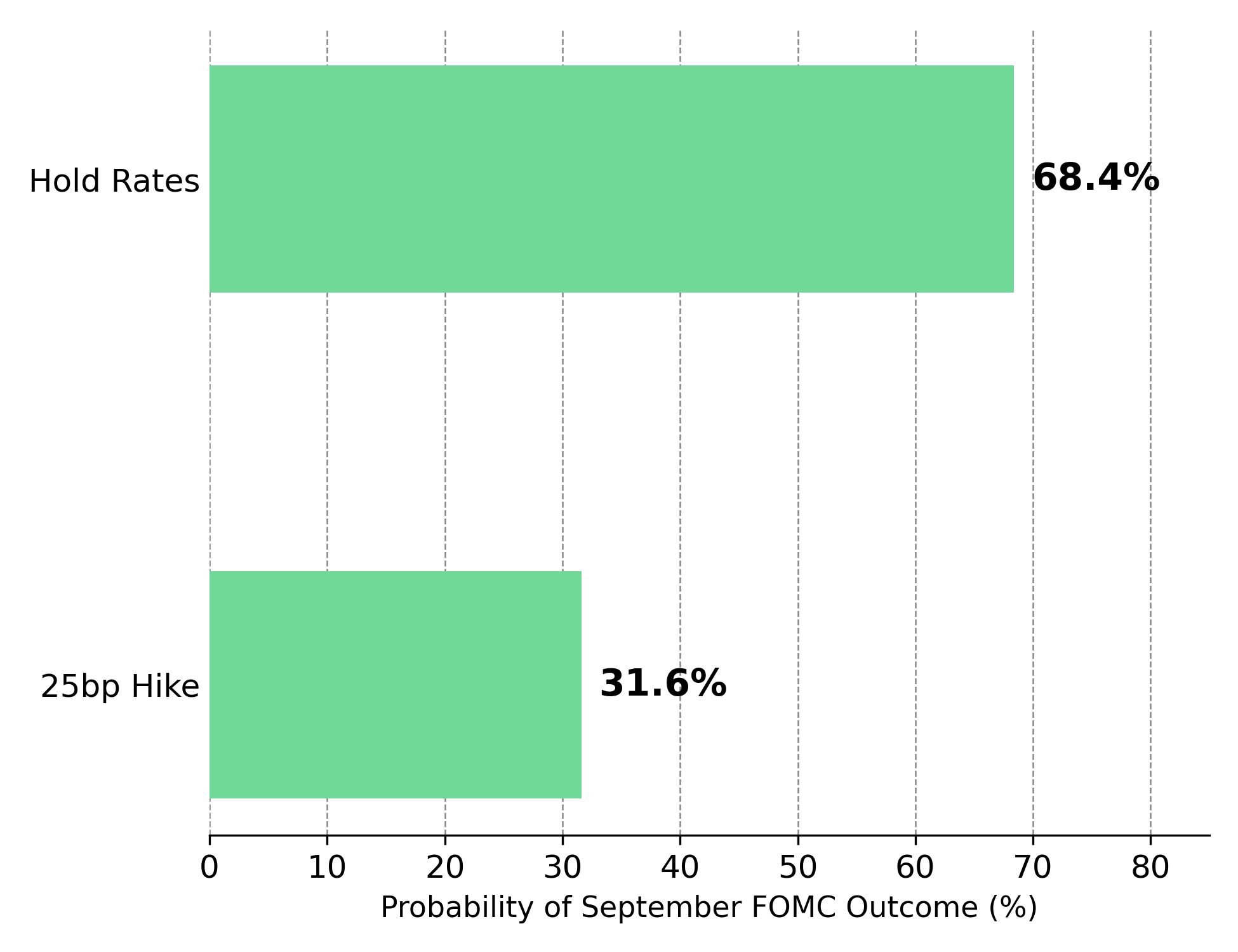
Fed Chair Kevin Warsh is scheduled to deliver his first Jackson Hole address as chair on August 28, 2026, at the Kansas City Fed's annual symposium. A hawkish signal could raise expected interest rates and the opportunity cost of holding non-yielding gold, putting downward pressure on bullion and potentially offsetting some of the support from lower long-term Treasury yields.
A hawkish Fed signal could affect future gold prices and cash generation, but it would not reverse free cash flow or debt reduction already reported for the second quarter of 2026. Treasury debt management has provided a source of near-term gold support independent of Fed policy, while any subsequent decline in spot gold would affect prospective producer margins rather than financial results already recorded.
The Investment Thesis for Gold
- The US Treasury's bond buyback expansion created a separate near-term channel for gold through lower long-term yields, independent of the Fed's next policy signal.
- Central-bank gold purchases operate across multiple quarters rather than around a single policy announcement, providing a demand source separate from near-term Treasury and Fed catalysts.
- Total gold supply showed a limited near-term response to higher prices in the second quarter of 2026, as a 2% rise in mine production was offset by a 6% decline in recycling, limiting additional physical supply reaching the market.
- Higher realized gold prices are supporting cash generation at production-stage companies, increasing their ability to fund growth from existing liquidity rather than relying immediately on new equity issuance.
- Development-stage projects owned by cash-generative producers can still face unresolved construction funding, making a disclosed debt facility, equity plan, or cash allocation a checkable underwriting variable.
- A hawkish Fed signal could pressure future gold prices and producer margins, but it would not reverse free cash flow, debt reduction, or capital already reported in second-quarter 2026 financial results.
The US Treasury's bond buyback expansion provided near-term support for gold above $4,600 per ounce without requiring a Fed rate decision, separating the current rally from a purely Fed-driven move. Second-quarter 2026 financial results show that higher realized gold prices are supporting producer cash generation, while stronger cash positions and existing liquidity can reduce the need for near-term equity issuance to fund growth. Development-stage projects without a disclosed funding structure can still face unresolved construction financing even when owned by cash-generative producers, because stronger gold prices improve project economics without committing the capital required to build them.
TL;DR
The US Treasury's expanded bond buybacks helped lower long-term yields and support gold above $4,600 without a Fed rate decision, while central-bank purchases rose 62% year over year to 288.9 tonnes in Q2 2026. Gold supply showed a limited response to higher prices, with mine growth offset by weaker recycling. Higher realized prices are supporting producer cash flow and reducing reliance on new equity, although development-stage projects can still face unresolved construction funding. A hawkish Fed signal remains a near-term risk to gold prices and future margins, but it would not reverse cash flow or debt reduction already reported in Q2.
FAQs (AI-Generated)
Analyst's Notes





Subscribe to Our Channel







Stay Informed






















